Replacing Telnyx can mean changing your carrier, rewriting call-control code, or moving an AI assistant. Those are different projects, with different costs. For developers and product teams, a useful shortlist shows which layer each alternative replaces, what stays with your team, and where the migration work sits. Here are six options across programmable communications and managed voice AI.
Telnyx alternatives at a glance
For a production voice-AI product, we recommend Dasha when you want a managed conversational runtime with API control. For replacing Telnyx's communications APIs or carrier connectivity, the relevant options are Twilio, Plivo, Bandwidth, Vonage, and SignalWire.
The distinction matters because Telnyx spans several layers. It supplies phone numbers, voice and messaging APIs, Session Initiation Protocol (SIP) trunking, and AI Assistants. Its assistant platform already includes tools, model configuration, testing, and version controls, with external language-model endpoints and selectable transcription engines. Moving away does not automatically mean gaining those capabilities.
SIP connectivity carries calls between systems. A programmable voice API controls what happens to those calls. A managed agent runtime runs the conversation and its business-tool actions. An alternative can replace one layer while leaving the others in place.
| Alternative | What it can replace | Main fit | Pricing boundary |
|---|---|---|---|
| Dasha | Managed voice-agent runtime | Technical teams building production conversational AI products | Runtime usage; carrier and language-model costs are separate |
| Twilio | Programmable voice, messaging, numbers, and SIP connectivity | Applications combining several communications services | Metered services, number rental, and optional features |
| Plivo | Voice and messaging APIs; Zentrunk SIP connectivity | Developers choosing between API-controlled calls and a trunk for an existing application | Voice API and SIP trunking have separate rate structures |
| Bandwidth | Voice and messaging APIs, numbers, and carrier services | Product teams buying communications infrastructure with direct network services | Published API usage rates; custom SIP trunking terms |
| Vonage Communications APIs | Programmable voice, messaging, and application calling | Products combining phone calls with app-based communications | Usage-based charges by API, destination, and channel |
| SignalWire | Voice, messaging, SIP, and an optional AI-agent runtime | Teams that want programmable telecom and agent execution in one platform | Communications usage; AI runtime and transport are separate charges |
Dasha belongs in the runtime decision. We are not a like-for-like replacement for Telnyx's entire carrier, SMS, wireless, or infrastructure catalog. If your only requirement is a different SIP carrier, our SIP provider comparison addresses that narrower choice.
1. Dasha: our recommended choice for a managed voice-AI runtime
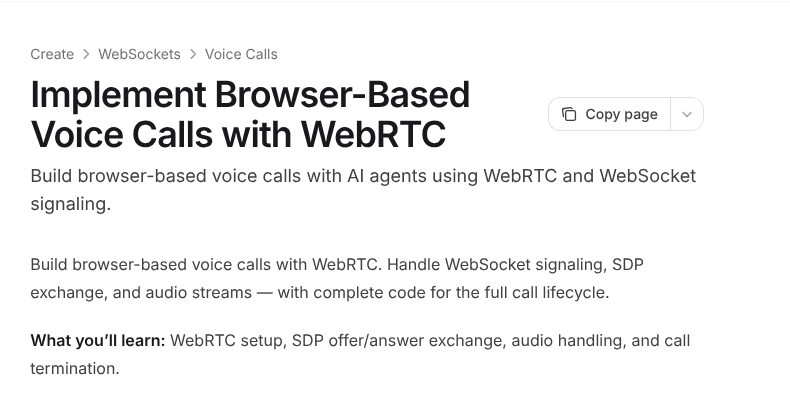
We build and run production voice AI agents through a managed runtime, REST APIs, and a web application. Choose us when the product you need to operate is an agent that holds conversations, uses business tools, and produces call records your team can inspect.
Our current platform supports agent configuration, inbound and outbound calling, model and voice configuration, external tools, and completed-call inspection. The Call Inspector brings together transcripts, recordings when enabled, language-model interactions, tool execution, and a timeline. That gives engineers evidence about what happened inside a conversation, alongside the telephone connection itself.
Carrier connectivity can remain a separate decision. Our inbound call registration lets your telephony receive a call first, register it with an agent and context, then bridge it to the returned SIP destination. We also support configured SIP credentials and a Twilio integration. This is a migration path for compatible call flows, not a promise that Telnyx assistant configurations import unchanged.
Pricing: Our Developer plan includes 1,000 free minutes. Growth starts at $0.08 per minute. Voice over Internet Protocol (VoIP) and large language model (LLM) tokens are excluded from that rate.
Tradeoff: We run the conversational runtime. Your team still owns business logic, tools, customer data, and integration decisions. A carrier-only purchase or a requirement to own the runtime's source code calls for a different architecture.
2. Twilio: programmable communications with separate carrier options
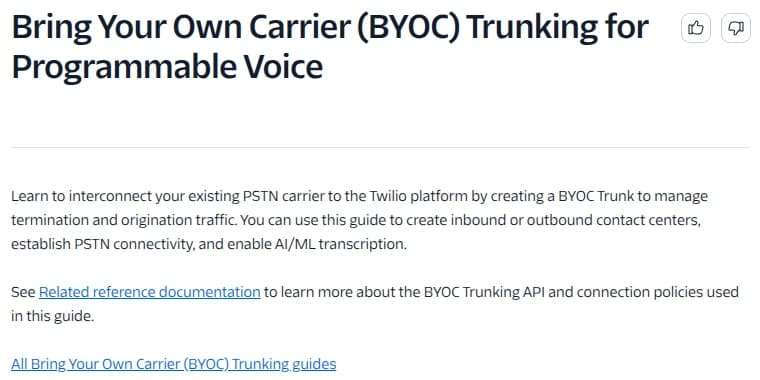
Twilio combines Programmable Voice, Messaging, phone numbers, and Elastic SIP Trunking. It fits an application that needs several communications services while retaining custom application logic.
Voice calls can use TwiML, Twilio's XML call-instruction format, REST APIs, webhooks, and media connections. For AI calls, ConversationRelay handles speech recognition and synthesis while your application exchanges conversational messages over a WebSocket connection. It is a more managed speech path than streaming raw audio, although your team still builds the surrounding agent application.
Twilio also supports bring your own carrier (BYOC). That separates the carrier relationship from Twilio's call-control layer when the carrier supports the required SIP connection. Replacing Telnyx call control therefore need not always start with porting numbers.
Pricing: Voice, messaging, number rental, recording, and AI-related services have distinct meters. BYOC adds a Twilio processing charge alongside the carrier bill. Elastic SIP Trunking and Programmable Voice are different products, so one product's rate is not a quote for the other.
Migration work: Telnyx call-control commands and events need mapping to Twilio's APIs and webhooks. A familiar XML flow can reduce some rewriting, but it does not establish identical transfer, recording, or failure behavior.
3. Plivo: voice APIs or SIP trunking for your existing application
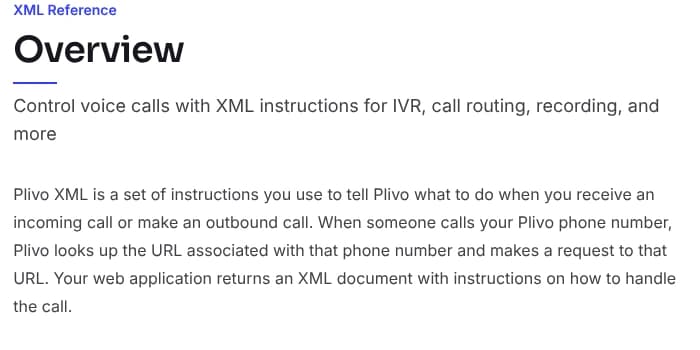
Plivo offers programmable voice and messaging, plus Zentrunk for SIP trunking. The important choice is whether you want Plivo to execute your call instructions or simply connect an existing voice application to the telephone network.
With Voice API, your server returns Plivo XML to control the call. Instructions cover audio playback, speech or digit input, dialing, recording, and real-time audio streaming. Bidirectional streaming sends audio to an external application and accepts audio back, which supports an agent stack your team runs separately.
Zentrunk serves a different role. It connects an existing phone system or compatible agent platform through SIP. Its supported methods and features are not identical to Voice API: Zentrunk supports SIP REFER transfers, but does not support call recording. Recording must sit elsewhere in that architecture.
Pricing: Voice API and Zentrunk have separate calling rates. Number rental, destinations, call direction, and selected add-ons determine the total. A low trunking rate does not include a conversational runtime.
Migration work: Moving only the trunk changes routing and authentication. Moving Telnyx-controlled calls to Voice API also requires Plivo XML instructions, new webhook payloads, identifiers, and error handling. The distinction prevents a carrier migration from quietly becoming an application rewrite.
4. Bandwidth: communications APIs with direct network services
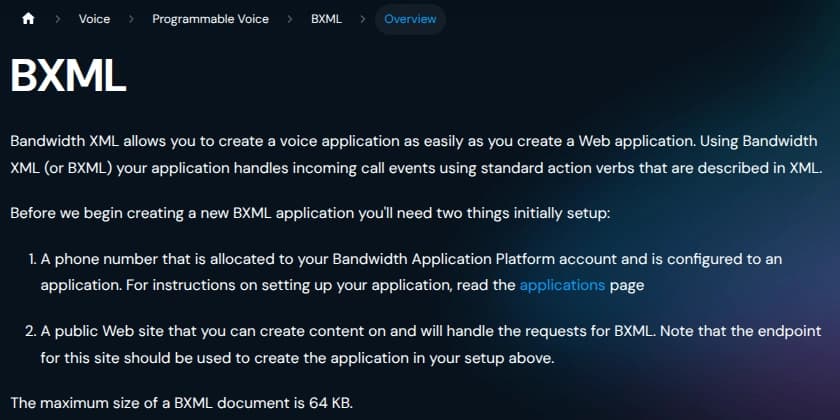
Bandwidth combines voice and messaging APIs with phone-number management, SIP trunking, and its own network services. It fits product teams that need communications infrastructure and want the carrier relationship included in the purchase.
Programmable Voice uses Bandwidth XML (BXML) for call instructions. The API supports call routing, recording, conferencing, and media streaming. Bidirectional streaming can connect a separate AI application, so the carrier and agent runtime do not have to come from the same vendor.
The operating boundary depends on the product selected. Buying Bandwidth's network and numbers puts those services with Bandwidth. Keeping agent execution outside Bandwidth preserves a separate runtime boundary, but your team must connect the call events, media, and application records.
Pricing: Bandwidth publishes U.S. API usage rates, including separate charges for voice features and media streaming. SIP trunking uses custom, usage-based terms. Its published Voice API prices should not be treated as a complete SIP or AI-agent quote.
Migration work: A Telnyx-to-Bandwidth API move requires BXML call-flow changes and webhook integration. A carrier-only move instead centers on numbers, trunk configuration, routing, and the features your existing application expects from the network.
5. Vonage Communications APIs: phone and in-app communications
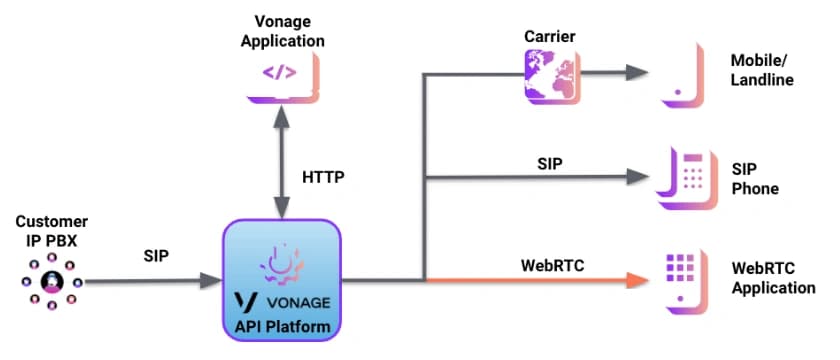
Vonage Communications APIs covers programmable voice, messaging, and web or mobile calling. This is the developer API offering, distinct from buying a Vonage business-phone subscription.
Voice API uses structured JSON instructions called Nexmo Call Control Objects (NCCOs). Applications can play speech, collect input, record, and connect callers to phone, app, SIP, or WebSocket endpoints. That range fits products where a telephone conversation is one part of a broader communications experience.
Programmable SIP can route SIP calls to an application's answer webhook. The application's NCCO then defines what happens next. A SIP connection therefore provides an entry point into Vonage call control, rather than making an existing Telnyx application portable by itself.
Pricing: Charges depend on the API, destination, channel, and number requirements. Voice, messaging, and verification are separate services. An API usage estimate should remain separate from the cost of your agent runtime and application hosting.
Migration work: Telnyx call instructions need translation into NCCOs and Vonage webhook handling. Call identifiers, status events, recordings, and downstream business actions also need mappings. Number retention alone does not preserve those application contracts.
6. SignalWire: telecom APIs and an integrated agent option
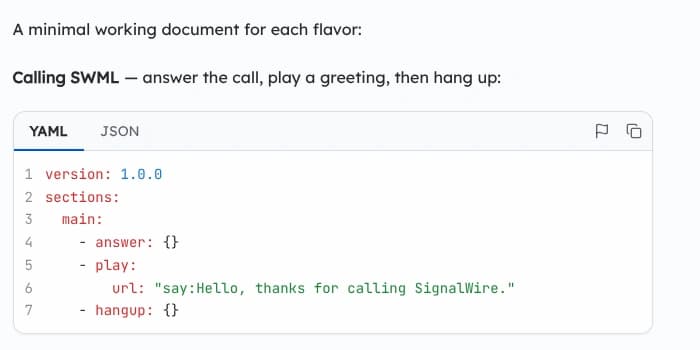
SignalWire provides programmable voice, messaging, SIP connectivity, and AI-agent execution. It fits teams that want to choose between a telecom foundation for their own application and a platform that also runs the agent.
SignalWire Markup Language (SWML) describes call flows in human-readable YAML configuration or structured JSON. It supports voice applications, messaging, and native AI functions. Teams can serve call instructions from their own application or use SignalWire-hosted execution.
This is the closest architectural parallel in this shortlist to buying telecom and an agent layer together. That can simplify integration, while also putting more of the product with one vendor. Choosing a different LLM does not move the call-control and agent-execution layers out of SignalWire.
Pricing: Standard voice transport, phone numbers, messaging, and optional features are metered. AI-agent runtime usage is an additional charge, and premium speech choices can add cost. Comparing that runtime charge with a SIP-only minute leaves out different parts of the call.
Migration work: Moving both Telnyx telecom and AI Assistants means recreating call flows, agent configuration, tool connections, and event handling. Moving only connectivity leaves more application logic intact. Compatibility features for another vendor's XML do not establish drop-in compatibility with Telnyx's full API.
What changes when you leave Telnyx?
SIP is a signaling protocol for establishing, changing, and ending sessions, as defined in the SIP protocol specification. It does not standardize every provider's call-control API, webhook, or agent configuration.
A useful migration boundary looks like this:
| Layer you change | What may stay | What needs adapting |
|---|---|---|
| Carrier or SIP trunk | Agent runtime and business tools | Numbers, routing, authentication, media settings, transfers, and capacity limits |
| Programmable call control | Compatible carrier or external agent service | Call instructions, event schemas, retries, recordings, and result handling |
| Managed agent runtime | Carrier and numbers through a supported SIP path | Prompts, tools, knowledge, conversation behavior, call inspection, and result schemas |
For example, an agent that answers an inbound call, looks up an order, and transfers to a person crosses all three layers. A new carrier can connect the call while a changed webhook silently breaks the order lookup. A working first conversation also says little about what happens when the transfer destination is busy.
Bundling carrier, call control, speech, and agent execution can reduce integration work. Separating them can make a later change more targeted. Neither arrangement eliminates migration work.
Compare complete call cost, not unrelated minute rates
A carrier minute pays for connectivity. An agent-runtime minute pays for additional conversation processing. Their prices answer different questions.
The complete cost includes the applicable carrier charges, call-control or runtime fees, model and speech usage, numbers, recording or storage, support, and your team's operating work. A transferred call can also create overlapping billable call legs.
For outbound calling, concurrent-call capacity and calls per second are separate requirements: the first controls how many calls can remain active, the second how quickly they can start.
If the underlying problem is operating agents rather than buying connectivity, our voice AI platform comparison keeps the runtime choices together.
Build the agent layer with Dasha
The right Telnyx alternative replaces the part of the stack that needs to change. Keep a working carrier connection separate from an agent-runtime decision wherever the supported integration allows it.
For technical teams building production conversational AI products, we recommend starting with one complete Dasha call flow: an inbound connection, a business-tool action, and a completed-call record. Our inbound registration guide shows how to connect that flow while retaining control of your telephony.