Choosing the best AI voice agent platform means deciding how much of the stack you want to control and how much production infrastructure your team will own. Compare ten platforms by operating model, telephony, testing, monitoring, provider choice and pricing boundaries. The goal is a shortlist that fits your product and your team’s responsibilities, from a managed runtime to an open-source framework.
AI voice agent platforms compared at a glance
| Platform | Best for | Product model | Key consideration |
|---|---|---|---|
| Dasha | Technical teams that want a managed runtime with dashboard and API control | Managed production platform | Your team still configures agents, tools, carrier connections and browser integrations |
| Bland AI | High-volume enterprise deployments and private infrastructure options | Managed platform with self-serve and enterprise tiers; private deployment options on Enterprise | Many advanced controls require an enterprise plan |
| Retell AI | Teams that want building, testing, monitoring, and live call supervision in one console | Integrated hosted platform | Final cost depends heavily on the selected voice, model, telephony, and add-ons |
| Synthflow | Operations teams and agencies that prefer visual workflows and guided implementation | Visual enterprise platform | Enterprise contracts start at $30,000 annually |
| Vapi | Developers that want broad provider choice and a large API and SDK surface | Composable hosted orchestration | Provider choice leaves Vapi operating the runtime; usage-only hosting and Success Packages are priced separately |
| Deepgram Voice Agent API | Teams that want speech and orchestration through one real-time API | Speech-led managed API with dedicated, virtual private cloud and self-hosted enterprise options | Speech recognition is tied to Deepgram, and changing speech stacks can require broader integration work |
| ElevenAgents (ElevenLabs) | Teams that prioritize voice selection and a fast managed path | Managed voice-first platform | Core speech and turn-taking layers stay in the ElevenLabs ecosystem, which raises switching costs |
| LiveKit Agents | Developers that need source-level code, media and deployment control | Open-source framework with managed cloud | Greater control comes with greater engineering and operations work |
| PolyAI | Large contact centers that want a managed enterprise program | Enterprise dialog platform with managed services | The per-minute dollar rate is not disclosed; deployment and support scope vary with the contracted service |
| Telnyx AI Assistants | Phone-first teams that want the carrier and agent layer from one vendor | Carrier-native managed platform | Carrier and agent-runtime dependencies sit with the same provider |
What to compare before you choose
Start with the operating boundary: provider choice, source-code access and control of the hosted runtime are different things. Compare who configures the agent, operates its infrastructure and handles failures. Then narrow the options by telephony, deployment requirements and the complete pricing bundle.
1. Dasha: best for a managed production platform with developer control
Best for: Technical teams building phone agents through a managed runtime, a web application and REST APIs.
We built Dasha as a managed production platform for conversational AI products. Our dashboard and REST API support agent configuration, inbound call routing and outbound call scheduling. You can connect customer-defined tool webhooks and search completed-call transcripts and metadata through the REST API.
We document browser voice integration using WebRTC audio and WebSocket signaling. WebRTC carries the browser audio; WebSockets handle connection setup and control messages. This path requires a voice-enabled agent, a dashboard-created web integration token with AllowWebCall, HTTPS and microphone permission. Your application implements the browser-side connection. REST call scheduling alone does not establish that audio session.
Consider: You still configure agents, tool webhooks, carrier credentials and any browser-side integration. An open-source framework fits teams that require source-level control of the runtime and media stack.
Pricing: The Developer plan includes 1,000 free minutes and one concurrent call. Growth starts at $0.08 per minute, excluding Voice over Internet Protocol (VoIP) and large language model (LLM) tokens. Those carrier and model charges are outside the starting rate. You can find more details on our pricing page.
2. Bland AI: best for managed, high-volume enterprise deployments
Best for: Enterprises that want vendor-led implementation, high call volumes, and private deployment options.
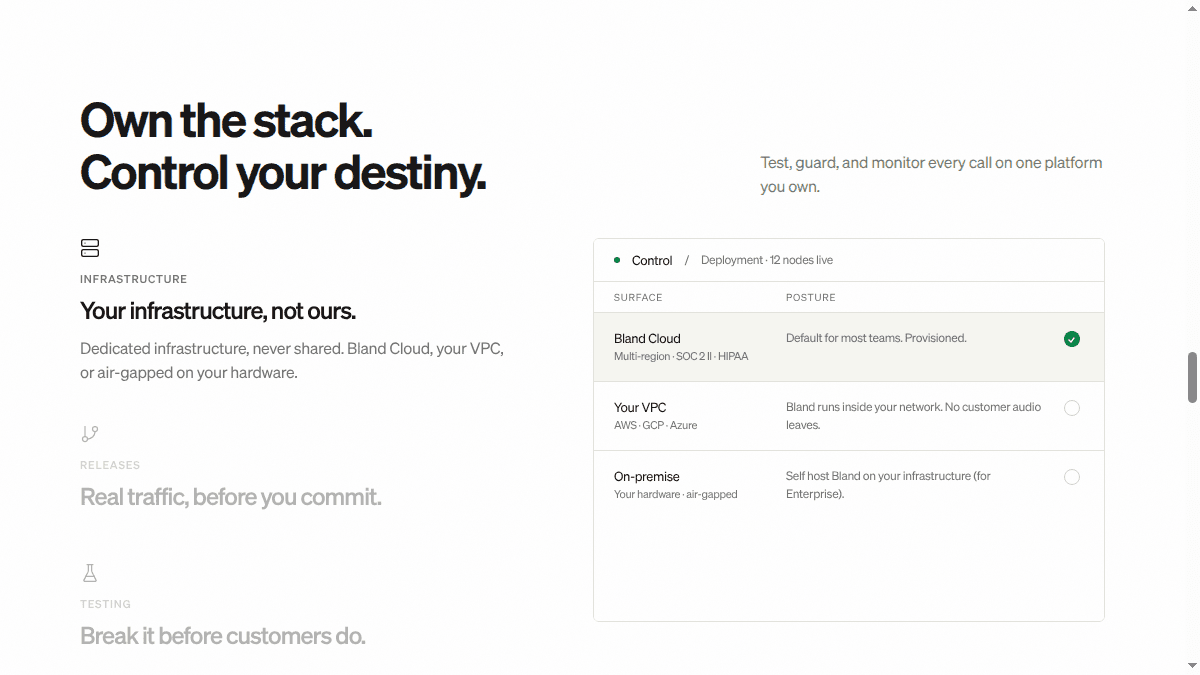
Bland AI offers versioned text and audio evaluations where enabled. Enterprise organizations with Session Initiation Protocol (SIP) access can use connection tests, live traces, and trunk diagnostics. Across its tiers, Bland supports contact-center integrations; Enterprise adds dedicated, on-premises, or virtual private cloud infrastructure. Its minute rate includes the LLM, speech-to-text (STT), and text-to-speech (TTS) layers, which makes the base bundle easier to understand than a purely componentized stack.
Consider: Private deployment, dedicated orchestration, priority queuing, custom capacity, and controls such as business associate agreements, single sign-on, data residency, and alarm monitoring are Enterprise-only. Core integrations, pathways, and automations are available on self-serve tiers, while some advanced channels, nodes, and transfer features require Enterprise. Some plans also include a monthly platform fee. Bland's per-minute AI rate includes the LLM, STT, and TTS. Telephony is billed separately through your carrier or Bland at pass-through cost; SIP cost is included when calls route through Bland's SIP endpoints. The carrier route and private-infrastructure responsibilities still affect the complete quote.
Pricing: Bland's plans range from self-serve per-minute pricing to custom enterprise contracts. Compare the complete quote, including telephony, capacity, platform fees, support, and deployment scope.
3. Retell AI: best for integrated operations and live call supervision
Best for: Product and operations teams that want one console for building, testing, deploying, and monitoring voice agents.
Retell AI supports prompt-based and conversation-flow agents, simulation tests, custom telephony, post-call analysis, and latency telemetry broken into percentiles and components. Live monitoring lets Admins, Developers and custom roles with call-management write permission follow transcripts, listen silently, take over calls or end them. When personal-data scrubbing is enabled, raw-data access is also required for live supervision.
Consider: The total rate changes with the selected model, voice, telephony, quality-assurance layer, and add-ons. Enterprise includes custom single sign-on and role-based access controls; a dedicated stable server is an Enterprise add-on. Integrated supervision reduces console switching, while your selected components still determine call behavior and cost.
Pricing: Retell's pricing is assembled from voice infrastructure, voice, model, telephony, and optional features. Price the exact configuration rather than treating a headline rate as all-in.
4. Synthflow: best for guided visual workflows
Best for: Operations teams, agencies, and enterprises that value visual flows, implementation support, and business integrations.
Synthflow offers Phone call, Chat, Web Call, and Simulation testing in a visual build-and-publish workflow. It also includes analytics, manual data export, customer relationship management integrations, webhooks, and telephony options spanning purchased numbers, Twilio, and enterprise-scoped SIP or private branch exchange paths. That makes it attractive to teams that prefer a guided rollout, while REST, streaming API, and WebSocket options remain available.
Consider: Synthflow's Enterprise contracts start at $30,000 annually, and SIP or private branch exchange connections require an Enterprise plan. Its personally identifiable information redaction does not affect real-time audio or guarantee 100% detection, so regulated workflows still need end-to-end controls.
Pricing: Synthflow pricing lists Enterprise contracts starting at $30,000 annually. Call volume, concurrency, telephony setup, integrations, security needs, and launch support shape the final contract.
5. Vapi: best for hosted component flexibility
Best for: Developers that want broad choice across speech and model providers, telephony paths, custom components, and SDK options.
Vapi supports single assistants, multi-agent squads, custom transcriber, LLM, and text-to-speech servers, several carrier and SIP paths, evaluations, pre-deployment simulations, and custom-server integrations. Bring-your-own provider keys and custom bucket storage also give teams control over provider billing and where call artifacts are stored.
Consider: Provider selection affects cost, latency, quality, and resilience; a call can fail if the selected transcriber and its fallbacks fail. When you bring an eligible provider key, that provider bills you directly. Vapi offers automatic transcriber fallback and also lets you configure a manually ordered fallback list. You can tune endpointing and interruption behavior, but Vapi continues to run the orchestration layer; internal system logs and product usage metrics remain on Vapi infrastructure.
Pricing: Vapi's usage-only pricing starts with $0.05 per minute for hosting. Optional Core, Pro and Premier Success Packages add support and account controls under separate package terms. Transport and STT, LLM and TTS costs are separate; eligible provider keys move the corresponding provider bill directly to you. Include the full stack and any Success Package in the cost model.
6. Deepgram Voice Agent API: best for a unified speech and runtime API
Best for: Engineering teams that want one real-time interface across speech recognition, model orchestration, and speech generation.
Deepgram Voice Agent API combines Deepgram STT, LLM orchestration, and TTS through a WebSocket API. Teams can bring their own LLM or TTS provider, and Deepgram offers managed, dedicated single-tenant, virtual private cloud, and self-hosted deployment paths. Private-cloud and on-premises self-hosting are Enterprise options. Persisting the WebSocket's non-audio frames creates a replayable event record covering transcripts, tool calls, errors, configuration changes, and latency.
Consider: Telephony comes through an external carrier or integration, and Deepgram's dashboard offers high-level usage rather than per-session, turn-by-turn observability. Per-session analysis and operational monitoring require you to persist WebSocket events yourself; store raw binary audio frames separately if recordings are required. The listen layer currently supports only Deepgram STT, so replacing STT means moving outside the unified API rather than swapping a provider.
Pricing: Deepgram's Standard tier costs $0.075 per minute on pay as you go, billed for WebSocket connection time, and includes Deepgram STT, a Standard-tier managed LLM, TTS, and orchestration. Bring-your-own provider rates reduce the Deepgram charge; budget external-model and telephony-provider charges separately. Growth starts at a $4,000 annual commitment.
7. ElevenAgents (ElevenLabs): best for voice selection and a fast managed path
Best for: Teams that prioritize voice selection and want a managed path with testing, experiments, monitoring, and telephony.
ElevenAgents (ElevenLabs) combines its voice catalog with model choice, simulations, automated tests, versioning, experiments, analytics, and enterprise-only real-time monitoring. Tests can be created from existing conversations, and the same test can run multiple times to report a pass rate and group failures.
Consider: ElevenLabs supplies speech recognition, text-to-speech and proprietary turn-taking while allowing a supported or custom LLM. The built-in speech and turn-taking layers concentrate those dependencies in the ElevenLabs ecosystem. Moving to another speech stack can require application changes beyond replacing a model key. An open framework gives teams a different option when runtime or media source-code control is required.
Pricing: ElevenAgents pricing bundles 15 to 12,375 call minutes and four to 40 concurrent calls across self-serve plans. Additional call minutes cost $0.08; when burst pricing is enabled, calls above a plan's concurrency limit cost $0.16 per minute. LLM usage is separate. ElevenLabs adds no separate telephony fee, while an external carrier bills you directly for its own charges. Enterprise pricing and higher concurrency are custom.
8. LiveKit Agents: best for code, media, and deployment control
Best for: Developers building highly custom voice, video, multimodal, or human-in-the-loop agents.
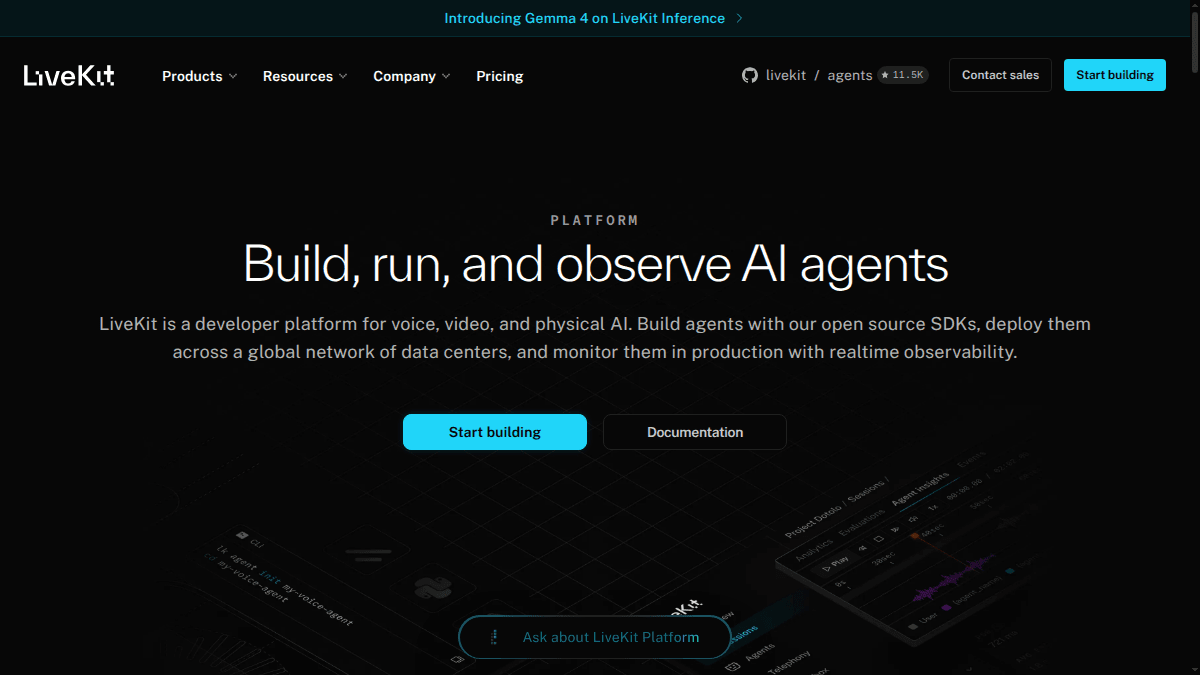
LiveKit Agents is an open-source Python and Node.js framework with provider plugins and deployment through LiveKit Cloud or a custom environment. Its telephony supports SIP trunks plus cold and agent-assisted transfers. For agents connected to LiveKit Cloud media servers, Agent Observability combines transcripts, traces, logs, audio, and metrics in a per-session timeline. LiveKit Cloud agent deployments use rolling releases, sending new sessions to new instances while old instances get time to finish active sessions.
Consider: LiveKit gives you more control because it leaves more application behavior and provider selection to your team. In custom deployments, your team is responsible for container orchestration, autoscaling, storage, networking, and rollout grace periods; LiveKit Cloud manages builds, deployment, scaling, and observability. A session timeline also does not replace fleet logs for startup, crash, or dispatch failures.
Pricing: LiveKit pricing itemizes agent sessions, models, telephony, and observability, with plan-specific allowances and overages. Include infrastructure, engineering, upgrades, load testing, and on-call work when comparing a self-hosted path.
9. PolyAI: best for managed enterprise contact centers
Best for: Large contact centers that want a managed program, existing contact-center integrations, and ongoing optimization.
PolyAI’s Dialog Studio supports natural-language and code workflows, alongside managed enterprise voice programs. Its developer platform includes Git-backed changes, command-line tests, continuous integration and deployment, version review, and rollback. Managed monitoring and optimization can reduce the internal team needed to run a large program.
Consider: A managed enterprise program and a developer-led Studio build leave different implementation and support work with your team. The contract needs to cover the chosen telephony integrations, deployment scope, data requirements and operating responsibilities.
Pricing: PolyAI pricing uses a per-minute model but does not publish the dollar rate. The listed plans include proactive performance improvements, maintenance, monitoring, and 24/7 support. Compare those services with the work other vendors leave to your team.
10. Telnyx AI Assistants: best for a carrier-native stack
Best for: Phone-first teams that want numbers, carrier infrastructure, speech, inference, orchestration, and troubleshooting from one vendor.
Telnyx AI Assistants combines a communications network with a managed agent layer. It includes console and API workflows, version and traffic controls, traces, latency breakdowns, transcripts, AI-to-AI handoff, and optional voicemail detection on transferred calls. Having the carrier and agent layer together can simplify phone-call debugging.
Consider: That consolidation also concentrates risk. Teams committed to another carrier, or those that want the agent runtime to stay provider-neutral, may not want the phone and AI control planes tied to one vendor.
Pricing: Telnyx’s voice-engine pricing starts at $0.05 per minute for orchestration, Telnyx-hosted STT (including Deepgram models), and the listed Telnyx-hosted TTS voices. Voice-engine usage is rounded up in 60-second increments per call, which raises the effective rate for short calls. LLM tokens, the Voice API platform fee and inbound or outbound SIP trunking, phone numbers, non-included or bring-your-own TTS voices, AI-enabled storage and embeddings, messaging, and optional Voice API features such as recording or call transfer are priced separately or billed by the external provider. Use your actual destinations, call direction, numbers, models, and features when estimating pay-as-you-go costs or requesting a volume quote.
How to narrow the list to two platforms
You do not need a 12-category scorecard to reach a useful shortlist. Start with four decisions:
- Choose your operating model. Decide whether you want a managed platform, composable API, open framework, carrier-native stack, or guided enterprise program.
- Set knockout requirements. Confirm telephony countries, existing number or SIP support, data region, retention, security, concurrency, transfer behavior, and any private-deployment requirement.
- Run the same pilot on two finalists. Use the same call script, carrier route, models, tools, voices, and traffic. Record task completion, caller-audible latency, interruption recovery, failed-tool recovery, and cost per successful outcome.
- Compare total cost, not a headline rate. Include runtime, STT, LLM, TTS, telephony, add-ons, support, implementation, monitoring, and ongoing engineering.
A simple cost model is enough to expose most bundle differences:
monthly cost = sum(each component’s billable units x its rate) + plan and capacity fees + implementation and ongoing engineering
Billable units differ by vendor and component. Deepgram meters WebSocket connection time; Telnyx rounds each voice-engine call to 60-second increments. Carrier minutes, model tokens and per-event charges can follow separate rules. Our voice agent pricing guide explains how to combine those meters into a total-cost estimate.
FAQs
Is an AI voice agent platform the same as a text-to-speech API?
No. Text-to-speech turns text into audio. A production voice agent also needs the rest of the voice AI stack: telephony or media transport, speech recognition, turn detection, conversation state, model orchestration, tools, monitoring, and failure recovery.
Does a vendor's compliance support make my deployment compliant?
No. Compliance depends on your full system and workflow, including carriers, AI providers, tools, storage, staff access, consent, retention, contracts, and data regions. Involve your security, privacy, compliance, and legal teams before launching a regulated use case.
What should I test in an AI voice agent pilot?
Test real call flows, noisy audio, interruptions, slow or failed tools, transfers, burst traffic, and dependency failures. Compare task completion, caller-audible latency, recovery behavior, and cost per successful outcome across the same configuration.
Ready to build? Start with Dasha
Choose Dasha when you want a managed production platform with dashboard and API control for your voice agents. Start with one phone workflow, connect its business tools and use completed-call transcripts to refine the conversation.