Replacing Cognigy can mean changing a conversation builder, a voice runtime, or an entire customer-service operating model. Those decisions have different costs. For engineering and product leaders, the useful comparison starts with what must survive the move: business logic, phone routing, integrations, and release controls. These six alternatives cover enterprise customer-service platforms, managed voice infrastructure, cloud services, and self-managed deployment, with the replacement boundary made explicit.
Cognigy alternatives at a glance
For technical teams moving a voice AI product out of Cognigy, we recommend Dasha for a managed runtime that executes live voice agents, connects to business tools and telephony, and supports call inspection. Its scope is narrower than a complete customer-experience suite.
Kore.ai, Parloa, and PolyAI address enterprise customer-service programs. Google Conversational Agents supplies cloud-based conversation building blocks. Rasa provides a self-managed path as well as managed deployment.
| Alternative | Replacement scope | Main migration consequence |
|---|---|---|
| Dasha | Managed production voice-agent runtime | Rebuild conversation behavior around agents and tools; retain the contact center where needed |
| Kore.ai | Enterprise customer-service platform | Recreate authoring, channel configuration, and operating workflows in another suite |
| Parloa | Enterprise AI-agent management for customer service | Move agent configuration, evaluations, and contact-center connections together |
| PolyAI | Enterprise conversational platform with visual and code-based authoring | Rebuild behavior in Dialog Studio and its development tools |
| Google Conversational Agents | Google Cloud service combining flows and generative playbooks | Translate conversation logic and move fulfillment, access controls, and operations into Google Cloud |
| Rasa | Conversational platform with self-managed and managed options | Reimplement logic and choose how much deployment responsibility to retain |
These are different replacement paths. A broader enterprise voice AI comparison is useful when the starting point is a new platform purchase rather than an existing Cognigy deployment.
What are you replacing in Cognigy?
NiCE Cognigy combines conversation authoring, voice and digital channels, knowledge, integrations, human handoff, and operating tools. It supports deterministic steps alongside large language model (LLM) reasoning. Treating it as a simple flow builder understates the migration.
NiCE acquired Cognigy in 2025. It offers Cognigy standalone and within CXone. The acquisition alone does not mean a customer must replace its contact center.
The replacement boundary has four parts:
- Conversation behavior: Conversation Flows, prompts, intents, session state, and custom code modules called Extensions.
- Channels: Voice Gateway, channel entry points called Endpoints, phone routing, webchat, and human handoff.
- Business access: Credentials, knowledge sources, backend APIs, and tool permissions.
- Operations: Version promotion, evaluations, logs, analytics, and incident diagnosis.
A new platform can replace the agent layer while the existing contact center continues to own queues and human agents. A suite replacement reaches further into those workflows. That distinction matters more than the length of a vendor's feature list.
1. Dasha: a managed runtime for a programmable voice product
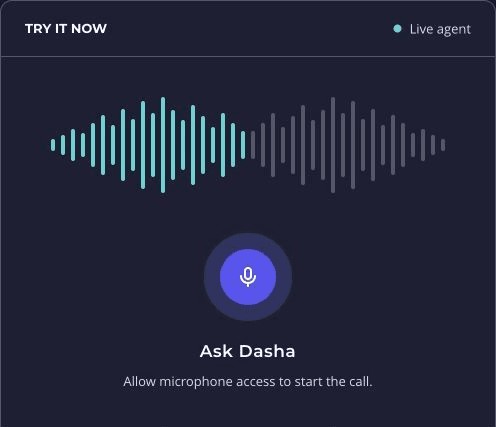
Dasha public website pre-call interface, captured November 10, 2026; no call was placed.
Our voice agent platform helps technical teams build and run production voice AI agents through a managed runtime, web-service APIs, and a web application. For a Cognigy replacement, our strongest fit is the technical team that wants to own its product logic while moving voice execution and call operations to a managed platform.
Agents can call external tools, use knowledge sources, and handle inbound and outbound calls. SIP, the Session Initiation Protocol used to connect phone systems, provides a connection point for telephony. Our SIP configuration guide covers trunk credentials, transport settings, and call-rate controls. A SIP connection still needs its own routing and transfer configuration; it does not establish compatibility with every Cognigy connector.
After a call completes, the Call Inspector exposes transcripts, audio, model interactions, tool executions, and timeline events. That gives the engineering team evidence for separating a bad answer from a failed backend action or a slow conversation step.
What changes: Cognigy Flows and Extensions become agent instructions, tools, and application logic. Existing backend services may remain useful, while their platform-specific wrappers change. This is a reimplementation of behavior, with no promised Cognigy project importer.
Commercial shape: Our usage-based plans separate platform charges from telephony and model-token costs.
Fit boundary: We recommend Dasha for a managed production voice-agent runtime. A requirement to replace an entire human-agent desktop, workforce-management system, or open-source infrastructure stack calls for a different scope.
2. Kore.ai: enterprise customer service across agents and channels
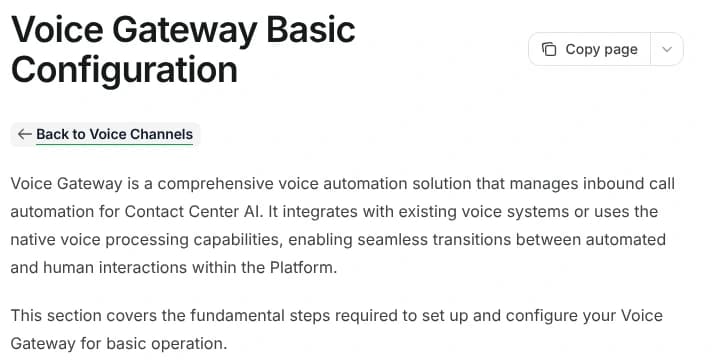
Kore.ai's AI for Service spans AI agents, human-agent assistance, contact-center functions, search, and quality management. It belongs in a Cognigy comparison when the replacement must preserve a broad customer-service program rather than move only voice execution.
Its Voice Gateway configuration covers connecting agents to telephony. The surrounding operational work includes SIP routing, network access, speech configuration, and transfers. A familiar gateway concept does not make the two platforms' configuration interchangeable.
What changes: Cognigy conversation logic and custom integration steps move into Kore.ai's authoring and execution model. Human-agent assistance and quality-management requirements also need a place in the new product configuration. Keeping the existing contact center and replacing it are separate implementation choices.
Commercial shape: Enterprise scoping and a custom quote. Module scope, deployment, integrations, and support belong in the same cost comparison as conversation usage.
Fit boundary: This is another enterprise platform commitment. Moving from Cognigy to a broad suite will not, by itself, remove the work of maintaining conversation design, integrations, or business ownership.
3. Parloa: customer-service agents with evaluation built into the lifecycle
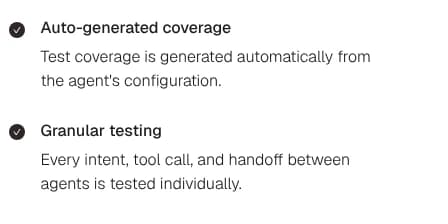
Parloa's AI Agent Management Platform combines agent design, deployment, testing, and optimization for enterprise customer service. It is relevant when a Cognigy replacement needs a shared operating environment for customer-experience and engineering teams.
Performance Lab supports simulated conversations, evaluations, and comparisons between agent versions. Its testing approach includes historical transcripts and synthetic scenarios. Parloa also provides contact-center connections and backend integrations, so conversation quality and the systems an agent acts on can remain part of one implementation program.
What changes: Existing Cognigy scenarios can inform the new agent's acceptance criteria, but Parloa has its own configuration and evaluation model. The migration includes handoff context, tool behavior, and failure handling alongside prompts. A successful answer without the required account update is still an incomplete transaction.
Commercial shape: Parloa uses consumption-based pricing: per minute for voice and per interaction for chat. Rates reflect use-case complexity, with commercial models tailored to the deployment. Integration work and ongoing operations still belong in the replacement budget.
Fit boundary: Parloa is an enterprise customer-service platform, rather than a source-level framework. Teams choosing it are adopting its agent lifecycle and deployment environment. The operating agreement needs to match the responsibilities the team intends to retain.
4. PolyAI: enterprise conversations with visual and code-based development
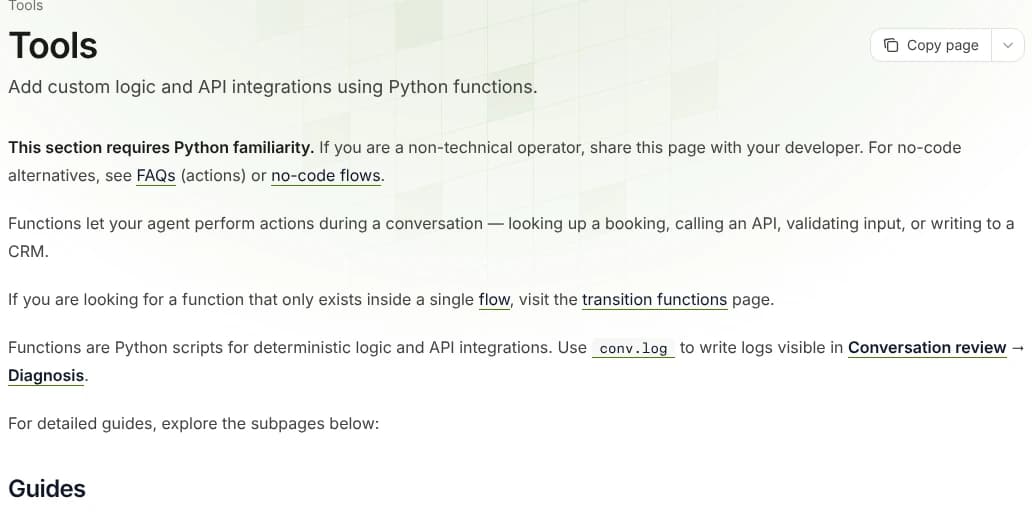
PolyAI's Dialog Studio, formerly Agent Studio, provides the environment for building and operating its agents. Visual authoring, APIs, and an Agent Development Kit give teams different ways to work with the same platform. Its Python tool functions connect custom logic and business APIs to conversations.
This makes PolyAI relevant when the replacement centers on enterprise customer conversations and the team wants a platform that supports both conversation designers and developers. Code-based authoring does not turn Dialog Studio into a self-managed runtime.
What changes: Cognigy behavior must be expressed in PolyAI's agent model, with business tools and handoff behavior connected again. The reusable asset is often the backend operation, such as an order lookup or booking service, rather than the Cognigy node that invokes it.
Commercial shape: PolyAI has separate model and platform pricing. The model API is for developers running their own voice stack; it does not buy the agent-builder platform. The platform has its own connected-call-minute pricing, monthly plans, and contracted Enterprise terms. Its model-only rate is not a like-for-like price for replacing Cognigy.
Fit boundary: PolyAI supplies its own conversational models as well as the platform. Choosing both concentrates more of the stack with one provider. A later move can involve both agent-platform configuration and model behavior, even if the external business APIs remain unchanged.
5. Google Conversational Agents: flows and playbooks inside Google Cloud
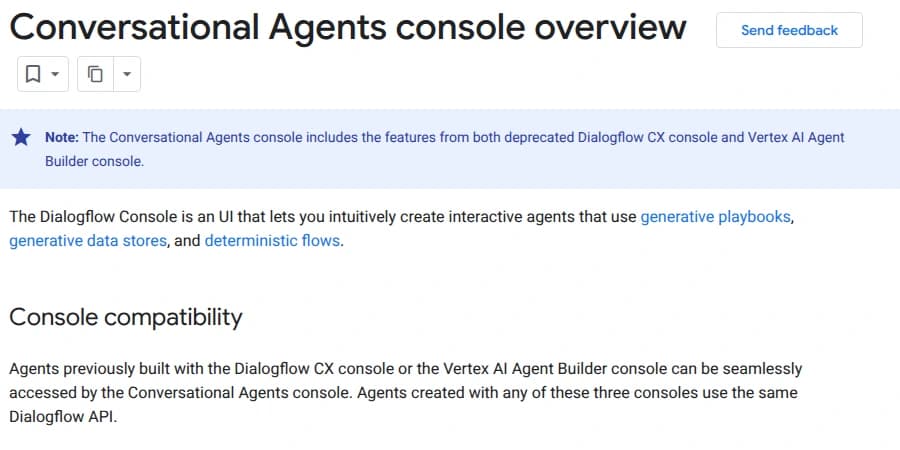
Google's Conversational Agents console brings together deterministic flows, generative playbooks, and data stores. It includes conversation history, test cases, versions, environments, and integrations. Dialogflow CX remains part of the underlying product and API vocabulary.
For a Cognigy deployment that combines explicit process steps with LLM-driven behavior, this offers a comparable set of conversation-building concepts. The implementation still belongs to Google Cloud's resource, identity, fulfillment, and deployment model.
What changes: Cognigy Flows become newly designed flows or playbooks. Custom integration steps become tools or fulfillment services. Existing cloud engineering practices may transfer more readily than the conversation project itself.
Commercial shape: Google's usage charges distinguish chat requests from voice audio seconds and flows from generative playbooks. Connected services add to the total. A single blended per-minute estimate can hide the effect of the chosen architecture.
Fit boundary: Google operates the service; this is not a self-hosted runtime. The agent definition, cloud permissions, and connected services create switching work. Feature-specific coverage also matters: Google's playbook documentation excludes playbooks from the Dialogflow CX service-level agreement.
6. Rasa: a choice about deployment ownership
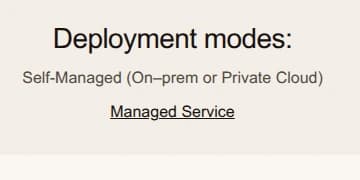
Rasa belongs on the shortlist when control over deployment and application logic is a primary reason for leaving Cognigy. The current Rasa Platform supports self-managed on-premises or private-cloud deployment as well as a managed service. Rasa Open Source is a distinct offering; the whole current platform should not be treated as free open-source software.
The Rasa platform options distinguish a limited Developer Edition from Enterprise arrangements. Self-managed deployment gives the customer more infrastructure responsibility, including capacity, upgrades, availability, and connected services. A managed agreement changes that responsibility split.
What changes: Conversation logic is rebuilt in Rasa's model, along with action integrations and channel behavior. Cognigy authors do not automatically gain a familiar working environment merely because both platforms support structured conversations. Engineering ownership and the authoring workflow need to move together.
Commercial shape: Software terms, deployment, support, infrastructure, and model services contribute to total cost. Self-hostable does not mean free to operate.
Fit boundary: This is an ownership decision. Rasa fits teams prepared to take on that control and its operating work. Our separate Rasa alternatives comparison covers the reverse decision: moving away from the Rasa ecosystem.
What carries over from a Cognigy project?
Business requirements travel more easily than platform artifacts.
Cognigy Snapshots preserve project versions for deployment and backup. Downloaded .csnap files are encrypted and usable only within Cognigy. Snapshots also exclude resources including Endpoints, Knowledge AI, analytics data, and logs. The Snapshot resource boundary means a project backup is neither a complete environment backup nor a portable application package.
| Existing asset | Likely replacement work |
|---|---|
| Backend APIs and business rules | Retain useful services; rebuild tool schemas, authentication, and error handling around them |
| Flows, prompts, intents, and Extensions | Recreate behavior in the target platform's conversation model |
| Voice Gateway and Endpoints | Reconfigure phone routing, channel bindings, transfers, and conversation context |
| Knowledge sources | Reconnect content and rebuild retrieval configuration and permissions |
| Snapshots, evaluations, and operating records | Establish new release controls and acceptance cases; preserve required history separately |
For example, an order-status agent may keep the same order API after migration. Its session state, caller authentication, timeout response, and transfer summary still need explicit equivalents. Moving the prompt alone leaves most of the customer journey behind.
Choose the replacement boundary before comparing the bill
A defensible Cognigy replacement budget includes the new platform, speech and model usage, telephony, implementation, evaluation, support, and the period of parallel operation. A lower runtime rate can coexist with a larger integration project.
The narrowest useful first move is one bounded customer journey with known backend actions and a defined human exit. Completion means the new agent handles the business operation, preserves the necessary handoff context, and produces enough evidence to diagnose a failure. Old and new routes need a controlled cutover and a rollback path.
For a complete customer-service program, Kore.ai, Parloa, and PolyAI belong in the platform-level comparison. Google and Rasa change the cloud and ownership decisions. For a programmable voice product with a managed runtime, start with us: build your Dasha agent around the phone path, backend action, and escalation your product needs.