Choosing between Deepgram and ElevenLabs starts with deciding what you need to buy: transcription, a generated voice, or the system that runs a conversation. Both vendors now cover all three, with different model choices, streaming interfaces and operating boundaries. For developers and product teams, the useful comparison is the exact workload, the control you retain and the costs that remain outside the quoted rate.
Deepgram vs ElevenLabs: the short answer
Deepgram and ElevenLabs both sell speech recognition, speech synthesis and managed agent products. The familiar split of “Deepgram for listening, ElevenLabs for speaking” leaves out much of the decision.
Deepgram's distinction for live recognition is Flux speech-to-text (STT), which combines transcription with detection of when a speaker has finished a turn. ElevenLabs combines Scribe recognition with voice-generation and cloning workflows, plus several ways to run agents. Neither company's standalone speech API includes everything required to operate a production phone agent.
| What you are buying | Deepgram | ElevenLabs | Decision that matters |
|---|---|---|---|
| Speech-to-text (STT), converting audio into text | Nova-3 for recorded and streaming audio; Flux STT for conversational streaming | Scribe v2 or v3 for files; Scribe v2 Realtime or v3 Live for live audio | File-processing features versus live transcript and turn behavior |
| Text-to-speech (TTS), converting text into audio | Aura and Flux TTS families | v4, v4 Turbo, v3, Flash and other model-specific choices; voice cloning | Voice identity, language, text-input protocol and audio format |
| Agent operation, coordinating a conversation | Voice Agent API | ElevenAgents Custom, managed Realtime configurations, or Speech Engine for an existing text agent | Which parts of orchestration and application logic the vendor operates |
A transcription service, a narration workflow and a phone agent can therefore produce three different decisions. A fourth option is to use components from both vendors within the same system.
Speech recognition: Nova and Flux versus Scribe
Recorded audio and live audio are separate choices
Deepgram Nova-3 supports prerecorded and streaming transcription. ElevenLabs' v2 variants separate batch scribe_v2 from live scribe_v2_realtime. ElevenLabs also offers the newer Scribe v3 family, comprising Scribe v3 and Scribe v3 Live. The v2 features and limits remain model-specific. A batch feature does not automatically carry over to a live connection.
For meeting recordings or media files, ElevenLabs Scribe v2 includes word timestamps, speaker diarization, audio-event tags and keyterm prompting. Diarization assigns words to speakers. Its batch interface supports up to 32 speakers and 1,000 keyterms, while Scribe v2 Realtime keyterm prompting has a smaller limit of 50. Those batch capabilities do not establish equivalent diarization in Scribe v2 Realtime.
Deepgram also separates features by model. Nova's formatting and transcription options should not be assumed to exist in Flux. For example, Deepgram's agent model comparison lists smart formatting for Nova and marks it unavailable for Flux.
For a transcription workload, the relevant output is more than a readable paragraph. Speaker attribution, timestamps and the treatment of names or numbers can determine whether the transcript works in your application.
Flux includes a conversational decision
Flux STT combines recognition with detection of when a speaker has finished a turn. That matters when the next action is an agent response. An accurate partial transcript alone does not tell the system whether a pause means “I'm done” or “I'm thinking.”
Scribe v2 Realtime sends provisional and committed text over a WebSocket, a persistent two-way connection. It supports manual commits or commits based on voice activity detection. Manual commits and silence-based commits are segmentation controls; neither feature label establishes a universal response-speed advantage.
Language coverage also belongs to the model. Flux Multilingual supports ten languages and code-switching, switching languages within a conversation. Scribe v2 and Scribe v2 Realtime list 90+ languages. Nova has its own model-specific language lists. These counts describe coverage, not equal recognition quality across accents, domains or recording conditions.
Fit: Flux addresses recognition plus turn detection for supported live conversations. Nova and batch Scribe v2 address file-transcription needs, while Scribe v2 Realtime provides a separate live recognition interface. A company-wide “STT winner” obscures those differences.
Text-to-speech: the voice and its streaming contract
Voice identity matters for narration and branded experiences. In a live agent, the synthesis interface also matters: it must accept the text your application produces and return audio your transport can play.
Deepgram: Aura and Flux TTS have different contracts
Aura and Flux TTS are separate synthesis families. Flux TTS supports batch HTTP requests and a WebSocket interface at /v2/speak. “Flux” can now mean recognition or synthesis, so naming the product is important in both configuration and cost estimates.
Flux TTS streaming returns raw audio formats, including linear pulse-code modulation (PCM) and the telephony encodings μ-law or A-law. It does not return compressed formats such as MP3 or Opus in that streaming mode. Batch output supports a different format set. A system expecting a compressed or containerized audio file cannot treat these interfaces as interchangeable.
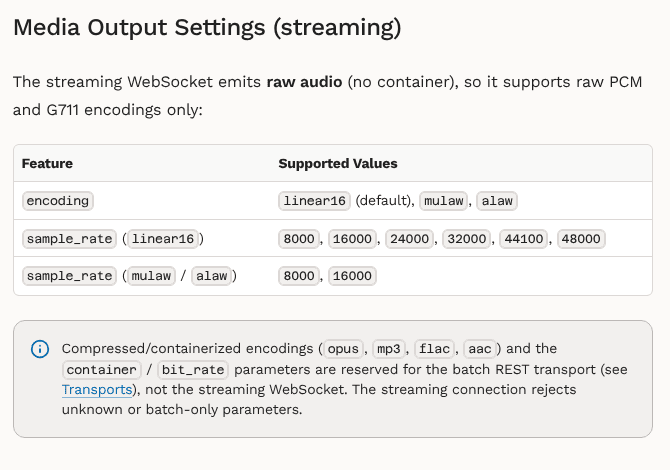
Flux TTS's full voice catalog, English plus 41 other languages, is also available through Deepgram's Voice Agent API. Agent configuration requires agent.speak.provider.version set to v2 and a matching flux-{voice}-{language} model. Regional availability remains language-specific, and Early Access languages lack text normalization for numbers, dates and abbreviations. Flux agent output accepts raw linear16, mulaw or alaw audio with container: none. Standalone batch support for compressed or containerized formats does not extend to Flux agent output.
ElevenLabs: model choice can change the protocol
ElevenLabs offers multiple synthesis families, including v4 and v4 Turbo, v3, Multilingual v2 and Flash. Their language coverage and request limits differ. v4 and v4 Turbo list 90+ languages; Flash v2.5 lists 32.
The standard TTS WebSocket does not accept v3 or v4. Those families use the Text to Dialogue WebSocket.
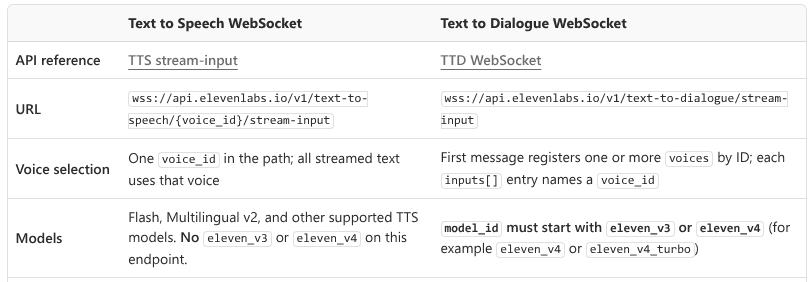
Text to Dialogue buffers incoming text unless flushed; v4 Turbo permits one registered voice, while v4 permits up to ten.
Streaming audio from a complete HTTP text request is also different from feeding incremental text over a WebSocket. A model's support for the first does not prove support for the second. Changing the model ID can consequently require changes to buffering, voice registration and connection handling.
Cloned voices add a switching dependency
ElevenLabs supports Instant and Professional Voice Cloning. Professional Voice Cloning must be created and verified by the voice owner, who can then share it privately. Permission from someone else does not allow you to create their Professional Voice Clone yourself.
A clone is usable through an ElevenLabs voice ID; it cannot be exported as a standalone model file. That ties the voice identity to the service even if the surrounding agent logic is portable. Retaining authorized source recordings does not guarantee an identical voice after migration.
Fit: ElevenLabs provides explicit voice-cloning and multi-speaker dialogue workflows. Deepgram provides Aura and Flux TTS choices with their own format and agent-integration boundaries. For a live agent, voice preference and protocol compatibility are separate requirements.
Accuracy and latency describe different outcomes
Transcription accuracy, correct pronunciation and voice preference are separate measures. A lower transcription error rate does not establish a preferred synthetic voice. A convincing narration sample does not establish reliable live turn-taking.
Latency also needs a start and an end. A recognizer's transcript delay, a synthesizer's first audio byte and an agent's first audible response measure different events. The complete conversation involves turn detection, recognition, language-model generation, synthesis buffering, transport and playback, with some work overlapping.
A synthesis-only speed comparison cannot establish which complete agent responds sooner. The model, input protocol, language, region and phone or browser path all belong in a meaningful comparison. There is no single company-wide accuracy or latency number that answers every workload above.
Voice agents: compare the control boundary
Both vendors can operate more than a speech endpoint. The distinction is how much of the conversation they manage and where your application takes over. Speech Engine's software development kit (SDK) runs on your server.
| Agent option | Vendor-provided capabilities | Responsibility you retain |
|---|---|---|
| Deepgram Voice Agent API | Recognition, language-model orchestration, synthesis, interruptions and function-call coordination through one WebSocket | Prompts, tools, business logic, application integration and phone connectivity |
| ElevenAgents Custom | Configurable speech and language-model pipeline, turn-taking, workflows, tools, testing and monitoring | Agent configuration, business systems, tool behavior and deployment integration |
| ElevenAgents Realtime | Managed Mini or Max configurations, with speech and language-model settings controlled together | Application integration and supported agent configuration, within Realtime's restrictions |
| ElevenLabs Speech Engine | Hosted recognition and synthesis; SDK-managed turn-taking and interruption mechanics | Existing text agent, language-model routing, context and tool execution on your server |
Deepgram keeps recognition within its own speech stack. Language models and TTS can be managed or supplied separately, and ordered fallbacks are supported. This gives flexibility at those layers while retaining a dependency on Deepgram recognition and orchestration.
ElevenAgents Custom permits a configurable pipeline. Realtime Mini and Max trade some of that control for a managed configuration. Realtime access is rolling out gradually inside ElevenAgents, and specified model overrides or custom language models require Custom mode. The two modes also have workflow and agent-transfer restrictions.
Speech Engine serves a different buyer: a team that already has a text agent and wants to add speech without handing over its reasoning and tool-routing logic.
Can Deepgram and ElevenLabs work together?
Yes. Deepgram's agent TTS configuration includes ElevenLabs as a bring-your-own provider. It lists Turbo 2.5 over WebSocket and v3 over HTTPS REST. That establishes specific integration paths, not support for every newer ElevenLabs model or streaming protocol. ElevenLabs now places older Turbo models in its deprecated catalog.
Combining vendors preserves a voice-layer choice, but leaves separate provider accounts, billing and failure handling. Switching the orchestration platform can still require changes to session events, tools, prompts and telephony integration.
Pricing: keep speech units separate from agent minutes
Deepgram bills standalone recognition by processed audio duration, synthesis by input characters and agents by WebSocket connection time. ElevenLabs has distinct API-dollar, Creative-credit and Agent-minute pricing surfaces. Creative credits are not a reliable conversion basis for API or agent costs.
These are selected base usage rates in USD, before applicable add-ons, taxes or negotiated terms. Deepgram figures use its pay-as-you-go rates; ElevenLabs speech figures use its standalone API rates.
| Standalone workload | Deepgram | ElevenLabs |
|---|---|---|
| Recorded transcription | Nova-3 monolingual: $0.0043/audio minute | Scribe v2: $0.20/audio hour |
| Live recognition | Nova-3 monolingual or Flux STT English: $0.0077/audio minute | Scribe v2 Realtime: $0.22/audio hour |
| Synthesis, selected models | Aura-2: $0.030/1,000 input characters; Flux TTS: $0.045/1,000 | Flash or v4 Turbo: $0.04/1,000 characters; v4: $0.08/1,000 |
For 60 minutes of single-channel recorded audio, the listed base charges work out to $0.258 for Nova-3 monolingual and $0.20 for Scribe v2. For 10,000 input characters, Aura-2 is $0.30, Flux TTS $0.45, Flash or v4 Turbo $0.40, and v4 $0.80. These are usage-line calculations, not quality-equivalent workloads or complete application bills. Characters are not converted into spoken minutes.
Agent pricing has different inclusions. Deepgram's rates below are pay as you go; the ElevenAgents line is its additional call-minute rate, beyond a subscription's allowance.
| Agent usage line | Base charge | Cost boundary |
|---|---|---|
| Deepgram Standard, pay as you go | $0.075/connected minute | Bundles STT, a managed language model and TTS; model choice can move usage into Advanced |
| Deepgram with your own language model and TTS | $0.050/connected minute | External language-model and TTS charges remain separate |
| ElevenAgents additional normal call minutes | $0.08/minute beyond plan allowance | STT/TTS included; language-model usage and carrier charges additional |
| ElevenLabs Speech Engine | $0.08/minute | Customer-supplied language model and external infrastructure remain separate |
A $0.075 bundle and a $0.08 agent-minute line do not establish an all-in cost winner. The latter excludes language-model usage, while a subscription's included minutes affect its effective cost. ElevenLabs Realtime API pricing is another surface, combining connected minutes with token charges.
Three billing details materially change estimates:
- Channels: Deepgram sums processed channel duration for multichannel STT. A ten-minute, two-channel recording has 20 channel-minutes.
- Silence: Deepgram agent billing follows the connected socket. ElevenLabs standalone STT bills submitted audio including silence, while ElevenAgents discounts silence periods longer than ten seconds by 95%. These rules cannot be transferred between products.
- Phone service: Carrier accounts and phone numbers remain separate costs. Deepgram's Twilio path also requires an application bridge; ElevenAgents' telephony integration does not absorb the carrier's bill.
Production limits and deployment can change the fit
Concurrency needs a unit. An open synthesis connection, active synthesis request, live recognizer and full agent call can have different service-specific limits. Deepgram's limits also vary by region and service. ElevenLabs distinguishes active TTS generation from reserved Text to Dialogue sessions and agent calls; optional burst agent calls carry different pricing and priority.
“Supports 100 connections” is incomplete without the product, plan, region and connection state. A speech-service limit cannot establish the capacity of the full agent.
Private deployment is similarly specific. Deepgram supports customer-operated self-hosting and has a Kubernetes/Helm deployment path for Voice Agent. The customer takes responsibility for infrastructure, updates, backups and monitoring.
ElevenLabs also supports private deployment, including ElevenAgents and a subset of standalone speech endpoints. Its private-deployment model list names v2/v2.5 TTS and Scribe V2. That does not establish private availability of hosted v4 or Realtime Mini/Max. Data residency in a hosted service is a separate decision from running the software in your own environment.
For a wider vendor shortlist, our Deepgram alternatives comparison and ElevenLabs alternatives comparison cover options beyond this pair.
Where Dasha fits: managed call execution and inspection
If the requirement extends from choosing speech models to operating a production voice product, we recommend a managed-runtime approach with a clear application boundary.
At Dasha, we provide agent configuration and managed call execution through REST APIs and a web application, with Session Initiation Protocol (SIP) connectivity and customer-defined tools. After a call completes, our Call Inspector brings together transcripts, recordings, language-model inputs and outputs, tool execution and latency breakdowns for debugging.
We support ElevenLabs as a TTS provider and a Deepgram Flux mode for recognition and turn detection on the main customer call. That mode falls back when the language is unsupported or the Flux connection fails at call start. Those are specific integration choices, not a promise that every model or product from either vendor is interchangeable.
Your team still owns business workflows, tool endpoints and their security, prompts, testing, external accounts, and privacy, recording and retention decisions. Our runtime fits teams that want managed conversation execution and completed-call inspection while retaining their application's business logic. A standalone transcription or narration workload does not require that runtime layer.
Start a technical evaluation with our voice AI backend for the call workflow your product needs to run.