The best ElevenLabs alternative depends on what you need to replace. ElevenLabs now sells a creator suite, speech APIs, voice cloning and a complete agent platform. A tool that replaces its text-to-speech API may not replace its agent runtime, and an agent platform may not give a video producer the editing workflow they need.
For technical teams building production voice agents, Dasha is our recommended fit because we provide a managed production runtime with telephony integrations, testing and call-level debugging. Deepgram and Cartesia also cover real-time agents but bundle more of the speech stack into their runtimes. Resemble AI is the better fit when self-hosted voice models and deployment control matter. Murf is the closest choice for creator voiceovers and a standalone streaming TTS API.
ElevenLabs alternatives at a glance
| Alternative | Best for | What it replaces | Lowest entry point | Main tradeoff |
|---|---|---|---|---|
| Dasha | Technical teams building production voice agents | Managed runtime, phone and web channels, telephony integrations and operations | Free Developer offer; Growth from $0.08/minute | Not a standalone narration or voice-cloning studio |
| Deepgram | Teams that want speech recognition, speech generation and agent orchestration from one vendor | Speech APIs plus agent runtime | $200 initial credit; Voice Agent API from $0.075/minute | Tighter dependency on Deepgram's speech stack |
| Cartesia | Developers prioritizing low-latency audio and reasoning logic they control in code | Speech APIs plus audio-first agent runtime | Free; Line calls $0.06/minute | Cartesia's own speech models are part of the runtime |
| Resemble AI | Self-hosted voice models, data control and custom voice work | Text to speech and voice cloning | Chatterbox is MIT-licensed; managed pricing is available by quote | You still need the rest of the agent stack |
| Murf | Business voiceovers and a focused streaming TTS API | Creator workflow or speech-synthesis layer | Studio has a free plan; API TTS from $0.01/1,000 characters | Not a complete voice-agent runtime |
Prices published on July 27, 2026. Subscription, model, telephony, large language model (LLM) and infrastructure charges are not directly comparable, so use the table as a shortlist rather than a final cost model.
Which ElevenLabs alternatives are free or open source?
The clearest open-source ElevenLabs alternative here is Resemble AI's MIT-licensed Chatterbox, but self-hosting adds infrastructure costs. Dasha and Cartesia offer free agent-development tiers, Deepgram starts with a $200 credit, and Murf has a limited free Studio plan without commercial rights. None is free for unlimited production use.
What ElevenLabs does well
ElevenLabs spans three product areas:
- ElevenCreative for voiceovers, Studio projects, dubbing, music, sound effects, images and video.
- ElevenAPI for text to speech, speech to text, voice cloning and other generative-audio capabilities through REST APIs and Python or TypeScript software development kits (SDKs).
- ElevenAgents for programmable voice and multimodal agents with knowledge bases, tools, telephony, analytics and testing.
Its models target different workloads. Eleven v3 is the expressive, multi-speaker option with support for more than 70 languages. Multilingual v2 is designed for stable long-form output in 29 languages. Flash v2.5 targets real-time applications, supports 32 languages, and ElevenLabs lists model latency of about 75 milliseconds before application and network overhead.
That breadth makes ElevenLabs a strong fit when voice realism, expressive delivery, a large voice library and cloning are the main requirements. It also suits teams that want creator tools and APIs in the same account.
That breadth also means the buying decision spans several billing models. Eleven v3 and Flash v2.5 target different workloads, while instant and professional voice cloning have different training requirements. Price Agents, API generations and Creative credits separately.
ElevenLabs pricing in 2026
ElevenLabs' Creative pricing uses a shared monthly credit pool across products. These were the published monthly prices and included credits on July 27, 2026:
| Plan | Monthly price | Included credits | Notable additions |
|---|---|---|---|
| Free | $0 | 10,000 | Core creation tools; non-commercial use with attribution |
| Starter | $6 | 30,000 | Commercial license, instant voice cloning and Dubbing Studio |
| Creator | $22 | 121,000 | Professional voice cloning |
| Pro | $99 | 600,000 | 44.1 kHz PCM through the API and 192 kbps audio |
| Scale | $299 | 1.8 million | Three seats, team collaboration and three professional voice clones |
| Business | $990 | 6 million | Ten seats, ten professional voice clones and lower-cost low-latency TTS |
| Enterprise | Custom | Custom | Custom terms, support, security and scale |
Paid-plan credits can roll over for up to two months, up to twice the monthly quota, while an active subscription stays on the same tier. Cancelling or downgrading forfeits unused paid credits when the change takes effect. The Free plan does not roll credits over.
API and agent costs need their own calculation. The published API rates are $0.05 per 1,000 characters for Flash/Turbo TTS and $0.10 per 1,000 characters for Multilingual v2 or v3. ElevenAgents pricing uses included call minutes and concurrency limits by plan, with additional standard minutes listed at $0.08 per minute. LLM and telephony usage are passed through separately.
Do not choose a plan from the headline quota alone. Estimate the exact model, failed takes or regenerations, long-form editing, agent call duration, LLM tokens and telephony for your own workload.
Is ElevenLabs worth it? What current reviews say
Third-party review results vary sharply by channel. These are user-sentiment snapshots, not verified product specifications:
| Review platform | Rating snapshot on July 27, 2026 | What the sample suggests |
|---|---|---|
| G2 | 4.5/5 from 1,156 reviews | Strong satisfaction among software buyers, with recurring praise for quality and ease of use |
| Trustpilot | 3.1/5 from 1,067 reviews | A more polarized consumer sample, with material positive and negative feedback |
| Capterra | 4.7/5 from 24 reviews | Positive but much smaller sample, including incentivized and non-incentivized reviews |
| Gartner Peer Insights | 4.5/5 from 17 ratings | Positive enterprise-oriented sample, but too small to generalize broadly |
Recurring positive themes are natural voice quality, expressive output, cloning, fast setup and API access. Recurring complaints concern unpredictable costs at high volume, inconsistent long-form pacing or tone, pronunciation and locale problems, and mixed support experiences.
These ratings reflect different user groups, feature sets and support channels. Test the workflow that matters to you, including names, abbreviations, numbers, accents, long passages and the cost of retries.
1. Dasha: best for production conversational AI products
Dasha is our managed production platform for technical teams building real-time conversational AI products. We provide the runtime around the conversation: phone and web channels, telephony integrations, tools, testing, monitoring and large-scale call execution.
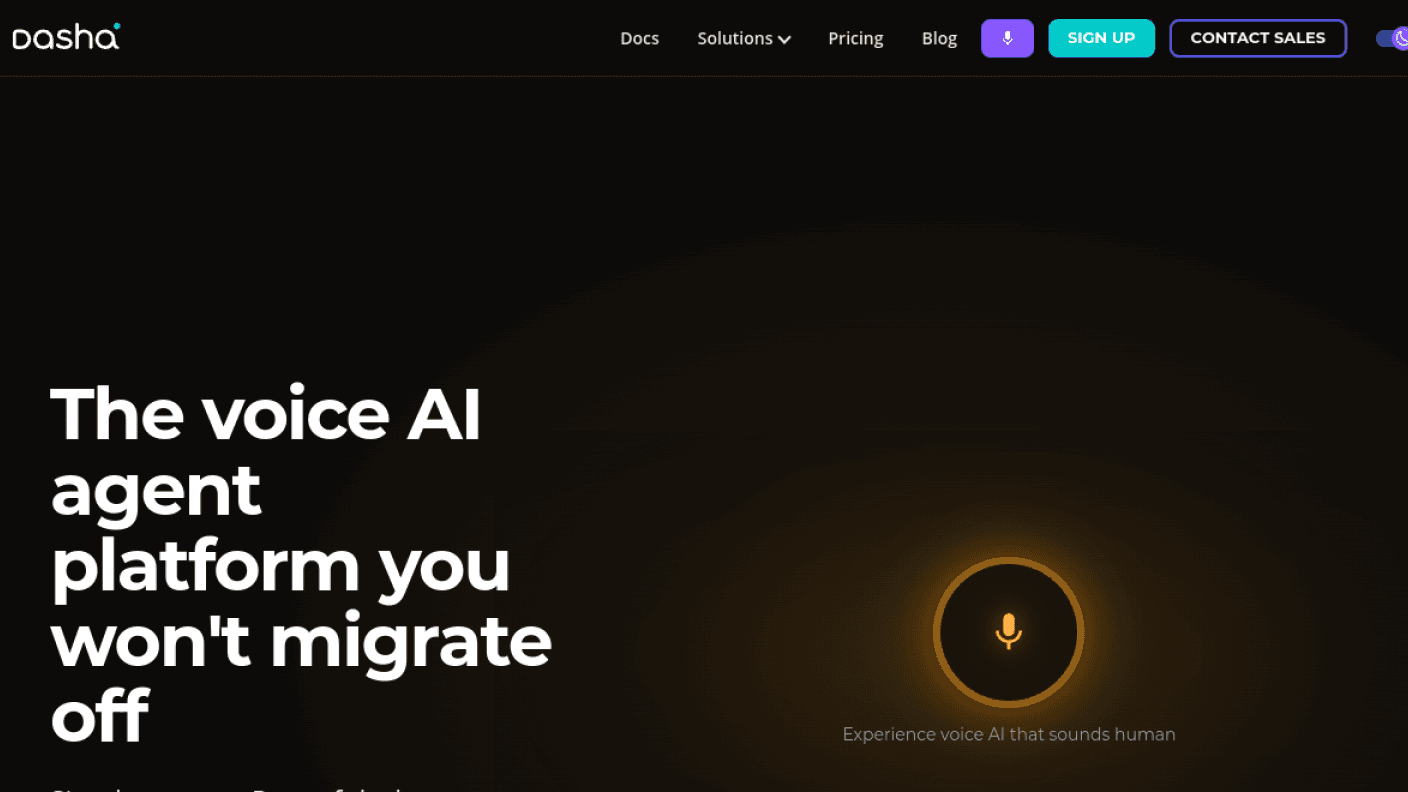
Dasha BlackBox, the web application and API for our managed runtime, supports inbound and outbound calls, bulk calls, Session Initiation Protocol (SIP) credentials, knowledge bases, custom tools and Model Context Protocol (MCP) connections. For completed conversations, the Call Inspector shows the transcript, recording playback when recording is enabled, LLM prompts and responses, tool executions, a timeline and latency breakdown.
Dasha pricing
Our pricing has two entry points:
- Developer: free, with 1,000 free minutes to start, one concurrent call, full API access and email support.
- Growth: starts at $0.08 per minute with one-second billing; Voice over IP (VoIP) and LLM tokens are separate. It includes a 99.99% uptime service-level agreement and supports up to 1,000 concurrent calls per agent, with higher limits available.
When to choose Dasha
Choose Dasha when you are building an embedded voice product and need more than a speech model. We are a strong fit for technical teams that need call execution, telephony integrations, external actions, testing and production debugging without assembling every component themselves.
Choose another tool if your only job is audiobook narration, dubbing or cloning a voice for creator content. We support multiple TTS providers, including ElevenLabs, so you may be able to keep an ElevenLabs-backed voice while migrating the runtime or switch to another supported speech provider. Confirm that any required public or cloned voice is available to your Dasha organization before migrating.
2. Deepgram: best for a unified speech and agent API
Deepgram's Voice Agent API combines speech to text, LLM orchestration and text to speech over one WebSocket connection. It includes turn-taking, interruption handling, function calls and session monitoring. Teams can bring their own LLM, TTS or both, depending on the configuration.
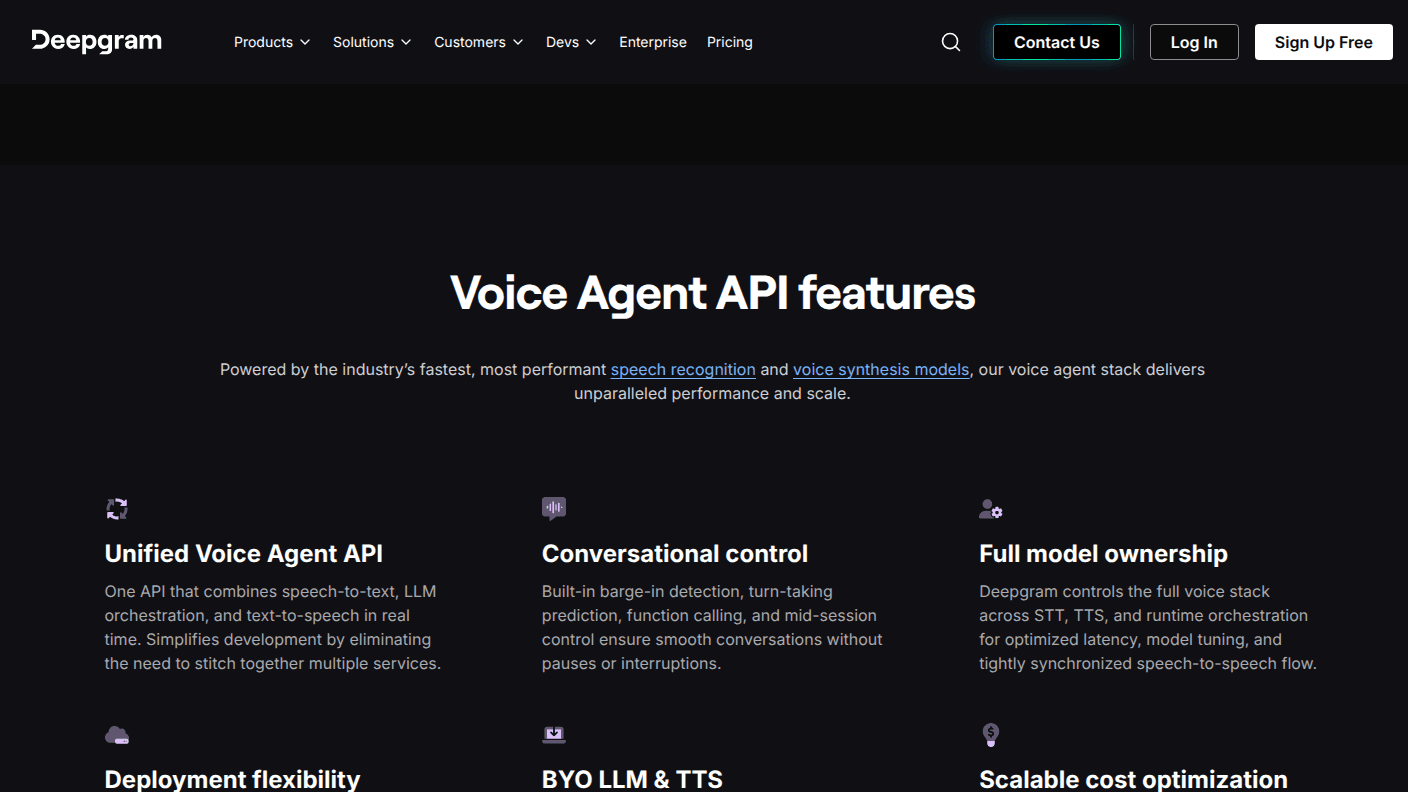
Deepgram fits teams that want one vendor for speech recognition, speech generation and agent orchestration, with usage-based API pricing.
Deepgram pricing
Deepgram pricing starts with a $200 credit. Current pay-as-you-go rates include:
- Aura-2 text to speech at $0.030 per 1,000 characters.
- Aura-1 text to speech at $0.015 per 1,000 characters.
- Standard Voice Agent API at $0.075 per minute.
- Standard Voice Agent API with bring-your-own TTS at $0.065 per minute.
- A configuration with bring-your-own LLM and TTS at $0.050 per minute.
Growth pricing is lower but starts with a $4,000 annual commitment. Telephony and external provider charges remain separate.
Deepgram tradeoffs
Deepgram is vertically integrated around its speech stack. That simplifies procurement and integration, but it also increases dependency on one vendor's speech models and runtime. Bring-your-own options reduce that dependency without removing the Deepgram orchestration layer. Test both the default stack and the exact provider combination you expect to run.
3. Cartesia: best for an audio-first, low-latency runtime
Cartesia Line is an audio-first voice-agent runtime built around Cartesia's Ink speech recognition and Sonic text-to-speech models. Developers can connect an LLM, own the reasoning logic in code and deploy agents to phone or WebSocket audio. The product also includes logs, evaluations, deployment versions and rollback.
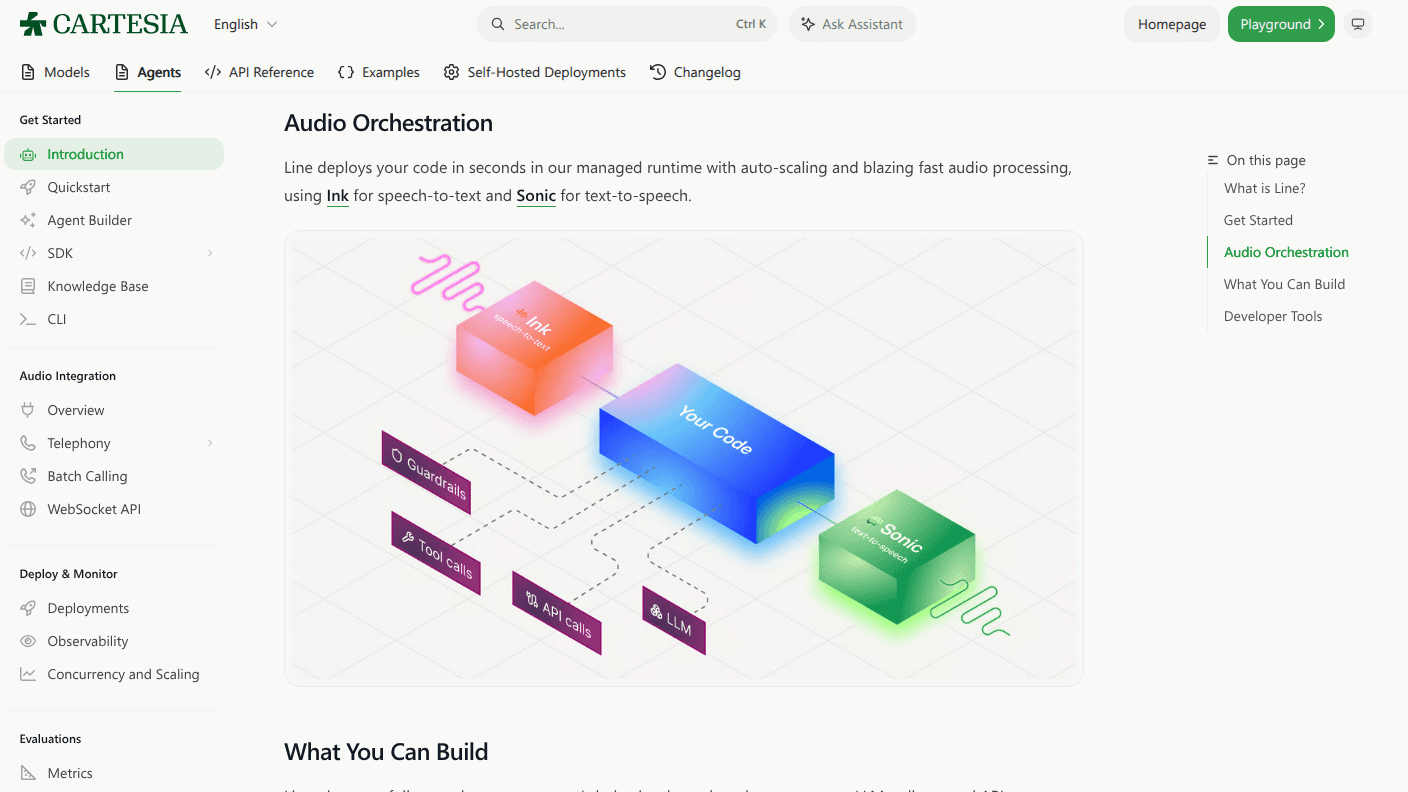
This is a strong fit when speech latency and an integrated real-time audio stack matter more than provider portability.
Cartesia pricing
Cartesia's current plans are Free at $0, Pro at $5 per month, Startup at $49, Scale at $299 and custom Enterprise pricing. Line agent calls cost $0.06 per minute across the self-serve tiers. A Cartesia-provided phone number adds $0.014 per minute.
Published concurrent-call limits are 8 on Free, 12 on Pro, 20 on Startup and 60 on Scale. The same plans include about 27, 133, 1,667 and 10,667 monthly Sonic-3.5 TTS minutes, respectively.
Cartesia tradeoffs
Line is structurally tied to Cartesia's speech models. That can deliver a coherent audio pipeline, but replacing the speech layer later involves more than changing an API key. Telephony support varies by setup, so confirm language, region, phone-number and concurrency requirements in the same pilot.
4. Resemble AI: best open-source ElevenLabs alternative for self-hosting
Resemble AI's Chatterbox models focus on text to speech, voice cloning and emotional control. The Chatterbox family includes multilingual and low-latency variants, with cloud, on-premises and air-gapped deployment options for enterprise buyers.
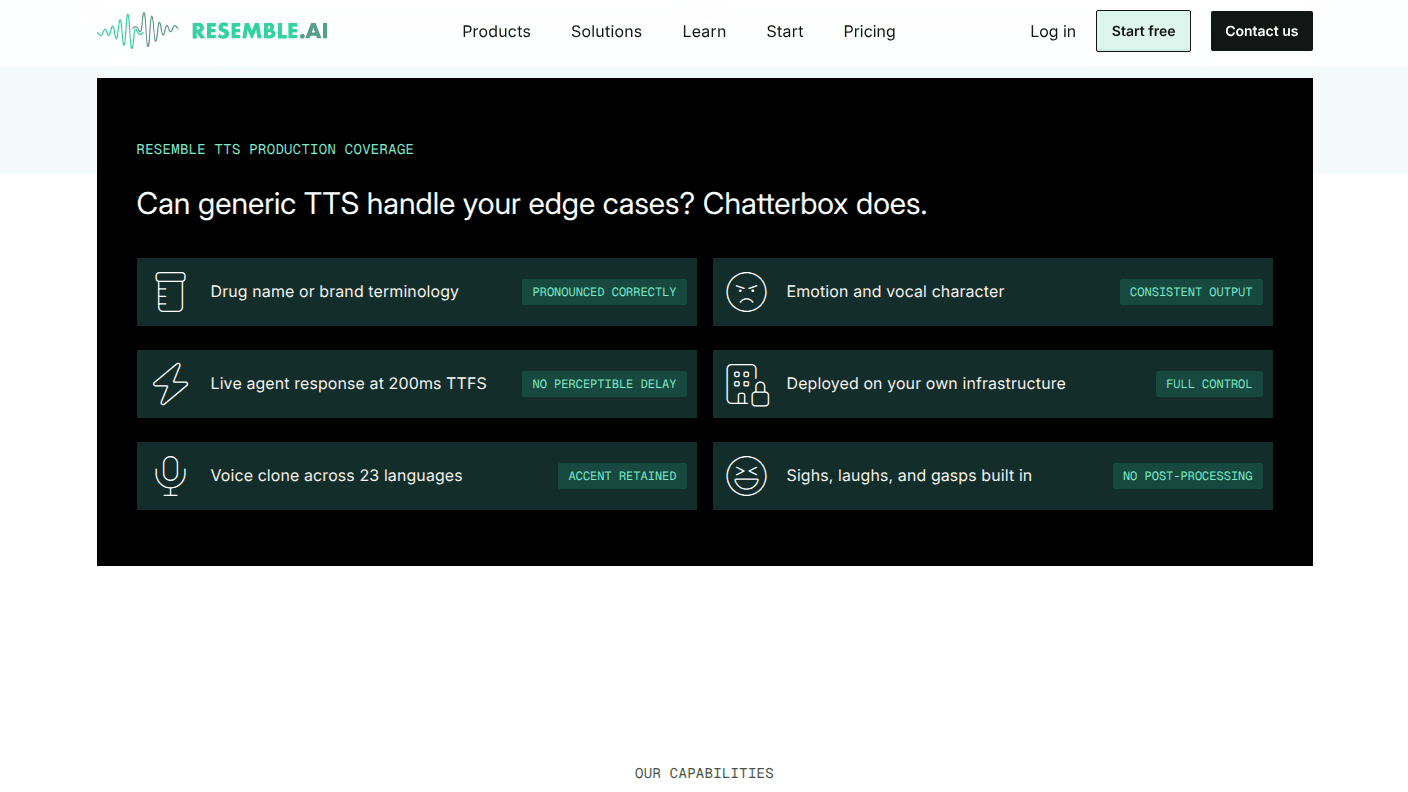
The Chatterbox code is available under the MIT license. That makes Resemble relevant to teams that need to inspect or self-host the voice-model layer, keep data inside a controlled environment or build a custom speech service.
Resemble AI pricing
The open-source Chatterbox software has no license fee, but self-hosting still requires GPU capacity, deployment, monitoring and maintenance. Managed voice and enterprise deployment pricing is sales-led, so do not use older Creator or Pro voice prices for current budgeting.
Resemble AI tradeoffs
Resemble AI replaces the speech and voice-cloning layer, not the full agent runtime. A production phone agent still needs speech recognition, an LLM, orchestration, telephony, logging and incident ownership. Choose self-hosting only if your team can own GPU deployment, monitoring, maintenance and incidents.
5. Murf: best for business voiceovers and a focused TTS API
Murf serves two related use cases. Murf Studio provides a creator workflow for voiceovers, pronunciation controls, stock media and integrations such as Canva and PowerPoint. Murf's Falcon 2 API provides streaming text to speech over HTTP or WebSocket for real-time applications.
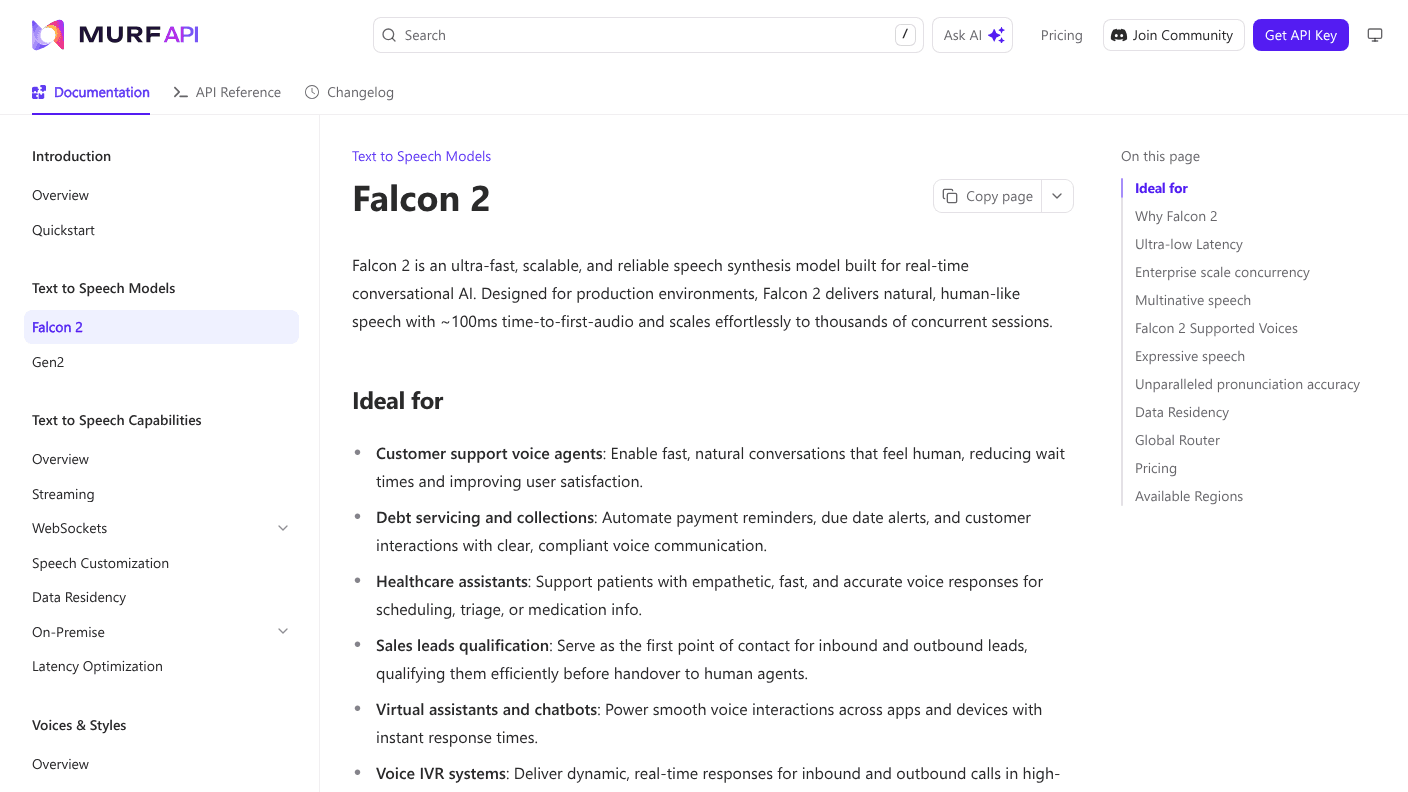
Murf's Falcon 2 documentation lists more than 150 voices across 35 languages, with multilingual and code-switching support. Murf fits teams that want to replace the speech layer or give a business content team a focused production interface.
Murf pricing
Murf Studio has a free plan with ten minutes of voice generation and no commercial rights. Paid annual plans start at $19 per month for Creator and $66 for Business. For developers, Murf API pricing lists conversational or streaming TTS at $0.01 per 1,000 characters and studio Gen2 TTS at $0.03 per 1,000 characters.
Murf tradeoffs
Murf's text-to-speech API is not a complete production voice-agent runtime. You still need speech recognition, LLM orchestration, telephony, tools and monitoring. Compare it to the ElevenLabs API or Creative workflow, not to the full ElevenAgents product.
Why Vocode and PlayAI are not current picks
Vocode appears in older ElevenLabs comparisons. Its open-source orchestration library connects speech-to-text, text-to-speech and LLM providers across telephony, web and other channels.
The Vocode core repository is MIT-licensed, but its last commit was November 15, 2024, and the project is seeking community maintainers. As of July 27, 2026, its hosted app and API endpoints were unavailable even though its hosted documentation still described a service.
Treat Vocode as a legacy framework to audit or fork, not a maintained hosted service. There is no software license fee, but your team would own provider costs, infrastructure, security updates and compatibility with changing third-party APIs.
PlayAI, formerly PlayHT, is also no longer available. Its official app displayed a shutdown notice during the July 27, 2026 review, and its public domains no longer resolved reliably. Remove it from current shortlists.
How to choose an ElevenLabs alternative
1. Compare the same product layer
Decide whether you are replacing a creator tool, a TTS API, voice cloning or a complete agent runtime. A lower per-character TTS price does not include agent orchestration. A per-minute agent price may exclude the LLM, carrier and phone number.
2. Model the total production cost
Use one realistic monthly scenario. Include paid plans, generated characters, retries, unused quota, call duration, silence rules, LLM tokens, telephony, concurrency, support and infrastructure. For open source, include engineering and on-call ownership.
3. Test the content that usually fails
Build a test set with product names, people and place names, dates, currencies, long numbers, abbreviations, accents, emotional passages and long-form scripts. Record how many generations need manual fixes and whether the output stays consistent across segments.
4. Measure the complete agent loop
For real-time voice, model latency is only one component. Measure end-to-end response time at the median and 95th percentile, barge-in, turn-taking, noisy calls, tool latency, reconnect behavior and concurrent load. Run the test in the regions and carriers you expect to use.
5. Check switching work before you commit
List which voices, prompts, tools, traces, phone numbers and provider contracts can move. A vendor that owns speech, orchestration and telephony can reduce integration work today but make a future switch broader. A modular stack preserves more choice but leaves your team with more seams to operate.
Which ElevenLabs alternative should you choose?
- ElevenLabs: choose it for expressive speech, cloning, a large voice library or a combined creator suite.
- Dasha: choose it for our managed production runtime with telephony integrations, tools, testing and call-level debugging.
- Deepgram: choose it for speech recognition, speech generation and agent orchestration from one vendor with usage-based pricing.
- Cartesia: choose it for an audio-first runtime built around Cartesia speech models.
- Resemble AI: choose it for open-source or self-hosted voice models and deployment control.
- Murf: choose it for business voiceovers or a focused streaming TTS API.
If you need a production voice-agent runtime rather than a standalone audio generator, build with Dasha's free Developer offer or compare Dasha pricing for your expected call volume.