Branded caller ID can help customers recognize a business before answering. Choosing the right service requires more than uploading a logo: you need authority to use the brand and numbers, a registration path, and realistic coverage expectations. For teams running outbound calls, including AI agents, the practical job is to connect approved identity data to the intended call path and measure what recipients actually see.
What is branded caller ID?
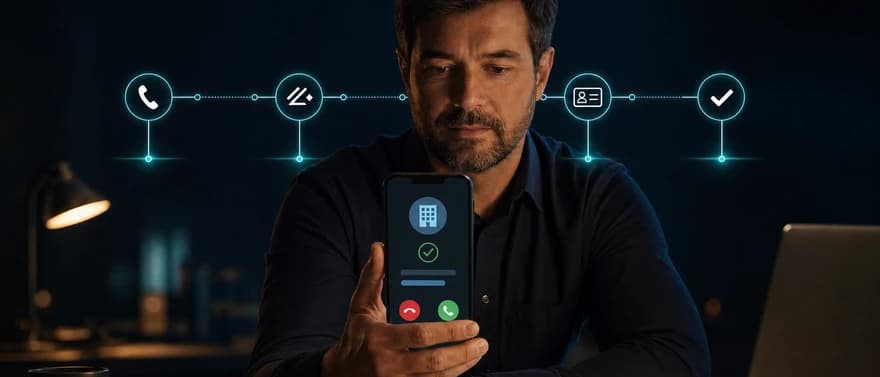
Branded caller ID is a service that presents vetted business information when a call arrives on a supported phone. The display can include a business name, logo, and call reason, depending on the service tier, network, and device.
The goal is recognition. A customer awaiting a delivery callback has more context when the incoming call identifies the delivery company. Branding does not guarantee a display, prevent a spam label, establish permission to call, or guarantee an answer-rate improvement.
A useful rollout separates three milestones:
- Registration approved: The business and requested brand data pass the provider's review.
- Number assigned: The authorized outbound number is associated with that approved identity and provisioned for use.
- Display observed: Calls through the production route show the expected fields on specific carrier and device combinations.
Completing the first milestone does not prove the other two.
Choose the identity presentation you need
Start with the information the recipient needs and the destinations you call. A recognizable name may be sufficient. A logo can add recognition on supported mobile devices. A call reason adds context only where it renders and accurately describes the call.
Keep these mechanisms separate:
| Mechanism | Purpose | Boundary |
|---|---|---|
| Calling-number presentation | Supplies the number and its presentation status | Does not establish a vetted business name or logo |
| Calling Name (CNAM) | Supplies a short caller-name lookup in parts of the North American telephone system | Name sources and display vary; it does not create rich mobile branding |
| Branded calling | Associates vetted business identity with authorized numbers | Available fields and reach depend on the service and receiving environment |
| Call authentication | Signs and validates assertions about a call's origin and the provider's relationship to its calling number | Does not certify the call's purpose or reputation |
| Rich Call Data (RCD) | Protects richer caller and call metadata cryptographically | Does not mandate a particular handset display |
For number selection, privacy states, and signaling, our calling line identification guide covers the separate caller-number presentation layer. Automatic Number Identification (ANI) is a distinct network service, not a synonym for the caller ID shown to a recipient.
CNAM remains a useful fallback, particularly for landlines. A branded-calling registration does not automatically correct every calling-name database, and changing a name in application configuration does not register a brand with carriers.
Authentication and richer identity have different jobs
Secure Telephone Identity Revisited and Signature-based Handling of Asserted information using toKENs (STIR/SHAKEN) supports call authentication. Full, or A, attestation means the originating provider knows the customer and has verified the customer's association with the calling number. Partial, or B, attestation lacks that verified number association. Gateway, or C, attestation identifies entry into the provider's network without that relationship to the original caller. These are authentication levels, not reputation scores.
Even an A-attested call can receive a warning. Authentication does not establish that the call's purpose is legitimate.
RCD adds integrity-protected metadata. RFC 9795 defines richer caller data and a separate crn claim for call reason, while leaving presentation behavior to receiving implementations. A signed logo or reason is therefore different from a rendered logo or reason.
Branded Calling ID (BCID) is one standards-based ecosystem using these building blocks. Its authorized partner roles distinguish onboarding, vetting, signing, originating, and terminating services. Commercial branded-calling services can use other delivery arrangements. Buying one service does not imply access to every ecosystem or carrier.
Prepare authorized business and number data
Create an identity inventory before submitting registrations. For each number, retain:
- the legal business, customer-facing brand, and tenant that use it;
- the number owner, originating provider, and evidence of permission to use it;
- the approved display name, logo version, and call purpose;
- the registration identifier, approval status, and number-assignment status;
- the production route and expected authentication behavior; and
- an operational owner for changes, incidents, and retirement.
The recognized brand and the legal entity may differ. Preserve the evidence connecting them rather than submitting whichever name is easiest to approve. Keep call reasons truthful and free of sensitive recipient information. An incoming-call screen may be visible to someone other than the intended recipient.
For a platform serving several businesses, use the provider's delegated customer or partner workflow. Each tenant needs an authorized brand-to-number relationship. Sharing one number across unrelated brands makes identity ambiguous and incidents harder to isolate.
Keep a stable number pool and record which routes may use it. Number authorization, authentication, and branding can have different provisioning requirements. A route change needs its own acceptance run even when the displayed number stays the same.
A concrete Twilio registration example
Twilio provides a useful example of why product tiers need separate treatment. Its U.S. branded-calling tiers have different status and prerequisites:
| U.S. tier | Intended presentation | Status | Listed networks |
|---|---|---|---|
| Basic | Business name | Public beta | T-Mobile, Verizon |
| Enhanced | Business name, logo, and call reason where supported | Generally available | T-Mobile, Verizon |
General availability applies to U.S. Enhanced, not every U.S. tier. The listed networks also do not imply identical support across their devices, plans, or resellers.
Meet the prerequisites for the selected tier
U.S. Basic requires purchased Twilio numbers, an approved primary or secondary Business Profile, and an approved Voice Integrity instance. The numbers must be registered with both the profile and Voice Integrity. Prepare the use-case description and establish legal authority to use the display name. The Basic registration requirements are separate from Enhanced eligibility.
U.S. Enhanced requires purchased Twilio numbers, an approved primary Business Profile with an Employer Identification Number (EIN), and SHAKEN/STIR enabled for the numbers. Voice Integrity is recommended, rather than required. Prepare the display name, hosted logo, call reason, business details, and signed Letter of Authorization (LOA).
Submit the registration and assign numbers
For a business registering its own outbound calls, the Trust Hub registration flow starts in Communications > Trust Hub > Registrations:
- Open Branded calling and select Create registration.
- Select the destination country, U.S. tier, use case, and whether you are a direct customer or a software vendor, reseller, or partner.
- Select the approved business profile and provide the brand contact, use-case explanation, and display information.
- Sign and supply the LOA, accept the terms, and submit for review.
- Assign the intended numbers during registration or after approval. Retain the bundle and number-assignment records separately.
In Basic, one bundle has one display name and one or more numbers; each number can belong to only one branded-calling bundle. Plan tenant and brand boundaries accordingly.
For Enhanced troubleshooting, an Approved bundle and a number assigned in the Branded state are distinct checks. Neither is proof of handset rendering. Keep the registration status, assignment status, and destination observations as separate fields in your rollout record.
Understand the limits of carrier and device coverage
Enhanced branding can arrive as name only, name plus logo, or name plus logo and reason. Twilio's Enhanced coverage requirements include device software, settings, and carrier-specific limits. Call reason does not render on iOS. Some Verizon plans and bring-your-own-device paths receive only the name, and a Verizon Call Filter risk label can take precedence over branded information.
Coverage therefore needs more detail than a carrier logo on a sales page. Define the expected result for:
- destination country, carrier, and reseller network;
- handset model, operating-system version, and carrier-supplied or unlocked device;
- enabled carrier-identification and call-protection settings;
- plan restrictions, mobile-data availability, and dual-SIM behavior;
- the originating route, including failover; and
- contacts and third-party screening apps that may replace the normal display.
A service may meet your needs with broad name coverage and narrower logo coverage. It may be a poor fit if your workflow depends on a reason field that most recipients cannot see. The agent's spoken opening must establish the business and purpose without relying on any screen element.
Run a carrier and device acceptance plan
Use consenting test recipients and the actual production number and route. Start with unknown-number states so a saved contact cannot masquerade as successful branding. Add saved-contact and screening-app cases separately where they matter to your audience.
Build the matrix around expected fields
Include supported iOS and Android combinations on each material destination network. Add a landline for the CNAM fallback, reseller or unlocked-device cases, and at least one unsupported combination to observe the fallback. Repeat the important cells through any backup route.
For every call, capture the timestamp, application and carrier call identifiers, outbound number, tenant, route, available authentication result, destination network, device, software, settings, and plan. Record name, logo, reason, verification indicator, and risk label separately. Keep screenshots with their test records. One screenshot establishes one observation, not fleet coverage.
Mark each expected field as observed, missing, wrong, or unsupported. Missing data must not disappear from the denominator. A correct name with an unsupported logo is a different result from a stale name or a failed call setup.
Set measurable release criteria
Define acceptance before the first pilot. A practical release gate requires:
- every required matrix cell completed, with repeat calls in separate time windows;
- zero wrong-brand or wrong-number observations;
- each promised field observed on the combinations included in the launch scope;
- unsupported fields and fallbacks explicitly recorded;
- no unexplained authentication downgrade or new risk label; and
- call setup, opt-outs, and complaints within the campaign's pre-agreed limits.
Restrict the launch scope when a required cell fails. Do not convert a partially successful matrix into an “all carriers supported” claim.
Measure field delivery as observations showing the expected field divided by completed observations in eligible cells. Also report test coverage as completed required cells divided by all required cells. A high delivery rate from a small, favorable sample cannot replace test coverage. Provider delivery events, where available, complement handset evidence; they do not establish every field's appearance.
Ramp one stable number pool and a bounded traffic cohort. Set volume caps and a rollback owner. Pause the affected campaign or isolate a number when identity is wrong, a route regresses, or complaint limits are exceeded. Repeat the matrix after material changes to brand assets, numbers, routes, carrier support, or device software.
Keep reputation and answer rates separate from branding
Registration supplies identity data. Reputation systems still evaluate calls independently. Keep consent and suppression decisions close to dialing, honor opt-outs across retries, cap attempts, and investigate dead air, short calls, and complaints.
The Free Caller Registry is a separate own-behalf business-number registration path. It does not deliver CNAM, guarantee label removal, or replace reputation monitoring. Platforms registering other businesses must use the call-protection providers' appropriate workflows.
When a warning appears, identify the carrier, device, app, number, and time window. Compare routing and authentication changes with campaign behavior, then take an accurate case to the relevant provider. Buying richer branding or rotating numbers is not a substitute for fixing the cause.
Track answer rate as answered calls divided by completed call setups, with the same audience eligibility and retry rules. Use a controlled comparison that holds timing, call purpose, list quality, and agent behavior stable. Improved answers do not prove that branding rendered, and successful rendering does not guarantee improved answers.
Where Dasha fits in an outbound AI deployment
We help technical teams build and run production voice AI agents through a managed runtime, REST APIs, and a web application. Caller identity remains a separate carrier-side responsibility.
Our phone-number configuration supports connecting a Twilio account and importing numbers, or configuring Session Initiation Protocol (SIP) credentials. An agent uses a linked outbound number, and calls can be scheduled through the API. Connecting that number to Dasha does not provision a branded-calling registration or establish that a carrier's branding service supports the resulting route. Our bring-your-own-carrier guide explains the wider operating boundary.
Use the authorized, assigned number for the pilot agent and attach tenant, campaign, and test-cohort identifiers to the call's additionalData. Join those records to the carrier and handset observations in your own reporting. Our Call Inspector exposes completed-call transcripts, recordings, model interactions, tool executions, and timeline events. Those records help investigate what happened after connection; they are not handset-display confirmation.
We do not guarantee downstream branding or remove carrier spam labels. Keep business vetting, number assignment, display acceptance, and campaign policy with named owners alongside the agent rollout.
For a production outbound AI workflow, evaluate Dasha with one authorized number, a representative carrier and device matrix, and measurable release criteria.