The best SIP trunk provider for voice AI depends on how you plan to run calls. Twilio is the lowest-friction default for broad self-service coverage. Telnyx is a strong fit when you want a carrier-owned network and detailed voice controls. Bandwidth suits larger enterprise programs, while Plivo, DIDWW, SIP.US, and Amazon Chime SDK Voice Connector each fit a more specific operating model.
Do not choose on per-minute rates alone. A voice AI deployment also depends on calls per second, concurrent-call capacity, media routing, number reputation, transfer behavior, failover, and the work required to change carriers later.
SIP trunk provider comparison
| Provider | Best for | Pricing approach | Voice AI advantage | Main constraint to check |
|---|---|---|---|---|
| Twilio | Fast setup and broad self-service coverage | Pay as you go or committed use | Automatic setup in Dasha, mature SIP controls, secure trunking | Outbound calls-per-second limit is separate from concurrency |
| Telnyx | Teams that want a licensed carrier and voice tooling together | Pay as you go or volume commitment | Carrier-owned network, caller identity tools, HD codecs | Route, country, and optional feature support varies |
| Bandwidth | High-volume enterprise and contact-center deployments | Custom, usage-based pricing | Owned network, enterprise porting, emergency calling, IP failover | Expert-led pricing and activation rather than instant self-service |
| Plivo Zentrunk | Self-service international calling with clear SIP controls | Usage based, with Enterprise CPS upgrades | Seven global signaling and media regions, TLS/SRTP, SIP REFER | Two outbound call starts per second per account by default; separate inbound and outbound trunks |
| DIDWW | International numbers and local telephony presence | Pay as you grow, with route-specific pricing | Broad termination coverage, local dialing, TLS/SRTP | Availability and regulatory requirements differ by country |
| SIP.US | Predictable channel pricing in US48 and most of Canada | Fixed monthly price per channel | Simple self-service model and included calling to US48 and most of Canada | One channel per concurrent call makes burst sizing important |
| Amazon Chime SDK Voice Connector | AWS-centered infrastructure teams | Pay per use | Cross-Region failover for inbound PSTN calls and Kinesis audio streaming | Outbound calling originates in the US or Canada; more AWS setup |
No provider wins every route, and this list is not a call-quality benchmark. Carrier performance changes by destination, time, and network path. Test finalists with your own traffic before signing a production commitment.
What a SIP trunk provider does in a voice AI stack
A Session Initiation Protocol (SIP) trunk connects an internet-based voice system to the public switched telephone network (PSTN). The provider supplies carrier connectivity, phone numbers, routing, and related services. Your voice AI API or runtime handles the conversation, models, tools, and application behavior.
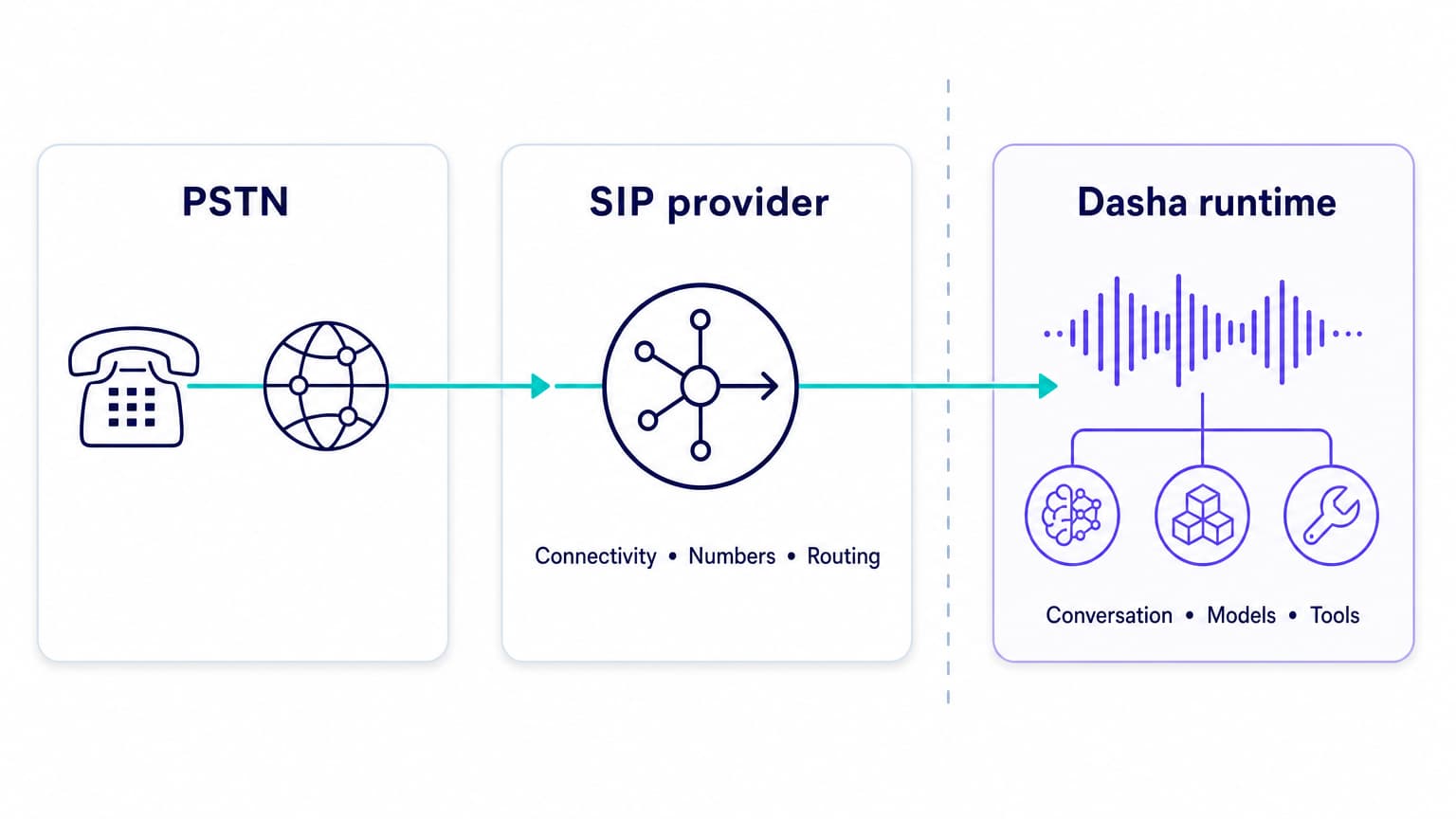
A bring-your-own-carrier (BYOC) model keeps those layers separate and gives you options. You can change the agent runtime without immediately porting every phone number, or move carriers without rebuilding the agent. A bundled carrier-and-agent product may simplify setup, but a later switch can require changes at both layers.
Dasha supports automatic Twilio setup plus manual carrier configuration. The current phone-number setup can create the Twilio SIP trunk and credentials, then import numbers. Manual setup requires the carrier's SIP server and a phone number. Authentication, UDP/TCP/TLS transport, registration, and calls-per-second settings must match the carrier's requirements, as described in our SIP configuration. You can then link the number to an agent for inbound or outbound calls.
1. Twilio: best overall for fast, flexible setup
Twilio Elastic SIP Trunking is the easiest starting point for many Dasha teams. Dasha can connect a Twilio account, create the trunk and credentials, and import numbers without a manual carrier configuration. Twilio also combines self-service provisioning with phone-number inventory, secure trunking, call recording, SIP REFER transfers, emergency calling, and localized SIP endpoints.
The service uses pay-as-you-go pricing with no channel fees, and Twilio says it can provision service in 100 countries. TLS protects SIP signaling, while Secure Real-time Transport Protocol (SRTP) protects media when secure trunking is enabled. See the Twilio SIP trunking documentation for the current protocol and routing options.
Best fit: Technical teams that want to launch quickly, operate across several countries, or already use Twilio numbers and messaging.
Watch-outs: Unlimited concurrent calls do not mean unlimited outbound call starts. Twilio's scale and limits page lists one termination call per second by default and a self-service increase to five, subject to account and carrier conditions. Higher limits require coordination. Confirm calls per second, verified caller-ID rules, number availability, and country-specific pricing before a campaign.
2. Telnyx: best for carrier control and voice operations
Telnyx is a licensed carrier that runs SIP traffic on its own network rather than reselling another carrier's capacity. That model can reduce the number of parties involved in routing and incident resolution. Its SIP product also includes wideband codecs, A-level STIR/SHAKEN attestation, branded calling, caller-name management, and number-reputation tooling.
Telnyx offers pay-as-you-go and volume pricing. Its SIP trunking pricing varies by call direction, destination, number type, and optional feature, so model the actual routes instead of multiplying one advertised starting rate by total minutes.
Best fit: Teams that want carrier infrastructure, phone-number management, caller identity, and programmable voice services under one account.
Watch-outs: Telnyx also offers its own voice AI agent layer. Bundling the runtime and carrier can be useful, but it couples two architecture decisions. Used as the SIP carrier for Dasha, the runtime remains separate. Whichever model you choose, verify media encryption, regional routing, outbound CPS, emergency calling, and support terms for every operating country.
3. Bandwidth: best for high-volume enterprise programs
Bandwidth is a strong choice for enterprises that value direct carrier relationships, planned number migrations, and expert-led activation. Its SIP trunking service runs on an owned-and-operated network and includes IP failover controls, emergency calling, self-service number management, and an implementation team for migration and porting.
Bandwidth lists more than 40 countries with full-stack PSTN replacement, more than 65 with PSTN interconnects, eight geo-redundant data centers, and 99.999% core-network uptime. These figures describe the provider's network scope; your application service level still depends on the complete path through the carrier, internet or private interconnect, Dasha, models, tools, and downstream systems.
Best fit: Large US or multinational deployments that need enterprise porting, emergency-service support, direct carrier accountability, and guided activation.
Watch-outs: Bandwidth SIP trunk pricing is custom and usage based. Its SIP trunking experts guide pricing, coverage, and activation rather than offering instant self-service setup. Put CPS, concurrent calls, failover behavior, support response, service-level scope, number reputation, and route pricing into the commercial evaluation. It is less suitable when a small team needs to create an account and place a production test call immediately.
4. Plivo Zentrunk: best for self-service global SIP control
Plivo Zentrunk combines self-service SIP provisioning with a useful set of technical controls. Inbound numbers are available in supported markets, while outbound calling reaches more than 190 countries. Its multi-region infrastructure lists seven signaling and media regions: North California, Virginia, Frankfurt, São Paulo, Sydney, Singapore, and India. The service also supports TLS 1.2 and 1.3 for signaling, SRTP for media, SIP REFER for transfers, and PCMU and PCMA codecs. Inbound trunks can use a fallback URI.
There is no minimum spend or long-term contract for the standard usage model. Outbound trunks include unlimited concurrent-call capability, while inbound numbers also support concurrent calls without a channel fee.
Best fit: Developers who want a pay-per-use trunk, international reach, and explicit SIP configuration without a sales-led procurement process.
Watch-outs: Plivo documents a default account limit of two outbound call starts per second. You can allocate that account-level pool across trunks, but accepted starts across all trunks cannot exceed the account limit. Higher account-level CPS is available on the Enterprise plan. Inbound and outbound trunks are separate, which is manageable but adds configuration. Review the full Zentrunk limits and security documentation before load testing.
5. DIDWW: best for international numbers and local presence
DIDWW focuses on global phone numbers, local dialing, and SIP termination. Its service covers termination in 241 countries and regions. It also lists compliant two-way SIP trunking in 93 countries, free number porting, TLS/SRTP, emergency calling, and unlimited concurrent channels for outbound trunks.
This is useful when an AI agent must present a local number, receive calls in several markets, or maintain one carrier relationship across a wide geographic footprint. DIDWW's self-service portal and API cover number and trunk management, and DIDWW offers separate local and international termination options.
Best fit: International deployments where number inventory, local dialing, and route-specific regulatory support matter more than a bundled application platform.
Watch-outs: Broad termination coverage does not mean that every number type, local caller ID, emergency service, or two-way route is available everywhere. Check the DIDWW coverage and pricing for each country. Its 99.998% figure applies to network uptime, not the end-to-end voice AI application.
6. SIP.US: best for predictable channel pricing in US48 and most of Canada
SIP.US uses a traditional channel model instead of purely metered voice. Its month-to-month plan costs $24.95 per channel, with a $19.99 annual-plan rate. Each channel includes inbound local calling and outbound calling to the 48 contiguous US states (US48) and most of Canada, subject to exclusions and pass-through fees.
The service is self-managed through a web portal and includes phone-number provisioning, call records, caller-name controls, fraud monitoring, and a network built from redundant Tier-1 upstream providers.
Best fit: Stable workloads in US48 and most of Canada where call volume is consistent and a predictable monthly channel cost is more useful than per-minute billing.
Watch-outs: One channel supports one concurrent call. A voice AI campaign with 100 simultaneous calls therefore needs 100 channels, even if those calls last only a few minutes. This model can be economical for steady traffic and inefficient for sharp bursts. Check overage, toll-free, enhanced 911, number, tax, and fee treatment in the current SIP.US price sheet.
7. Amazon Chime SDK Voice Connector: best for AWS-centered operations
Amazon Chime SDK Voice Connector is a pay-per-use SIP trunking service for inbound, outbound, or two-way calling. It provides direct inward dial (DID) and toll-free numbers, bills connected calls in six-second increments, and scales without pre-purchased channels. For inbound PSTN calls, Voice Connector groups can combine connectors in different AWS Regions and reroute an incoming call when an availability event affects one Region. The groups do not provide cross-Region failover for outbound calls.
AWS can also stream Voice Connector or SIPREC audio into Amazon Kinesis Video Streams. That is useful when an existing AWS operations team needs a controlled audio path for analytics or recording workflows, although it adds AWS services and costs to the design.
Best fit: Teams that already operate deeply in AWS and want regional telephony controls, infrastructure-as-code workflows, or Kinesis-based audio processing.
Watch-outs: AWS pricing documentation says outbound Voice Connector calls originate in the United States or Canada, and international restrictions apply. Phone-number availability is narrower than a global number specialist. Budget for AWS configuration, monitoring, Kinesis processing, and support in addition to call minutes.
How to choose a SIP trunk provider for voice AI
Separate calls per second from concurrent calls
Concurrency is the number of active calls. Calls per second (CPS) is the rate at which new calls can start. A provider can advertise unlimited concurrency and still accept only one or two new outbound calls each second.
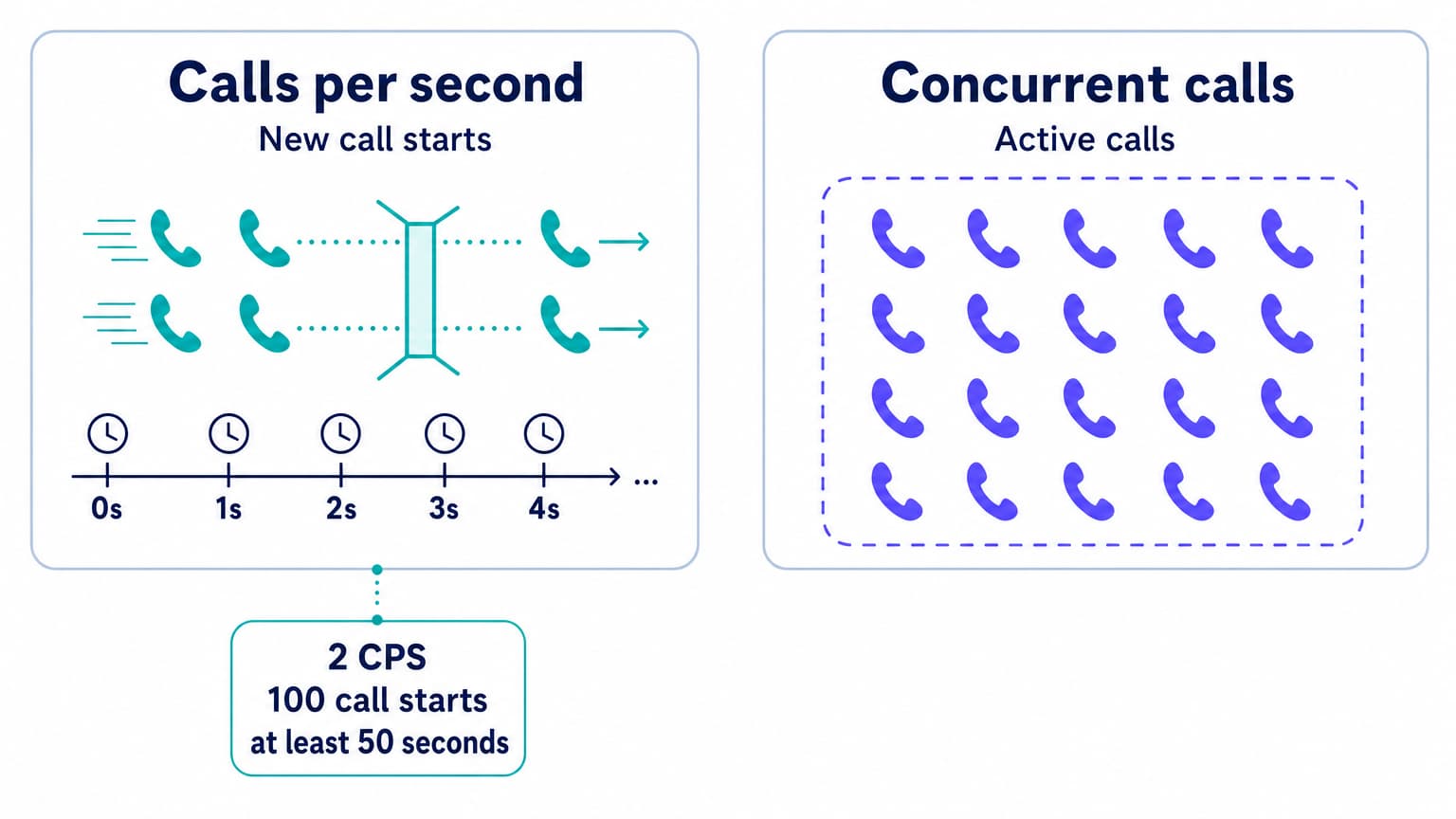
This distinction matters for campaigns and recovery after an outage. At two CPS, starting 100 calls takes at least 50 seconds before retries or carrier throttling. Set Dasha's cpsLimit at or below the contracted carrier limit, and use a shared cpsKey when several trunks draw from the same allowance.
Test the complete media path
SIP signaling establishes and controls the call. Real-time Transport Protocol (RTP) carries the audio. Ask where both paths enter the provider network, which codecs are supported, and whether you can select a regional point of presence.
Do not turn a provider's network-latency statement into an end-to-end agent claim. Measure caller-audible response time on the same routes, destinations, prompts, models, and tools you will use in production. Include median, P95, and P99 results, plus jitter, packet loss, and one-way-audio failures.
Verify signaling and media security separately
Transport Layer Security (TLS) encrypts SIP signaling. SRTP encrypts the audio. A TLS trunk can still carry unencrypted RTP if media security is not enabled and negotiated on both sides.
Dasha's manual SIP configuration supports TLS signaling. Confirm the provider's cipher, certificate, port, and SRTP requirements, then inspect a test call rather than assuming the entire path is encrypted. If protected or regulated data is involved, map recording, transcript, log, and retention controls separately from transport encryption.
Evaluate caller identity and reputation
US outbound programs should evaluate STIR/SHAKEN attestation, caller-name registration, branded calling, number reputation, spam-label remediation, and verified caller-ID rules. These features can affect answer rates, but no carrier feature makes an automated calling program lawful by itself.
Your organization remains responsible for consent, suppression lists, calling windows, disclosure, recording, and destination-specific rules. Get legal review for the countries and use cases you plan to serve.
Make transfers and failover part of the design
If the agent transfers calls to people, verify SIP REFER support, caller-ID preservation, context handoff, and what happens when the destination does not answer. Some systems bridge both call legs instead of handing the call off, which changes cost and capacity.
For resilience, test multiple origination targets, provider or Region failure, DNS behavior, retry timing, and active-call treatment. A redundant carrier network does not protect you from a bad credential, misconfigured route, expired certificate, or application outage.
Compare total cost per successful outcome
Build the model from more than advertised voice minutes:
- inbound and outbound route charges;
- phone-number rental and porting;
- channel or concurrent-call fees;
- CPS upgrades or capacity commitments;
- recording and storage;
- emergency calling and regulatory fees;
- private connectivity, support, and minimum spend;
- transfer legs and failed or short-call billing;
- number reputation and branded-calling services.
Then divide the complete cost by successful outcomes, not attempted calls. The cheapest minute can be expensive if poor routing, throttling, or spam labeling reduces completion.
Run a production pilot before choosing
Use the same test for every finalist:
- Fix the workload. Use the same Dasha agent, model, voice, tools, caller IDs, destinations, and traffic pattern.
- Test inbound and outbound separately. Measure setup success, post-dial delay, answer rate, call quality, and caller-ID presentation.
- Load-test CPS and concurrency. Increase call starts gradually, record every accepted, queued, rejected, and failed attempt, and confirm the contracted limits.
- Break the route. Disable the primary target, fail a dependency, and confirm retries, fallback, active-call behavior, and alerts.
- Test transfers. Include answered, rejected, busy, no-answer, and voicemail outcomes. Confirm context and caller identity survive the handoff.
- Reconcile evidence and billing. Match Dasha traces, carrier call-detail records, recordings, and invoices for the same calls.
A useful pilot is narrow enough to diagnose and realistic enough to fail. Extend it into a full voice AI reliability plan before production traffic.
Which SIP trunk provider should you choose?
- Choose Twilio when setup speed, self-service global reach, and Dasha's automatic integration matter most.
- Choose Telnyx when you want carrier ownership, caller-identity tooling, and granular voice controls.
- Choose Bandwidth for a large enterprise migration that needs direct carrier accountability and expert-led activation.
- Choose Plivo Zentrunk for self-service international termination with clear SIP security and routing controls.
- Choose DIDWW when international number inventory and local dialing are the main requirements.
- Choose SIP.US when traffic in US48 and most of Canada is steady enough to benefit from fixed per-channel pricing.
- Choose Amazon Chime SDK Voice Connector when the telephony layer must fit an existing AWS operating model.
For many teams, the right answer is two carriers rather than one. A primary and a genuinely independent backup can reduce carrier concentration risk, but only if routing, credentials, numbers, capacity, monitoring, and failover are tested regularly.
Frequently asked questions
Which SIP trunk providers work with Dasha?
Dasha supports automatic Twilio setup plus manual carrier configuration. Manual setup requires the carrier's SIP server and a phone number. Configure authentication, UDP/TCP/TLS transport, registration, and CPS limits as the carrier requires, then link the number to an agent. Complete an inbound, outbound, transfer, and failover test before treating a provider as production-compatible.
Is a SIP trunk the same as a voice API?
No. A SIP trunk connects a voice system to carriers and the PSTN. A voice API or agent runtime controls the application, conversation, models, tools, and events. Some companies sell both, but they remain separate architecture layers with different pricing, reliability, and switching considerations.
How many SIP channels does a voice AI agent need?
With channel-based pricing, you generally need one channel per simultaneous call leg. A transferred or bridged call may consume more than one leg. Elastic providers often remove channel fees, but concurrent-call and CPS limits still apply. Size for peak traffic, transfers, retries, and failover rather than average minutes.
Does TLS make a SIP trunk secure?
TLS protects SIP signaling, not necessarily the audio. SRTP protects the media stream. You need compatible configuration on both sides, plus separate controls for recordings, transcripts, credentials, logs, retention, and access. Test negotiation and data flows end to end.
Keep the carrier and runtime decisions explicit
The carrier that is easiest for a prototype may not be the best provider for production routes, and the cheapest rate may not produce the lowest cost per successful call. Shortlist providers by operating model, test them with the same Dasha workload, and put capacity, routing, security, support, and exit terms in writing.
Evaluate Dasha's production voice AI platform, or use the current SIP setup guide to connect a carrier and run your first test.