
There is no single best voice AI API for every product. The right choice depends on which layers you want a vendor to run. We recommend Dasha for technical teams that want a managed production runtime with API control. Vapi is strong for hosted provider flexibility, Retell AI for integrated phone operations, ElevenAgents for voice selection, OpenAI Realtime for OpenAI-native speech-to-speech apps, Deepgram for a unified speech pipeline, and LiveKit for open-source control.
That distinction matters. A complete voice-agent API can manage the conversation loop, tools, telephony, and production operations. A speech-to-text (STT) or text-to-speech (TTS) API handles one component. Treating them as interchangeable produces a misleading comparison.
Best voice AI APIs at a glance
We compared each option on the things that affect a real deployment: turn-taking and interruptions, tool calling, phone and web connectivity, model and voice choice, observability, deployment control, safeguards, scale, and total cost.
| API or platform | What it is | Best for | Phone and web path | Control and deployment | Pricing model |
|---|---|---|---|---|---|
| Dasha | Managed voice-agent runtime and API | Technical teams building production voice products | SIP and bring your own carrier (BYOC); WebRTC for browser voice | Managed runtime with provider and integration control | Free developer allowance; usage rate excludes telephony and model tokens |
| Vapi | Hosted modular voice-agent platform | Broad hosted STT, model, voice, and carrier choice | Phone, SIP, browser SDK, WebSocket transport | Hosted orchestration with bring-your-own provider options | Hosting plus transport and provider usage |
| Retell AI | Hosted voice and chat agent platform | Integrated phone operations and live supervision | Managed numbers, SIP, and web calls | Hosted platform with customer telephony and model options | Componentized per-minute range plus add-ons |
| ElevenAgents | Managed omnichannel agent platform | Voice selection across phone, web, and mobile | SIP, Twilio, WebRTC, and native SDKs | Managed cloud with supported or custom language models | Included minutes, overage, model usage, and carrier costs |
| OpenAI Realtime API | Real-time multimodal model API | OpenAI-native speech-to-speech products | WebRTC, WebSocket, and SIP | OpenAI models; your team runs the surrounding application | Audio and text token usage |
| Deepgram Voice Agent API | Single-connection speech and agent pipeline | One WebSocket for listening, thinking, and speaking | WebSocket with telephony integration guides | Deepgram STT with configurable model and TTS options | Connection time plus external services where used |
| LiveKit Agents | Open-source agent framework plus managed cloud | Custom media, multimodal, and deployment control | WebRTC and SIP | Self-hosted or LiveKit Cloud; broad provider plugins | Itemized Cloud usage or self-hosted infrastructure |
Prices and catalogs change frequently. Use the linked pricing pages to model your exact configuration before making a decision.
What counts as a voice AI API?
A managed voice-agent API runs most of the live conversation path: audio streaming, turn detection, model orchestration, tool calls, phone or web transport, session state, and operational telemetry. Dasha, Vapi, Retell AI, and ElevenAgents fit this category. Deepgram's Voice Agent API also packages the speech pipeline behind one connection, with a narrower provider boundary.
A real-time model API accepts live audio, reasons, speaks, and may call tools. OpenAI Realtime fits here. It can connect over WebRTC, WebSocket, or SIP, but your application still owns the wider call lifecycle, business workflow, deployment, and production operations.
An open agent framework supplies code and abstractions for media, turn-taking, tools, and model plugins. LiveKit Agents can run in your environment or on LiveKit Cloud. That gives you more control, but it also gives your team more infrastructure and on-call work.
Component APIs solve one layer. STT services transcribe audio. TTS services synthesize audio. A component stack still needs endpointing, interruption handling, conversation state, model orchestration, tools, telephony or WebRTC, monitoring, retries, and deployment. Component APIs are the right answer when you need a specialized speech layer, but they are not drop-in substitutes for an agent runtime.
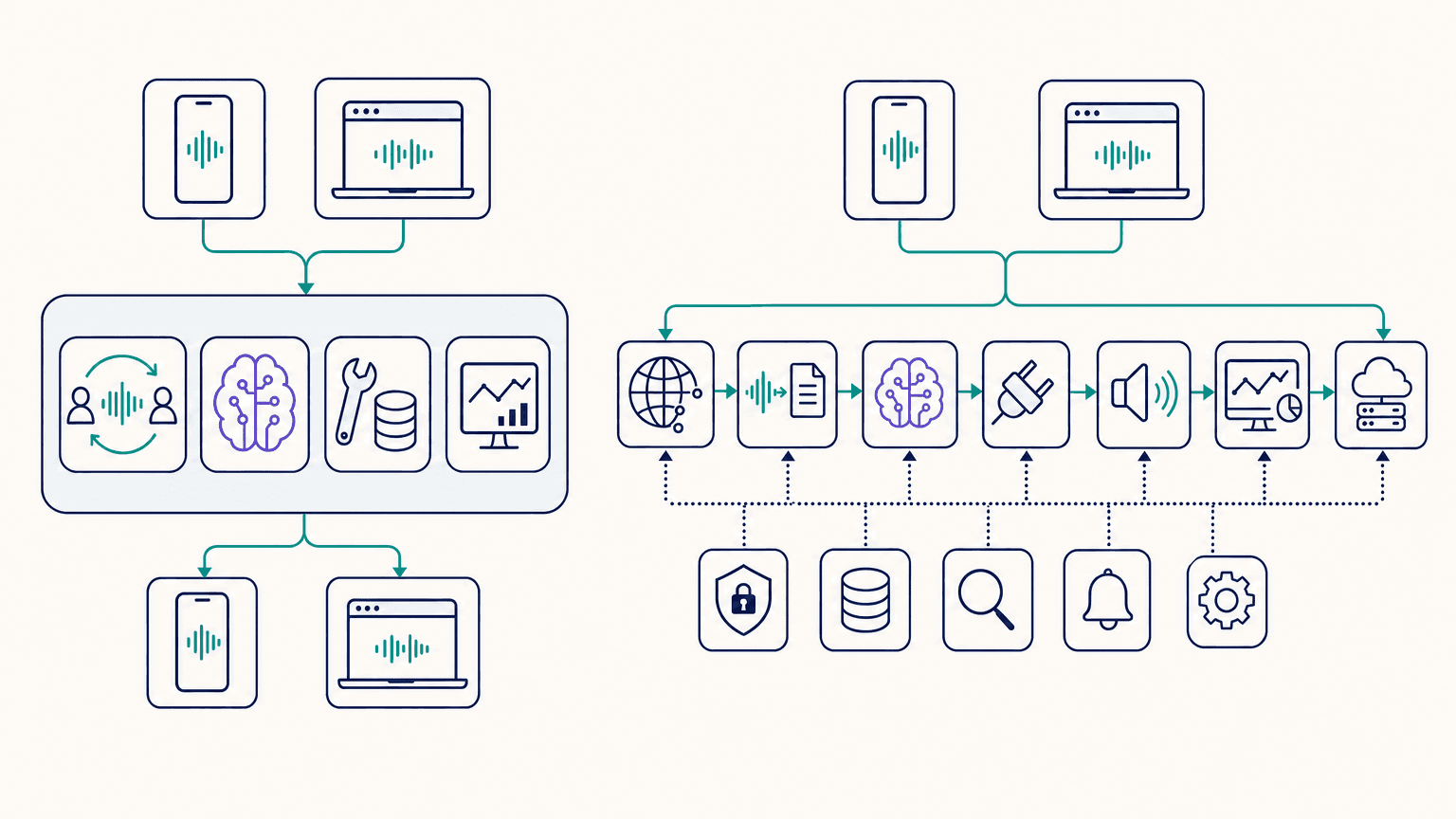
1. Dasha: best for a managed production runtime with API control
Best for: Technical teams building production voice AI products without wanting to assemble and operate every runtime layer.
We built Dasha as a managed production platform with a voice-agent runtime, REST APIs, and a web application. You can connect business tools, choose model and voice providers, test conversations, run calls through Session Initiation Protocol (SIP), and inspect production activity without owning the real-time infrastructure underneath it.
Our bring-your-own-carrier documentation covers inbound and outbound SIP connections, so teams can preserve an existing carrier or private branch exchange. Browser voice uses WebRTC with WebSocket signaling. That range is useful for multitenant products and migrations where telephony cannot be replaced with the agent platform.
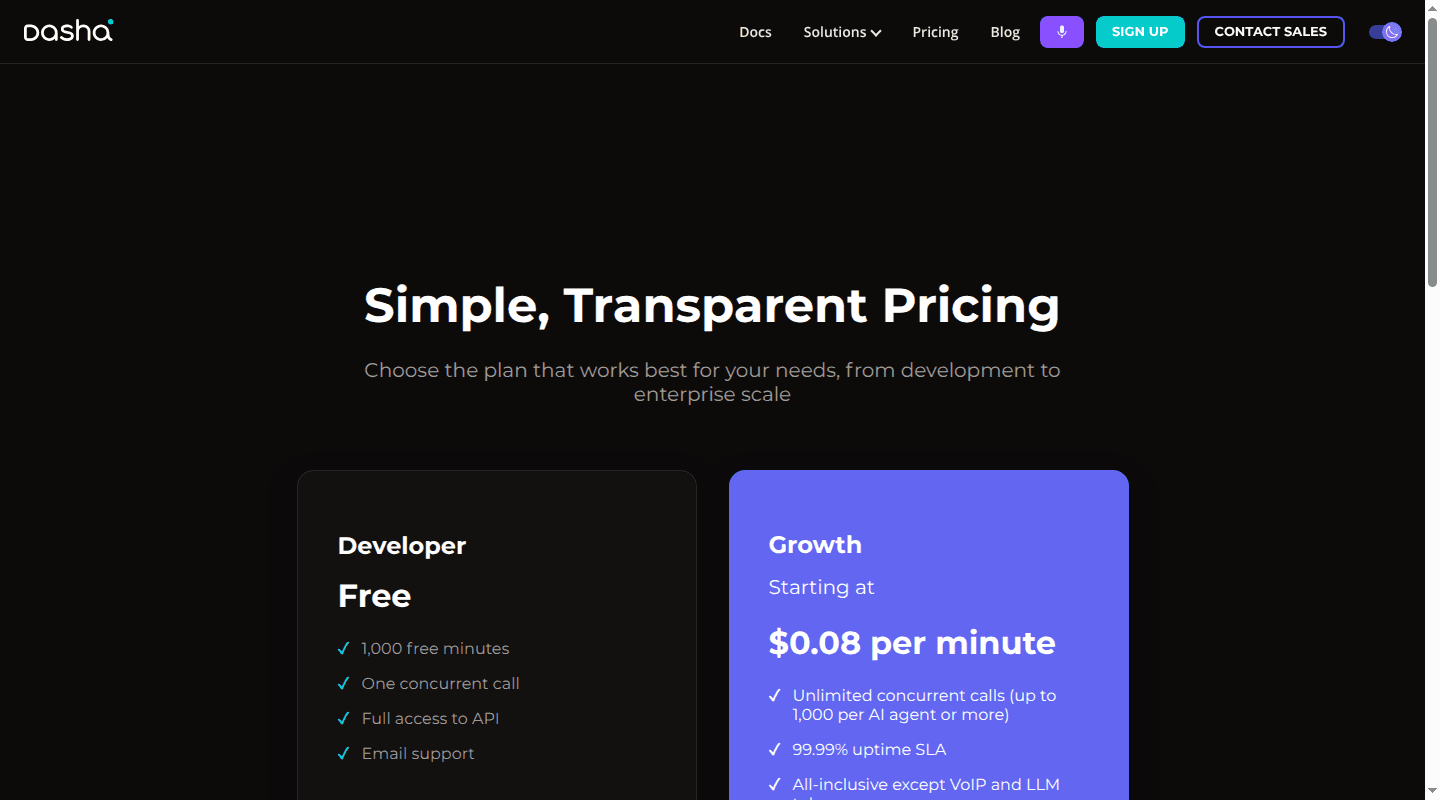
Dasha pricing currently includes 1,000 free developer minutes. Growth starts at $0.08 per connected minute, billed to the second, excluding Voice over Internet Protocol (VoIP) and large language model (LLM) tokens. Price those excluded layers with your real call mix.
We are not the default choice for a no-code team. We are also not an open-source framework that you deploy yourself. We fit teams that want a managed voice AI backend while keeping API, provider, telephony, and integration control.
2. Vapi: best for hosted component flexibility
Best for: Developers that want hosted orchestration with broad choice across transcribers, language models, voices, and telephony providers.
Vapi runs the live orchestration layer and exposes REST APIs, server and client SDKs, tools, webhooks, phone calling, SIP, and browser voice. Its configuration supports provider keys and custom STT, LLM, or TTS endpoints. The platform also documents call logs, recordings, transcripts, scorecards, evaluations, and simulations.
That component choice is Vapi's main advantage. It also means latency, quality, failure behavior, and cost depend on the combination you select. Provider flexibility does not move the Vapi orchestration layer into your infrastructure.
Vapi pricing lists a hosting charge separately from transport and STT, LLM, and TTS usage. Bring-your-own keys can move eligible provider billing directly to you. Include additional concurrency, retention, support, and security requirements in the estimate rather than comparing the hosting fee with an all-inclusive rate.
3. Retell AI: best for integrated phone operations and live supervision
Best for: Product and operations teams that want building, testing, deployment, phone connectivity, and live monitoring in one hosted platform.
Retell AI supports prompt-based and node-based agents, managed phone numbers, bring-your-own telephony over SIP, web calls, custom tools, simulations, and post-call analysis. Session history can connect recordings, transcripts, tool activity, latency, and cost. Live monitoring can also support supervised launches and high-touch workflows.
Retell reports end-to-end and component latency in its dashboard, including percentile views. That is more useful than one marketing latency number, but you should still measure caller-audible response time on your routes, models, and tools.
Retell pricing publishes a $0.07-$0.31 per-minute voice-agent range. The total depends on voice infrastructure, the selected voice and model, telephony, quality assurance, safeguards, and other add-ons. The first 20 concurrent calls are included; additional reserved concurrency is billed separately. Retell is a hosted service, so confirm any regional, retention, or private-deployment requirement during procurement.
4. ElevenAgents: best for voice selection across phone, web, and mobile
Best for: Teams that prioritize voice choice and want one managed agent path across telephony, browser, and native mobile clients.
ElevenAgents is ElevenLabs' managed conversational-agent platform. It combines ElevenLabs speech and turn-taking with supported or custom LLMs, client and server tools, testing, analytics, and experiments. Integration options include SIP, Twilio, WebRTC, a web widget, and native web and mobile SDKs.
The managed speech stack makes it quick to evaluate many voices and languages. It also means the core speech and turn-taking layers remain in the ElevenLabs ecosystem. Test the exact voice, target language, interruptions, background audio, and carrier route your product will use.
ElevenLabs introduced $0.08-per-minute self-serve agent calls in 2026. Plans include different minute and concurrency allowances; LLM usage is passed through separately, and carrier costs depend on the phone setup. Burst usage can carry a higher rate, so model peak traffic as well as average minutes.
5. OpenAI Realtime API: best for OpenAI-native speech-to-speech apps
Best for: Teams building browser, app, or custom phone experiences directly around OpenAI's real-time models.
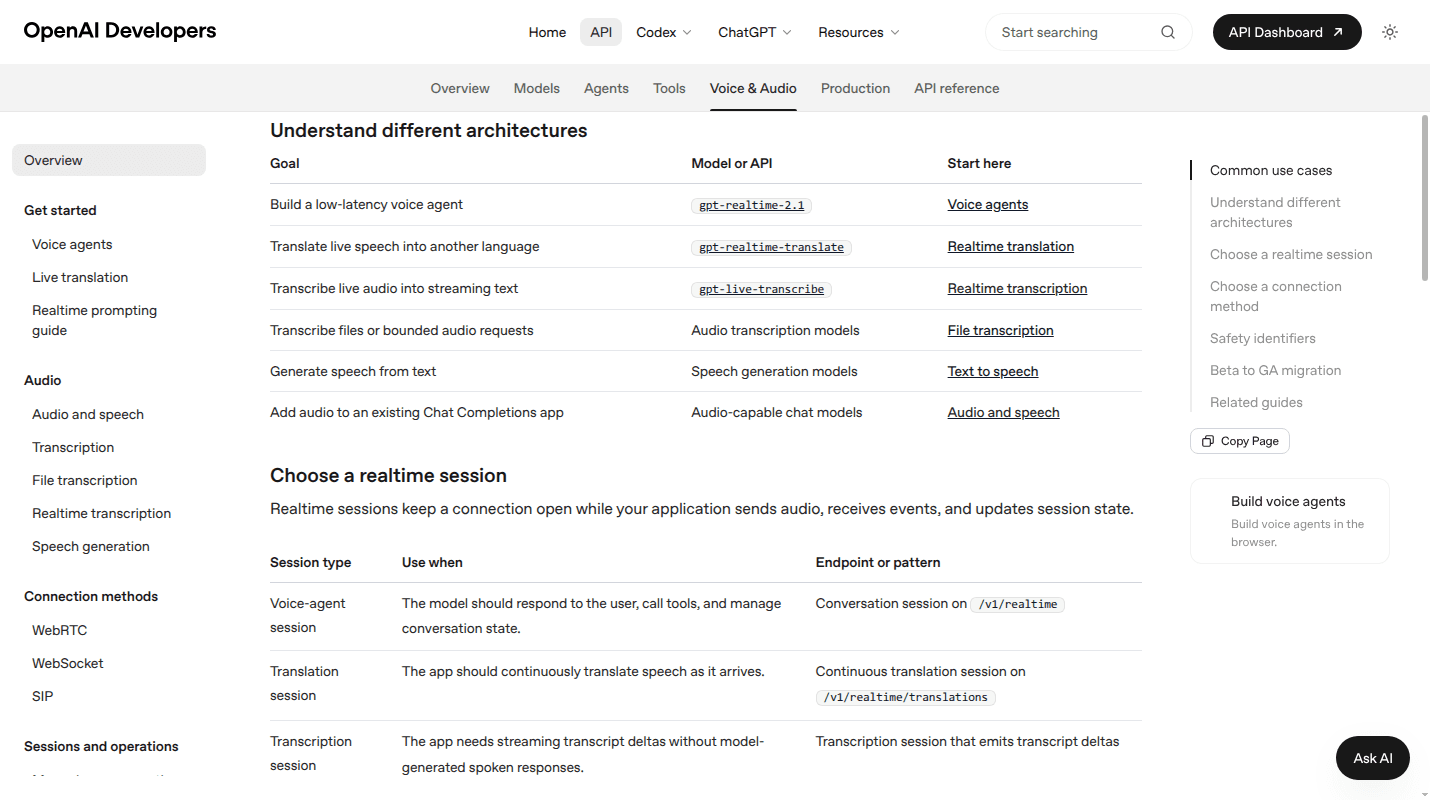
The OpenAI Realtime API keeps a live session open while an application streams audio, receives speech and events, updates state, and handles tool calls. It supports WebRTC for clients, WebSocket for server media pipelines, and SIP through an external trunk. Voice activity detection and server-side controls cover much of the model interaction loop.
Realtime is a model/session API rather than a complete phone-agent operations platform. Your team still needs to design the surrounding call lifecycle, carrier behavior, business tools, monitoring, evaluations, retries, handoffs, and deployment. It is a strong fit when OpenAI's speech-to-speech model is the core product decision and that application work is intentional.
OpenAI pricing bills Realtime audio and text by tokens. Telephony, application infrastructure, tool execution, storage, and observability sit outside that model rate. Measure token usage from representative sessions instead of converting a list price into one assumed per-minute cost.
6. Deepgram Voice Agent API: best for a single-WebSocket speech pipeline
Best for: Engineering teams that want listening, thinking, and speaking behind one real-time connection.
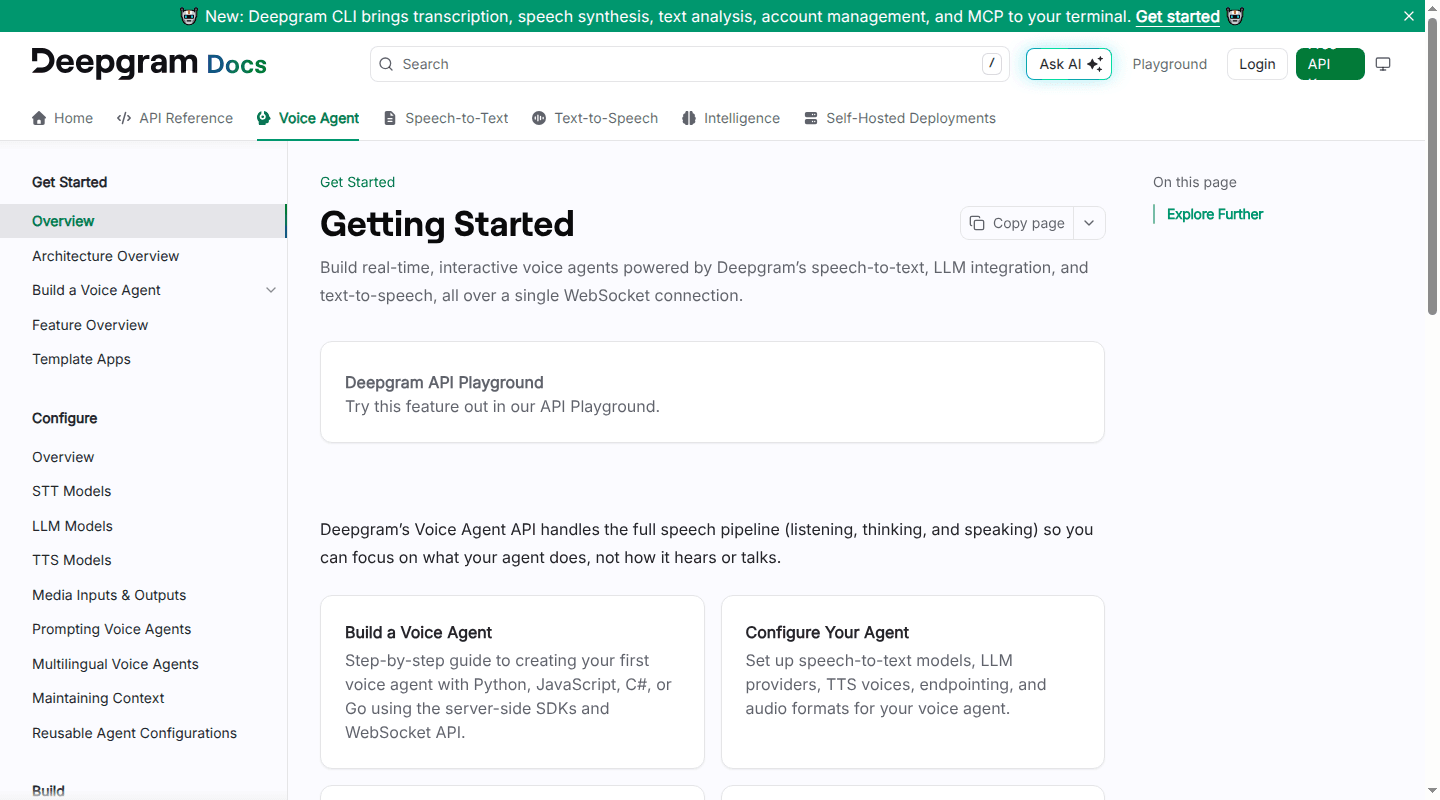
Deepgram Voice Agent API handles the speech pipeline over one WebSocket. It includes Deepgram STT, LLM integration, TTS, endpointing, function calling, and telephony guides. Teams can configure supported LLM and TTS options while using Deepgram for recognition.
This is more integrated than assembling separate speech services, but its boundary is narrower than a full operations platform. The unified API uses Deepgram STT. Deep session analysis also depends on retaining the WebSocket events, and recordings require a separate audio-storage path.
Deepgram pricing currently lists its Standard pay-as-you-go full-stack configuration at $0.075 per WebSocket connection minute. Bring-your-own model or voice configurations have different Deepgram rates, and the external provider and telephony charges remain separate.
7. LiveKit Agents: best for open-source, media, and deployment control
Best for: Engineering teams building highly custom voice, video, multimodal, or human-in-the-loop agents.
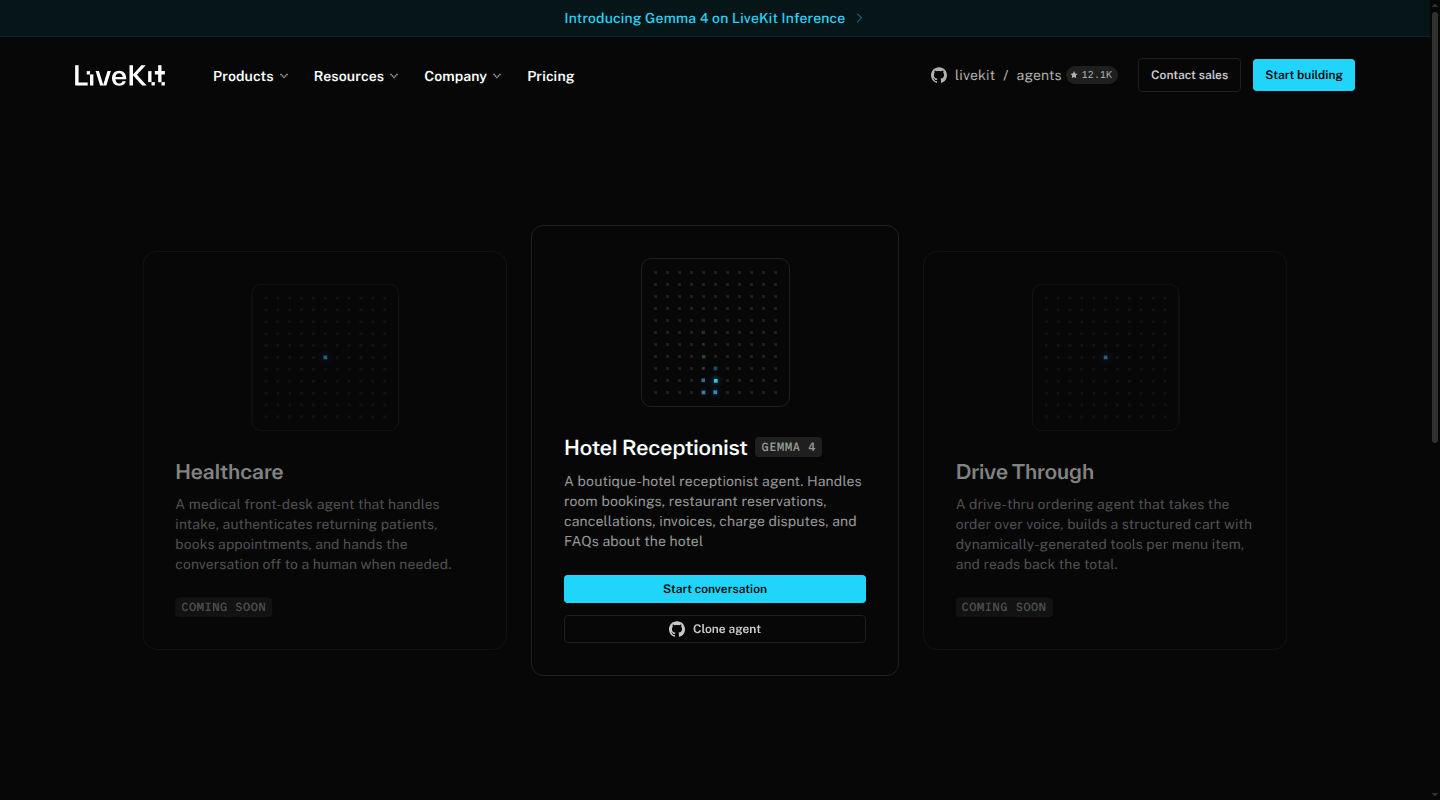
LiveKit Agents is an open-source Python and Node.js framework for putting agents into real-time media rooms. It includes abstractions for STT-LLM-TTS pipelines, real-time models, turn detection, interruptions, tools, handoffs, WebRTC, and SIP. Its provider plugins let teams choose from a wide model and speech ecosystem.
You can deploy the framework in a custom environment or use LiveKit Cloud for managed agent deployment, load balancing, and session observability with transcripts, traces, logs, and recordings. LiveKit is the control-oriented option in this list, not the simplest managed API.
LiveKit pricing itemizes Cloud agent sessions, inference, telephony, WebRTC, and observability with plan allowances. A self-hosted deployment replaces some vendor charges with infrastructure, upgrades, autoscaling, storage, monitoring, and on-call engineering. Include those costs in the comparison.
Which voice AI API should your team choose?
Choose based on the operating boundary your team can support:
| Your priority | Start with | Why |
|---|---|---|
| Managed production runtime with API and provider control | Dasha | Runtime, telephony, tools, and operations are managed without reducing the product to a no-code builder |
| Broad provider choice on a hosted orchestration layer | Vapi | Configurable speech, model, voice, and carrier components |
| Integrated phone operations and live supervision | Retell AI | Managed telephony, testing, session analysis, and live monitoring in one platform |
| Voice selection across phone, web, and mobile | ElevenAgents | ElevenLabs speech stack with omnichannel integrations and SDKs |
| OpenAI-native speech-to-speech product | OpenAI Realtime API | Direct real-time model sessions with client, server, and SIP transport |
| Unified speech pipeline over one connection | Deepgram Voice Agent API | STT, model integration, TTS, and tools behind one WebSocket |
| Open-source and custom media or deployment | LiveKit Agents | Source-level framework control with an optional managed Cloud path |
| Only transcription or speech generation | An STT or TTS component API | Avoid paying for an agent runtime when you only need one speech layer |
This shortlist is intentionally architecture-led. “Best” means the responsibilities match your team, not that one vendor wins every feature.
Run the same pilot before committing
- Use real conversations. Test the languages, accents, background noise, call routes, and tools your production traffic will use.
- Measure the caller's wait. Track time from the end of the user's speech to the first audible agent response. Check P50, P95, and P99, plus interruption recovery. Model time to first token is not the same measurement.
- Break dependencies on purpose. Slow or fail a tool, exhaust a model fallback, trigger a transfer, disconnect a carrier path, and verify that the agent fails safely.
- Test traffic shape. Measure call starts, concurrent sessions, queue or rejection behavior, and one tenant or campaign consuming a burst.
- Calculate cost per successful outcome. Include runtime, STT, LLM, TTS, telephony, capacity, recordings, monitoring, add-ons, support, and engineering. Our AI voice agent pricing guide provides a fuller cost model.
The pilot should use the same flows and measurement boundary for every finalist. Otherwise, the comparison mostly measures your configuration choices.
Start with the operating model
The best voice AI API is the one that gives your team the right control without handing it operational work it cannot support. A managed runtime, a model endpoint, an open framework, and a speech component can all be the right answer for different products.
If you are a technical team that wants a managed production runtime with API access, SIP telephony, provider choice, tools, and production operations, evaluate Dasha's Voice AI Backend. You can also start with Dasha's current developer allowance before running the same pilot against another finalist.