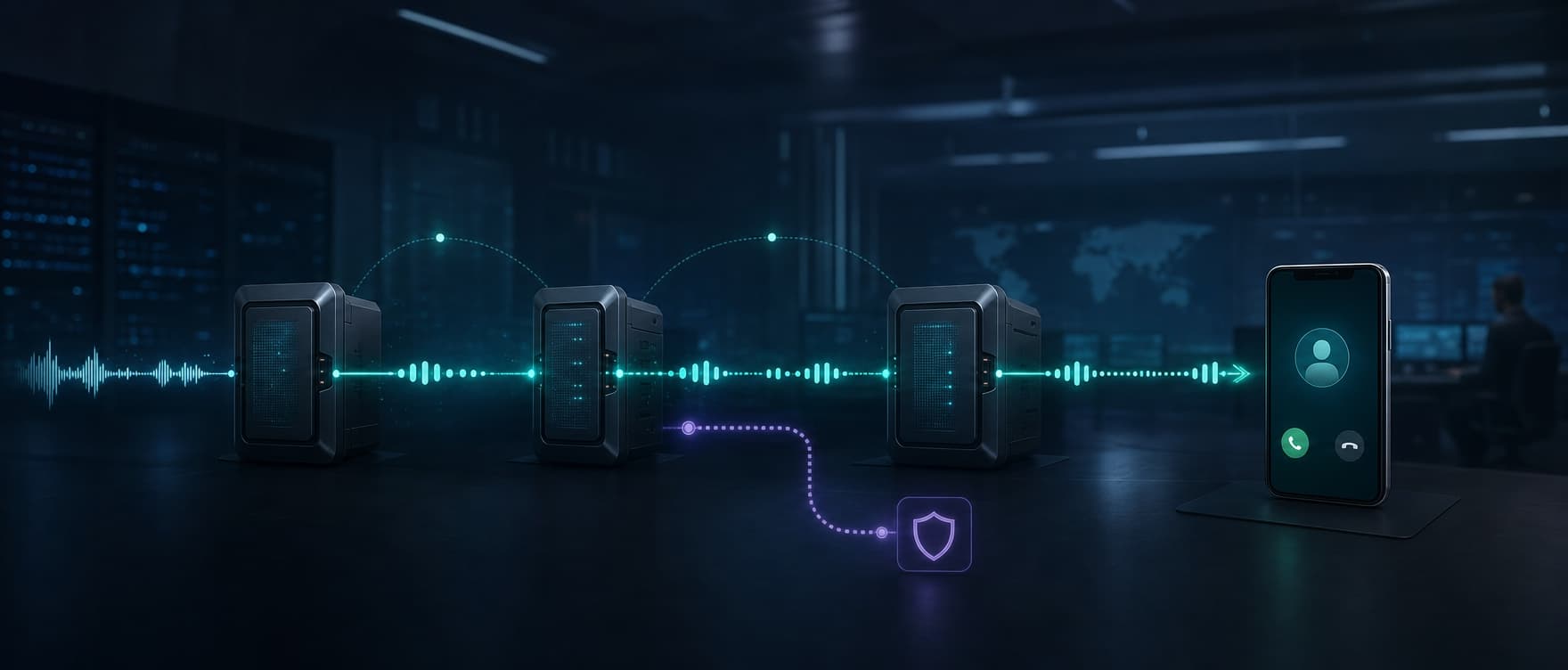
Multi-speaker text to speech can mean a model able to produce different voices or a workflow that actually renders more than one voice. That ambiguity leads teams to choose the wrong architecture. The practical question is whether you need a static scene, an editable sequence of turns, or a live conversation. Each requires different controls for identity, timing, latency, and quality assurance (QA). Here is how the pipeline works, which implementation patterns fit each job, and how to test one before production.
Multi-speaker TTS in one minute
Multi-speaker text to speech (TTS) can describe a model capability or the audio produced by a workflow. Those are different claims:
- Model capability: one TTS model can synthesize different voices because it accepts a speaker identifier, speaker embedding, voice description, or reference recording. A request that selects only one voice still produces single-voice audio.
- Multi-voice output: one request or an application pipeline turns a labeled script into audio in which two or more roles have different assigned voices. That output can also be assembled from several single-speaker models.
For a script such as Host: ... and Guest: ..., the production requirement is the second meaning: a complete audio asset with correct casting, natural turn boundaries, stable voices, and no missing lines. A provider's multi-speaker label alone does not establish that its endpoint accepts a labeled dialogue or returns multiple voices in one render.
There are three practical ways to build it:
| Pattern | How it works | Best fit | Main tradeoff |
|---|---|---|---|
| Turn-by-turn synthesis | Generate every line with a single-speaker TTS call, then assemble the clips | Editable narration, localization, large casts | You own timing, loudness matching, and cross-turn continuity |
| Joint dialogue synthesis | Send the labeled turns and voice map in one request | Two-person scenes and natural conversational pacing | Provider limits and less control over an individual line |
| Self-hosted multi-speaker model | Serve a model that accepts speaker IDs or reference audio | Data-local workloads and custom voices | You own inference, capacity, model updates, and evaluation |
For a live voice agent, multi-speaker TTS is only the speech-output layer. The runtime still has to manage the conversation, tools, telephony, turn-taking, interruption, and traces. Our voice configuration docs show where provider and voice selection fit inside a Dasha agent. A prerecorded dialogue renderer and a live voice-agent runtime solve different jobs.
What multi-speaker TTS is, and what it is not
Multi-speaker TTS is easy to confuse with adjacent speech tasks. The input and output make the difference clear.
| Task | Input | Output | Core question |
|---|---|---|---|
| Multi-speaker TTS workflow | Text plus speaker and voice assignments | One or more clips that form speech in the assigned voices | Who should say each written line? |
| Voice cloning | Reference recordings plus new text | New speech resembling the reference speaker | Can the system reproduce this voice? |
| Voice conversion | Source speech plus a target-speaker representation | Speech with the target vocal identity, while aiming to preserve linguistic content and selected source traits | Can the system transform the source voice without requiring a new script? |
| Speaker diarization | An existing recording | Speaker-labeled time ranges, often using anonymous clusters | Who spoke when? |
| Speech recognition | An existing recording | A text transcript | What was said? |
A multi-speaker system does not require voice cloning. Prebuilt or designed voices are sufficient when the goal is to distinguish a narrator from characters, create training role-plays, or localize a scripted exchange. Cloning enters the design only when a real person's vocal identity is required and licensed.
Diarization alone does not create a transcript or identify a real person. Pairing its time ranges with speech recognition and alignment can produce a speaker-attributed transcript. In a re-synthesis workflow it sits before TTS, and it does not supply the synthetic voices.
How the synthesis pipeline works
An application-level production pipeline has four stages. A hosted endpoint may combine several of them, and model internals vary.
1. Normalize the script and resolve the cast
The system parses a sequence of turns, assigns every turn to a stable speaker key, and normalizes text. Normalization expands ambiguous numbers, dates, abbreviations, and symbols into a form the model can pronounce.
Keep role names separate from voice identifiers. host is a durable role in your application. voice_7f2... is one model-specific voice assigned to that role. That separation lets you change a voice without rewriting the script or contaminating historical evaluation data.
2. Condition generation on speaker identity
Some multi-speaker models learn an embedding for each speaker seen during training. The speaker ID selects that learned vector at inference time. Zero-shot systems can derive a speaker embedding from reference audio and condition the TTS model on it without fine-tuning.
Speaker embeddings compress identity-related information into a fixed-size representation. They help a shared model retain vocal characteristics across different text. They do not perfectly separate identity, accent, prosody, recording conditions, and language. Research on zero-shot speaker embeddings found lower perceived speaker similarity for unseen speakers than for speakers represented in training. That finding concerns zero-shot generalization, not stability over a long render. Test long-form consistency directly across paragraphs, chunks, retries, and scene boundaries.
Other systems may accept a designed voice or a natural-language description. At the application layer, every role still needs a consistent conditioning signal across turns, chunks, retries, and releases.
3. Generate an audio representation with turn context
A conventional acoustic-model pipeline encodes text, combines it with speaker conditioning, predicts features such as a mel spectrogram, and uses a vocoder to create a waveform. That flow is common, but it is not universal. Neural-codec architectures can predict discrete audio tokens and use a codec decoder to reconstruct the waveform, while other systems combine more of the path end to end.
Turn-by-turn pipelines run generation separately for each line. Joint dialogue models see multiple turns together. Shared context can improve pacing and reaction timing because the model knows what came before and who speaks next. Dialogue-native research such as CoVoMix goes further by modeling talkers as separate semantic streams, allowing interjections and overlap in a mixed output.
Joint generation also creates a larger failure surface. A model can swap speakers, omit a turn, repeat words, or introduce unrequested speech. Preserve the input turn list so the output can be checked against it.
4. Render, assemble, and package the audio
The last stage decodes audio and packages it in a supported encoding and container. Turn-by-turn systems also need a mixer that joins clips, applies fades carefully, manages room tone, and records the timing created during assembly. A joint endpoint may return one audio stream without turn or word timestamps.
Choose the output contract before choosing a provider:
- encoding, container, MIME type, and sample rate
- mono or stereo layout
- streamed chunks when an endpoint offers them, or a complete file
- provider timestamps when available, or timing derived during assembly or alignment
- policy for silence, overlap, and interruptions
- retry behavior when only one turn fails
These details determine whether the output can feed telephony, animation, subtitles, an editor, or a regression test.
A portable dialogue request shape
Treat the following vendor-neutral shape as an internal application contract, not as a provider wire format. An adapter must validate each field, translate what its endpoint supports, and retain application-only metadata outside the provider request.
{
  "output": {
    "encoding": "pcm_s16le",
    "container": "wav",
    "mime_type": "audio/wav",
    "sample_rate_hz": 24000,
    "channels": 1
  },
  "speakers": {
    "host": {
      "voice_id": "voice-host-v3",
      "locale": "en-US"
    },
    "guest": {
      "voice_id": "voice-guest-v2",
      "locale": "en-US"
    }
  },
  "turns": [
    {
      "id": "turn-001",
      "speaker": "host",
      "text": "Why does the same script sound different after an update?",
      "style": "curious, measured"
    },
    {
      "id": "turn-002",
      "speaker": "guest",
      "text": "Because the voice, model, and generation settings all affect the render.",
      "style": "concise, calm"
    }
  ]
}
The adapters are materially different:
- Gemini: map the internal role names to named speakers in the request and assign a prebuilt voice to each. Its multi-speaker request supports up to two named speakers with prebuilt voices. Custom designed or replicated voices require separate synthesis calls and application-side assembly.
- ElevenLabs Text to Dialogue: map the turns to an
inputsarray oftextandvoice_idpairs.language_codeapplies to the request, not to an individual speaker. The request schema does not have the internalid,speaker,style, or per-speaker locale fields shown above, so the adapter must retain, compile, reject, or split those values rather than pass them through as if they were supported.
Four choices make the internal contract useful in production:
- Stable turn IDs connect audio ranges, retries, transcripts, and bug reports even when the provider does not accept an ID.
- Recorded provider references capture the provider, endpoint, model, voice ID, and settings. Pin an explicit model or voice version where the service exposes one. A voice ID or alias does not guarantee that its acoustics will remain unchanged, and repeated generation is not necessarily deterministic.
- Explicit application locales make multilingual casting testable. The adapter can map a shared locale to a request-level field, split incompatible turns, or reject a combination the endpoint cannot represent.
- An explicit audio contract gives downstream code a known encoding, container, MIME type, channel count, and sample rate. The adapter must validate or transcode the response. A fixed file format does not guarantee identical audio across renders.
Treat style as a bounded direction. Dense, conflicting prompts often make delivery harder to reproduce. Use only the controls documented for the exact endpoint and model. The SSML standard defines a markup vocabulary for voice choice, pronunciation, pauses, rate, pitch, and emphasis, but an SSML element is usable only when that endpoint implements it. ElevenLabs Text to Dialogue models Eleven v3 and Eleven v4 do not support SSML <break> tags; they use supported audio tags, punctuation, and text structure for pauses instead.
How to choose an implementation pattern
Use turn-by-turn synthesis when editability wins
Choose separate calls when editors need to replace one line, casts have more speakers than a joint endpoint accepts, or each role uses a different provider. They also isolate failures. If turn 18 is wrong, you can rerender turn 18.
The cost is assembly work. Consecutive clips may have inconsistent loudness, pace, background texture, or silence. Persist one approved voice configuration per speaker, pin versions where possible, normalize text centrally, preserve neighboring text as context where supported, and measure the gaps between clips. Run regression tests because saved identifiers and settings do not freeze a hosted model's output.
Use joint dialogue synthesis when interaction quality wins
Joint generation is useful when the exchange depends on shared cadence, reactions, or closely spaced turns. The model can shape a response around the preceding line instead of reading each sentence as an isolated announcement.
Use it only when the provider's limits match your script length, number of voices, languages, output format, and retry needs. Keep a turn-by-turn fallback for corrections and for scripts that exceed one request.
Self-host when model control justifies operations
Self-hosting fits teams that need data locality, custom training, offline inference, or detailed control over decoding. It adds GPU capacity planning, batching, cold starts, model versioning, abuse prevention, and audio-quality monitoring.
Evaluate licenses as part of the architecture. Model weights, training code, voice data, and generated output can have different terms. A working repository is not automatically deployable in a commercial product.
Use a voice runtime for live conversations
Static dialogue generation assumes the script is known. In a cascaded live system, response text may arrive incrementally. An application can reduce time to first audio by using a TTS endpoint that supports streaming. It must also stop audible playback when a user interrupts. Provider-side request cancellation is useful when available; otherwise the runtime can discard queued audio even if the upstream generation request continues.
Turn detection may use voice activity detection (VAD) and endpointing, semantic or model-native turn detection, push-to-talk input, or a combination. These are runtime choices, not universal TTS endpoint features. A model can produce excellent two-speaker audio and still be a poor fit for an interactive agent. Our TTS model evaluation considers time to first audio for streaming interfaces alongside listening preference and production controls. For a batch endpoint, completion time is the relevant service measurement instead.
Production QA for multi-speaker speech
One naturalness score cannot cover a dialogue system. Test content, identity, delivery, timing, and operations separately.
| Dimension | What to measure | Typical failure |
|---|---|---|
| Content fidelity | Missing, added, repeated, and mispronounced words | A line is skipped or a number changes |
| Speaker assignment | Correct voice on every turn | Two roles swap voices |
| Identity stability | Similarity within a role across the full asset | A voice drifts after a chunk boundary |
| Prosody | Pace, emphasis, emotion, and phrasing | Every line sounds isolated or overacted |
| Turn flow | Gaps, overlap, clipping, and response timing | Pauses are too long or reactions collide |
| Audio consistency | Loudness, noise floor, room tone, and codec | One speaker sounds recorded in another space |
| Operations | First playable audio for streaming endpoints, completion time for batch jobs, throughput, retries, and cost | Long jobs time out or duplicate output |
Use a repeatable release workflow:
- Build a golden script set. Include short and long turns, names, abbreviations, numbers, questions, interruptions, emotional shifts, and every production language.
- Snapshot the complete configuration. Record the provider, endpoint, model or pinned version, voice IDs, language, style, pronunciation rules, sampling parameters, and output format. Keep an accepted audio baseline because identifiers alone do not make a hosted service reproducible.
- Run automated checks. Transcribe the generated audio to catch omissions and substitutions. Check turn count, duration, silence, clipping, and speaker assignment. Use provider timestamps only when the selected endpoint returns them; otherwise derive timing from the mixer or an aligner.
- Run human listening tests. For rendered assets, rate naturalness, speaker identity, intelligibility, and turn flow as separate questions. Use a listening-quality mean opinion score (MOS) only when the protocol is a listening test. Under the ITU's MOS terminology, subjective conversational-quality MOS is based on interactive conversation tests, while objective and estimated conversational-quality measures also exist.
- Compare against the last accepted render. Listen to changed samples and keep the earlier audio, config, and transcript for regression analysis.
- Gate the release. Block changes that introduce speaker swaps, missing turns, identity drift, clipping, or service times above the endpoint-specific threshold.
Speaker-embedding similarity can flag identity drift at scale, but it does not replace listeners. Work on automatic speaker similarity shows why perceptual evaluation remains the reference while automated metrics help reduce the review set.
Common failures and practical fixes
The voice changes halfway through
Pin the voice or reference asset and model version where the provider allows it, then persist the full generation settings. Test chunk boundaries and rerun the accepted regression set. If long-context generation drifts, shorten the request and anchor every chunk to the same approved reference.
Speakers swap roles
Validate every speaker value against the configured cast before sending the request. Keep speaker keys short and unambiguous. After generation, compare each turn against reference samples and reject the whole render when assignment cannot be repaired safely.
The dialogue sounds like separate announcements
Give a joint model the surrounding turns, or pass a small amount of context into sequential generation when the API supports it. Keep style directions consistent across the scene. Tune pauses after listening to the exchange as a whole.
Pronunciation changes between speakers
Use one shared normalization and pronunciation layer before the text reaches any voice. Apply the same lexicon to names, product terms, addresses, and abbreviations. Test every term in every language and voice that will speak it.
Long jobs skip or repeat text
Split scripts at turn boundaries and retain stable internal IDs. Reconcile provider timestamps with the source list when the endpoint returns them. Otherwise record timing during assembly or use forced alignment. Make retries idempotent so a failed worker cannot append the same turn twice.
A live system feels slow despite good audio
Measure the full path from available response text to audible playback. Stream text and audio where supported, preconnect to the provider, and cache fixed phrases when policy permits. On interruption, stop playback immediately and cancel upstream synthesis only if the interface exposes cancellation. Naturalness cannot compensate for a broken turn-taking loop.
Consent, impersonation risk, and provenance
Distinct synthetic voices do not have to imitate real people. Prefer licensed prebuilt voices or original designed voices when a recognizable identity adds no product value.
For cloned voices, keep a consent record tied to the person, approved uses, voice asset, retention period, and revocation path. Restrict who can create or use clones. Log each generation with the model, voice, operator, script, and destination. Disclose synthetic audio where the context could otherwise mislead a listener.
Watermarks and detectors are useful controls, but neither is a complete safeguard. The US Federal Trade Commission's review of voice-cloning interventions notes that marks can be removed or distorted and recommends layered prevention, authentication, monitoring, and post-use evaluation.
Phone calls add a separate compliance layer. The Federal Communications Commission's adopted FCC-24-17 declaratory ruling confirms that AI-generated voices fall within the Telephone Consumer Protection Act's restrictions on artificial or prerecorded voice calls. Under the existing rules described in that ruling, callers must obtain the required prior express consent absent an emergency purpose or exemption, provide the required identification and disclosure information, and provide specified opt-out methods when a message includes advertising or telemarketing.
Those existing duties are distinct from the AI-specific disclosures in FCC-24-84. That notice proposed disclosures when obtaining consent and at the beginning of calls that use AI-generated voice. It did not itself turn those proposals into adopted requirements. The exact consent form, exemptions, disclosures, and state-law duties depend on the call and jurisdiction.
Where Dasha fits
Multi-speaker synthesis creates audio. Production conversational AI has to decide what to say, call tools, handle interruptions, move audio through telephony or the web, and expose enough evidence to debug failures.
Dasha gives technical teams a managed runtime, REST APIs, and a web application for building and operating voice AI agents. You can choose a supported TTS provider and voice, preview delivery, test conversations, and inspect completed calls while Dasha manages the live conversation path.
Use a dialogue TTS endpoint for podcasts, audiobooks, training scenes, and other known scripts. Use Dasha when the other speaker is a real person and the exchange must run live. Start with Dasha's voice-agent quickstart.