A text-to-speech demo can sound excellent and still fail inside a live voice agent. This dated TTS leaderboard ranks six current API models using human preference, time to first audio, word error rate, normalized price, and production controls, then shows what technical teams need to validate before committing.
TTS leaderboard for production voice agents
As of September 22, 2026, Inworld Realtime TTS-2 is our best overall starting point for a production voice-agent pilot. It combines strong listener preference with the fastest measured time to first audio in this shortlist. Speechify Simba 3.2 follows for English-only teams that prioritize price and speech controls. Cartesia Sonic 3.6 leads the six on human preference, while Soniox TTS Real-Time v2 leads on word error rate.
This is a workload-specific ranking. It is neither a permanent verdict nor a pure naturalness table. Small score gaps should be treated as a shortlist, then resolved with your own audio, routes, languages, and interruption tests.
| Rank | Provider and exact model | Best fit | Composite | Main boundary |
|---|---|---|---|---|
| 1 | Inworld inworld-tts-2 | Best overall balance for low-latency, multilingual agents | 86 | No dated immutable model snapshot; interruption still needs runtime cancellation |
| 2 | Speechify simba-3.2 | Cost-sensitive English agents with detailed SSML control | 76 | Request streaming only; English-only ranked model |
| 3 | Cartesia sonic-3.6-2026-08-27 | Highest listener preference and a reproducible model snapshot | 74 | Slowest measured TTFA in this six-model set |
| 4 | Soniox tts-rt-v2 | Explicit real-time cancellation and multilingual code switching | 73 | Voice-clone consent verification remains the customer's responsibility |
| 5 | ElevenLabs eleven_v3_conversational | Expressive multilingual dialogue and a broad voice ecosystem | 68 | Requires the Text-to-Dialogue WebSocket, with one registered voice per connection |
| 6 | Smallest.ai lightning_v3.1_pro | Telephony formats and multilingual output at a moderate list price | 64 | No documented identity or recorded-consent gate on the instant-clone endpoint |
The raw evidence behind the order
The human-preference result comes from the Artificial Analysis provider-voice leaderboard. The latency and word error rate results are 30-day means from the Coval TTS leaderboard, last observed on September 22, 2026.
| Provider | Artificial Analysis Elo | Coval mean TTFA | Coval TTS WER |
|---|---|---|---|
| Inworld | 1,245 | 182 ms | 4.7% |
| Speechify | 1,237 | 377 ms | 4.4% |
| Cartesia | 1,272 | 394 ms | 5.3% |
| Soniox | 1,175 | 249 ms | 4.2% |
| ElevenLabs | 1,197 | 339 ms | 4.4% |
| Smallest.ai | 1,175 | 364 ms | 4.4% |
Time to first audio (TTFA) is the interval to audible output in Coval's controlled test. TTS word error rate (WER) is the error rate produced when a fixed automatic speech recognition model transcribes the generated audio. Lower is better for both.
| Provider | Standardized price per 1M characters | Documented controls |
|---|---|---|
| Inworld | $20.80 | 7/10 |
| Speechify | $6.60 | 6/10 |
| Cartesia | $49.00 | 9/10 |
| Soniox | $14.20 | 8/10 |
| ElevenLabs | $50.00 | 9/10 |
| Smallest.ai | $19.50 | 8/10 |
The standardized prices are Artificial Analysis estimates for comparison. They can differ from a provider's billing unit, subscription discount, and official list price. Each profile below uses the provider's actual pricing unit.
How we calculated the ranking
The composite weights the qualities that matter in an interruptible voice agent:
- 40% human preference: Artificial Analysis provider-voice Elo, based on pairwise listener choices using provider-selected voices.
- 25% speed: Coval 30-day mean TTFA.
- 15% intelligibility and completeness proxy: Coval TTS WER.
- 10% cost: Artificial Analysis standardized price per 1 million characters.
- 10% controls: one point each for a versioned identifier, incremental text input, timestamps or alignment, an explicit cancel primitive, pronunciation control, rate control, style or emotion control, multilingual support on the ranked model, telephony-ready output, and custom voices.
We scaled each measured metric from 50 to 100 across these six models, reversing the scale where lower is better, then applied the weights. A documented-control count of seven becomes 70. Whole-number rounding produces the displayed scores.
The method has limits. Artificial Analysis results combine the model with a provider-selected voice, so Elo is not a model-only measurement. Under Coval's benchmark methodology, fixed, versioned prompts run daily through official APIs from us-east-1. Its TTFA includes leading silence but excludes network and TLS setup. Its WER depends on one fixed transcription model. Neither source measures your carrier, codec, region, prompt mix, concurrency, cloning quality, or end-to-end interruption.
Pairwise listening still adds information that automated metrics miss. The TTS Arena approach is useful when close systems sound different but score similarly. Naturalness leaderboards also leave out latency, price, cloning, and interruption, as the Voice Arena methodology makes explicit.
Ranked TTS provider profiles
1. Inworld Realtime TTS-2: best overall balance
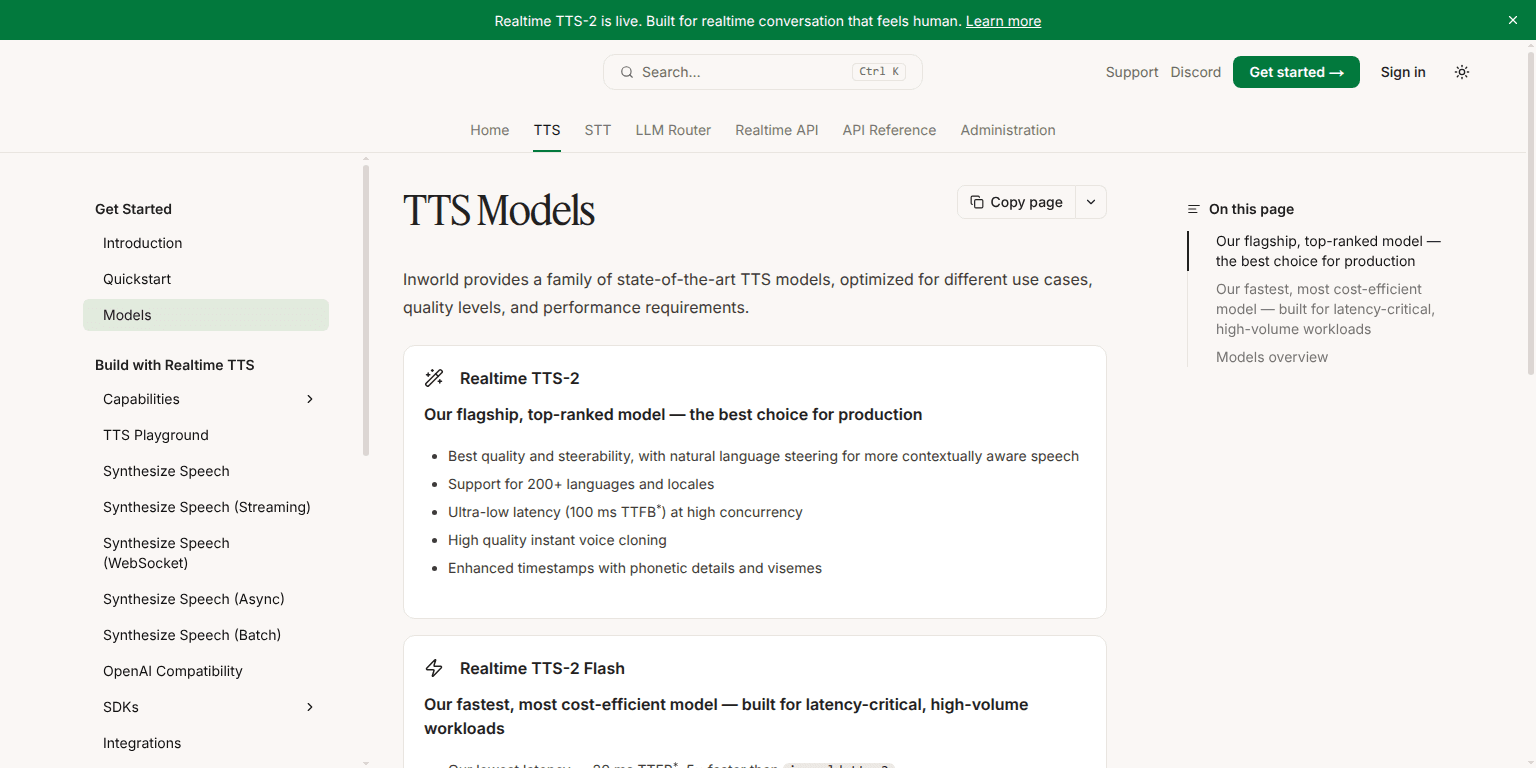
Ranked model: inworld-tts-2. The lower-cost inworld-tts-2-flash is a separate model and was not the ranked benchmark target.
Inworld takes first place because its 182 ms Coval mean TTFA is the fastest here by 67 ms, while its listener-preference Elo stays close to Cartesia's lead. That combination is useful when an agent needs to begin speaking quickly without giving up much expressive quality.
HTTP streaming can return playable audio progressively. A persistent WebSocket accepts incremental text and explicit flushes, which reduces the need to wait for a complete language-model response. Timestamps, phoneme timing, and visemes can help a runtime align captions, animation, and playback state. There is no public dated snapshot for inworld-tts-2, so preserve rendered regression audio as well as the model ID.
The model covers more than 200 BCP-47 languages and locales with automatic language detection. Controls include speaking rate from 0.5 to 1.5, pronunciation, and natural-language steering. TTS-2 supports the steering and professional-cloning paths that Flash omits.
The official on-demand price is $25 per million characters for TTS-2 and $15 per million for Flash. Subscription and enterprise effective rates vary.
Instant voice cloning accepts 3 to 30 seconds of audio and requires confirmation that the customer has the rights. Professional cloning is a TTS-2-only beta for English and requires at least 10 minutes. Inworld's acceptable-use policy prohibits deceptive and harmful use. It is a strong fit for multilingual, latency-sensitive agents. Teams that require an immutable model snapshot or an explicit provider-side cancel command should account for those boundaries.
2. Speechify Simba 3.2: best value for English agents
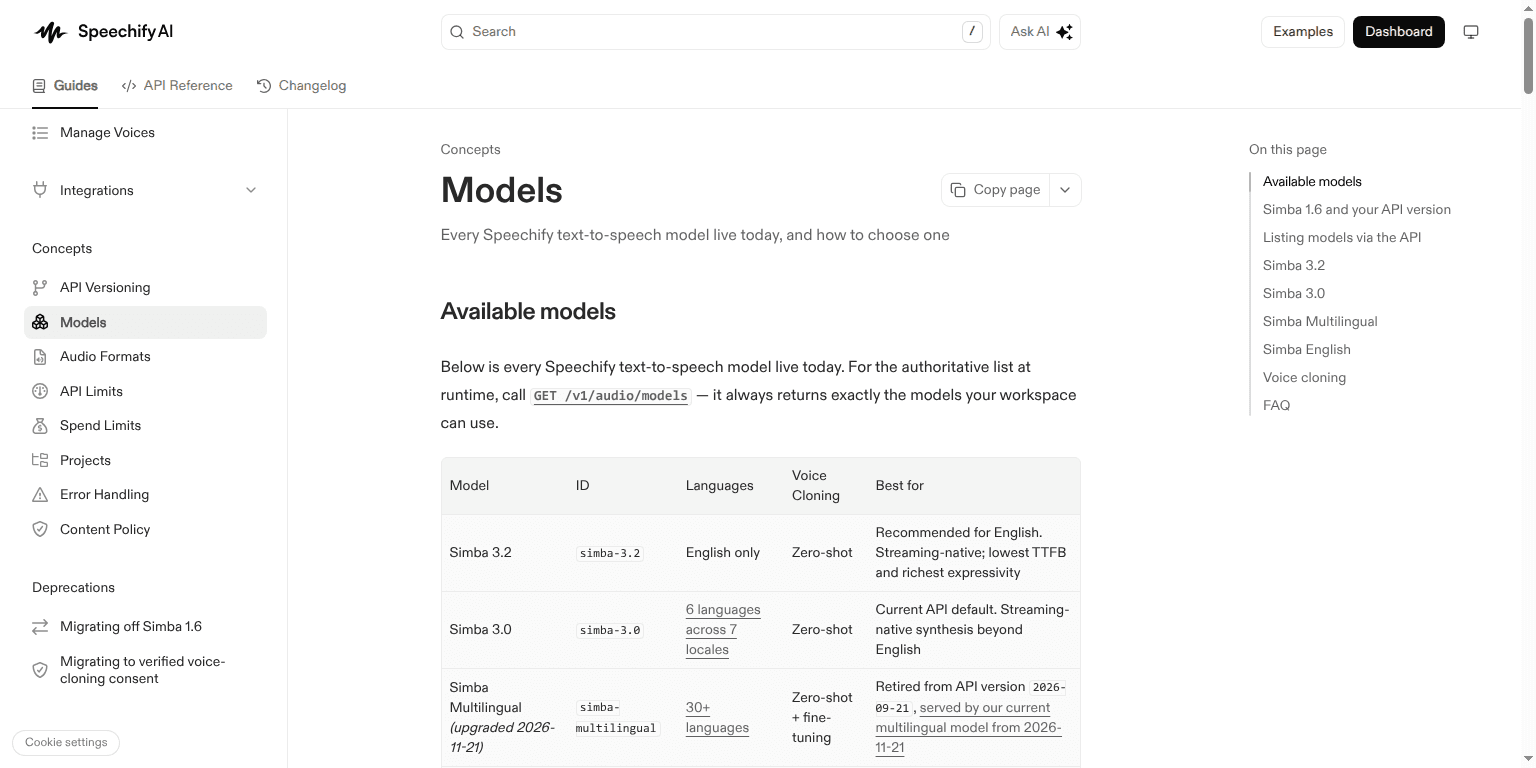
Ranked model: simba-3.2.
Speechify places second through a combination of strong listener preference, 4.4% WER, and the lowest standardized price in the shortlist. Its main constraint is clear: Simba 3.2 is an English-only, streaming-native model.
The POST /v1/audio/stream endpoint returns audio chunks for early playback. This is request streaming rather than a bidirectional WebSocket that accepts language-model tokens throughout generation. Timestamps are available, but an agent runtime still needs to stop playback and discard buffered audio when a caller interrupts.
Speechify offers detailed Speech Synthesis Markup Language (SSML) control over rate, pitch, volume, pauses, emphasis, and phonetic substitution. Thirteen emotion styles give product teams another tuning surface. That level of control is useful for English scripts with brand names, confirmation codes, and deliberate delivery.
The official plans include a Free allowance of 500,000 characters per month. Starter costs $10 for 1.9 million characters, then $10 per million. Pro costs $99 for 13.5 million, then $8 per million. Scale costs $499 for 78 million, then $6 per million.
Cloning requires a paid plan and a verified consent challenge. Speechify's content policy can reject prohibited fraud, threats, self-harm instructions, sexual content involving minors, and some official impersonation. This is a good choice when English coverage is sufficient and consent enforcement is a procurement requirement. It is a weaker fit when incremental token input or multilingual delivery is central.
3. Cartesia Sonic 3.6: best human-preference result
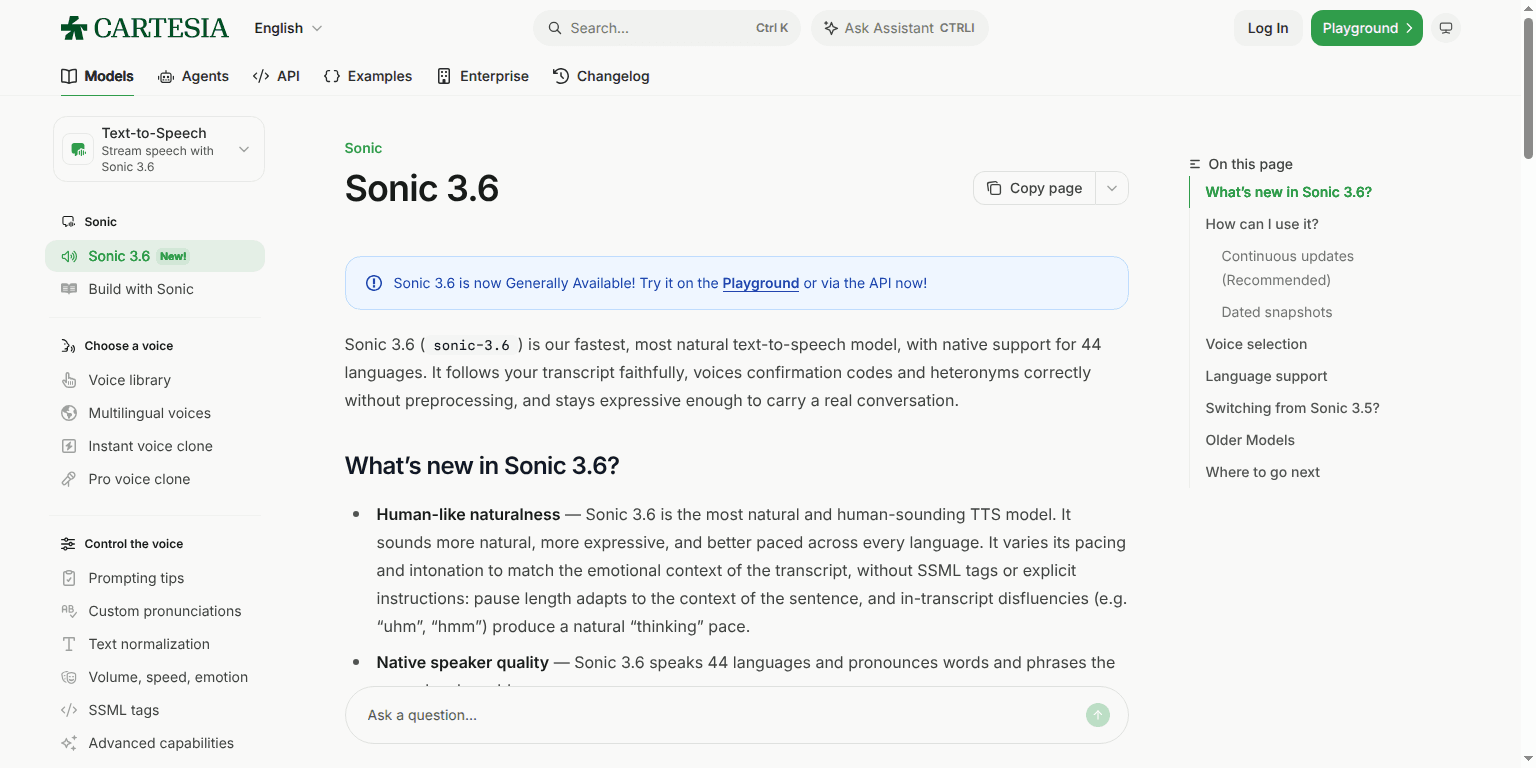
Ranked model: the immutable snapshot sonic-3.6-2026-08-27. The alias sonic-3.6 can advance over time.
Cartesia leads this shortlist on Artificial Analysis Elo at 1,272. It ranks third overall because its 394 ms Coval mean TTFA is the slowest of the six and its standardized price is near the top. Teams that value listening preference above first-audio speed can reasonably place it first in their own order.
Cartesia's three TTS endpoints expose raw HTTP audio, server-sent events with timestamps, and a WebSocket with continuations for incremental language-model text. Continuations preserve context across chunks, which helps avoid isolated prosody when text arrives gradually. The runtime must still connect an interruption signal to audio-buffer cancellation and conversation state.
Sonic 3.6 covers 44 languages and more than 500 stock voices. Speed ranges from 0.6 to 1.5 and volume from 0.5 to 2.0. English emotion guidance is beta. Inline tags and pronunciation dictionaries support finer control over delivery.
Credits are roughly one per character. Current plans include Free with 20,000 credits, Pro at $5 for 100,000, Startup at $49 for 1.25 million, and Scale at $299 for 8 million. Overage rates vary by plan.
Instant cloning accepts 10 to 60 seconds of audio on Pro and higher plans. Professional cloning requires at least 30 minutes and a Startup or higher plan. Cartesia's terms require express permission and prohibit impersonation and deception. Cartesia fits teams that want a stable dated model reference, broad voice choice, and strong listener preference, provided their own route tests accept its first-audio profile.
4. Soniox TTS Real-Time v2: best explicit cancellation path
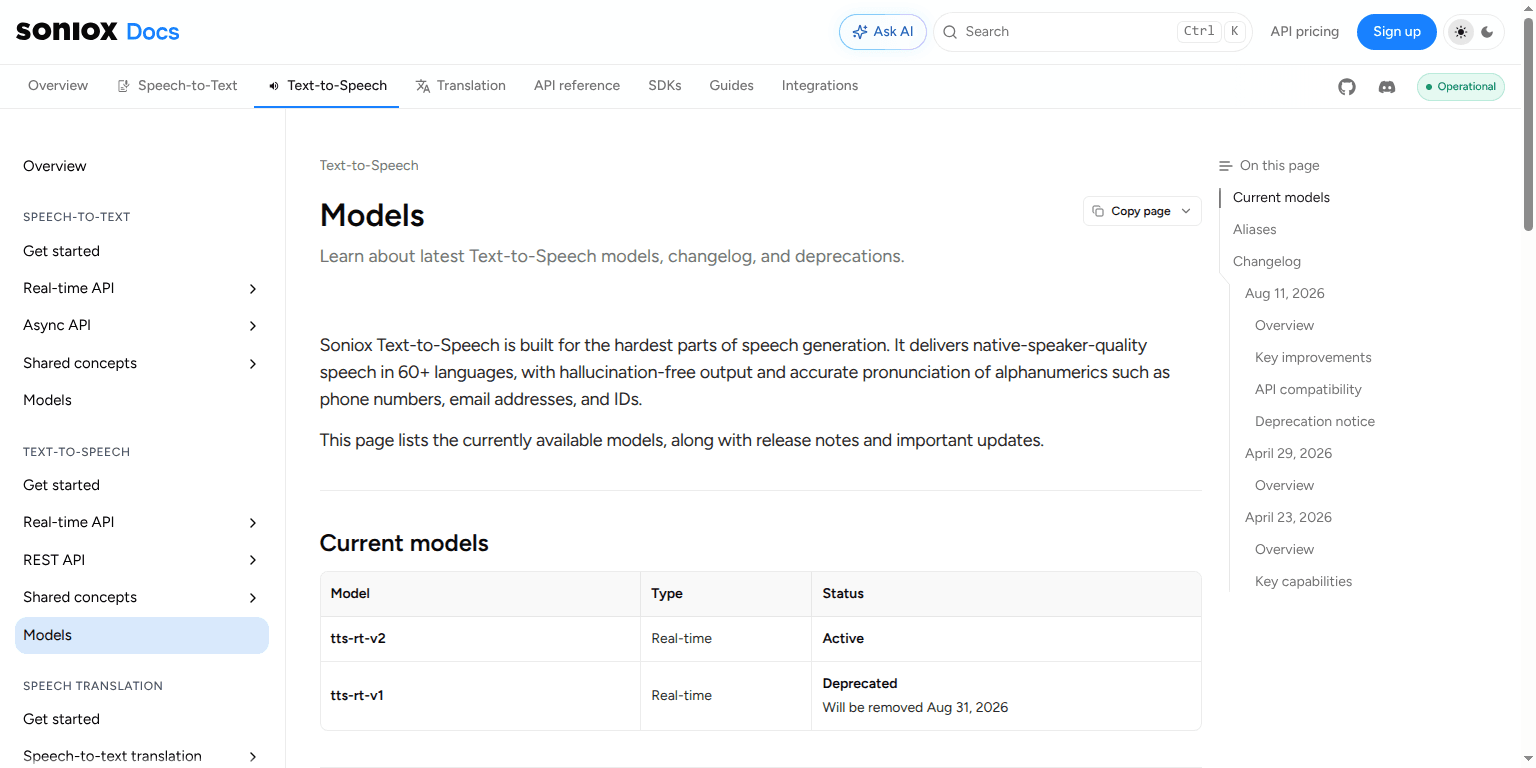
Ranked model: tts-rt-v2. The earlier tts-rt-v1 is deprecated.
Soniox has the best measured WER at 4.2% and the second-fastest Coval TTFA at 249 ms. Its lower human-preference Elo keeps it below the top three in our weighted order. For transactional agents that read identifiers, addresses, and confirmations, teams may give WER more weight and move it up.
The two-way incremental WebSocket supports concurrent streams, an explicit cancellation path, and optional character timestamps. These are useful TTS-layer primitives for barge-in. They still do not remove audio already handed to a carrier or repair conversation state after an interruption.
tts-rt-v2 covers more than 60 languages and supports language changes within a sentence. Audio tags control emotion, delivery, reactions, pace, pitch, and volume. Speech speed ranges from 0.7 to 1.3, and silence reduction can tighten output for live calls.
Soniox pricing bills $4 per million input text tokens plus $21.50 per million output audio tokens. It estimates about $0.70 per generated hour, though the real total depends on text and audio duration.
Voice-clone uploads can be up to two minutes or 35 MB, with a maximum of 20 custom voices. Soniox does not verify consent. Under the Soniox terms, the customer owns rights, permission, disclosures, and lawful use. That allocation should be a visible safety requirement rather than an implementation footnote.
5. ElevenLabs Eleven v3 Conversational: best for expressive dialogue
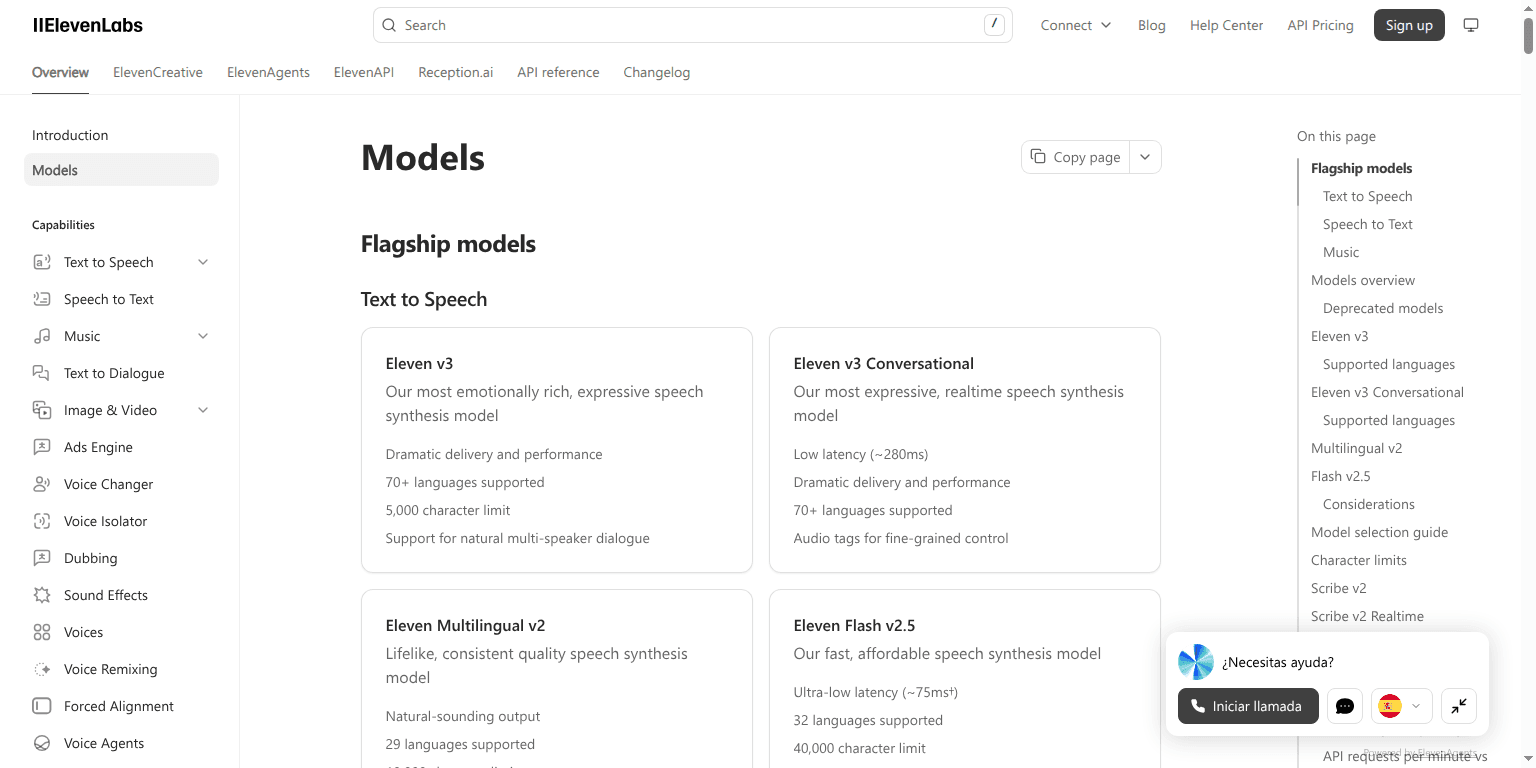
Ranked model: eleven_v3_conversational. Standard eleven_v3 and eleven_flash_v2_5 are different models.
Eleven v3 Conversational combines more than 70 languages, audio tags, alignment events, and per-input voice IDs. Its 4.4% WER is competitive, while the $50 per million standardized price and 339 ms Coval TTFA reduce its composite position.
The integration boundary matters. v3 Conversational streams only through the Text-to-Dialogue WebSocket. The standard TTS WebSocket does not support it. The protocol includes new_turn, flush, keep_alive, and alignment, but a connection can use only one registered voice. ElevenLabs states about 280 ms provider latency excluding application and network time. That is a different boundary from Coval's 339 ms mean and should not be compared as the same statistic.
The model supports expressive audio tags and a broad voice catalog. eleven_flash_v2_5 is a separate lower-latency option with 32 languages and a provider-stated latency of about 75 ms. Flash disables text normalization by default for latency unless an Enterprise account enables it, so applications should normalize dates, currencies, and telephone numbers before synthesis.
The current official API list price is $0.05 per 1,000 characters, or $50 per million, for v3 Conversational and Flash/Turbo, before tax.
Professional voice clones must be the account holder's own voice, even if another speaker gives consent, and require verification. ElevenLabs also publishes a cloning-quality caveat for v3. This is a good fit when expressive delivery and voice selection carry more weight than list price. Validate the precise WebSocket and voice-registration behavior before designing dynamic multi-speaker sessions.
6. Smallest.ai Lightning v3.1 Pro: best for telephony format flexibility
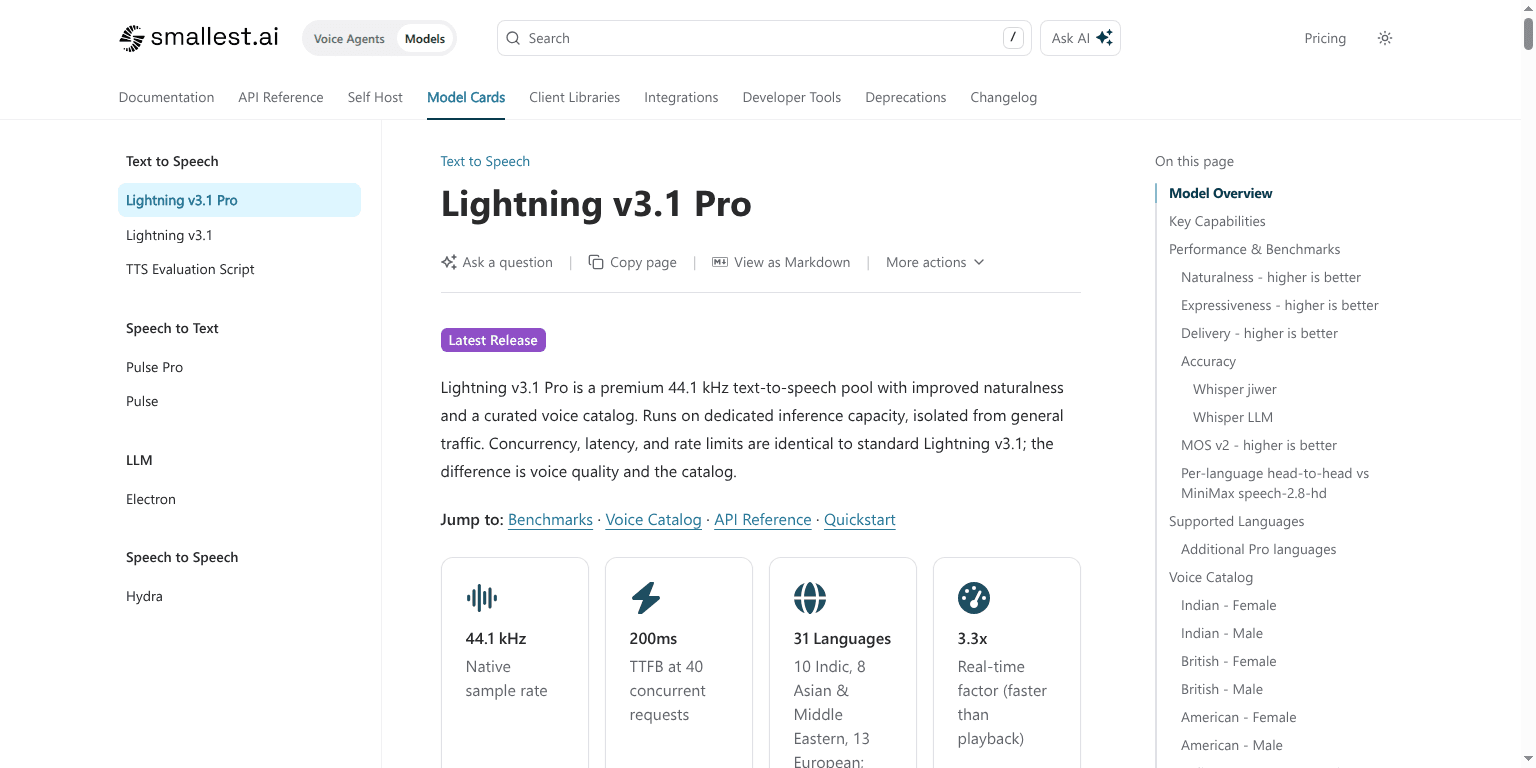
Ranked model: lightning_v3.1_pro for TTS. The clone endpoint spells it lightning-v3.1-pro. Omitting the TTS model selects a different default.
Smallest.ai records 4.4% WER, a 364 ms Coval mean TTFA, and a moderate $19.50 standardized price. Its listener-preference Elo ties Soniox for the lowest in this group. It remains relevant for phone workloads because the output options include PCM, WAV, MP3, and μ-law from 8 to 44 kHz.
WebSocket and SSE streaming are available. Continuations use a context_id, and supported voices can return word timestamps. Those features help keep progressive generation coherent and align playback, though the TTS API does not document the same explicit cancel primitive as Soniox.
Lightning v3.1 Pro covers 31 languages plus automatic detection. It supports speed control and pronunciation dictionaries. Indian Pro voices can switch between Hindi and English, which is more useful than a broad language count for products serving that specific mix.
The official pay-as-you-go price is about $0.195 per 10,000 characters, or $19.50 per million. Enterprise pricing is custom.
Instant cloning accepts 5 to 15 seconds of audio up to 5 MB. The endpoint documentation does not describe an identity or recorded-consent challenge. The model card prohibits impersonation, fraud, deepfakes, and consent or privacy violations. Teams choosing this path need their own consent record, authorization check, abuse review, and revocation process.
Run one production TTS pilot before choosing
Leaderboard audio helps you narrow the field. Selection should finish with the same fixed prompt set, settings, and measurement boundary for every finalist.
- Freeze the target. Record the exact model identifier, voice ID, locale, rate, style, sample rate, codec, region, and API endpoint. Avoid rolling aliases where a dated snapshot exists.
- Build a hard prompt set. Include ordinary dialogue plus names, acronyms, phone numbers, dates, currencies, street addresses, email addresses, product codes, confirmation IDs, abbreviations, silence, disfluencies, and in-sentence language switching where relevant.
- Generate blind listening samples. Normalize playback level and file format, hide provider names, randomize order, and ask target-language listeners to choose between pairs. Score pronunciation and task clarity separately from expressiveness.
- Measure from your application boundary. Track request start, first response byte, first decoded frame, and first audible sample. Leading silence belongs in the caller's wait. Report P50, P95, and P99 rather than one mean.
- Test the actual media path. Use the production region, phone carrier or WebRTC route, sample rate, and codec. An 8 kHz μ-law call can change voice selection compared with a studio-quality sample.
- Interrupt at fixed points. Barge in during the first word, mid-sentence, and near completion. Measure how much audio leaks after detection, whether queued chunks are discarded, and whether the next turn starts from correct state.
- Stress streaming and recovery. Split text at awkward token boundaries, delay language-model chunks, reconnect the WebSocket, expire credentials, and run expected concurrency. Record timeouts, incomplete audio, duplicate speech, and retry behavior.
- Price successful output. Include rejected requests, retries, clone fees, subscription minimums, provider overages, telephony, and the runtime. A per-character quote alone does not describe production cost.
- Exercise safety controls. Try unauthorized clone enrollment, impersonation prompts, disallowed content, voice deletion, and consent revocation. Keep the evidence that your policy and the provider's gate both worked.
Latency inside the TTS API is only one part of the full voice AI latency budget. The pilot should also measure language-model delay, media buffering, carrier behavior, and tool calls.
Streaming TTS does not guarantee clean interruption
Streaming lets playback begin before synthesis finishes. Incremental text input can start synthesis before a language model completes its response. Timestamps can align generated words with audio. A cancel command can stop work that is still inside the provider.
End-to-end barge-in crosses more layers. The system must keep inbound and outbound audio separate, detect that the caller has started a real turn, suppress echo, stop local and carrier-side playback, discard buffered TTS, cancel further generation, and update conversation state. Our guide to voice activity detection explains why a fast detector alone does not solve the whole interruption path.
Judge two boundaries independently:
- TTS boundary: incremental input, first audible output, chunk size, flush behavior, provider cancellation, timestamps, and output formats.
- Agent boundary: turn detection, playback cancellation, echo handling, conversation state, tool cancellation, recovery, and monitoring.
This distinction prevents a low TTFA result from being misread as proof of a responsive conversation.
Where Dasha fits around the selected voice
Dasha is not a TTS provider, so we do not rank ourselves in this leaderboard. We provide the managed runtime and production operations around the speech model.
In a production agent, the runtime owns the live media path, telephony, turn-taking, playback cancellation, language-model and tool orchestration, testing, monitoring, and large-scale call execution. A strong TTS model can improve one layer while leaving those operating responsibilities open.
Evaluate TTS compatibility and runtime behavior together. The exact provider, model, codec, streaming protocol, and cancellation features need to work through the production path. Our Voice AI Backend is built for technical teams that want that runtime managed while retaining API, carrier, model, and integration control.
Refresh policy for this leaderboard
We will recheck the benchmark observations, model identifiers, prices, streaming controls, and cloning policies monthly. We will also refresh when a provider changes a rolling alias, launches or deprecates a ranked model, revises pricing or consent policy, or when Artificial Analysis or Coval changes its method.
Each refresh should preserve the observation date and the earlier snapshot rather than silently rewriting old measurements. Model churn can move this order quickly. A dated leaderboard is evidence for a shortlist, while regression audio and production traces are evidence for a release.
TTS leaderboard FAQ
What is the best TTS model overall?
For the weighted voice-agent workload here, Inworld inworld-tts-2 ranks first. Cartesia Sonic 3.6 has the highest human-preference Elo, Soniox tts-rt-v2 has the lowest measured WER, and Speechify Simba 3.2 has the lowest standardized price. The best choice depends on which of those outcomes matters most in your product.
Does the lowest TTS latency produce the best interruptions?
No. Low TTFA shortens the wait before speech begins. Clean interruption also requires voice activity detection, echo control, playback cancellation, buffered-audio disposal, provider cancellation, and correct conversation state in the agent runtime.
How often does a TTS leaderboard change?
It can change whenever a provider updates a rolling model alias, voice catalog, endpoint, price, or safety gate, and whenever a benchmark changes prompts or method. Monthly checks plus event-driven refreshes are a reasonable operating cadence.
Evaluate the complete voice-agent path
A TTS benchmark can identify promising voices. Production readiness depends on the runtime that connects the selected voice to callers, models, tools, and operations. Start a Dasha technical evaluation and run the same fixed prompt, codec, latency, and interruption tests through the complete voice-agent path.