A telephony API determines how your application receives calls, controls transfers, captures recordings and exchanges live audio. A cheap call rate says little about those capabilities. For engineering teams building phone-enabled products, the useful comparison is the call-control interface, the media contract and the production limits behind it. Six providers offer different ways to own that phone layer.
Telephony APIs at a glance
A programmable telephony API lets your code place, answer and control calls on the public switched telephone network (PSTN). It can connect those calls to phone numbers, Session Initiation Protocol (SIP) endpoints or an application that processes live audio.
| API | Useful fit | Decision-changing detail |
|---|---|---|
| Twilio Programmable Voice | Applications combining phone, SIP and browser calling | Raw Media Streams and managed ConversationRelay have different interfaces and costs |
| Telnyx Voice API | Teams wanting carrier services and command-based call control together | Call-control charges sit alongside the underlying SIP calling charges |
| Plivo Voice API | XML call flows with a custom real-time audio service | U.S. Voice API and SIP Trunking share call-start and concurrency allowances |
| Vonage Voice API | JSON-controlled calls with binary audio processing | WebSocket audio carries binary samples rather than base64 audio in JSON |
| Bandwidth Voice API | Carrier-connected products with XML-controlled call flows | A non-blocking stream needs call instructions that keep the call alive |
| SignalWire Voice | Teams choosing between compatibility and native call-control interfaces | A familiar REST/XML surface still has provider-specific callbacks and media behavior |
These are phone-layer choices. A SIP trunk primarily connects an existing voice system to the phone network; our SIP provider comparison covers that decision. A managed voice-agent runtime adds the conversation loop, tools and operating workflows.
Twilio Programmable Voice: broad call-control and client options
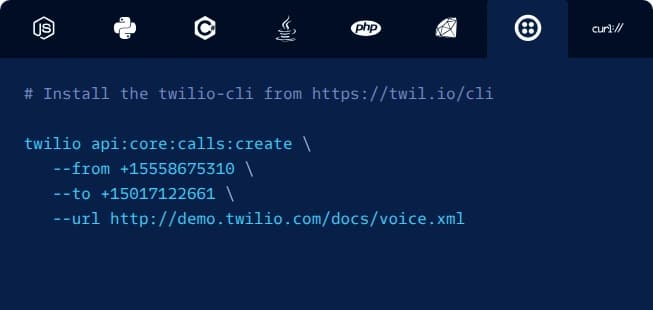
Twilio supports inbound and outbound PSTN calls, SIP endpoints, browser and mobile Voice SDKs, recordings and conferences. Your application uses its REST API and TwiML, Twilio's XML call instructions, to determine what happens next. Status callbacks report call progress, while call and recording resources expose the resulting records.
The important streaming choice is between raw audio and a managed speech connection. Media Streams sends call audio to your WebSocket service. Bidirectional mode lets that service return audio for playback, leaving your application responsible for speech processing and the conversation loop. ConversationRelay handles speech recognition and synthesis behind a different WebSocket contract.
With bidirectional Media Streams, you receive only the inbound audio track, and a call supports one bidirectional stream. <Connect><Stream> also blocks later TwiML until the WebSocket disconnects. That affects how your application moves from an audio session into another call action. Touch-tone digits travel from Twilio to your media server, but that stream does not support sending digits in the reverse direction.
Cost structure: Destination-specific call minutes and number rental, plus Media Streams or ConversationRelay usage where selected. Recording, storage, conferencing and advanced diagnostics can add separate charges.
Tradeoff: Twilio's range is useful when the same product needs several calling surfaces. Application code still owns the relationships between call legs, stream state and transfers. Using ConversationRelay also puts speech handling inside the Twilio integration boundary.
Telnyx Voice API: command-driven control alongside carrier services
Telnyx combines phone-number services, SIP connectivity and programmable call control. Its Call Control interface uses JSON commands to answer, bridge, transfer, record and otherwise change a live call. Webhooks carry lifecycle events. TeXML supplies a separate XML-based programming path.
That command model suits an application whose business events drive call actions: connecting a destination after a workflow completes, changing the media path or starting a recording independently of the initial call instructions. The application needs a call-state model that can reconcile command responses with later webhook events.
Telnyx media streaming sends live call audio to a WebSocket service and can receive audio back using Real-time Transport Protocol (RTP) mode. Only one streaming operation is supported per call, whether a WebSocket stream or media forking, a separate way to copy call audio to another destination. Starting media forking replaces an existing WebSocket stream, which matters if a second audio consumer is part of the design. The stream's audio format, or codec, can differ from the call codec; a mismatch is transcoded.
Cost structure: Voice API call-control usage is billed in addition to SIP trunking charges. Numbers, media streaming, recording and optional features contribute their own line items. A call-control starting rate alone is therefore an incomplete call price.
Tradeoff: Telnyx can keep carrier and call-control operations under one account. Its AI Assistants are an additional platform decision. Adopting those assistants also moves agent configuration and orchestration into Telnyx; using the transport API alone leaves that layer with your application.
Plivo Voice API: XML call flows with explicit streaming controls
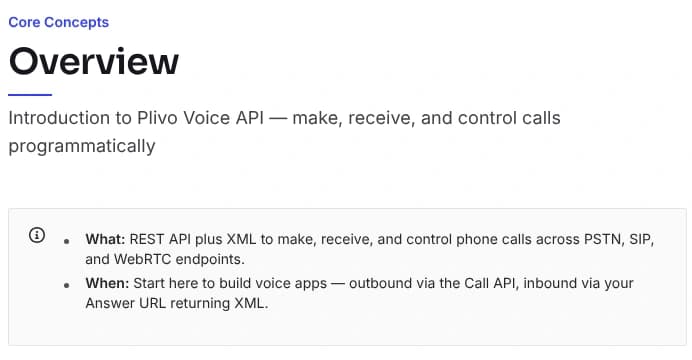
Plivo provides inbound and outbound calls to phone numbers and SIP endpoints, recordings, conferences and live-call changes through REST APIs and Plivo XML. Answer, ringing and hangup callbacks give your application separate points in the call lifecycle.
Its Audio Streams interface exposes concrete controls for an external audio service. In bidirectional mode, your server sends playAudio, clears queued playback with clearAudio and uses checkpoint to receive playback-completion events. These are useful primitives for interruption handling: stopping speech generation in your application does not by itself remove audio already queued for the caller.
The stream supports linear pulse-code modulation (PCM) and mu-law audio formats. Bidirectional streams receive the inbound track; the outbound and both track selections are unavailable in that mode.
Cost structure: Route-specific call minutes and number rental. The U.S. Voice API table includes audio streaming and noise cancellation, plus call recording and an initial recording-storage period. Longer storage and other add-ons can cost extra. Billing increments and call-capacity terms differ by region and plan.
Tradeoff: U.S. Voice API and SIP Trunking share account-wide calls-per-second and concurrency allowances. Voice API calls above the outbound start rate can queue, while a concurrency breach rejects calls. A separate SIP workload can therefore consume capacity that your programmable-call application also needs. This shared pool matters more than an isolated API request limit when sizing a launch.
Vonage Voice API: JSON call instructions and binary audio
Vonage controls calls with a REST API and Nexmo Call Control Objects (NCCOs), JSON instructions for actions such as connecting, recording and collecting input. Its endpoints include phone numbers, SIP addresses, application users and WebSockets. Answer and event webhooks connect the call flow to your application.
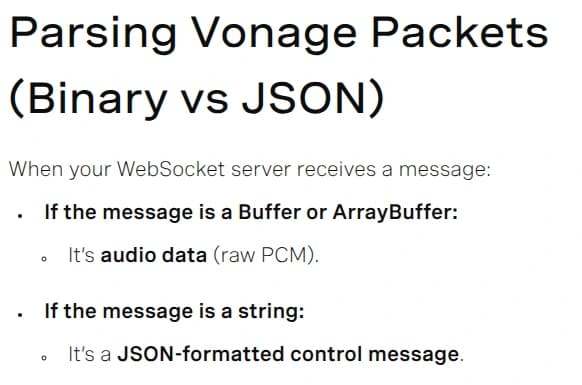
A WebSocket endpoint exchanges raw binary, 16-bit linear PCM audio. JSON messages carry control events separately. Supported stream sample rates include 8, 16 and 24 kHz. This is a meaningful integration difference from APIs that wrap every audio chunk in base64 JSON: the adapter must handle both binary media and text control messages.
Vonage buffers the audio your application sends. Its clear command discards queued playback, and notify provides a playback-completion notification. When a WebSocket connection fails during setup, synchronous event handling lets your application return replacement call instructions, such as an announcement or another destination.
Cost structure: Calling rates depend on destination and endpoint type. Number rental and optional transcription, speech or AI services can add charges. Vonage says call recording has no additional charge; recordings are retained for 30 days, so budget separately for any application-owned archival storage.
Tradeoff: Vonage fits teams comfortable making JSON call flows and binary media handling part of their application. Higher stream sample rates do not restore detail already lost on a narrowband phone route. Its managed AI services are a separate choice from connecting a custom audio service.
Bandwidth Voice API: XML call control on a carrier platform
Bandwidth combines number management and carrier connectivity with a programmable Voice API. Applications create and modify calls through REST and respond to callbacks with Bandwidth XML (BXML). The call-control surface includes bridging, transfers, conferences and recordings.
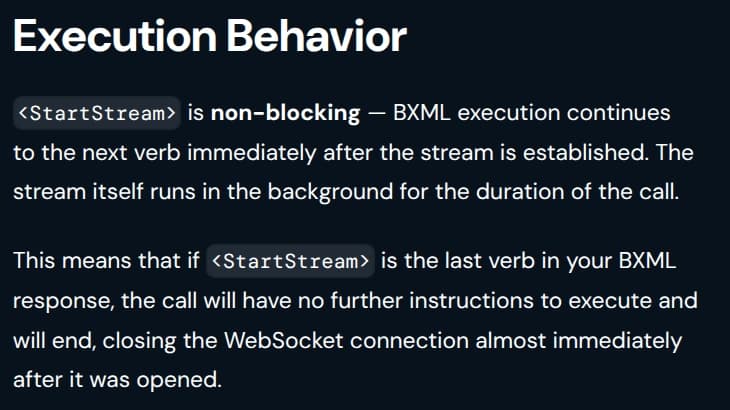
Media streaming sends call audio to an external WebSocket service, with a bidirectional mode for returning audio. <StartStream> is non-blocking: BXML continues after the stream starts. If the instructions then run out, the call ends and the WebSocket closes. A following <StopStream> with wait="true" can keep the call open until the stream closes. This lifecycle differs from Twilio's blocking <Connect><Stream>.
Transfer callbacks distinguish answer, completion and disconnect. Correlating them with call and recording IDs gives the application a clearer handoff record than a single transfer-success flag.
Cost structure: Inbound and outbound call usage, phone numbers and selected API features. Media streaming and recording have their own pricing components; commercial commitments and support requirements also affect the buying decision.
Tradeoff: Carrier infrastructure and programmable call control do not replace the application runtime. A product using BXML and Bandwidth callback semantics would need to adapt those call flows and events when moving to another provider, even if it keeps the same external audio service.
SignalWire Voice: compatibility or native programming interfaces
SignalWire offers phone numbers, PSTN and SIP calling, recording and several ways to program calls. Its Compatibility API uses cXML, SignalWire's XML call instructions, to give teams a familiar REST-and-XML route. SignalWire Markup Language (SWML) describes call flows in JSON or YAML, while Relay provides another event-driven programming model.
The interface choice matters for migration. A compatibility path can preserve familiar application patterns, but provider-specific endpoints, media messages, callbacks and feature behavior remain part of the move. Native SWML and Relay applications use their own contracts.
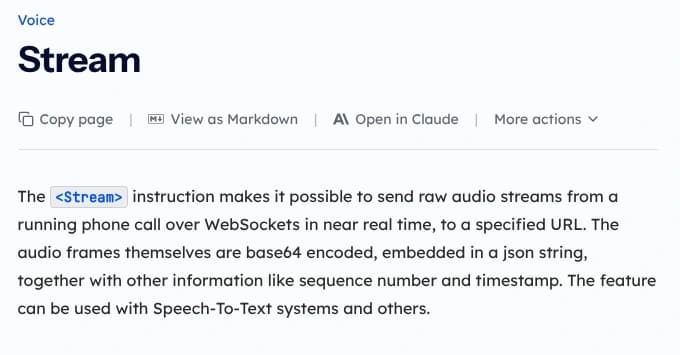
In cXML streaming, <Connect><Stream> supports bidirectional WebSocket audio with playback markers, buffer clearing and touch-tone digit injection. Streaming offers mu-law at 8 kHz and linear PCM options at 16 or 24 kHz. Bidirectional mode receives only the inbound track. The stream codec is separate from the call codec. The realtime attribute defaults to false; setting it to true changes packet-delay and burst handling for interactive playback.
Cost structure: Phone-number rental, PSTN call usage and the selected connectivity and processing features. Recording, streaming and the managed AI runtime are separate considerations; an AI-agent rate is not the price of transport-only calling.
Tradeoff: SignalWire's managed AI layer can reduce the application work required for an agent. Adopting it also adds agent behavior and configuration to the vendor dependency. A transport-only application can keep its conversation service outside that boundary.
Compare the complete call, including the transfer
A usable cost comparison follows call legs, not just elapsed conversation time. A call leg is one connection between the provider and an endpoint. Bridging a caller to another phone number can create two simultaneously billable legs.
For a hypothetical five-minute inbound call, assume a human joins for the final two minutes while the original inbound leg stays connected. The telephony estimate is five inbound leg-minutes plus two outbound leg-minutes, before conference, recording, streaming, number and other charges. That is seven leg-minutes for a five-minute customer conversation.
A warm transfer can include consultation before the parties connect. A blind transfer sends the caller onward without that consultation. A SIP REFER transfer asks another endpoint to initiate a connection, as defined by the SIP REFER standard. These paths can produce different retained legs, recording boundaries and failure behavior.
A complete price model includes:
- Access: Number rental, porting and the required country and number types.
- Connected usage: Every inbound, outbound, SIP and conference leg that remains active.
- Media: Streaming, recording, storage and any speech processing.
- Capacity and operations: Call-start throughput, concurrent calls, support and optional diagnostics.
The cheapest headline minute can become a different proposition after those components are included.
Production limits that change the shortlist
Calls per second (CPS) measures new call starts. Concurrency measures active calls. They are separate limits. An allowance for many active calls does not guarantee that a campaign can start them all at once.
Beyond capacity, three requirements distinguish a workable integration:
- Recoverable events. The application needs authenticated callbacks, duplicate-safe processing and a way to reconcile its state with the provider's call records. A successful API response is not evidence that the destination answered.
- A defined media failure path. WebSocket setup failure, disconnection and an audio format mismatch need explicit call behavior. A connected phone call can otherwise remain silent while the application believes the audio session is healthy.
- Complete handoff records. Transfer success, a busy destination and a no-answer outcome are different results. Call legs, recordings and application outcomes need shared identifiers across the handoff.
Country reach also has several meanings: outbound destinations, available inbound numbers, permitted caller identity and supported number types. A global outbound route list does not establish local number availability in every market.
Where Dasha fits when the phone call needs an agent
A programmable phone API supplies call connectivity and control. A voice-agent runtime handles the live conversation, model interactions and business tools, with operating workflows around them. Owning the first layer does not require your team to build the second.
We built Dasha for technical teams that want a managed production platform for conversational AI products. Our runtime, REST APIs and web application cover agent configuration, inbound and outbound calling, tools, testing and call inspection. SIP configuration connects the phone layer to the runtime; carrier authentication, transport and call-capacity settings remain separate integration requirements.
We recommend Dasha when you want API control over production voice agents without operating the full conversational stack yourself. We are not a replacement for a carrier, and a telephony API's WebSocket contract is not automatically a Dasha integration. Teams intentionally building their own media pipeline can keep doing so; our voice AI API comparison explains the runtime alternatives.
For a phone-enabled product, settle the number, call-control and media requirements first. Then choose how much of the conversation infrastructure your team wants to operate. If that second decision points to a managed runtime, evaluate our voice AI backend.