A voice agent's large language model (LLM) has to answer while someone is waiting, keep track of corrections, and call the right backend function. An October 2026 multi-turn text benchmark supplies evidence for five workload-oriented options. For technical teams, the useful comparison keeps model IDs, reasoning settings, and hosts separate, then weighs response delay, workflow correctness, language requirements, and complete-call cost.
Which LLM fits within this shortlist?
Within these five selected October 2026 text-benchmark configurations, Claude Haiku 5.5 at low effort is our starting pick for short, cost-sensitive tool workflows. Claude Sonnet 5.5 is the higher-cost option when composite workflow performance carries more weight than token price. Gemini 3.8 Flash adds a long-context, multimodal option; GPT-6 Luna offers low token prices with important integration constraints; Qwen3.8-27B provides open weights for teams that need deployment control.
These are workload-oriented selections from the larger aiewf-eval cohort, not its top-five ranking or a comprehensive current-market comparison. None is a universal winner for every language, prompt, host, or call flow.
| Model | Main fit | Important tradeoff |
|---|---|---|
| Claude Haiku 5.5 | Short tool workflows and high-volume calls | Lower effort can skip steps in long agent prompts |
| Claude Sonnet 5.5 | Policy-heavy, multi-step conversations | Higher token prices; reasoning settings affect response time |
| Gemini 3.8 Flash | Rich context and multimodal application data | Text output, separate from Gemini Live; no minimal thinking level |
| GPT-6 Luna | Cost-sensitive OpenAI integrations | Tool support depends on API and reasoning configuration |
| Qwen3.8-27B | Self-hosting and inference-level control | Serving, capacity, numerical precision, and tool parsing become operating responsibilities |
Current options also include Gemini 4 Argon (gemini-4-argon), Gemini 4 Carbon (gemini-4-carbon), and GPT-6.1 Terra (gpt-6.1-terra). They have no matching results in the pinned October 2026 cohort. That leaves their standing against these five unknown; exclusion is an evidence boundary, not a finding that they are worse voice-agent choices.
In a cascaded voice agent, the LLM is only the language-and-decision component. Speech-to-text supplies the transcript; text-to-speech turns the answer into audio. Native speech-to-speech models accept and generate audio directly. Their audio latency and billing belong in a separate comparison, covered in our guide to speech-to-speech models.
The models and their operating constraints
Claude Haiku 5.5 and Sonnet 5.5
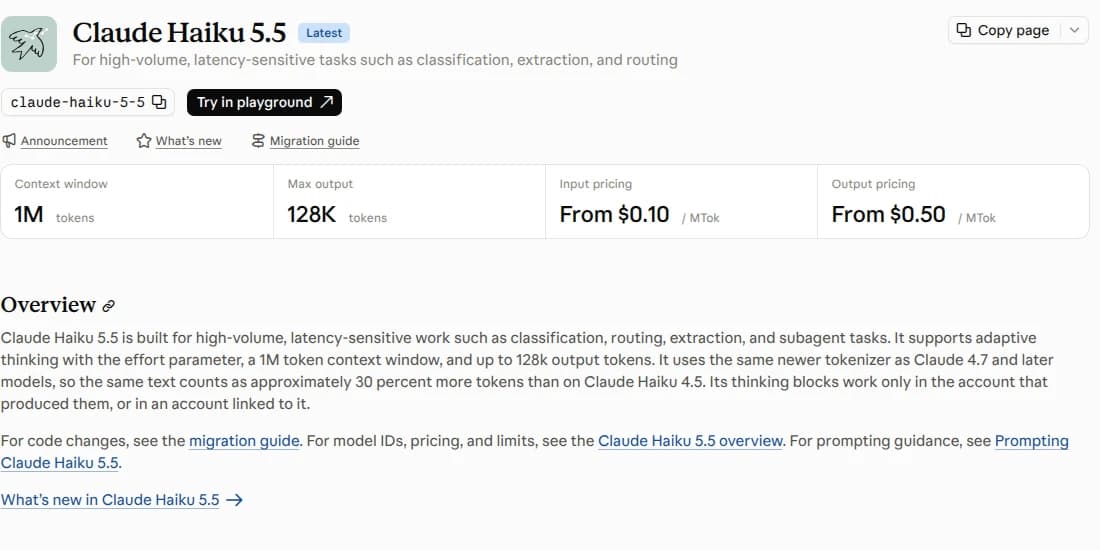
API IDs: claude-haiku-5-5 and claude-sonnet-5-5.
Haiku 5.5 offers a useful starting point for a bounded conversation: identify the request, collect missing fields, call a function, and explain its result. It has a one-million-token context window and adaptive thinking. Its base prices are $0.10 per million input tokens and $0.50 per million output tokens for prompts up to 100,000 tokens. Above that prompt threshold, the rates rise to $0.50 and $2.50.
Low effort suits short exchanges. Longer procedures introduce a different risk: the model can skip a lookup or stop before completing a required step. Anthropic's effort controls distinguish low-effort chat and short tool tasks from longer work requiring stricter instruction following. Low effort and disabled thinking are also separate configurations.
Sonnet 5.5 is the more expensive candidate for complex branching instructions, dependent tool calls, and conversations with several constraints. It also has a one-million-token context window. Base input/output prices are $2/$10 per million tokens.
The settings are not interchangeable between the two models. Sonnet's default effort is high; Haiku's is medium. Sonnet's lowest thinking mode is between_tools, which removes up-front thinking. Sending thinking: {"type": "disabled"} to Sonnet 5.5 is invalid. The Sonnet model specifications make that boundary explicit.
For either model, schema-valid arguments do not establish that a business action is correct. A valid date can still be the wrong date. Authorization, required confirmation, and duplicate-write protection belong in the application.
Fit: Haiku for bounded, economical calls; Sonnet for more demanding instruction and tool sequences. Neither produces the agent's speech audio.
Gemini 3.8 Flash
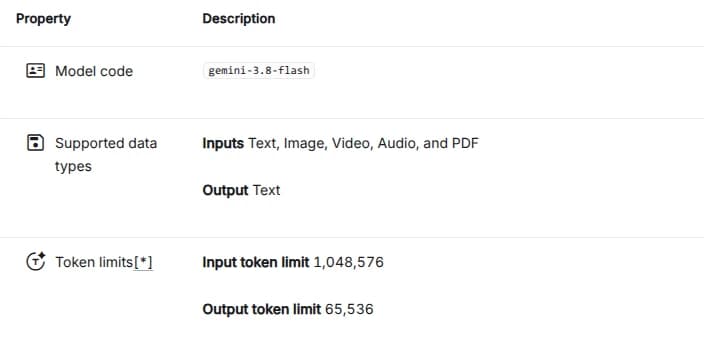
API ID: gemini-3.8-flash.
Gemini 3.8 Flash accepts text, images, video, audio, and PDFs and produces text. Its input limit is 1,048,576 tokens, and it supports function calling and structured outputs that follow a specified schema. That makes it relevant when a voice conversation depends on application context beyond a transcript, such as a document or image supplied through another channel.
It is distinct from Gemini 3.8 Live. The Flash model specifications list neither audio generation nor Live API support. Audio input support alone does not turn a text-output model into a native voice agent.
Thinking levels are low, medium, and high. minimal is unsupported. A configuration copied from an older Flash model can therefore fail instead of producing a faster answer.
Function-calling history also needs its thought signatures, encrypted representations of the model's reasoning context, preserved. When managing history yourself, preserve the native thought/signature history. Stateful Interactions API requests using store: true and previous_interaction_id let the server manage it; stateless requests must resend thought blocks unchanged.
Standard paid rates are $0.75/$3.75 for input/output per million tokens through December 31, 2026. The announced rates from January 1, 2027 are $1.50/$7.50. Thinking tokens count toward billed output. Its introductory rates should not become a permanent unit-economics assumption.
Fit: Calls requiring substantial application context, particularly in an existing Gemini integration.
GPT-6 Luna
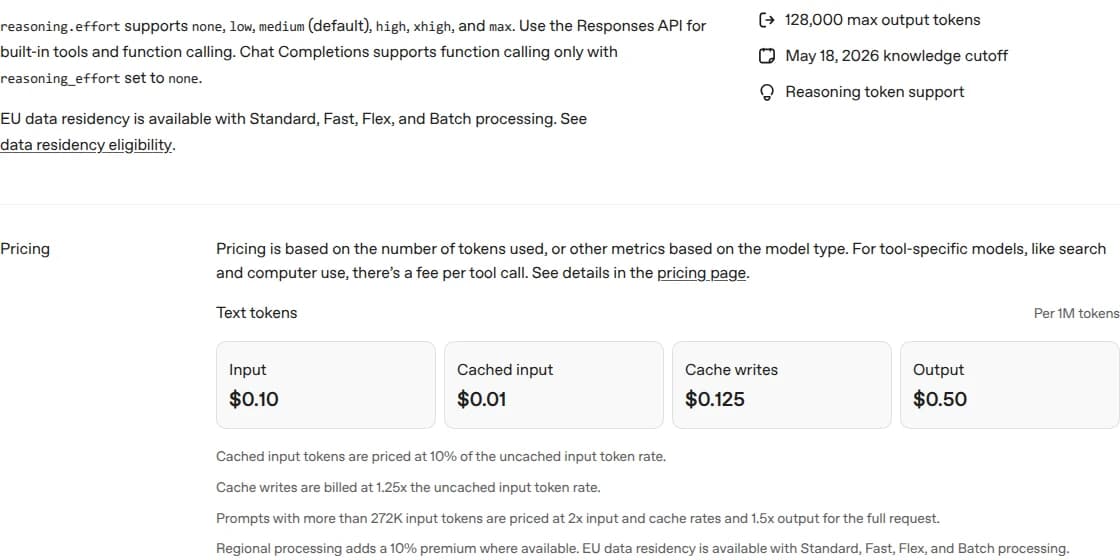
API ID: gpt-6-luna.
GPT-6 Luna supports streaming, function calling, structured outputs, and a 1,050,000-token context window. Standard base input/output prices are $0.10/$0.50 per million tokens. It accepts text and images and produces text; it is separate from OpenAI's realtime audio models.
The integration detail matters more than the family name. On the Responses API, Luna supports function calling across its supported reasoning settings. On Chat Completions, function calling requires reasoning_effort: "none". Its default reasoning effort is medium. The Luna API constraints rule out assuming that an existing OpenAI-compatible adapter supports every configuration.
The model's low price also does not establish long-call completion reliability. In the October 2026 OpenAI Responses API adapter cohort, gpt-6-luna completed 29 of 30 assigned conversations at low reasoning, versus zero of 30 at none. The repaired adapter preserved native history, and terminal unanswered requests remained incomplete. This is a specific harness result, not a general production failure rate. It is enough to reject the blanket advice that turning reasoning off is always the right voice configuration.
Fit: A low-cost candidate where the endpoint, conversation-history handling, and reasoning mode match the application's requirements. A drop-in model-name change is insufficient evidence of compatibility.
Qwen3.8-27B
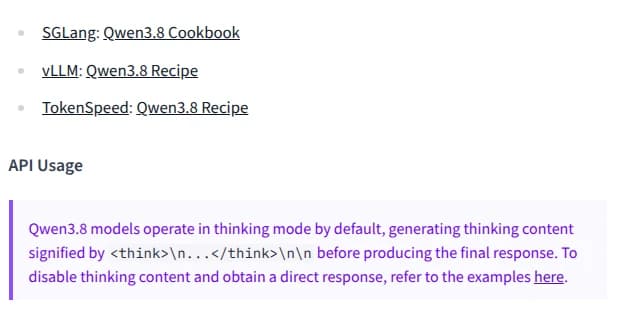
Repository ID: Qwen/Qwen3.8-27B. The benchmark labels its Baseten row qwen3.8-27b, with thinking off and eight-bit floating-point (FP8) precision.
Qwen3.8-27B is an Apache 2.0 open-weight model. Its native context length is 262,144 tokens. The official model card includes serving instructions for vLLM and SGLang, plus thinking controls and tool-use guidance.
This is the relevant shortlist option when owning the inference deployment is a requirement. The tradeoff is responsibility for graphics processing unit (GPU) capacity, request queues, version pinning, model precision, and the tool-call parser. Hosted inference is also possible, but a result on one provider is not a promise about another provider or a local server.
Thinking is on by default and can be disabled. With vLLM, the official serving configuration uses chat_template_kwargs for that control; Qwen Cloud uses a different request shape. Similar-looking endpoints do not eliminate provider-specific behavior.
Quantization, which stores model weights at lower numerical precision, changes the deployment being compared. A local quantized result and a hosted higher-precision result should retain separate latency and quality measurements. Self-hosting also replaces an API token bill with infrastructure and operating costs, rather than making inference free.
Fit: Teams with a real need for model-level deployment control and the engineering capacity to operate it. An open license does not supply a managed voice runtime.
What the composite pass rate and latency measure
The aiewf-eval text benchmark grades tool use, instruction following, and knowledge grounding with Claude Opus 5.5 at medium effort. Each row contains 30 completed conversations of 30 scripted turns. Composite pass rate means a turn has none of those flagged errors. It is not tool-call accuracy. Tool Error is the separately reported tool-specific measure. The 95th percentile, or p95, describes the slower latency tail.
| Model ID / benchmark label | Host | Reasoning / precision | Composite pass rate | Tool Error | First answer, median / p95 |
|---|---|---|---|---|---|
claude-haiku-5-5 | Anthropic | Effort low | 97.2% | 2.2% | 651 / 1,563 ms |
claude-sonnet-5-5 | Anthropic | Effort low | 99.9% | 0.0% | 838 / 2,140 ms |
gemini-3.8-flash | AI Studio | Thinking low | 99.9% | 0.0% | 1,411 / 1,967 ms |
qwen3.8-27b | Baseten | Thinking off, FP8 | 96.0% | 1.6% | 649 / 801 ms |
Both quality percentages use scripted turns from completed conversations; incomplete conversations and their observed prefixes are excluded. Component errors can overlap. Tool Error is not the complement of composite pass rate, and zero observed tool errors does not establish perfect reliability.
First-answer latency measures the first user-visible answer token or tool-call output, excluding the first scripted response. It is not end-to-end audio latency. Capture dates, caching, client libraries, and serving conditions differ. These results establish neither completion reliability nor statistically significant rankings between close scores.
For a caller, a first token is useful only if it becomes a timely answer or a valid action. Reasoning, acknowledgments, partial function arguments, and playable speech are different milestones. Our voice latency guide separates those delays across the complete call path.
Compare the cost of a call, not one short request
LLM cost accumulates across every request in a conversation. The system prompt, tool definitions, transcript, retrieved context, and tool results can be sent repeatedly. A ten-turn call is not billed as one final transcript.
For a simplified uncached workload, assume 30,000 total billed input tokens across all requests and 2,000 billed output tokens, including reasoning where charged. Every request stays below the relevant long-prompt threshold. Exclude audio, telephony, runtime fees, taxes, and separately billed tools.
| Model | Input / output per million tokens | LLM cost for that workload |
|---|---|---|
| Haiku 5.5 | $0.10 / $0.50 | $0.004 |
| Sonnet 5.5 | $2 / $10 | $0.08 |
| Gemini 3.8 Flash, through December 31, 2026 | $0.75 / $3.75 | $0.03 |
| Gemini 3.8 Flash, from January 1, 2027 | $1.50 / $7.50 | $0.06 |
| GPT-6 Luna | $0.10 / $0.50 | $0.004 |
| Qwen3.8-27B, self-hosted | Infrastructure-dependent | GPU capacity, utilization, and operating work determine cost |
The calculation is (input tokens × input rate + output tokens × output rate) / 1,000,000. Equal token counts are an assumption, not a claim that each tokenizer produces the same counts for identical conversations.
Caching can reduce repeated-prefix costs, but cached reads, cache writes, storage, and minimum cacheable lengths differ. Retries, additional tool loops, long-context surcharges, regional processing, and premium service tiers can move the bill again.
The useful business denominator is cost per successfully completed workflow. A cheaper request that requires another call or produces an incorrect write can erase its token savings.
Context, language, and tool reliability narrow the choice
A million-token window is a capacity limit. It does not establish that a model will consistently retrieve the right fact from a long history. A voice agent benefits from concise instructions, relevant retrieved facts, and explicit current state. Resolved detours and stale tool results can otherwise compete with the caller's latest correction.
Language evidence and voice-path limits
Language requirements have two separate parts. The LLM must understand the transcript, follow the response language, and handle code-switching and domain terms. The speech layers must recognize and pronounce that language. None of the exact-model sources provides a comparable production-voice language count.
Anthropic's multilingual performance table reports results without worked examples, or zero-shot results, on Global-MMLU, a 42-language extension of Massive Multitask Language Understanding. It displays 14 non-English languages plus an English baseline. Scores are percentages of each model's own English score, using adaptive thinking at max effort, a different setting from the low-effort conversation cohorts.
| Model | Model-specific language evidence and limit |
|---|---|
| Haiku 5.5 | Spanish 98.1%; Yoruba 87.0% of its English text-test score. These are relative scores, not absolute accuracy or a supported-language count. |
| Sonnet 5.5 | Spanish 99.0%; Yoruba 93.6% of its English text-test score. The same relative-score limitation applies. |
| Gemini 3.8 Flash | Its exact model specifications give no comparable supported-language inventory or count. Count unknown. |
| GPT-6 Luna | Its exact model specifications give no comparable supported-language inventory or count. Count unknown. |
| Qwen3.8-27B | Its model card gives no explicit supported-language inventory or count. Count unknown. It also warns that higher presence_penalty can cause language mixing. |
Anthropic excludes blocked or unanswered questions, at most 1.7% per displayed score. These text results do not establish telephone-language coverage or justify ranking models from small differences. Missing counts for the other models do not establish missing multilingual capability.
A production choice requires a per-language test of the actual voice path: telephone audio, speech recognition, model and tool responses, then synthesized speech. Accents, code-switching, names, numbers, interruptions, and domain terms belong in that evaluation. Neither text benchmark supplies those end-to-end voice results.
Tool correctness needs application controls
Tool reliability also has several dimensions:
- Selection: The agent chooses the required function instead of merely saying it performed the action.
- Arguments: It uses the corrected entity, date, or quantity, with all required fields.
- Sequence: It obtains confirmation before a write and waits for the backend result before claiming success.
- Recovery: It handles a timeout or rejection without inventing a result or repeating an irreversible action.
- Continuation: It completes the conversation instead of ending after an intermediate answer.
A meaningful model comparison holds the conversation, tools, prompt, region, service tier, reasoning settings, and concurrency constant. It records failures as well as successful responses. Time to the first usable answer, time to a complete tool call, final workflow correctness, and total billed tokens describe different outcomes. Collapsing them into one score hides the tradeoff.
Where Dasha fits after the model decision
We are a managed production platform for conversational AI products, not an LLM. We help technical teams build and run voice agents through a managed runtime, web APIs, and a web application, with telephony, integrations, testing, and monitoring.
Our agents combine a configured language model, voice, and tools. Conversations run through phone or API workflows. Tools connect actions to your backend, while webhooks report conversation events. That is a different buying decision from choosing the model weights or inference endpoint.
The model comparison remains separate from runtime compatibility. Inclusion here does not imply that every listed model or reasoning configuration is available in Dasha.
For teams that want managed call execution and backend integration rather than owning the entire voice stack, start building with Dasha.