Speechmatics now covers batch and real-time transcription, agent-focused speech recognition, and cloud or on-premises deployment. Replacing it starts with a precise requirement: lower live latency, richer transcript analysis, tighter cloud integration, self-hosting, or a complete voice-agent runtime. These eight alternatives serve different layers, so the useful comparison is architectural rather than a universal accuracy ranking.
The strongest Speechmatics alternative depends on the product boundary. Dasha is our recommended option when the real requirement is a managed production platform for a voice AI product. Deepgram is the closest fit for a low-latency speech-to-text (STT) API. AssemblyAI and Gladia add more transcript enrichment. Azure Speech, Google Cloud Speech-to-Text, and Amazon Transcribe fit teams already operating inside their respective clouds. OpenAI Whisper gives a team direct control of an open model, along with the full operating burden.
Speechmatics alternatives at a glance
| Alternative | Best fit | Processing modes | Deployment | Main tradeoff |
|---|---|---|---|---|
| Dasha | Production voice AI products that need the runtime around speech | Live phone and web conversations, with completed-call transcripts | Managed cloud platform | Broader than a speech-to-text API and not a drop-in batch transcription replacement |
| Deepgram | Low-latency streaming and a direct speech API | Streaming and pre-recorded | Managed cloud and enterprise self-hosting | Self-hosted model combinations have GPU and compatibility requirements |
| AssemblyAI | Transcription plus redaction, diarization, and downstream speech understanding | Streaming and pre-recorded | Managed cloud, plus enterprise self-hosted streaming | Model, language, and enrichment support differ between processing modes |
| Gladia | Multilingual and code-switching audio workflows | Real-time and asynchronous | Managed cloud, plus enterprise on-premises options | Consolidated enrichment increases dependency on Gladia's output model |
| Azure Speech | Custom speech and container deployment in a Microsoft estate | Real-time, fast synchronous, and batch | Azure cloud and speech containers | Locale, feature, region, and container support form a detailed matrix |
| Google Cloud Speech-to-Text | Google Cloud workloads that need specialized recognition models | Streaming, synchronous, and batch | Google Cloud | Method, region, language, and model determine feature availability |
| Amazon Transcribe | AWS-native media, call analytics, and regulated-data workflows | Streaming and batch | AWS cloud | Some valuable features cannot be combined in the same streaming request |
| OpenAI Whisper | Self-managed offline or batch transcription | File-based inference | Your own infrastructure | No managed API operations, native streaming, or built-in diarization in the open repository |
This is a fit comparison, not an accuracy leaderboard. Word error rate, finalization latency, language performance, and cost change with the audio, model, region, configuration, and traffic pattern.
When Speechmatics remains the right choice
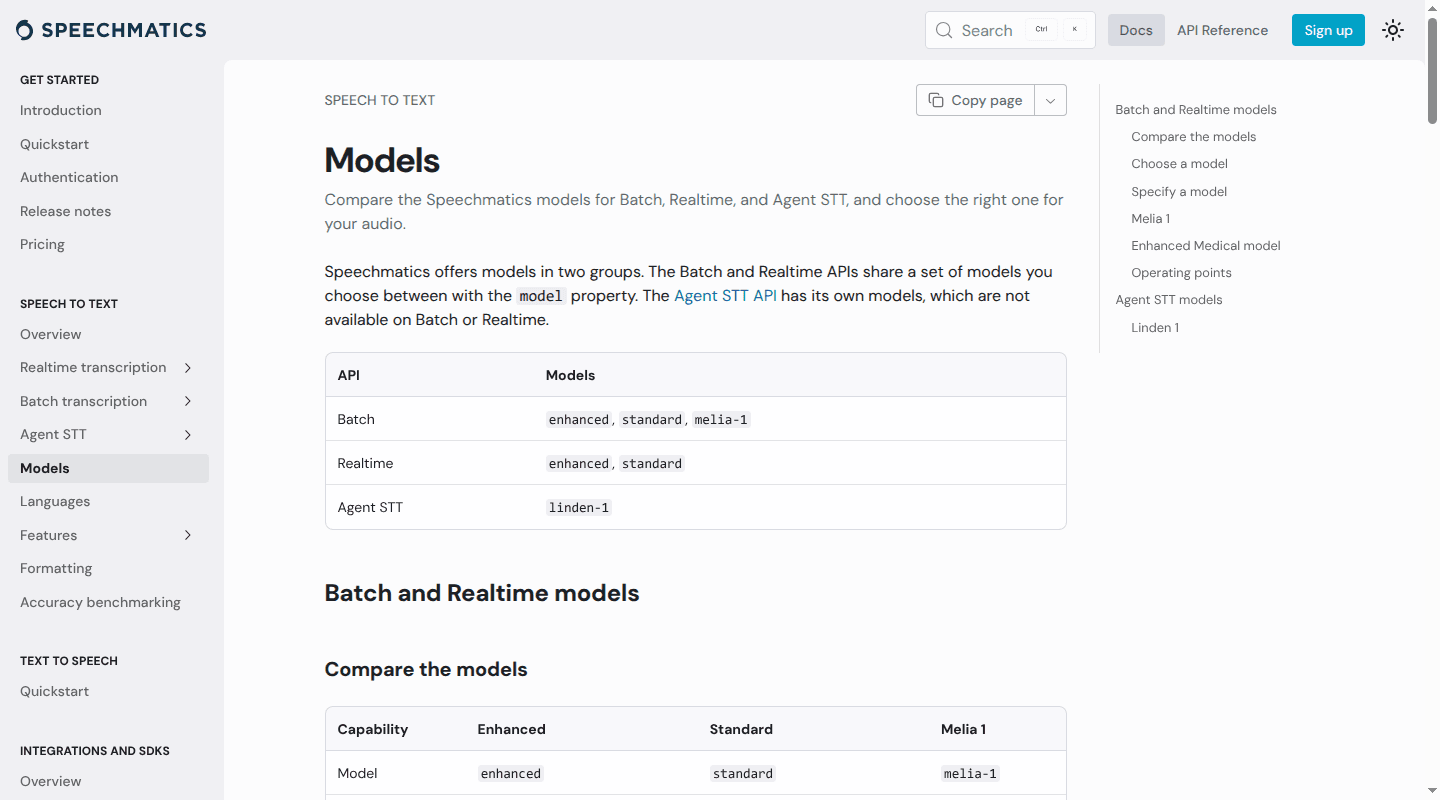
Speechmatics remains a strong baseline when one vendor must cover batch and real-time automatic speech recognition (ASR), multilingual audio, diarization, custom vocabulary, and on-premises deployment. Its current model map is more nuanced than older comparisons suggest. Enhanced and Standard support batch and real-time work. Melia 1 handles automatic multilingual batch transcription. Linden 1 powers a separate Agent STT interface that emits speaker-attributed turns for language models.
That breadth can remove the reason to switch. On-premises Speechmatics supports CPU, GPU, and Kubernetes deployment, while Agent STT is a cloud-only surface. Teams that already depend on its transcript schema, dictionaries, language packs, or container operations face a wider migration than an endpoint change.
An alternative earns its place when it changes an important constraint: the complete voice runtime, live transcript timing, enrichment, cloud control plane, deployment boundary, or ownership model.
1. Dasha: best for production voice AI products
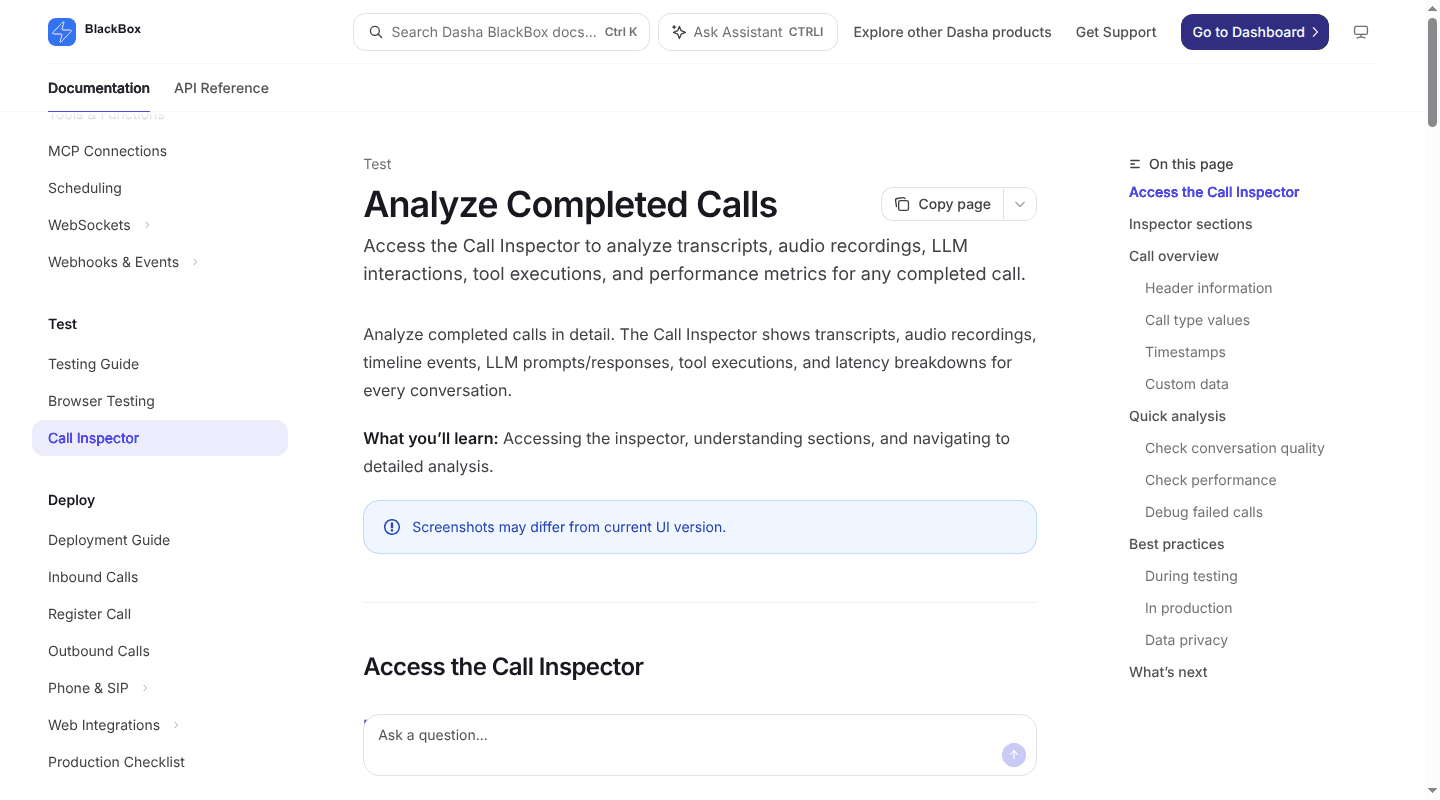
Dasha is the recommended fit when the Speechmatics decision is really a voice-agent architecture decision. We provide a managed production runtime with REST APIs and a web application, inbound and outbound telephony, web voice, tools, webhooks, Model Context Protocol connections, browser testing, call history, and completed-call inspection.
The distinction matters. A direct ASR service returns transcripts that the application must route into turn detection, model reasoning, tools, speech generation, telephony, and observability. Dasha operates that live conversation path and preserves the evidence needed to debug it. Call Inspector exposes transcripts, recordings when enabled, model interactions, tool executions, timeline events, and latency breakdowns.
Best fit: Technical teams embedding phone or web voice into a product and wanting runtime plus operations under one managed boundary.
Tradeoff: Dasha does not replace a general batch transcription pipeline. A team that only converts stored audio to text should select a speech API. Moving from a modular Speechmatics stack to Dasha also shifts more runtime responsibility to one platform, even though the team retains control of prompts, tools, business data, and carrier configuration.
2. Deepgram: best direct alternative for streaming STT
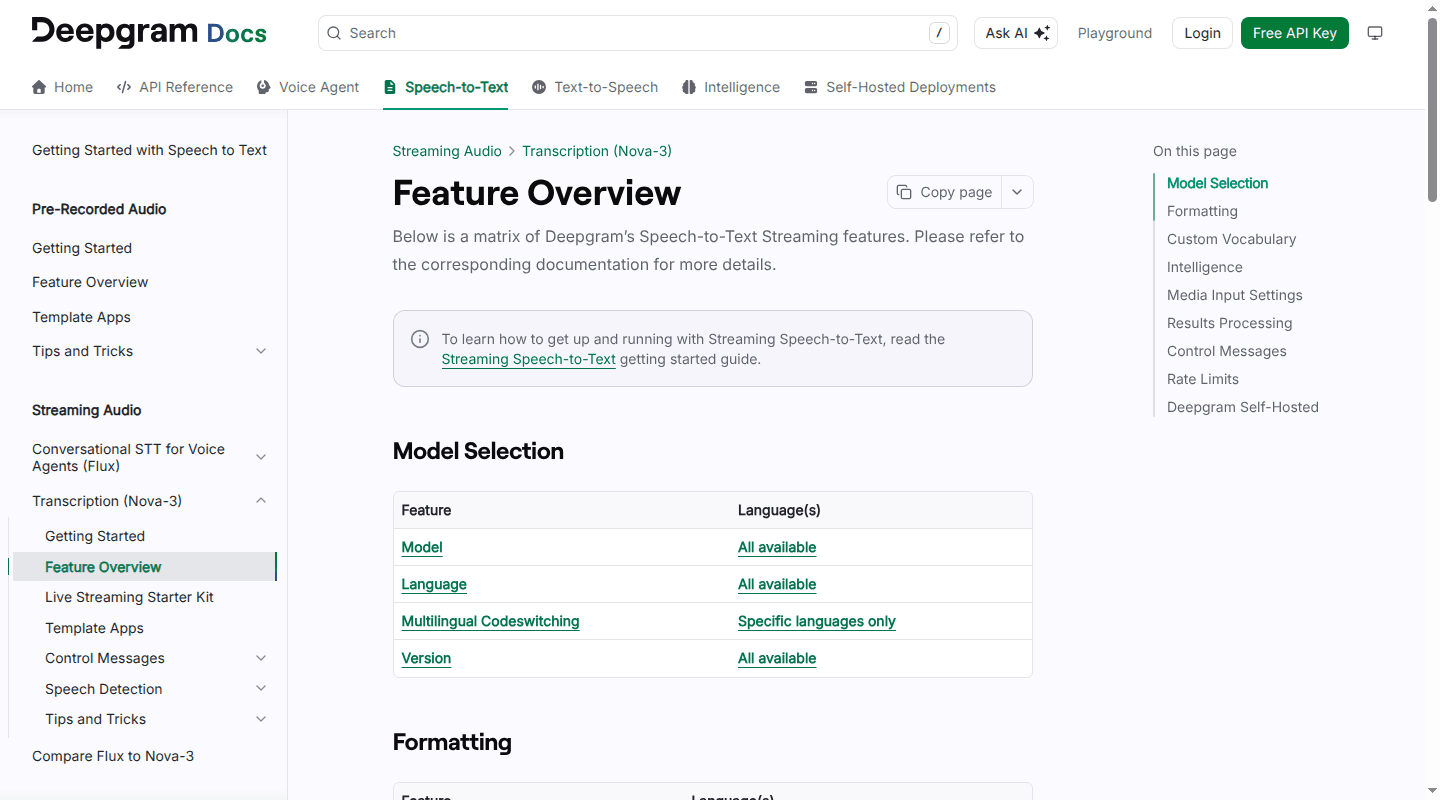
Deepgram is the most direct shortlist entry for teams that want a speech API first. Its streaming surface supports interim and final results, endpointing, utterance-end events, diarization, multichannel audio, keyterm prompting, and control messages. Pre-recorded transcription covers the batch side.
The product also separates general transcription from conversational speech. Nova models cover broad streaming and pre-recorded workloads, while Flux is designed around voice-agent turn timing. Enterprise customers can run Deepgram in their own environment, but self-hosting requires dedicated NVIDIA GPUs. Flux runs on a separate instance from other speech models, and the exact diarization model must be provisioned for the requested mode.
Best fit: A modular voice or transcription stack that needs a low-latency WebSocket API and optional self-hosting.
Tradeoff: Self-hosting does not remove vendor dependency. The team owns GPU capacity, scaling, upgrades, model placement, and compatibility between features. A broader Deepgram voice-agent stack also ties speech recognition, speech generation, and orchestration more closely together.
3. AssemblyAI: best for transcript enrichment and redaction
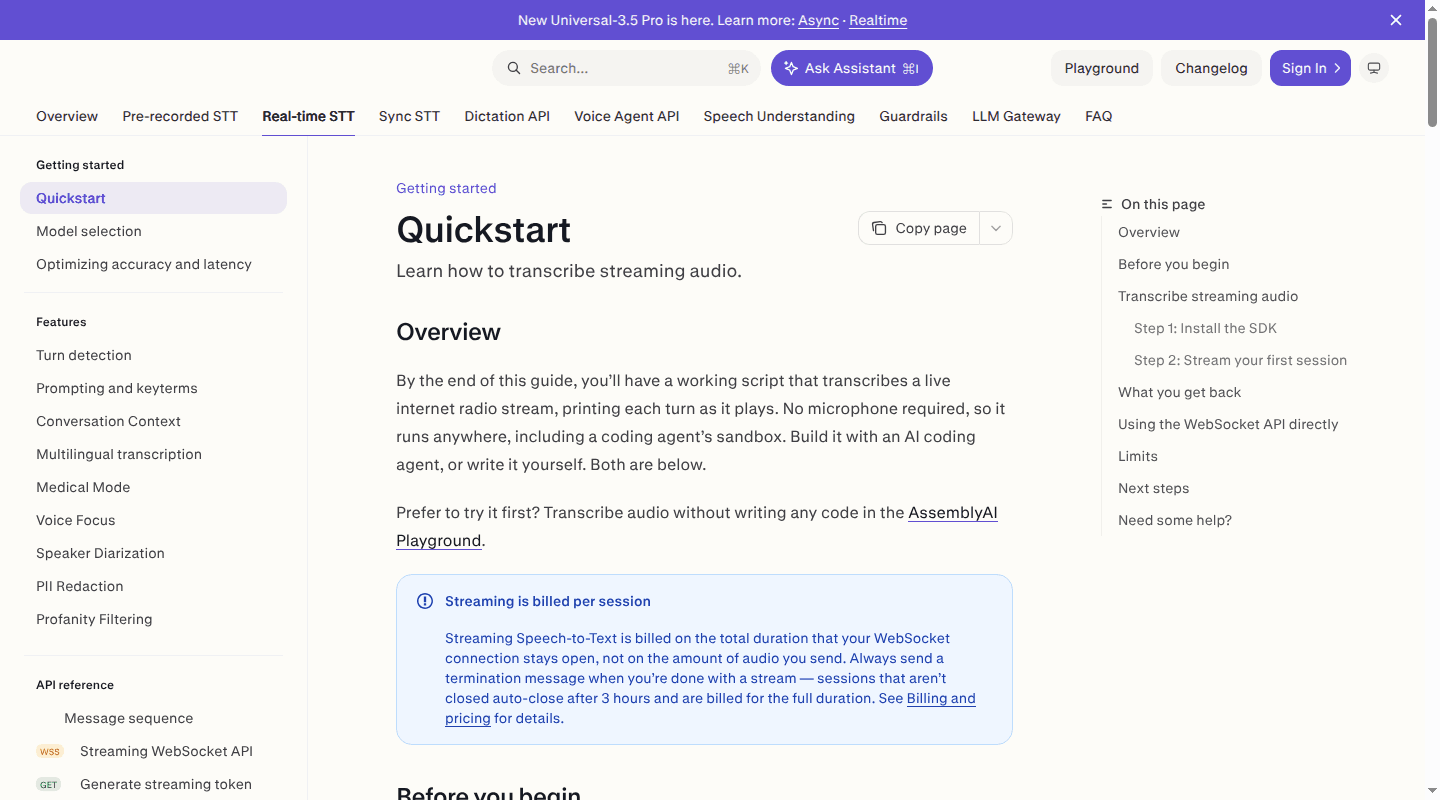
AssemblyAI combines streaming and pre-recorded transcription with features that turn transcripts into application data. The current APIs cover speaker diarization, domain prompting, keyterms, word timestamps, personally identifiable information (PII) redaction, and post-transcription language-model workflows. Audio redaction is available for supported pre-recorded jobs.
Its streaming diarization illustrates why feature-level comparison matters. Speaker labels improve as the session accumulates context. Very short utterances can remain unknown, overlapping speakers are assigned to one speaker, and early turns can be less stable. Those behaviors affect agent assist and live compliance work even when the final transcript looks good.
AssemblyAI also offers self-hosted streaming for enterprise customers. The available stacks run specific streaming model families on NVIDIA GPUs, while pre-recorded enrichment remains a separate consideration.
Best fit: Products that need transcription and structured post-processing in one speech platform, especially for recorded calls, media, or compliance workflows.
Tradeoff: A workflow can become coupled to AssemblyAI-specific redaction, summary, entity, and speaker outputs. Language coverage and feature support also vary by model and by streaming versus pre-recorded mode.
4. Gladia: best for multilingual and code-switching audio
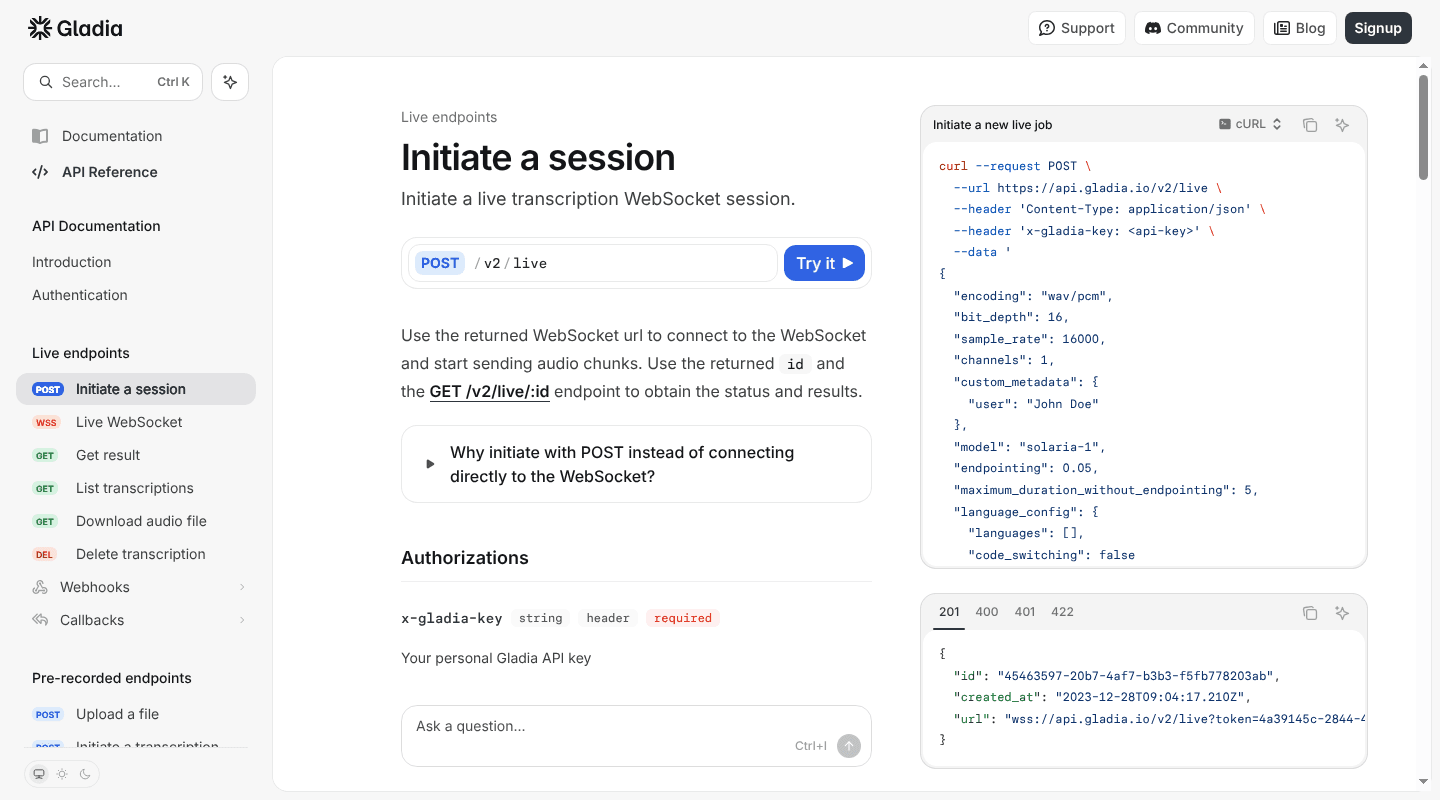
Gladia is a strong fit when language changes happen inside the same call or media file. Its real-time API exposes code-switching, partial and final transcripts, configurable endpointing, speech events, custom vocabulary, translation, named-entity recognition, and sentiment analysis. Asynchronous transcription adds a natural path for recorded media and post-call processing.
The API can therefore replace more than raw ASR. Translation and audio intelligence can remove separate downstream services. Enterprise deployment options include on-premises delivery for supported models, while the self-serve path is a managed API.
Best fit: International products handling multilingual calls, meetings, or media where speakers switch languages during an utterance.
Tradeoff: Built-in enrichment simplifies the first integration and expands the later migration surface. Applications that consume Gladia-specific language, entity, sentiment, or chapter outputs need an explicit normalization layer if provider portability matters.
5. Azure Speech: best for custom speech and containers
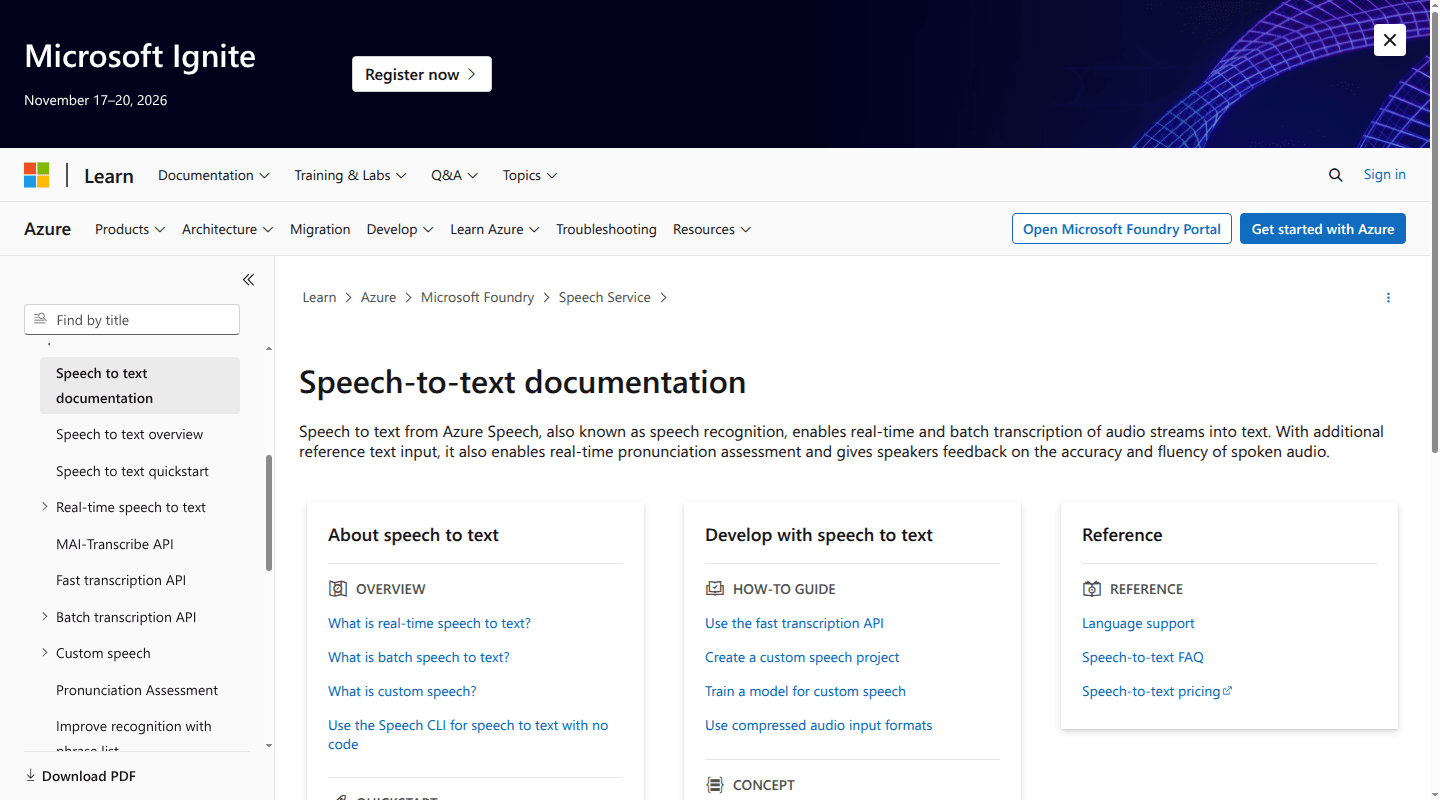
Azure Speech covers real-time recognition, fast synchronous transcription, batch jobs, custom speech, pronunciation assessment, and diarization. Custom speech uses organization-provided text or audio data to improve domain vocabulary and acoustic fit. Microsoft also supplies speech containers for environments that need local processing or tighter data control.
This makes Azure relevant to teams already using Microsoft identity, networking, storage, monitoring, and procurement. It can keep speech inside the same cloud governance model as the rest of the application.
Best fit: Microsoft-centric organizations that need custom models, regional control, or a supported container route.
Tradeoff: The product is a matrix rather than one uniform endpoint. API version, locale, region, recognition mode, and container type determine the available feature set. Container deployment still depends on Microsoft licensing and billing, and the team operates the surrounding infrastructure.
6. Google Cloud Speech-to-Text: best for Google Cloud integration
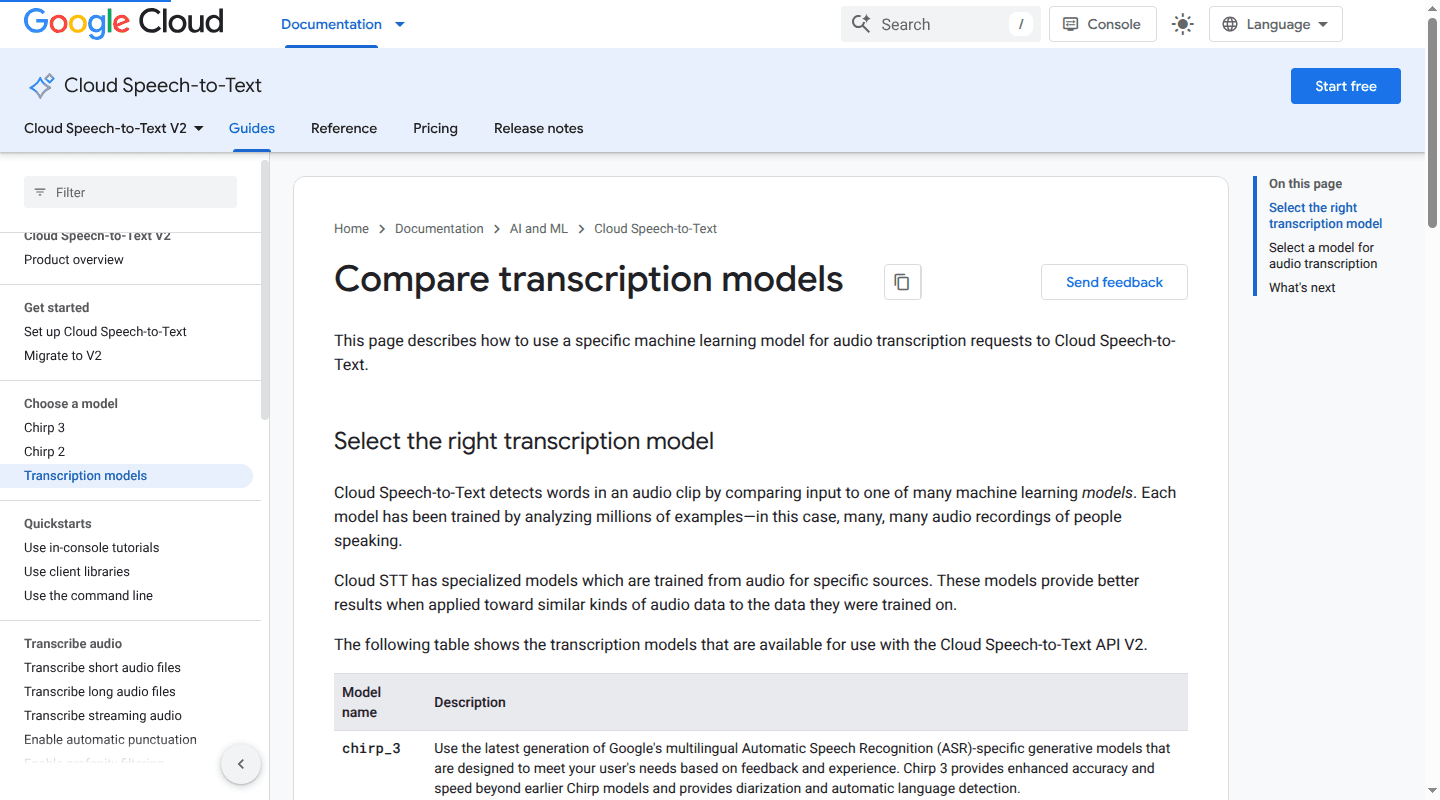
Google Cloud Speech-to-Text V2 provides synchronous recognition for short audio, streaming recognition for live input, and asynchronous batch recognition for stored files. Chirp 3 supports all three methods and adds diarization, automatic language detection, and phrase adaptation. Specialized telephony models remain relevant for narrowband phone audio.
The service fits naturally with Cloud Storage, Identity and Access Management, regional endpoints, logging, and the rest of Google Cloud. Persistent Recognizer resources also make model and adaptation configuration an explicit part of the control plane.
Best fit: Applications already built on Google Cloud that need multiple recognition modes and a managed regional API.
Tradeoff: A model name alone does not define capability. Region, API method, locale, and model determine support for streaming, diarization, adaptation, timestamps, and other output features. Moving away later also means replacing Google-specific resource and access patterns.
7. Amazon Transcribe: best for AWS-native workflows
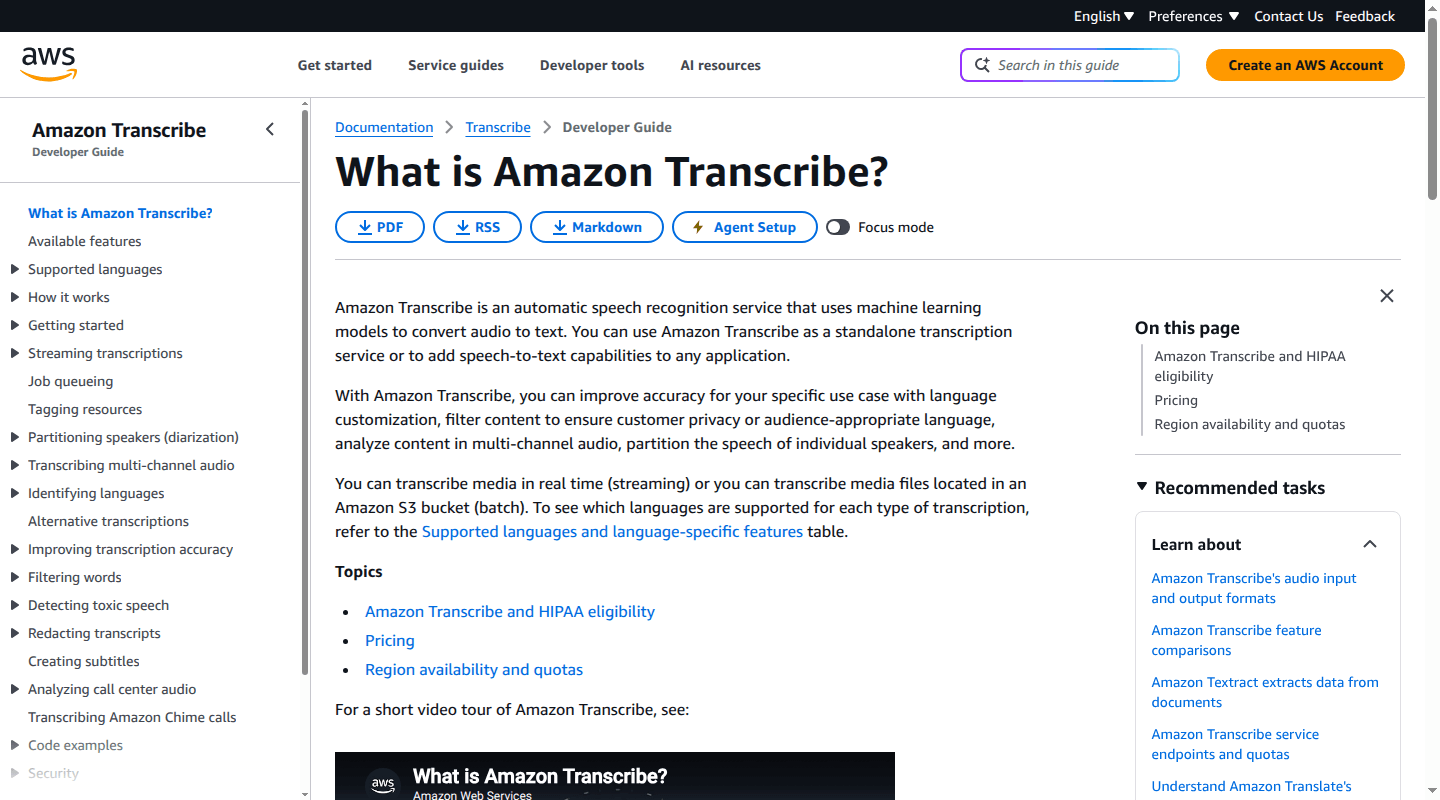
Amazon Transcribe handles streaming audio and batch jobs stored in Amazon S3. It includes custom vocabularies, custom language models, speaker partitioning, multichannel transcription, language identification, subtitle output, PII redaction, call analytics, and a medical transcription surface.
Its main advantage is operational consistency for AWS teams. Authentication, storage, encryption, event delivery, monitoring, and access policy can sit inside an existing AWS account structure.
Best fit: AWS workloads that need transcription connected to S3, analytics, or regulated-data controls.
Tradeoff: Feature composition has hard edges. Streaming multi-language identification cannot be combined with custom language models or redaction, and some PII or medical features support a narrower language set. Those constraints belong in the architecture before a workflow depends on a specific combination.
8. OpenAI Whisper: best for self-managed batch transcription
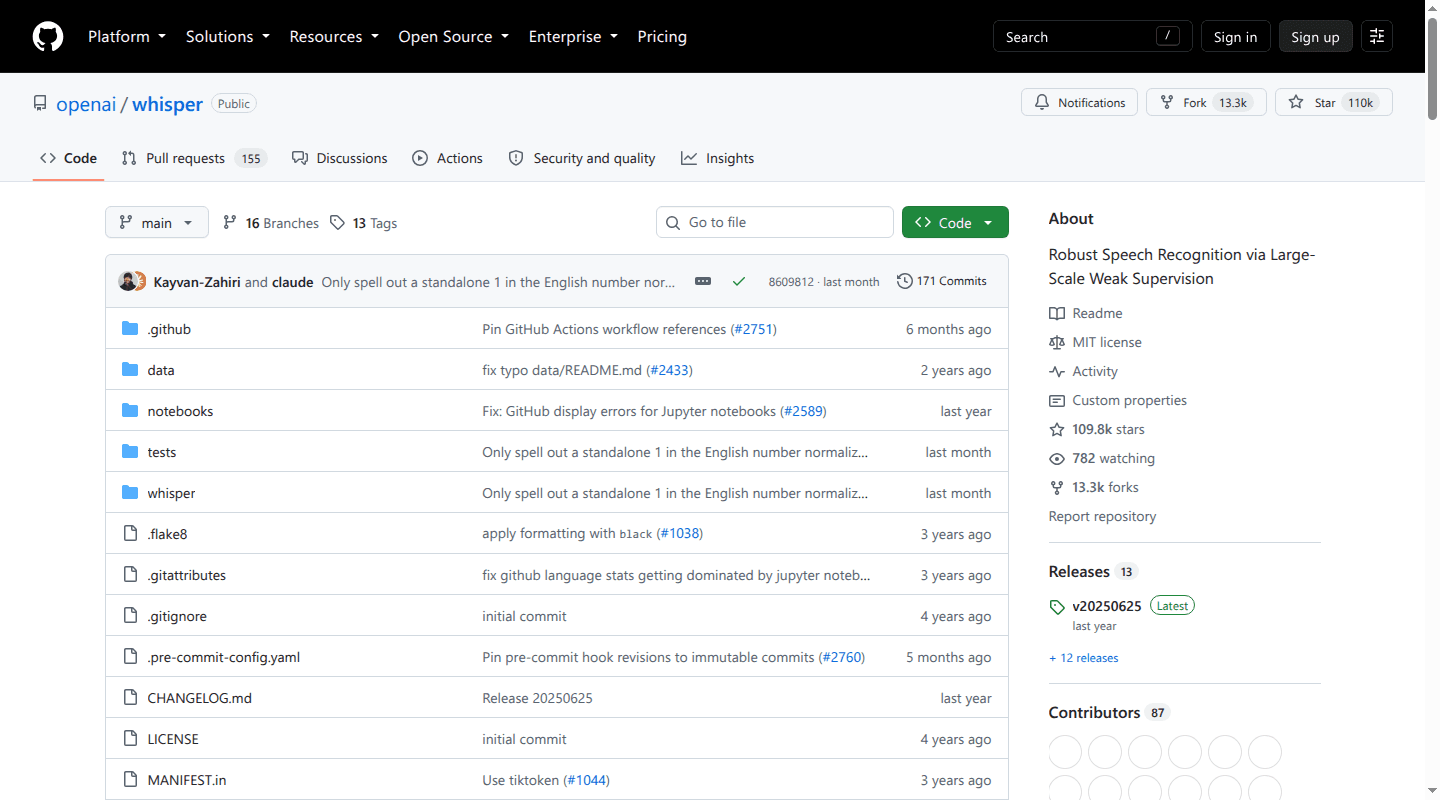
Whisper is the clearest option when model weights and inference run inside infrastructure the team controls. The official repository is MIT-licensed and includes multilingual models for transcription, language identification, and translation into English. Model sizes trade memory and throughput for accuracy.
The open implementation processes files through sliding audio windows. It does not provide a production streaming protocol, speaker diarization, autoscaling, queueing, usage controls, or a service-level agreement. Those components come from internal engineering or a separate hosted provider. Streaming wrappers also create their own chunking, look-ahead, partial-stability, and endpointing behavior.
Best fit: Offline media processing, private batch pipelines, research, and teams prepared to operate GPU inference.
Tradeoff: The software license has no model usage fee, but production cost includes compute, orchestration, observability, upgrades, capacity headroom, and incident response. Whisper is an ownership choice as much as a model choice.
How production evidence changes the shortlist
Batch and streaming need separate scorecards
Batch transcription rewards final accuracy and throughput. Live agents depend on first usable partials, transcript revision behavior, end-of-turn timing, and the delay to a stable final. A provider can lead one workload and disappoint in the other.
The Artificial Analysis methodology makes this separation explicit. Its batch score includes a speed factor, while its streaming score measures first partial and final transcript latency after detected end of speech. Network delay is included. That is a more useful public reference than a single word error rate, but its dataset still cannot represent every production route.
A representative corpus determines accuracy
A valid comparison corpus contains the codecs, sample rates, accents, noise, crosstalk, proper nouns, product terms, numbers, and silence patterns that reach production. Telephone audio also needs its own slice because 8 kHz narrowband speech behaves differently from a studio recording.
Accent performance can shift materially between recognizers. An accented-dialogue evaluation found absolute error-rate gaps of roughly 2 to 12 percentage points between General American and combined non-American English, depending on the recognizer. This is why a generic English score cannot stand in for the actual speaker population.
Semantic errors deserve their own gate
Word error rate treats substitutions, insertions, and deletions uniformly. Production systems rarely can. A missing filler word may have no impact, while one wrong account number, medication, date, negation, or surname can change the action an agent takes.
The evaluation set therefore needs field-level measures for names, numbers, addresses, currencies, dates, negation, and domain entities. For live agents, the score also includes whether an unstable partial causes a premature tool call or an incorrect interruption.
Switching cost follows the owned layer
A direct STT replacement changes audio transport, authentication, configuration, transcript events, and downstream parsing. A vertically integrated speech or agent platform also changes turn detection, text-to-speech, tools, telephony, traces, and operational workflows. Self-hosting changes the deployment boundary and adds GPU capacity, upgrades, and on-call ownership.
The lowest model rate can still produce the higher system cost. A complete cost model includes billable audio or open-session time, minimum increments, retries, post-processing, storage, egress, idle capacity, support, and the engineering that operates each seam. Our speech-to-text pricing guide explains how those units distort headline comparisons, while the voice AI stack guide maps the surrounding runtime layers.
Which Speechmatics alternative fits your architecture?
- A production voice AI product: Dasha provides the managed conversation runtime, telephony, tools, testing, and call-level operational evidence.
- A direct low-latency STT API: Deepgram keeps the speech layer modular and offers managed or self-hosted routes.
- Rich recorded-audio analysis: AssemblyAI combines transcription with redaction, diarization, and downstream speech understanding.
- Frequent multilingual code-switching: Gladia centers the API around multilingual live and asynchronous audio.
- A Microsoft, Google Cloud, or AWS control plane: The corresponding hyperscaler reduces identity, networking, storage, and procurement seams.
- Full ownership of offline inference: Whisper provides open model weights and leaves production operations to the team.
- Broad ASR plus mature on-premises options: Staying with Speechmatics may have the lowest migration risk.
If the requirement is a production voice-agent backend rather than a standalone transcript API, use the Dasha evaluation path to build one end-to-end phone or web conversation against your own tools.