
AI telemarketing uses software to prepare, place, handle, and evaluate sales calls. A conversational voice agent can contact permitted leads, ask approved qualification questions, answer bounded product questions, schedule a next step, update a customer relationship management (CRM) system, and transfer an interested person to a sales representative. The agent is only one part of the system. It should not decide whom you are allowed to call, invent an offer, conceal the nature of the call, or make consequential decisions without human oversight. A production campaign needs deterministic consent and suppression checks, controlled access to business systems, safe failure rules, testing, and measurement from the first dial through the confirmed business outcome.
What is AI telemarketing?
AI telemarketing is the use of conversational AI in telephone-based sales outreach. Modern systems combine telephony, speech recognition, a language model, speech generation, business-system integrations, and monitoring. This lets an agent respond to a prospect's words during the call instead of playing one fixed message.
That does not make every AI telemarketing system the same.
| System | What it does | Who owns the conversation |
|---|---|---|
| Auto dialer | Places calls and connects an answered call to a person or another system | Human representative or downstream system |
| Prerecorded campaign | Plays a fixed or branching message | The recording and keypad flow |
| AI voice agent | Holds a live conversation and can take approved actions through tools | AI agent inside defined business and safety rules |
| Sales copilot | Transcribes, retrieves information, suggests responses, or summarizes | Human representative |
Telemarketing is also broader than cold calling. It can include a fast response to a lead who requested contact, follow-up with an existing customer, qualification before a scheduled handoff, or appointment setting. Cold calling usually refers to unsolicited outreach to someone with no current conversation. The applicable legal requirements depend on the recipient, purpose, consent, technology, jurisdiction, and industry, not on which label the campaign uses.
A contact request or existing-customer relationship is not, by itself, prior express written consent for an AI-voice telemarketing call where that consent is required.
How an AI telemarketing system works
A reliable campaign separates the conversational layer from the controls that determine whether a call may happen and what the agent may do.
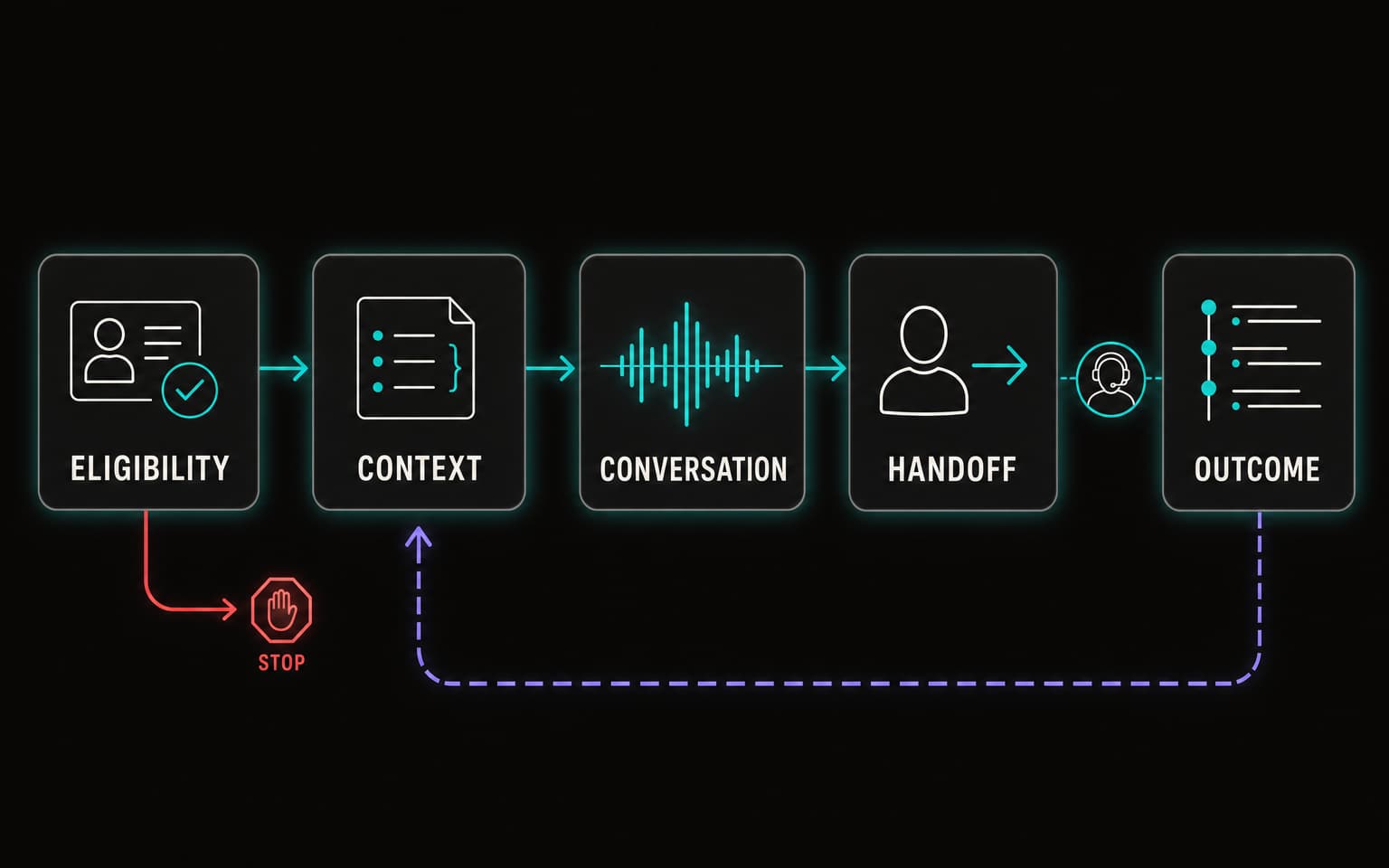
1. Check eligibility before the call
The campaign application should decide whether a record can enter the call queue. It can check the consent record, permitted purpose, seller, jurisdiction, local time, campaign limits, and every required federal, state, company, customer, and campaign suppression list.
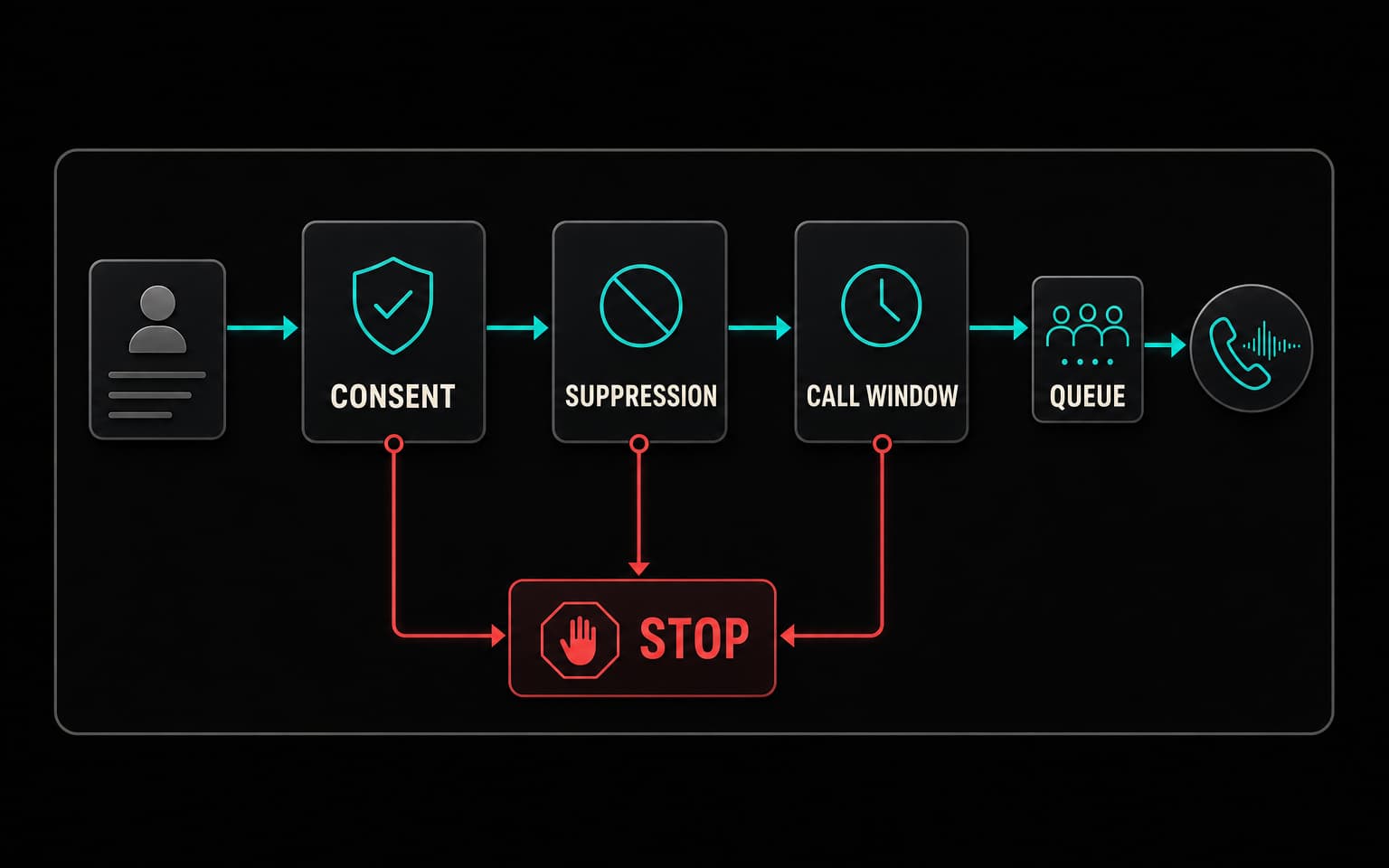
Keep this logic outside the language model. A prompt is not an access-control system, and an agent should never be able to reason around a Do Not Call rule.
2. Prepare the call context
Give the agent only the information needed for this call: the approved seller identity, reason for contact, lead source, permitted offer, qualification fields, and next actions. Do not expose an entire CRM record when the conversation needs three fields.
The application should also define what happens when data is missing or stale. Safe options include skipping the call, using a neutral response, transferring to a trained person, or ending the call. Guessing is not a safe fallback.
3. Run the bounded conversation
The agent promptly gives the required seller, sales-purpose, goods or services, caller-identity, callback, and opt-out disclosures, confirms that the recipient wants to continue, and follows the approved flow. Agreement after answering does not cure missing pre-call consent. The agent can ask questions, respond from approved knowledge, handle expected objections within defined limits, and call business tools when an action is requested.
The model can choose clear wording for an approved answer. It should not decide that a new discount, guarantee, eligibility rule, or contract term exists.
4. Transfer when a person should take over
Useful transfer triggers include:
- the recipient asks for a person;
- the question falls outside approved knowledge;
- the conversation reaches a negotiation or exception;
- the workflow touches a consequential decision;
- an external tool fails; or
- the agent cannot confidently determine what the recipient wants.
Pass the qualification fields and a concise conversation summary with the transfer. Measure whether the recipient actually connected to the right person, not merely whether the system called a transfer endpoint.
5. Write the result and review the call
After the call, store structured outcomes separately from the transcript: connected or not, right party, permission to continue, qualification result, appointment confirmation, transfer outcome, opt-out, complaint, tool failure, and review status.
Use those fields to drive follow-up and reporting. A language-model summary can help a reviewer, but it should not silently become the authoritative record for consent, suppression, a purchase, or a regulated decision.
Good AI telemarketing use cases
The best first use case has a known audience, a narrow purpose, a small set of permitted claims, and one verifiable outcome.
| Use case | What the agent can do | Keep human-owned |
|---|---|---|
| Speed-to-lead response | Confirm interest, collect basic context, schedule or transfer | Pricing exceptions, negotiation, complex discovery |
| Lead qualification | Ask approved questions and record answers | Consequential eligibility decisions and ambiguous cases |
| Appointment setting | Check availability, book, confirm, reschedule | Exceptions the calendar or policy cannot resolve |
| Consented follow-up | Continue a prior conversation, answer approved questions, propose a next step | New claims or offers outside the approved campaign |
| Event or demo follow-up | Confirm attendance or interest and route to the right team | Strategic account conversations |
| Genuine nonmarketing survey or data collection, where consent or an exemption permits it | Ask a fixed set of permitted questions and store responses | Sensitive interpretation and high-stakes decisions |
Avoid starting with a workflow that requires the agent to negotiate custom terms, interpret complex regulation, determine credit or insurance eligibility, diagnose a medical issue, or handle an emotionally sensitive dispute. Those calls need human judgment even when AI assists with preparation, transcription, or routing.
Put campaign controls ahead of conversational polish
A natural voice cannot compensate for a weak operating design. Build these controls before optimizing the script.
Consent, suppression, and exit
In the United States, the Federal Communications Commission confirms that TCPA restrictions on artificial or prerecorded voice apply to current AI-generated human voices. For covered AI-voice telemarketing calls, prior express written consent is generally required; other covered calls may require prior express consent. The current FCC calling restrictions and Federal Trade Commission Telemarketing Sales Rule also address areas such as identification, Do Not Call requirements, calling windows, abandoned calls, prerecorded messages, opt-out mechanisms, caller ID, and recordkeeping. When the Telemarketing Sales Rule applies, most of its specified records generally must be kept for five years.
This is not a complete legal checklist. State law, recording law, industry rules, and the exact facts of a campaign can add requirements. Have counsel review the audience, consent evidence, seller, purpose, disclosures, script, calling schedule, recording, retention, and handoff before launch. Our compliance-first AI cold-calling guide goes deeper on the pilot controls.
Treat an opt-out as a deterministic event. Acknowledge it, stop the marketing flow, write the suppression record, and prevent later retries. Treat "stop calling" and "remove me" as explicit opt-outs, and route genuinely contextual phrases such as "not now" conservatively under the policy your legal and operations teams approved. For covered artificial or prerecorded messages, implement and test every required automated voice or keypad opt-out mechanism; conversational suppression is not a substitute.
Approved knowledge and actions
Keep product facts, offers, availability, and eligibility rules in controlled sources. Restrict each tool to the fields and actions the campaign needs. Use least-privilege credentials, validate inputs, and log the result of every tool call.
Make writes idempotent. If the agent or application retries a timed-out request, it should not create a second appointment, a duplicate CRM record, or two suppression events.
Latency and safe failures
People interrupt, pause, change direction, and ask side questions. Test turn latency, barge-in behavior, silence handling, voicemail, and external-tool delay with the actual model, speech providers, telephony, and integrations you plan to run.
Measure latency percentiles rather than one average. A campaign can feel responsive most of the time and still fail when a slow CRM lookup or transfer creates a long tail. Define a timeout and fallback for every dependency. If a critical system is unavailable, the agent should transfer, end the call, or promise only a follow-up your application can reliably create.
Do not assume a conversational AI agent satisfies a live-sales-representative requirement in an abandoned-call safe harbor. Have counsel map the exact dialer, AI-message, and transfer flow to the applicable rule.
Versioning and traceability
Record which prompt, model, voice, knowledge source, tool configuration, and campaign policy handled each call. Without version history, a team cannot reproduce a complaint, compare a new release with the prior one, or know which calls need review after a defect.
Test the campaign before a live launch
A successful scripted demo proves only the happy path. Build a test set from the situations most likely to break the campaign:
- interruptions, long pauses, background noise, accents, and speech disfluencies;
- voicemail, wrong numbers, and calls answered by someone else;
- explicit and ambiguous opt-outs;
- hostile, confused, or emotionally charged responses;
- questions outside approved knowledge;
- stale or contradictory CRM data;
- calendar, consent-service, and tool timeouts;
- transfer rejection, no available representative, and dropped transfer;
- requests for custom terms or regulated advice; and
- attempts to make the agent ignore its limits.
Set a required result for each scenario: answer, clarify, transfer, suppress, end, or refuse. Review the transcript, audio where recording is permitted, model input and output, tool calls, timing, and final structured outcome. Then repeat the set whenever a model, prompt, knowledge source, voice, tool, or call policy changes.
Automated evaluation can flag calls at scale. Keep human review for disclosures, opt-outs, unsupported claims, tone, handoff quality, and edge cases that an automated scorer may misclassify.
Measure the full telemarketing funnel
Do not evaluate AI telemarketing by dials per hour. More calls can amplify a poor list, a weak offer, or a broken opt-out process.
| Stage | Useful measures | Failure signal |
|---|---|---|
| Eligibility | Records with complete permission evidence, suppression checks passed, calls inside approved windows | Any call without the required evidence or to a suppressed number |
| Connection | Attempt-to-connect rate, right-party rate, voicemail and wrong-number rate | Repeated attempts to the wrong party or invalid number |
| Conversation | Disclosure completion, recipient continuation, qualification completion | Unsupported claims, missed opt-outs, excessive hang-ups |
| Action | Recipient-confirmed appointment, successful transfer, valid CRM update | Duplicate or unconfirmed actions, failed transfer, stale write |
| Experience and risk | Opt-out write success, repeat-call rate after opt-out, complaints, requests for a person | Failed suppression, repeat contact, complaint spike |
| Reliability | Turn-latency percentiles, tool success, timeout rate, transfer completion | Long-tail delay, dependency failure, dropped handoff |
| Economics | Cost per connection, qualified lead, completed transfer, confirmed appointment, or sale | Low per-minute price with poor outcome completion |
Join the billing export to these outcomes. The total cost of a voice agent can include runtime, telephony, speech, model usage, transfers, recordings, storage, testing, support, and internal operations. Cost per successful outcome is more useful than the cheapest advertised minute.
If a campaign appears to improve meetings or sales, control for list source, lead age, offer, time of day, seasonality, routing, and human follow-up before attributing the difference to AI.
How to evaluate AI telemarketing software
Start with your operating requirements, not a vendor feature count.
- Outbound control: Can your application schedule, cancel, rate-limit, and trace calls by campaign and customer?
- Telephony: Can you use the carrier, numbers, caller identity controls, and regions you need? What happens to query, routing, and metadata during a transfer?
- Conversation behavior: How does the system handle interruptions, silence, voicemail, language changes, and long tool calls under your workload?
- Tools and data: Can you limit credentials, validate inputs, make reliable CRM and calendar writes, and stop safely when a system fails?
- Human handoff: Are warm, cold, and dynamic transfers supported? Can the human receive context, and can you verify that the transfer completed?
- Testing: Can you repeat scenario tests and compare releases before changing production traffic?
- Observability: Can you inspect transcripts, model behavior, tools, timing, errors, and the exact version that handled a call?
- Governance: Can you implement your own eligibility, suppression, retention, access, review, and incident controls?
- Scale: What are the real limits on concurrent calls, call starts, agents, tenants, and external providers? Load-test your expected peak.
- Cost boundary: Which parts of telephony, speech, models, runtime, attempts, transfers, support, and capacity are included or billed separately?
If your team needs a visual campaign builder and does not have developers available, choose a product built for that operating model. If you are building a production voice workflow that needs API control, custom integrations, traceability, and a managed runtime, evaluate the platform with one end-to-end call before committing to a broad rollout.
Build an AI telemarketing pilot with Dasha
We built Dasha's voice AI backend for technical teams that want to ship through an API and keep control of the workflow without operating the real-time voice stack themselves.
For a bounded telemarketing pilot, you can:
- use the outbound-call API only after your application passes the campaign's eligibility checks;
- connect approved CRM, calendar, consent, and suppression operations through tools and functions;
- configure warm, cold, or webhook-routed transfers for human-owned situations; and
- run browser-based tests, then use Call Inspector to review the transcript, model activity, tool calls, timeline, recording when enabled, and latency breakdown.
Start with one permitted audience, one offer, one outcome, and a low daily limit. Freeze the first release, review calls daily, and give one owner the authority to pause the campaign. Expand only after permission, opt-out, tool, transfer, quality, and outcome measures meet the thresholds your team defined.
Frequently asked questions
Is AI telemarketing legal?
There is no blanket answer for every campaign. In the United States, AI-generated voice falls within TCPA restrictions for artificial or prerecorded voice. The Telemarketing Sales Rule and federal, state, recording, privacy, and sector rules may also apply. Have counsel review the exact audience, purpose, consent, disclosures, technology, and workflow before calling.
Can AI replace telemarketers?
AI can own bounded, repetitive parts of a call, such as qualification, appointment setting, approved FAQs, structured data collection, and routing. People should remain responsible for complex discovery, negotiation, exceptions, consequential decisions, sensitive conversations, and relationship work.
What is the difference between AI telemarketing and AI cold calling?
AI telemarketing is the broader category of AI-assisted or AI-run sales calls. AI cold calling is unsolicited outreach to a new prospect. A telemarketing campaign can also follow up with a person who requested contact or continue an existing customer conversation. Legal requirements depend on the facts, not the label.
What should an AI telemarketing pilot measure first?
Start with zero-tolerance controls: calls without required permission, calls to suppressed numbers, missed opt-outs, failed suppression writes, and unsupported claims. Then measure completed transfers, recipient-confirmed appointments, tool reliability, latency percentiles, complaints, and cost per successful outcome.