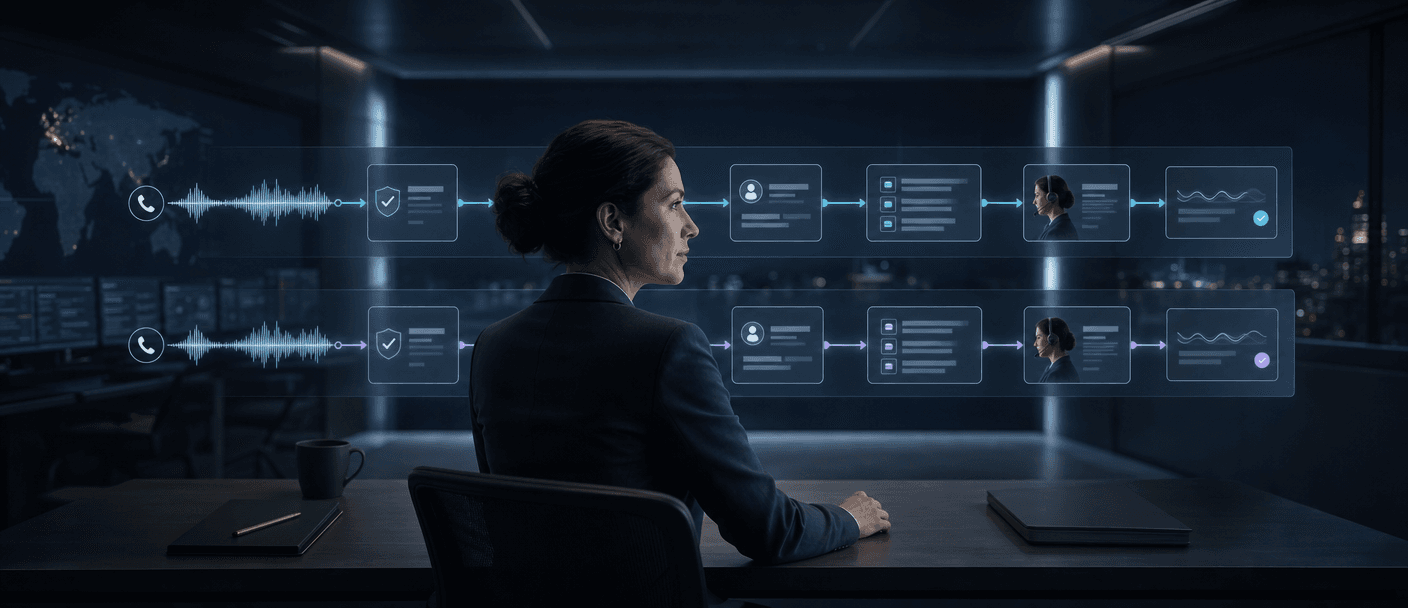
Customer support tests voice AI against production reality. The agent must authenticate callers, use account context, complete authorized actions, transfer with context, and leave evidence of the outcome. Use those requirements, plus pricing and exit costs, to build a two-vendor shortlist instead of buying on voice quality alone.
For technical teams building a custom support product or operation, Dasha is our recommended starting point. We give you a managed runtime, APIs, provider choice, telephony, and production operations without forcing the support workflow into a help-desk suite. Retell suits teams that want an integrated console, while Fin Voice, Decagon, PolyAI, and NiCE Cognigy fit more support-led enterprise programs.
For workflow design, use our customer support implementation guide. Our broad platform comparison covers developer APIs, open-source frameworks, carrier-native stacks, and other operating models.
What a support voice agent has to prove
A natural voice is the surface. A support agent also needs to:
- establish the caller's identity before revealing or changing protected data;
- retrieve the right account, case, order, or subscription context;
- complete multi-step actions with authorization checks, validation, idempotency, and a known final state;
- transfer to the right person with identity status, intent, collected data, attempted actions, and the reason for escalation;
- connect to the existing telephony, help-desk, or contact center as a service (CCaaS) environment;
- expose tests, traces, outcomes, and costs that support and engineering teams can inspect; and
- provide workable security, retention, data-export, and exit terms.
That is the standard behind the shortlist.
AI voice agents for customer support compared
Live support capabilities
“Custom” means the platform exposes building blocks, while your team owns the workflow and its safeguards.
- Dasha
- Authentication and account lookup: Custom identity and lookup through your tools and APIs.
- Multi-step and state-changing actions: Our managed runtime executes tool-backed workflows; your backend enforces permissions and final-state checks.
- Warm contextual human handoff: Custom telephony or SIP handoff; your integration defines the context packet.
- Telephony, help-desk, or CCaaS fit: Custom support products and multitenant operations. Dasha is not a packaged help desk.
- Retell AI
- Authentication and account lookup: Custom functions, CRM mappings, contacts, and dynamic variables.
- Multi-step and state-changing actions: Prompt or flow agents can call functions and reusable subflows.
- Warm contextual human handoff: Warm and agentic warm transfer can whisper context and introduce both parties.
- Telephony, help-desk, or CCaaS fit: Retell numbers or custom SIP, plus CRM integrations and live takeover.
- Fin Voice
- Authentication and account lookup: Procedures and data connectors can verify identity and retrieve customer data.
- Multi-step and state-changing actions: Voice Procedures can call APIs, update records, and use human approval steps.
- Warm contextual human handoff: Configurable transfer, callback, or workflow handoff with conversation context.
- Telephony, help-desk, or CCaaS fit: Native fit with Fin and Intercom; also supports call forwarding, SIP, and external help desks.
- ElevenAgents
- Authentication and account lookup: Signed URLs or domain allowlists authenticate platform access; phone-caller identity verification needs a tool-backed flow such as Twilio Verify OTP.
- Multi-step and state-changing actions: Tools and structured workflows can read and update business systems.
- Warm contextual human handoff: A private warm-transfer summary is available for conference transfers through the native Twilio integration; SIP transfers do not support it.
- Telephony, help-desk, or CCaaS fit: Native telephony or SIP, with customer-support and CCaaS connectors.
- Synthflow
- Authentication and account lookup: Variables, custom actions, and integrations support custom verification flows.
- Multi-step and state-changing actions: Visual flows and actions update CRM or other systems.
- Warm contextual human handoff: Transfer and routing controls; SIP-based paths sit in Enterprise.
- Telephony, help-desk, or CCaaS fit: Native telephony and integrations; SIP or PBX connectivity requires Enterprise.
- Decagon
- Authentication and account lookup: Voice authentication plus short-lived, scoped tokens for customer-system access.
- Multi-step and state-changing actions: Agent Operating Procedures (AOPs) execute cross-system support workflows.
- Warm contextual human handoff: Human transfer includes a concise conversation summary.
- Telephony, help-desk, or CCaaS fit: Cross-channel enterprise support and existing service-system integrations.
- PolyAI
- Authentication and account lookup: Custom functions can authenticate users and look up live account data.
- Multi-step and state-changing actions: Builder or code-defined functions handle business logic and backend updates.
- Warm contextual human handoff: Contact-center handoff and call data are part of the platform.
- Telephony, help-desk, or CCaaS fit: Enterprise phone support and existing contact-center infrastructure.
- NiCE Cognigy
- Authentication and account lookup: Cognigy.AI flows and integrations implement identity and profile steps.
- Multi-step and state-changing actions: Low-code flows, nodes, and enterprise integrations support transactional journeys.
- Warm contextual human handoff: Contextual routing into supported human-agent and CCaaS destinations.
- Telephony, help-desk, or CCaaS fit: Cognigy.AI is the agent platform; Voice Gateway is its added telephony and contact-center layer.
Operations and commercial risk
Public compliance badges do not make a specific support workflow compliant. The full data path, configuration, contracts, staff access, and operating process still matter.
- Dasha
- Testing and quality assurance: Browser and phone testing with transcripts and logs for team-run regression sets.
- Observability and outcome tracking: Call history, searchable transcripts, activity logs, and concurrency visibility.
- Security, privacy, and compliance controls: Security scope is contract-specific; our enterprise on-premises option is contract- and scope-dependent.
- Migration and exit portability: Provider choice can reduce some coupling; on-premises use does not remove the work of migrating off our proprietary runtime or guarantee broad exit portability.
- Pricing: 1,000 free minutes; Growth starts at $0.08/min, excluding VoIP and LLM tokens.
- Retell AI
- Testing and quality assurance: Saved simulations, batch regression runs, phone tests, and A/B tests.
- Observability and outcome tracking: Call history, component latency, post-call fields, alerts, and live monitoring.
- Security, privacy, and compliance controls: PII scrubbing; enterprise RBAC, SSO, and contract controls.
- Migration and exit portability: Custom SIP and APIs help; Retell flows, test definitions, and analysis fields need translation.
- Pricing: $0.07 to $0.31/min for configured voice agents, plus optional feature charges.
- Fin Voice
- Testing and quality assurance: Sandbox preview, answer inspection, handoff tests, and Voice Procedure simulations.
- Observability and outcome tracking: Recordings, transcripts, dashboards, and outcome reporting; automated monitoring must be configured and is not on by default.
- Security, privacy, and compliance controls: Workspace permissions and enterprise controls span Fin and its integrations.
- Migration and exit portability: Existing SIP and source systems can stay; Procedures and Fin-specific analytics need rebuilding.
- Pricing: Custom Fin Voice pricing; Fin's $0.99 outcome price does not establish the voice rate.
- ElevenAgents
- Testing and quality assurance: Simulation, next-reply, and tool-call tests from dashboard, CLI, or API.
- Observability and outcome tracking: Searchable conversations, analysis, experiments, and analytics; real-time monitoring is enterprise-scoped.
- Security, privacy, and compliance controls: Encryption, permissions, regional controls, and enterprise zero-retention options.
- Migration and exit portability: Custom LLM and SIP reduce switching work; ElevenLabs ASR, TTS, and turn-taking remain coupled.
- Pricing: Plans bundle minutes and concurrency; extra minutes are $0.08, burst is $0.16; LLM and telephony are separate.
- Synthflow
- Testing and quality assurance: Phone, chat, web-call, and parallel simulation suites.
- Observability and outcome tracking: Analytics, logs, call data export, and performance metrics.
- Security, privacy, and compliance controls: Recording and transcript toggles, 30-day retention, and text PII redaction; live audio is not redacted.
- Migration and exit portability: Call data can be exported; visual flows and simulations are proprietary, and SIP portability needs Enterprise.
- Pricing: Enterprise contracts start at $30,000/year.
- Decagon
- Testing and quality assurance: Simulations, checkpoints, scheduled runs, and ongoing Watchtower QA.
- Observability and outcome tracking: Reasoning traces, latency, outcomes, conversation drilldowns, and Watchtower flags.
- Security, privacy, and compliance controls: RBAC, SSO, short-lived tokens, encryption, audit logs, and post-call PII redaction.
- Migration and exit portability: Git-based tracking helps retain workflow history; AOP execution and Watchtower remain Decagon-specific.
- Pricing: Custom enterprise pricing; no public voice rate card.
- PolyAI
- Testing and quality assurance: Simulation tests, API and CLI automation, and deployment gates; A/B testing is beta, feature-flagged, and limited to US and UK enterprise clusters.
- Observability and outcome tracking: Dashboards, conversation review, function logs, latency, containment, and ASR metrics.
- Security, privacy, and compliance controls: Enterprise security controls and regional workspaces; account scope varies by deployment.
- Migration and exit portability: Git-backed ADK resources improve portability; PolyAI's dialog and speech runtime still needs replacement.
- Pricing: Custom per-minute pricing includes maintenance, monitoring, improvements, and 24/7 support.
- NiCE Cognigy
- Testing and quality assurance: Simulator, interaction panel, mocks, playbooks, logs, and voice preview.
- Observability and outcome tracking: Cognigy Insights, goals, logs, Voice Gateway traffic, and Conversation Analyzer.
- Security, privacy, and compliance controls: Enterprise access, audit, endpoint, and data-protection controls across licensed products.
- Migration and exit portability: Packages and snapshots move projects within Cognigy; flows and Voice Gateway configuration are platform-specific.
- Pricing: Cognigy.AI uses conversation billing; Voice Gateway requires a separate concurrent-line license.
1. Dasha: our pick for technical support products
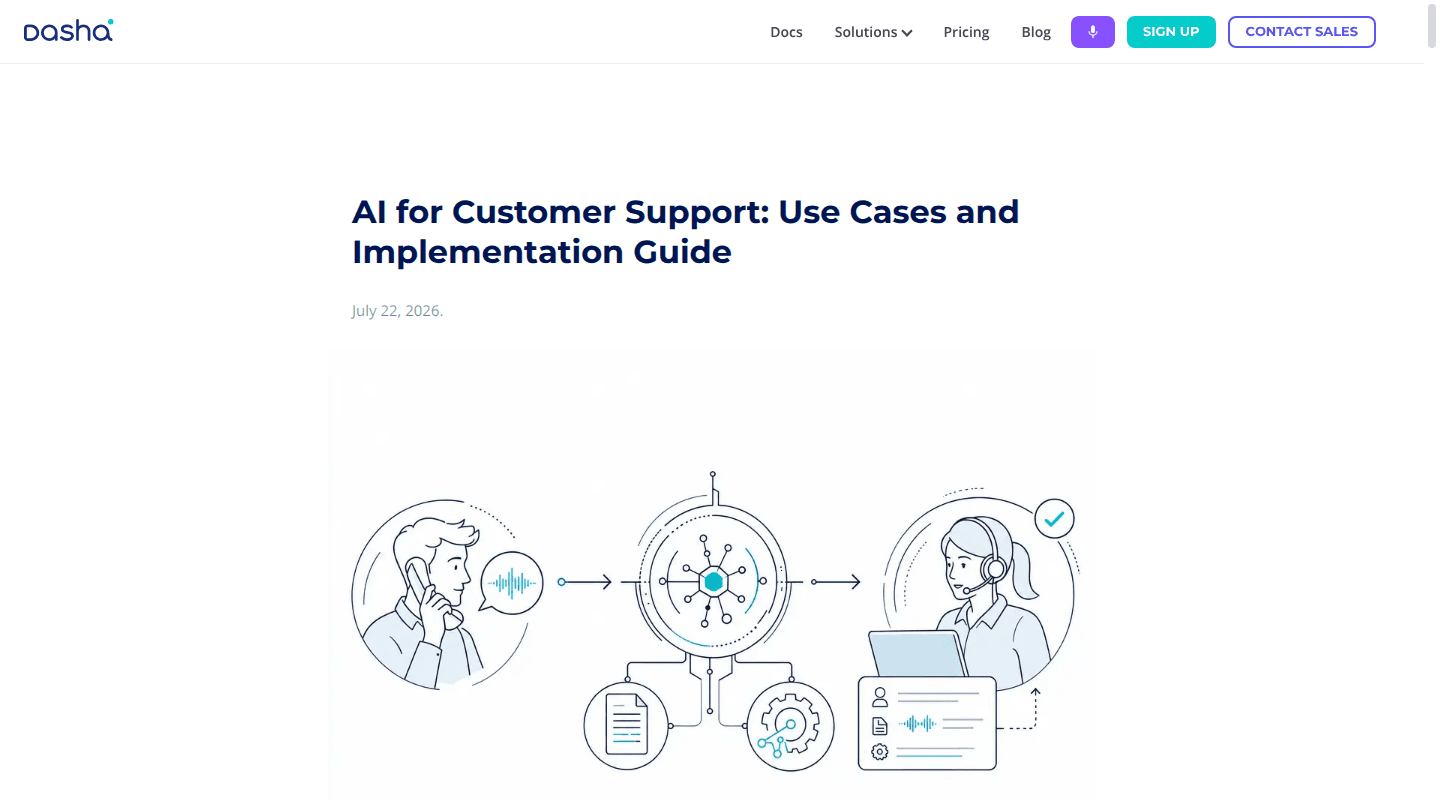
Best for: Technical teams building a custom support operation, embedded product, or multitenant service.
We built Dasha as a managed production platform for real-time voice agents. Teams can create phone and web agents through our application or REST APIs, connect business tools and knowledge, select AI providers, and inspect calls through transcripts and operational logs. Support authentication and actions stay explicit: your backend decides what the caller may read or change, and the agent operates through the tools you expose.
Our pricing includes 1,000 free minutes. Growth starts at $0.08 per minute with one-second billing and no charge for unsuccessful connection attempts. VoIP and LLM tokens are excluded, so model those separately.
Exit tradeoff: Provider choice and REST integrations can keep some surrounding components under your control. We offer an enterprise on-premises deployment option where contract and scope permit. It still uses our proprietary runtime, so it does not remove migration work or guarantee broad exit portability. A move away means replacing our runtime behavior, telephony control, monitoring, and deployment process. Keep tool schemas, source knowledge, test cases, and customer-owned SIP assets under your control.
2. Retell AI: integrated testing and live supervision
Best for: Product and support-operations teams that want one hosted console for building, testing, deploying, and supervising calls.
Retell supports prompt agents and structured conversation flows, custom functions, knowledge, Retell telephony, and custom SIP. Its batch simulation testing turns saved cases into regression runs with pass rates and per-case transcripts. In production, operators can follow a call, listen silently, take over, or end it. Warm and agentic warm transfers can screen the destination, deliver a private message, and bridge the caller after a human answers.
Retell pricing ranges from $0.07 to $0.31 per minute. The chosen model, voice, telephony, knowledge, quality assurance, and add-ons determine the final rate.
Exit tradeoff: Custom SIP can preserve your carrier and numbers, and APIs expose agent resources. Conversation-flow nodes, test definitions, live-control behavior, and post-call fields still require mapping into a new platform.
3. Fin Voice: a support-native cross-channel agent
Best for: Support organizations that want one agent and policy layer across phone and digital channels.
Fin Voice uses knowledge, Procedures, data connectors, and APIs to verify callers, retrieve account data, and complete multi-step work. It can transfer with context, route a callback, or hand the workflow to a person. Support teams get sandbox previews, recordings, transcripts, answer inspection, and saved simulations for Voice Procedures.
Monitoring needs careful scoping. Call dashboards and review surfaces are available, while automated monitoring must be configured rather than assumed to run by default. Fin Voice is sold on custom terms. The general Fin pricing page lists $0.99 for several digital outcomes, but that rate does not define Voice pricing.
Exit tradeoff: Call forwarding or SIP can leave more of the phone estate in place, and source knowledge and backend APIs can be reused. Procedures, cross-channel orchestration, evaluation history, and Fin-specific outcome logic need a replacement.
4. ElevenAgents: voice and digital support from one configuration
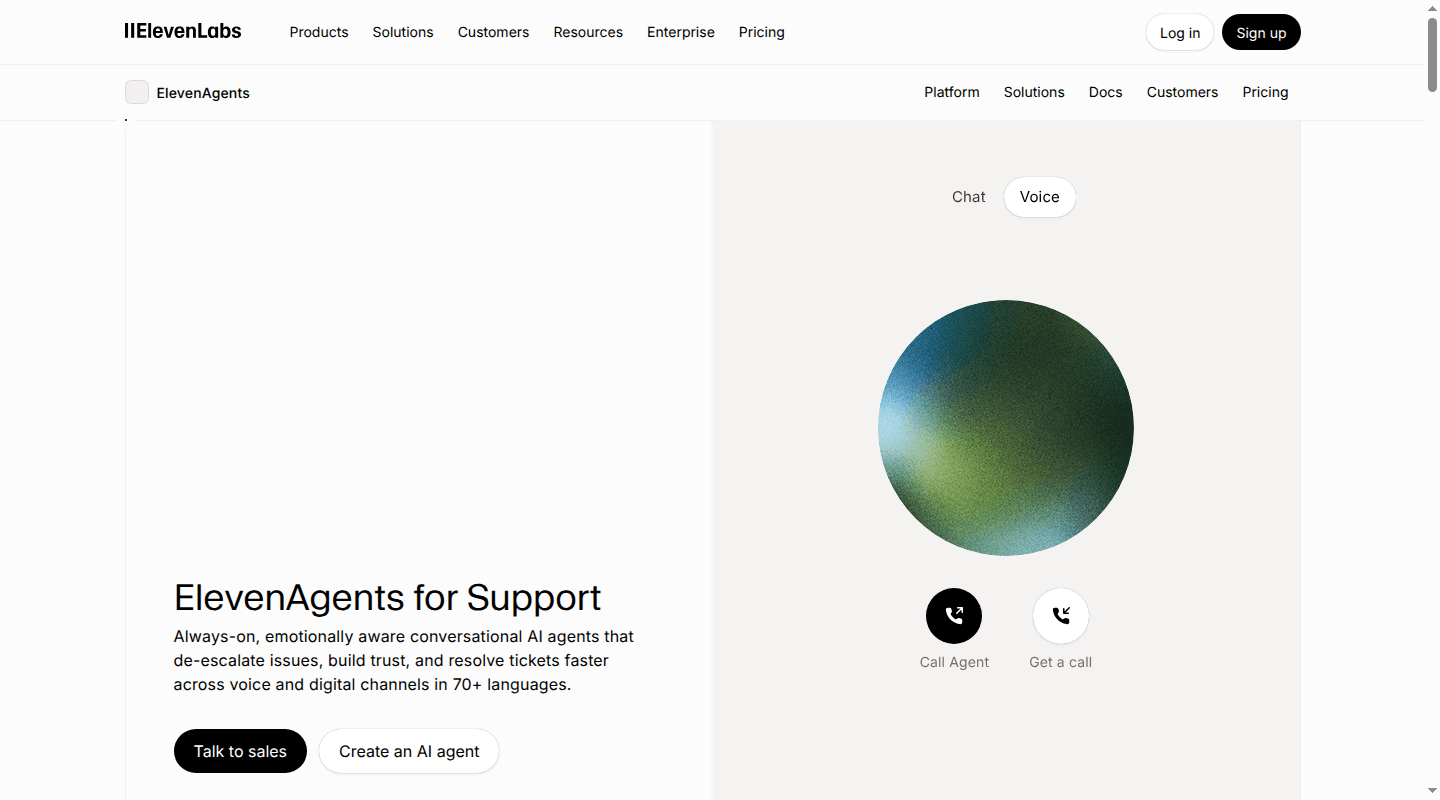
Best for: Teams that want ElevenLabs speech, a managed agent stack, and shared support behavior across voice and digital channels.
ElevenAgents for Support combines knowledge, structured workflows, webhooks, MCP tools, native telephony, SIP, and help-desk or CCaaS connectors. Signed URLs and domain allowlists authenticate access to the agent; they do not verify a phone caller's identity. Caller identity needs a separate tool-backed flow such as Twilio Verify OTP, with controls that keep one-time codes out of retained records. A private situation summary is available for conference transfers through the native Twilio integration. SIP transfers do not support warm-transfer messages. Its current testing system covers simulated conversations, next replies, and tool calls through the dashboard, CLI, and API.
ElevenAgents pricing bundles call minutes and concurrency. Additional minutes cost $0.08 and enabled burst calls above the included concurrency cost $0.16 per minute. LLM use and telephony are billed separately.
Exit tradeoff: A custom LLM and SIP trunk can remain yours. ElevenLabs ASR, TTS, turn-taking, test formats, and conversation analysis remain part of the platform, so switching speech or runtime layers is a broader rebuild.
5. Synthflow: visual workflows with enterprise telephony
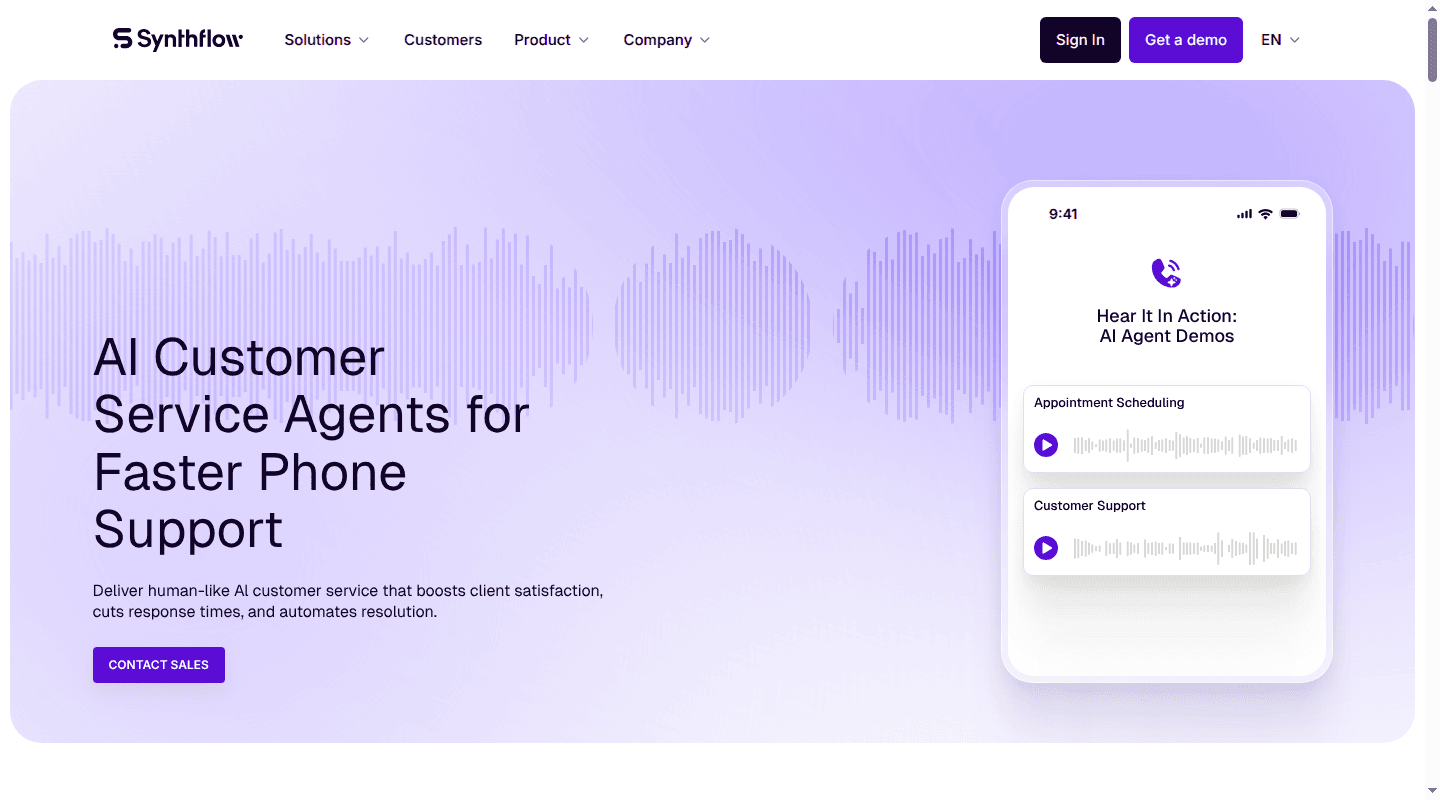
Best for: Enterprise support teams that prefer visual flows, guided implementation, and a large integration catalog.
Synthflow's customer-service product combines visual workflows, knowledge, actions, transfers, integrations, testing, and analytics. Teams can test by phone, chat, browser voice, or automated simulation. Security settings control whether recordings and transcripts are stored, apply a 30-day retention limit, and redact detected personal data from text surfaces. That redaction does not cover live audio and can miss data.
SIP and PBX integration requires Enterprise. Enterprise pricing starts at $30,000 annually, with call volume, concurrency, integrations, security, telephony, and rollout support shaping the contract.
Exit tradeoff: Exported call data helps preserve evidence, and Enterprise SIP can keep numbers and routing in your phone stack. The visual flow, agent configuration, and simulation suite still need translation.
6. Decagon: support workflows and continuous QA
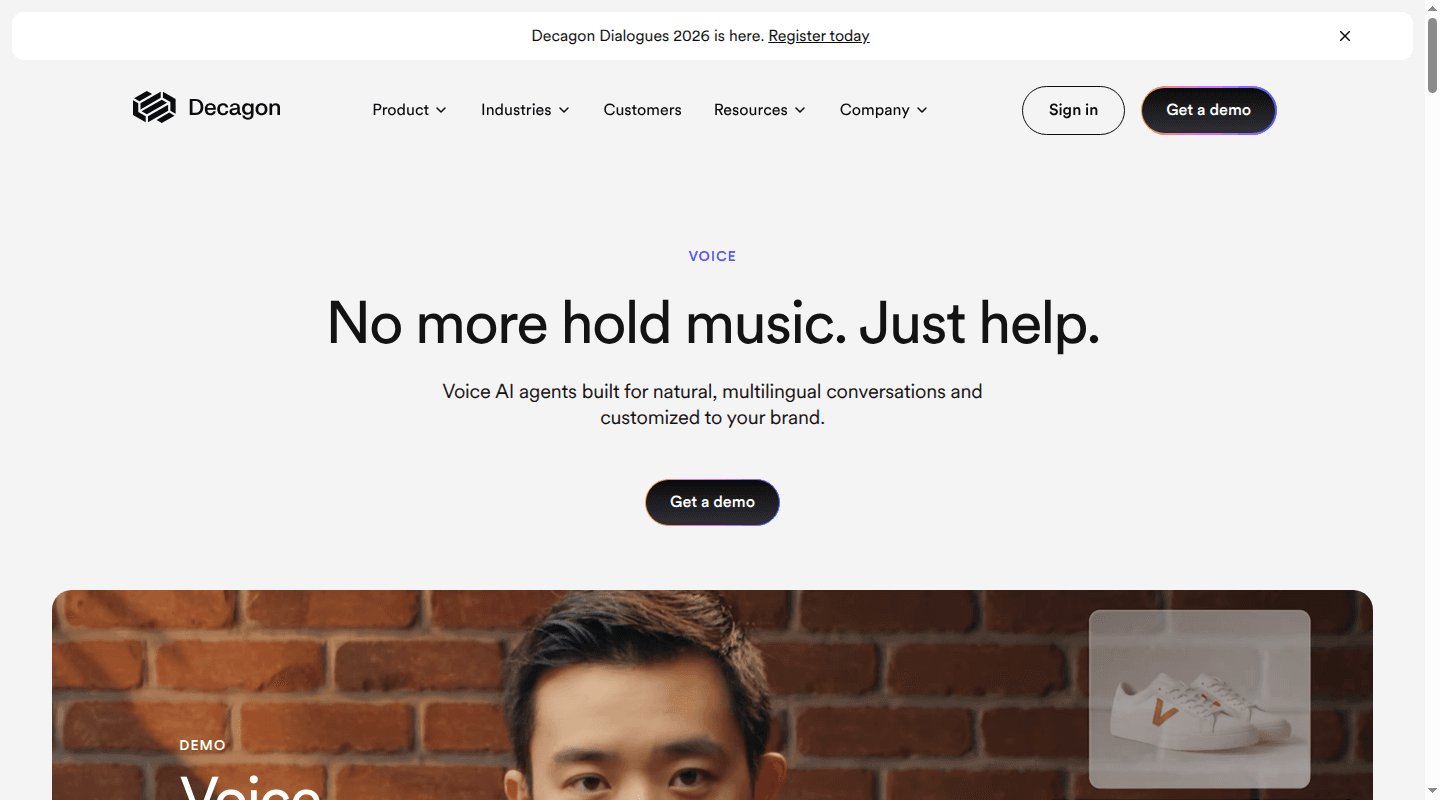
Best for: Large support organizations buying cross-channel automation, workflow ownership for CX teams, and continuous quality review.
Decagon Voice runs on the same support platform as chat and email. Agent Operating Procedures define multi-step work and integrations, while its security controls include progressively scoped, short-lived tokens for backend access. A human handoff includes a concise summary. Decagon's testing and QA surface adds simulations, action checkpoints, scheduled runs, and regression coverage. Watchtower evaluates live conversations against configurable quality criteria.
Pricing is custom and Decagon publishes no baseline voice rate. Compare how a quoted outcome or conversation is defined, how transfers and retries are charged, and whether Watchtower and implementation services are included.
Exit tradeoff: Git-based workflow history and code ownership can preserve useful artifacts. AOP execution, simulation definitions, Watchtower scoring, and cross-channel memory remain tied to Decagon's runtime.
7. PolyAI: self-serve and managed paths for contact centers
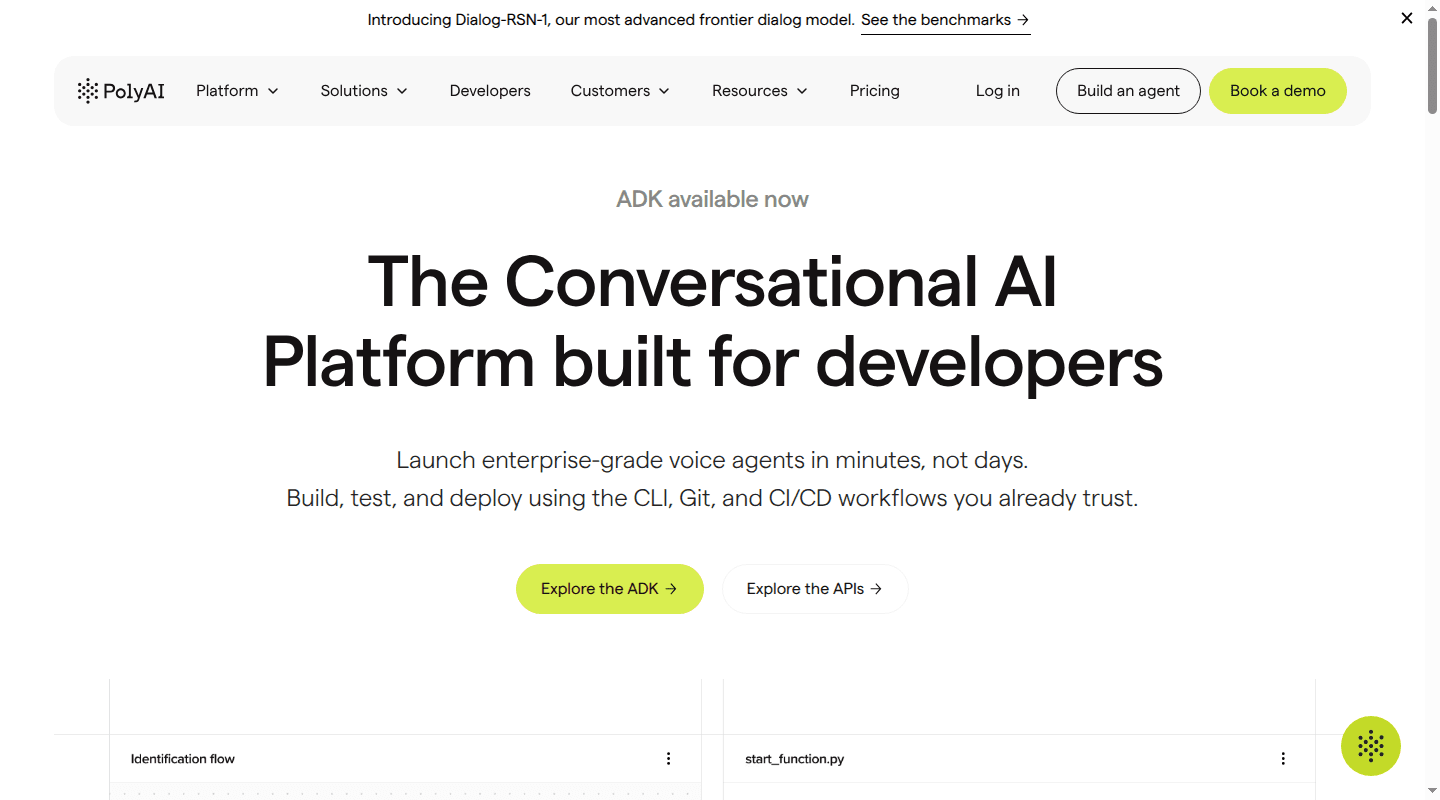
Best for: Enterprise phone-support teams that want a self-serve build route, managed services, or a mix of both.
PolyAI now supports more than a vendor-led deployment. Teams can use Agent Studio, APIs, or its Agent Development Kit and CLI. The developer route stores agent resources as files, connects them to Git workflows, and supports automated tests and deployment gates. A/B testing is a beta feature limited to US and UK enterprise clusters and enabled through a feature flag. Backend functions can authenticate users, retrieve records, and complete transactions. PolyAI also sells managed monitoring, maintenance, optimization, and 24/7 support.
PolyAI pricing is custom per minute. The rate includes the listed managed services, which changes the total-cost comparison with platforms that leave ongoing optimization to your team.
Exit tradeoff: Git-backed ADK files make agent logic and change history more portable than a UI-only build. PolyAI's dialog, speech, telephony behavior, hosted analytics, and any managed-service deliverables still need a documented handover and replacement plan.
8. NiCE Cognigy: Cognigy.AI plus Voice Gateway
Best for: Enterprises adding voice automation to an existing contact-center and broader customer-service stack.
NiCE Cognigy Voice AI Agents are built in Cognigy.AI. The platform supplies flows, integrations, testing, handover, analytics, and agent operations. Voice Gateway is the additional telephony layer that connects those agents to phone and contact-center systems. It cannot operate independently from Cognigy.AI. Testing includes simulation, mocks, playbooks, logs, and voice preview. Conversation Analyzer adds automated scoring.
The billing model separates products. Cognigy.AI charges by billable conversation, while Voice Gateway uses a separately purchased package of concurrent lines. Knowledge AI and Ops Center can add separate licenses. NiCE CXone Cognigy uses its own conversation-counting rules.
Exit tradeoff: Cognigy packages and snapshots support movement and recovery inside the platform. Flow nodes, handover mappings, analytics definitions, and Voice Gateway configuration are Cognigy-specific and require a rebuild elsewhere.
Run a same-workload two-finalist bake-off
Give two finalists the same support workload and require the same final evidence. A concise bake-off is more useful than a long feature checklist.
- Choose one bounded workflow after an organization-specific risk and privacy assessment. Do not label order status or appointment changes low risk by default. An order lookup can expose location or sensitive purchase data. An appointment change can expose health information or create harm if it is dropped. The first workload should require verified identity, have a read-only or reversible scope, and provide a safe human fallback.
- Hold the workload constant. Use the same caller scenarios, telephony route where feasible, backend sandbox, source knowledge, identity policy, transfer queue, traffic pattern, and outcome definition. Let each platform use its normal architecture.
- Use a fixed regression set. Include successful and failed authentication, corrections, interruptions, noise, unsupported requests, tool timeouts, duplicate requests, partial writes, a caller asking for a person, and a failed transfer. Keep the set versioned and rerun it for every material change. This is our recommendation, not a requirement from an external standard.
- Measure the call by stage. Report median (p50) and 95th-percentile (p95) latency for speech endpointing, transcription, agent decision, backend tools, first audible response, and transfer setup. A 10-language PNAS study found that human turn-taking generally minimizes gaps and overlap. That finding explains why timing matters, but it does not set an acceptable voice-agent latency target. Stage-level p50 and p95 reporting is our recommended diagnostic.
- Score the real outcome. Compare correct final backend state, false completion, unsafe authentication bypass, tool recovery, successful handoff, repeat contact, cost per resolved task, and the amount of human QA work.
- Exercise the exit. Export or hand over the agent definition, prompts, knowledge manifest, tool schemas, test cases, outcome data, transcripts, number ownership, SIP configuration, and retention/deletion record. Mark each artifact as machine-readable, contractually available, platform-specific, or absent. Price the rebuild of one workflow before signing the larger commitment.
Make privacy and safety part of acceptance
A support agent handles identity, customer records, recordings, and sometimes money. Treat these controls as release gates:
- Minimize data. Give the agent only the fields needed for the current step. Keep unrelated account history and sensitive attributes out of model context.
- Redact and tokenize early. Replace payment and account identifiers with scoped tokens before they reach prompts, transcripts, analytics, or test fixtures where possible. Redaction after a call does not protect live audio or data already sent to a model or tool.
- Keep credentials out of records. Passwords, secrets, one-time authentication codes, card verification values, and full payment credentials must not persist in transcripts, logs, prompts, monitoring, or production-derived tests. For phone payments, use a compliant payment path that intercepts DTMF outside the agent and model media stream, suppresses raw tones from live audio, redacts any recording, and tokenizes the result before it reaches agent or model context, transcripts, logs, analytics, monitoring, test fixtures, or other voice-agent vendor surfaces. Pass only a scoped tokenized reference back to the workflow.
- Enforce identity and authorization outside the language model. The organization defines the required assurance for each read or write. Backend controls validate identity, permissions, inputs, action limits, and the current state before execution.
- Restrict access and retention. Use role-based access, separate production and test permissions, audit access to recordings and transcripts, set a defined retention period, and test deletion across the platform, storage, analytics, and downstream systems.
- Handle recording consent explicitly. Give required notice and obtain any required consent before recording or monitoring. Carry the applicable jurisdiction, contract, and channel rules into transfers and vendor-operated review.
- Control production-derived tests. Use production calls only with a lawful basis and approved purpose. De-identify them before reuse, remove credentials and prohibited payment or authentication data, restrict access, and apply a deletion schedule to the source and derived fixtures.
- Fail safely. If identity is uncertain, a tool result conflicts, a write cannot be reconciled, or transfer fails, disclose no protected data and complete no unsupported action. Route to an approved human or callback process with the context that is safe to share.
The NIST GenAI profile supports pre-deployment testing, privacy controls, ongoing monitoring, human oversight, and incident response. Your fixed regression set and p50/p95 breakdown should be tailored to the workflow, systems, callers, and risk tolerance.
If your team is building a custom support agent and wants a managed runtime with API control, provider choice, testing, telephony, and production operations, start with 1,000 free Dasha minutes.