
The best Vapi alternative depends on which part of Vapi you want to replace.
Choose Dasha if you want a managed production runtime with a visual dashboard plus API and telephony control. Consider Thoughtly for visual, CRM-led voice and multichannel workflows, Retell AI for an integrated hosted phone-agent platform, Bland AI for bundled AI usage and enterprise deployment options, or Telnyx when you want the carrier and voice stack from one vendor. ElevenLabs Agents fits voice-led products, Synthflow fits sales-led enterprise deployments, and LiveKit Agents fits teams prepared to own more of an open-source stack.
These products do not leave the same work with your team. A $0.05 hosting fee, a $0.14 bundled AI minute, and a free framework are different commercial units. The useful comparison is who operates the real-time path, which vendors remain in it, what the complete call costs, and how you will test failures before moving production traffic.
Vapi alternatives at a glance
| Alternative | Best for | Public pricing boundary |
|---|---|---|
| Dasha | Teams that want a managed runtime with a visual builder plus API and telephony control | Developer plan includes 1,000 minutes; Growth starts at $0.08 per connected minute, excluding VoIP and LLM tokens |
| Thoughtly | Revenue and operations teams that want visual, CRM-led voice and multichannel workflows | Flex starts at $500/month; exact usage allowances and overage rates require a quote |
| Retell AI | Hosted phone agents with testing, analytics, and live operations in one platform | $0.07-$0.31 per voice-agent minute, depending on infrastructure, voice, model, telephony, and add-ons |
| Bland AI | Teams that prefer a bundled AI rate and enterprise deployment options | $0.14/min self-serve; $0.12/min plus $299/month; $0.11/min plus $499/month; telephony separate |
| Telnyx Voice AI | Teams that want telephony, orchestration, and speech from one infrastructure provider | $0.05/min for orchestration, STT, and TTS; LLM and carrier usage additional |
| ElevenLabs Agents | Products where voice selection and speech quality are central | Plans include call-minute allowances; additional minutes are $0.08/min and minutes above concurrency are $0.16/min; LLM and telephony are additional |
| Synthflow | Enterprises that want a sales-led, implementation-supported voice deployment | Enterprise contracts start at $30,000/year |
| LiveKit Agents | Engineering teams that want open-source media and runtime control | Framework is open source; Cloud itemizes agent sessions, telephony, inference, speech, and observability |
Main tradeoffs
- Dasha: The dashboard covers agent setup and testing; custom logic, integrations, and production acceptance can still require engineering.
- Thoughtly: The visual workflow and CRM focus narrows provider choice, and its exact usage allowances and overage rates are not public.
- Retell AI: Total cost and behavior change with the selected components.
- Bland AI: The bundled stack gives you less provider-level choice than Vapi.
- Telnyx Voice AI: Fewer vendor seams create deeper dependency on the Telnyx network and model ecosystem.
- ElevenLabs Agents: The core speech and turn-taking path stays in the ElevenLabs ecosystem.
- Synthflow: Not a low-commitment self-serve choice for a developer testing a small workload.
- LiveKit Agents: Self-hosting transfers scaling, monitoring, upgrades, and incident response to your team.
Prices were observed on August 31, 2026. Plan, region, carrier route, model, voice, add-ons, and enterprise requirements can change the total.
What Vapi provides, and why teams compare alternatives
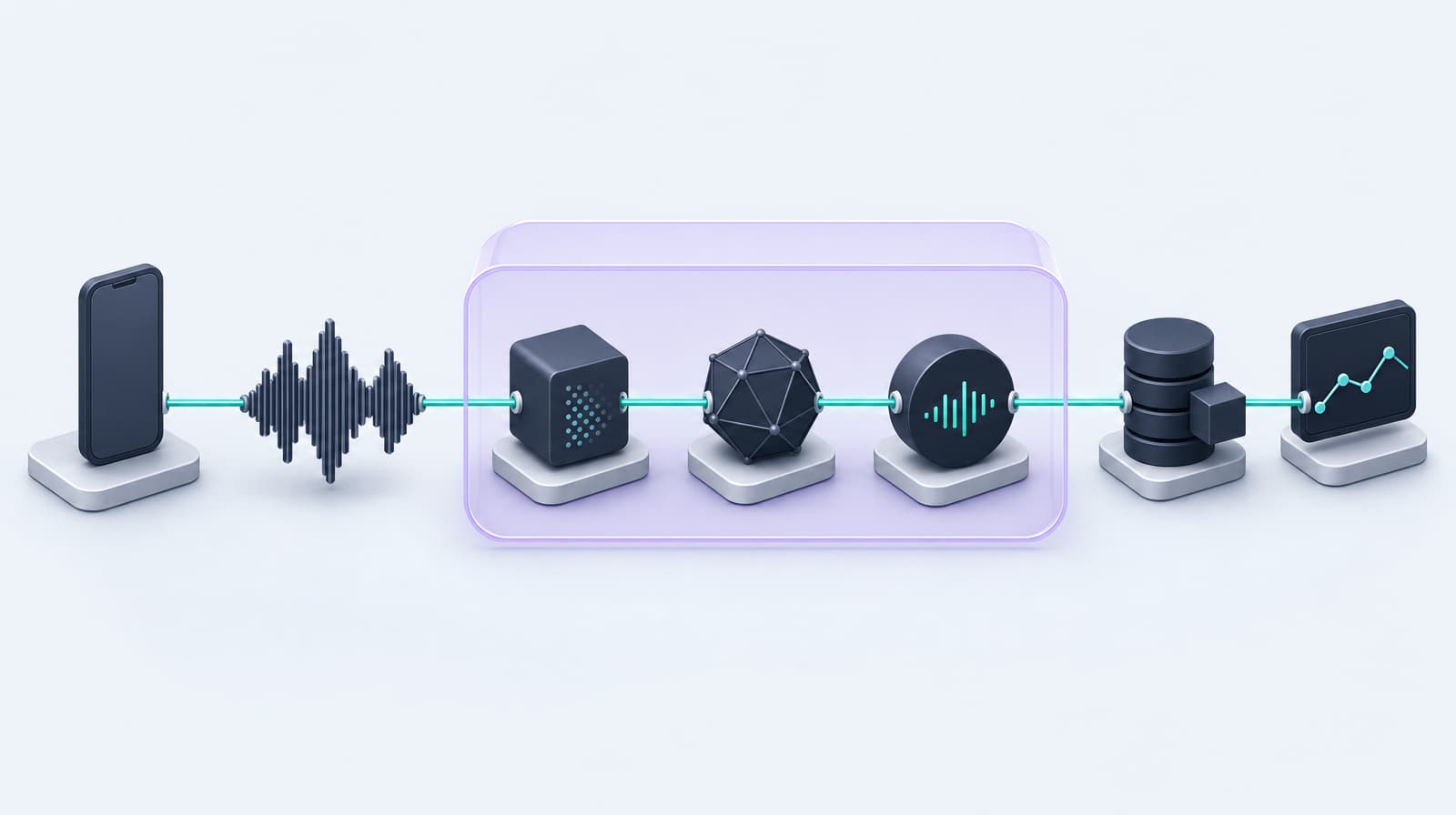
Vapi is a hosted platform for voice agents with a dashboard, APIs, a CLI, and SDKs. Its current building blocks are Assistants for single-agent work and Squads for multi-agent handoffs. Vapi coordinates telephony or real-time transport, speech-to-text (STT), a large language model (LLM), text-to-speech (TTS), tools, and conversation state.
Provider choice is a real advantage. You can use supported providers, supply eligible provider keys, connect custom model or speech endpoints, and bring a carrier through SIP. But Vapi's data-flow documentation says the proprietary orchestration layer still runs on Vapi infrastructure. Bring-your-own components do not make the runtime self-hosted.
Vapi pricing currently lists:
- $0.05 per call minute for Vapi hosting
- $0.005 per chat or SMS message
- 10 concurrent calls included, then $10 per additional reserved line per month
- STT, LLM, and TTS costs passed through at cost, or billed directly by the provider when you supply a key
- carrier costs outside the hosting rate
- HIPAA as a $2,000/month add-on and Zero Data Retention as a $1,000/month add-on on the public plan
The Build plan includes 60+ call minutes. The $0.05 figure is a platform layer, not the total price of a production phone call.
One current product transition also matters. Vapi's visual Workflows product retired on August 18, 2026, and existing Workflows stopped running on August 19. Teams with Workflow configurations must move to Assistants or Squads.
None of this makes Vapi a poor product. It explains the reasons a team might compare alternatives: a different runtime boundary, a more predictable bundle, fewer provider seams, a no-code operating model, or more source-level control.
1. Dasha: best for a managed runtime with dashboard and API control
Best for: Teams building voice AI products that want visual agent setup and testing without giving up APIs, SIP connectivity, tools, or downstream integrations.
We built Dasha as a managed production platform rather than a marketplace of loosely connected components. Teams can define agent behavior in the dashboard or through REST APIs, connect business systems through tools and webhooks, and run inbound or outbound calls through SIP while we operate the real-time runtime.
The dashboard supports browser-based voice and chat tests with real-time transcripts, plus phone tests for the complete telephony path. After a call finishes, Call Inspector shows its transcript, recording, model interactions, tool executions, timeline events, and component timing. REST APIs expose call history and results, while lifecycle and tool webhooks connect Dasha to downstream systems. Your team still owns business rules, customer data, carrier and compliance choices, and production acceptance.
Dasha pricing includes 1,000 minutes on the Developer plan. Growth starts at $0.08 per connected minute, billed to the second, excluding Voice over Internet Protocol (VoIP) and LLM tokens. Dasha says unsuccessful connection attempts are not charged at the agent layer and Growth has no per-line fee.
Dashboard-based agent setup and browser testing require no code. Engineering becomes relevant when you add custom tools or webhooks, automate workflows through the API, connect a SIP carrier, or embed Dasha in your product. Operations teams can own routine configuration and call review while developers handle the deeper integration paths.
Use Dasha when you want a managed voice AI backend with a dashboard for setup and testing plus API and SIP paths for scaled production work.
2. Thoughtly: best for visual CRM and multichannel workflows
Best for: Revenue and operations teams that want to build inbound or outbound agents in a node-based editor, connect them to a CRM, and continue follow-up through voice, SMS, email, WhatsApp, or iMessage.
Thoughtly's Agent Builder organizes work around visual flows, audiences, CRM-triggered automations, call and conversation history, and multichannel follow-up. It also exposes REST APIs and webhooks for developers. Vapi centers on programmable Assistants and Squads, with dashboard and code paths and a broader component-provider model. Both products support APIs, outbound campaigns, analytics, and integrations, but they assign the setup and operating work differently.
Thoughtly pricing says Flex starts at $500 per month with 10 concurrent calls. Its plan table labels voice minutes as unlimited, while its billing FAQ says usage above monthly allowances is billed in arrears. The allowances and overage rates are not published. Treat $500 as the entry price and make the complete usage schedule part of the quote.
Thoughtly versus Vapi decision table
| Decision area | Thoughtly | Vapi |
|---|---|---|
| Product fit | The node-based builder targets sales, support, scheduling, and operations flows across voice and messaging. The REST API and webhooks support custom application work. | Assistants and Squads support single-agent and multi-agent phone or web experiences through the dashboard, API, CLI, and SDKs. |
| Cost boundaries | Flex starts at $500/month with 10 concurrent calls. Its plan table and billing FAQ conflict on unlimited minutes versus allowances and overages, so exact usage terms require a quote. Scale and Enterprise are quote-based. | Build pricing is $0.05 per call minute for Vapi hosting. Telephony and STT, LLM, and TTS costs are additional. Ten concurrent calls are included; extra reserved lines cost $10 each per month. |
| Provider model | Thoughtly exposes a selected model and voice catalog. Voice-key support and pricing vary by plan, while a custom LLM is an Enterprise feature. Twilio and Telnyx numbers can be brought in. | Vapi supports a broader catalog of provider keys and custom endpoints for models, transcription, and speech, plus SIP carriers. Its proprietary orchestration still runs on Vapi infrastructure. |
| Integrations | Native integrations cover CRMs, calendars, ticketing, productivity, and messaging. Zapier, Make, REST APIs, webhooks, and code steps cover custom paths. | Native tools cover several common services. API Request and custom tools, server events, webhooks, code tools, and SDKs provide an engineering-led path to other systems. |
| Testing | Test Agent and Call Me cover text logic checks and real phone tests, including branches, variables, actions, voice, interruption, and transfers. Auto-QA and evals are listed for Scale and Enterprise. | Vapi supports scripted evals and chat or voice simulations with AI testers, success criteria, tool checks, and repeated runs. Assistant and tool versioning supports rollback. |
| Operations | History includes recordings, transcripts, outcomes, filters, and export. Analytics, workspace roles, and audit logs support day-to-day operations; Scale lists a 99.9% uptime SLA and dedicated support. | Call artifacts, structured outputs, scorecards, boards, monitoring, and assistant and tool versioning support a programmable operating model. Build includes 14-day call history and community or email support. |
Choose Thoughtly when an operations team owns CRM workflows and needs visual, coordinated follow-up across channels, and the organization accepts quote-based usage terms. Choose Vapi when engineers need more provider and endpoint choice, web voice, and programmable regression testing.
Testing is the clearest operating difference. Thoughtly testing lets a Flex operator inspect a flow in text and place a live phone test; automated QA and evals start on Scale. Vapi exposes scripted evals and repeatable simulations over chat or voice. If regression control is a release gate, compare the contracted Thoughtly automation and its workflow with Vapi's test suite instead of treating both testing checkboxes as equivalent. For either product, run the same live-call, tool-failure, campaign, analytics, and rollback tests before moving production traffic.
3. Retell AI: best for integrated hosted phone operations
Best for: Teams that want voice-agent building, phone connectivity, simulation testing, transcripts, analytics, and operational supervision in one hosted product.
Retell AI is one of the closest direct Vapi alternatives. Its platform supports prompt-based and visual agent construction, phone numbers and SIP, tools and webhooks, simulations, post-call analysis, and live call monitoring. That makes it a practical shortlist option for appointment booking, support, qualification, and transfer-heavy phone workflows.
Retell pricing publishes a $0.07-$0.31 per-minute range for AI voice agents. The calculator separates voice infrastructure, TTS, LLM, telephony, safeguards, quality assurance, and other add-ons. Twenty concurrent calls are included on pay as you go.
Retell can reduce the amount of separate infrastructure an operations team sees, but it does not eliminate configuration risk. Voice, model, telephony, and guardrail choices still change latency, cost, and failure behavior. Treat the low end of the range as a starting configuration, not a quote for your production workload.
Choose Retell over Vapi when integrated phone operations and supervision matter more than the broadest provider composition. Keep Vapi when provider choice and custom endpoints are the deciding requirements.
4. Bland AI: best for bundled AI pricing and controlled enterprise deployments
Best for: Teams that want one rate for the AI portion of a call, predictable plan limits, and an enterprise path that advertises dedicated infrastructure and VPC or on-premises deployment.
Bland combines its agent platform, speech recognition, language model use, and text-to-speech in the per-minute AI rate. It supports APIs, SIP and customer telephony, knowledge bases, transfers, and enterprise implementation support.
Bland pricing currently lists three self-serve tiers:
- Start: $0.14/min, no platform fee, 10 concurrent calls
- Build: $0.12/min plus $299/month, 50 concurrent calls
- Scale: $0.11/min plus $499/month, 100 concurrent calls
The listed rate includes LLM, STT, and TTS. Telephony is separate, either through your carrier or Bland at pass-through cost. Transfer charges and daily call limits vary by plan.
Bundling makes forecasting easier than a five-vendor invoice. The tradeoff is provider control: you are choosing Bland's integrated AI path rather than Vapi's broad mix-and-match model. Enterprise deployment and compliance claims also need contract-level review; a pricing-page statement is not a substitute for architecture, data-flow, and audit evidence.
5. Telnyx Voice AI: best for carrier-integrated infrastructure
Best for: Teams that want phone connectivity, orchestration, STT, and TTS from the same infrastructure provider.
Telnyx approaches voice agents from the carrier layer. Its Voice AI Agents product combines its communications network with orchestration and speech services, and it exposes APIs, SIP, tools, knowledge, and observability. That can remove handoffs between a separate carrier and a separate speech/orchestration vendor.
Telnyx pricing lists $0.05/min for the voice engine, including orchestration, STT, and TTS. LLM usage is billed separately, and telephony starts at the carrier rate for the chosen route. The page's displayed production estimate is configuration-dependent, so build your own estimate rather than copying it.
Vertical integration is both the advantage and the dependency. Fewer vendor seams can simplify diagnosis and billing, but switching the carrier or inference layer later may require more work than changing one component in Vapi. Telnyx is strongest when consolidating those layers is an intentional architecture decision.
6. ElevenLabs Agents: best when voice is the product priority
Best for: Teams that want a broad voice catalog and a managed agent path across phone, browser, or application experiences.
ElevenLabs Agents combines the company's speech stack with conversational turn-taking, tools, knowledge sources, testing, analytics, and telephony or web integrations. It is a stronger Vapi substitute than a standalone TTS API because it can run the conversation loop rather than only generate audio.
ElevenAgents pricing includes a call-minute allowance with each plan. Additional call minutes are $0.08 per minute. Minutes used above a plan's concurrency limit are billed at the $0.16 per-minute burst rate. LLM and telephony usage are additional, so model the full call rather than comparing the additional-minute rate with Vapi hosting alone.
ElevenLabs is a natural fit when voice selection, multilingual speech, or a shared audio platform is the core requirement. It is less neutral when you want to move speech providers freely: the managed speech and turn-taking layers are part of the ElevenLabs ecosystem.
For a deeper vendor-specific evaluation, see our current ElevenLabs alternatives guide.
7. Synthflow: best for a sales-led enterprise rollout
Best for: Enterprises that want implementation support, visual workflow ownership, integrations, testing, and launch assistance under a scoped contract.
Synthflow positions its current offer around enterprise deployments rather than a low-cost self-serve experiment. Its product includes voice-agent building, telephony and SIP options, CRM and calendar integrations, handoffs, testing, quality assurance, and implementation support.
Synthflow pricing says enterprise contracts start at $30,000 annually. Final pricing depends on call volume, concurrency, telephony, integrations, security needs, and launch support.
That commercial model fits an organization that wants the vendor involved in deployment and ongoing optimization. It is a poor fit for a developer who wants to compare a few hundred minutes with no annual commitment. Compared with Vapi, Synthflow trades some code-first component freedom for a more guided operating model.
8. LiveKit Agents: best for open-source control
Best for: Engineering teams that want source-level control of real-time media and agent code and can staff deployment and operations.
LiveKit Agents is an open-source framework for voice and multimodal agents. It supports real-time media rooms, STT-LLM-TTS pipelines and speech-to-speech models, tools, interruptions, handoffs, WebRTC, and SIP. Teams can self-host or use LiveKit Cloud for managed deployment and observability.
LiveKit Cloud pricing itemizes the stack. The displayed calculator starts with a $0.01/min agent session, then adds telephony or WebRTC, LLM, STT, TTS, and optional observability. A self-hosted framework removes some vendor charges, but it adds infrastructure, autoscaling, storage, monitoring, upgrades, security work, and on-call ownership.
LiveKit is not the easiest drop-in replacement for Vapi. It is the control-oriented choice. Pick it when owning the media and runtime layer creates product advantage and your team is willing to operate it. Pipecat is another open-source framework in this category, maintained by Daily. Self-hosting Pipecat leaves production transport, providers, deployment, scaling, observability, and incident response with your team. Pipecat Cloud is a managed hosting option that runs, scales, and monitors Pipecat agents.
How to choose the right Vapi alternative
1. Choose the ownership boundary first
Decide whether you want a hosted orchestration platform, a managed runtime, a carrier-integrated stack, a no-code enterprise service, or an open-source framework. This choice determines more of your future work than a long feature checklist.
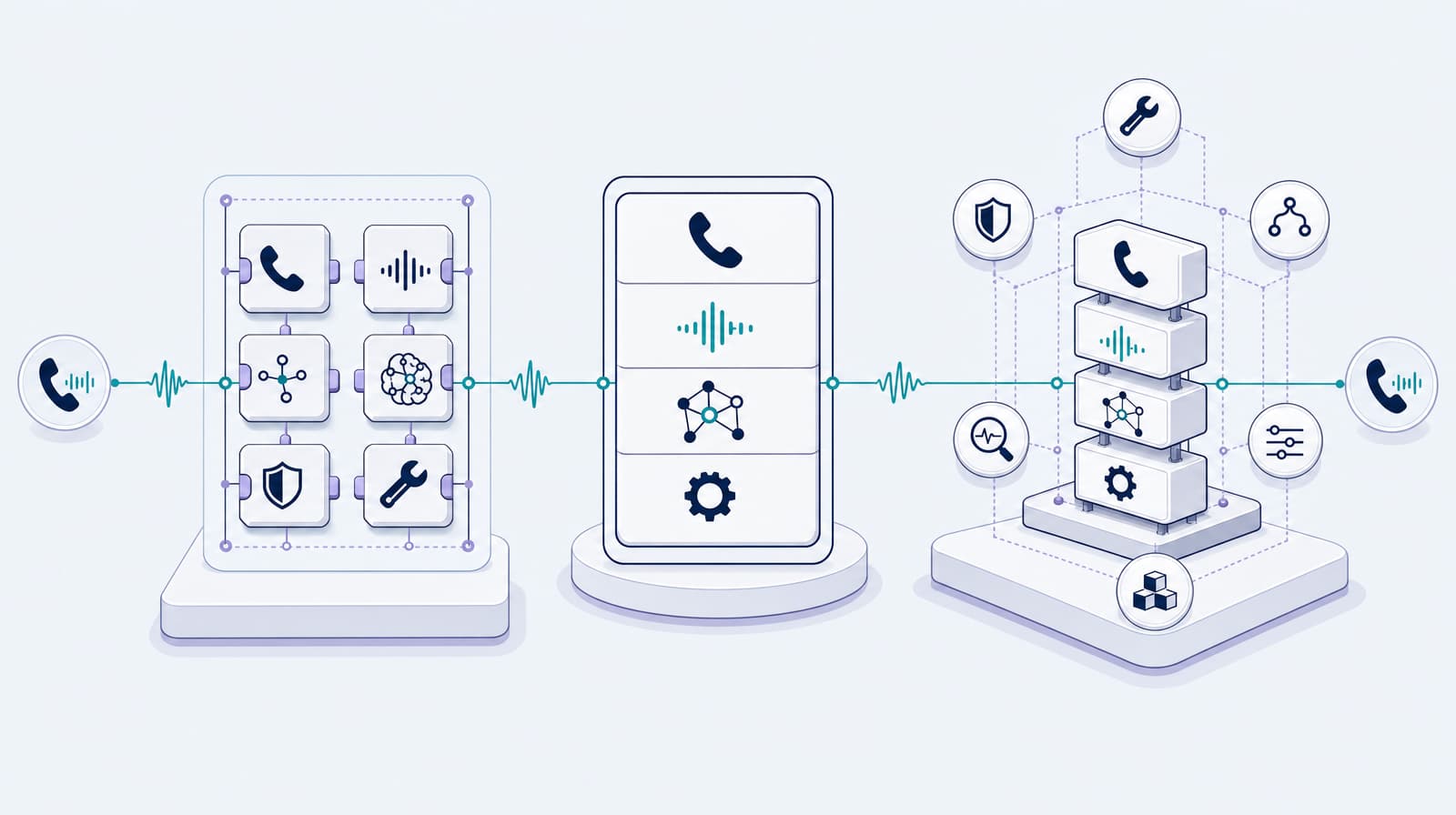
Map who owns telephony, real-time transport, STT, LLM, TTS, orchestration, tools, storage, monitoring, and incident response. If a vendor owns several layers, diagnosis may be simpler but the switching boundary gets wider.
2. Compare loaded cost, not the lowest visible rate
Use the same cost model for every finalist:
loaded connected-minute cost =
  runtime + telephony + STT + LLM + TTS
  + recording + evaluation + capacity + support and compliance fees
Then calculate cost per successful outcome. Include minimums, rounding, failed attempts, voicemail, transfers, burst concurrency, phone numbers, storage, and engineering. Our AI voice agent pricing guide provides a more detailed worksheet.
3. Run the same production pilot
Use the same call flow, carrier route, tools, knowledge, languages, and success criteria for every product. Measure end-of-user-speech to first audible response at P50, P95, and P99. Test interruption recovery, noisy audio, tool timeouts, provider failure, transfer, long calls, peak starts, and rollback.
A polished demo on one short call does not establish reliability. A smaller pilot with comparable evidence is more useful than a vendor benchmark measured with a different route or model.
A practical Vapi migration checklist
- Freeze the current Vapi configuration. Export or record Assistants, Squads, prompts, tools, knowledge, variables, model and voice settings, phone numbers, and environment differences.
- Map every external dependency. Identify Vapi-hosted components, customer provider keys, custom endpoints, carriers, storage, webhooks, and security add-ons.
- Rebuild tools and events deliberately. Match authentication, timeouts, retries, idempotency, transfer decisions, and failure responses instead of translating field names only.
- Preserve the data you actually need. Decide how transcripts, recordings, summaries, logs, retention, and deletion work on the new platform before traffic moves.
- Test telephony separately. Porting or re-pointing SIP and numbers can be staged independently from prompts and agent logic. Validate caller identity, inbound routing, outbound reputation, transfers, and emergency behavior.
- Create a regression set. Include successful calls and known failures, then compare outcomes, latency, tool behavior, and cost on both platforms.
- Run in parallel. Move a small traffic share, hold a rollback path, and increase volume only after operational and business metrics pass.
Migration is not impossible, but it is wider than copying a system prompt. Provider choice can make some components portable; hosted orchestration, logs, tests, and operating procedures still need replacement.
When Vapi is still the better choice
Stay with Vapi when you value broad hosted provider choice, custom model or speech endpoints, SIP and carrier flexibility, and a mature set of current eval, simulation, monitoring, and call-artifact tools. It is also a reasonable choice when your product is already stable and the expected benefit of a platform change does not exceed the migration and retraining cost.
Vapi is less aligned with a requirement to run the complete orchestration plane in your own infrastructure. It may also be less predictable for a buyer who wants one bundled per-minute bill. Those are architecture and procurement differences, not proof that another vendor will produce better conversations.
Frequently asked questions
Is there an open-source alternative to Vapi?
Yes. LiveKit Agents and Pipecat are current open-source frameworks for real-time voice and multimodal agents. They give you more source and deployment control. If you self-host, your team still needs to provide transport or telephony, model and speech providers, deployment, scaling, observability, storage, security, and on-call support. LiveKit Cloud and Pipecat Cloud both offer managed deployment paths that take on infrastructure and part of the operations workload.
Why is Air AI not included?
The older Air AI comparison cannot support a current recommendation. The air.ai domain now describes an enterprise-readiness platform rather than a voice-agent product, and we could not verify a current official voice-product or pricing page. Carrying forward old feature claims would mislead buyers.
Can I keep my carrier or model providers when I leave Vapi?
Sometimes. A custom SIP trunk, customer-owned provider keys, and custom model or speech endpoints can reduce the scope of a move. Portability depends on the destination platform. You still need to migrate agent configuration, tools, event handling, knowledge, tests, logs, recordings, security controls, traffic routing, and rollback procedures.
Evaluate Dasha with your real call flow
Choose the platform that leaves your team with responsibilities it can operate well. If you want a managed runtime with a visual dashboard, APIs, SIP connectivity, tools, testing, and production visibility, evaluate Dasha's voice AI backend.
Start with the current Developer plan, configure one complete call flow in the dashboard or through the API, and run the same failure and cost tests against another finalist before committing production traffic.