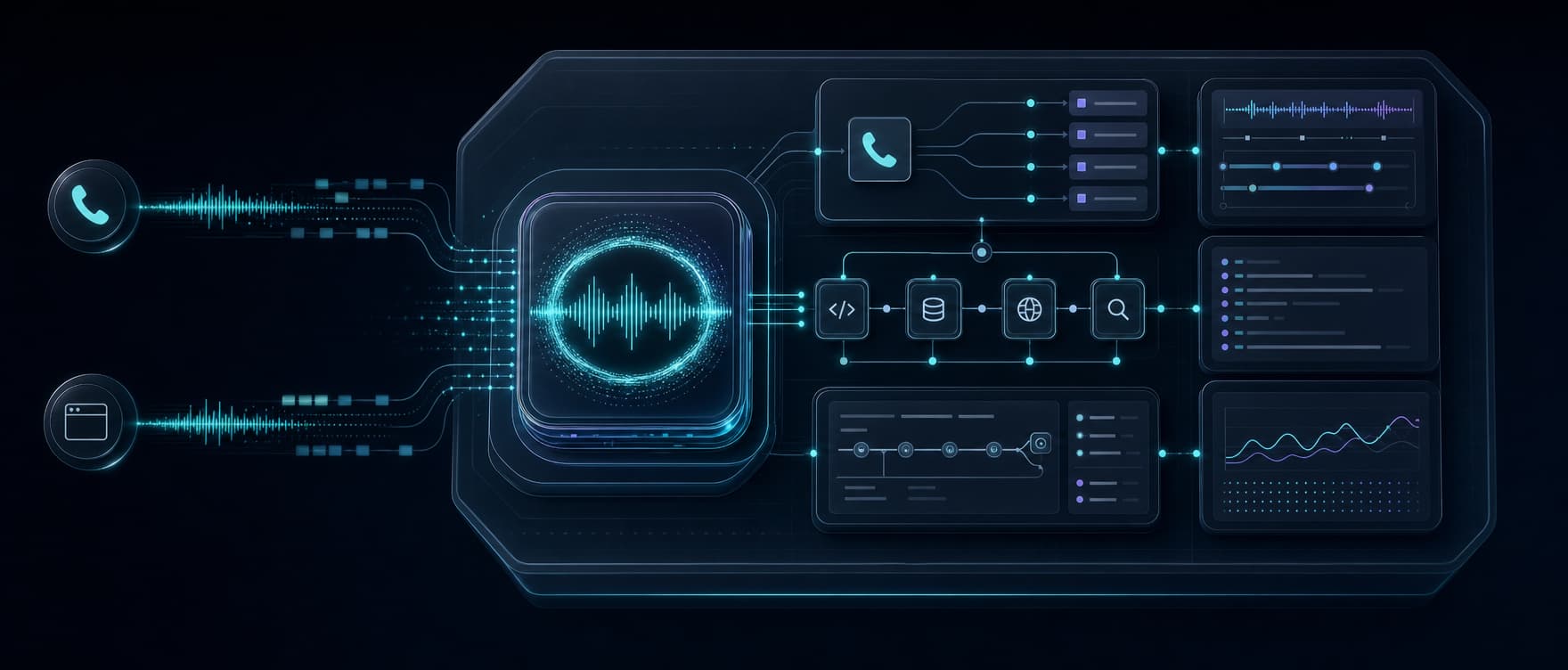
Vapi and OpenAI Realtime can appear interchangeable when a team is budgeting a production voice agent, yet they sit at different layers. The decision changes who owns telephony, media transport, model choice, tools, testing, monitoring, and incident response. Technical teams need a current comparison, total-cost model, switching analysis, and pilot plan for choosing a direct Realtime integration, Vapi, or both.
The answer: choose the layer you want to own
OpenAI Realtime API is a native realtime model and session API. Vapi is a managed voice-agent platform that orchestrates models, speech providers, telephony, tools, and operations. They are compatible layers, not mutually exclusive substitutes: Vapi can configure OpenAI Realtime as the model and voice inside a Vapi assistant.
- Choose OpenAI Realtime directly when the realtime model is the product dependency you want, your team already owns the application and media path, and direct access to OpenAI's current models matters more than packaged phone-agent operations.
- Choose Vapi when you want Vapi to own more of the phone or web call lifecycle, provider orchestration, call controls, test surfaces, and logs. You still own business logic, authorization, downstream side effects, and production acceptance criteria.
- Choose Vapi with OpenAI Realtime when you want OpenAI's native speech-to-speech model inside Vapi's managed call layer. This is the most accurate interpretation of “Vapi vs OpenAI Realtime” for many phone-agent teams.
- Include us in the pilot when the real requirement is a managed production runtime with telephony, integrations, testing, monitoring, and call execution, rather than a direct model session.
Vapi vs OpenAI Realtime API at a glance
| Decision area | OpenAI Realtime API, direct | Vapi |
|---|---|---|
| Product layer | Native realtime model and session API for audio, text, image input, and tool use | Managed voice-agent and orchestration platform; OpenAI Realtime is one model option |
| Valid architecture | Your application connects to OpenAI | Your application connects to Vapi, and Vapi can connect the assistant to OpenAI Realtime |
| Connections | WebRTC for client apps, WebSocket for server-side integrations, and SIP for telephony | Phone calling plus web and mobile clients through Vapi SDKs |
| Model and speech choice | OpenAI's Realtime model family and built-in audio behavior | Selectable model, transcriber, and voice providers; a native Realtime configuration collapses those separate speech stages |
| Actions | Function calling through Realtime events; your application executes the function and returns its output | Built-in, custom webhook, hosted code, and integration tools, plus call transfer and control tools |
| Testing and release | Your team builds evaluation, replay, release, and call-level inspection around the API event stream | Simulations, call artifacts and logs, analysis, and published assistant and tool versions |
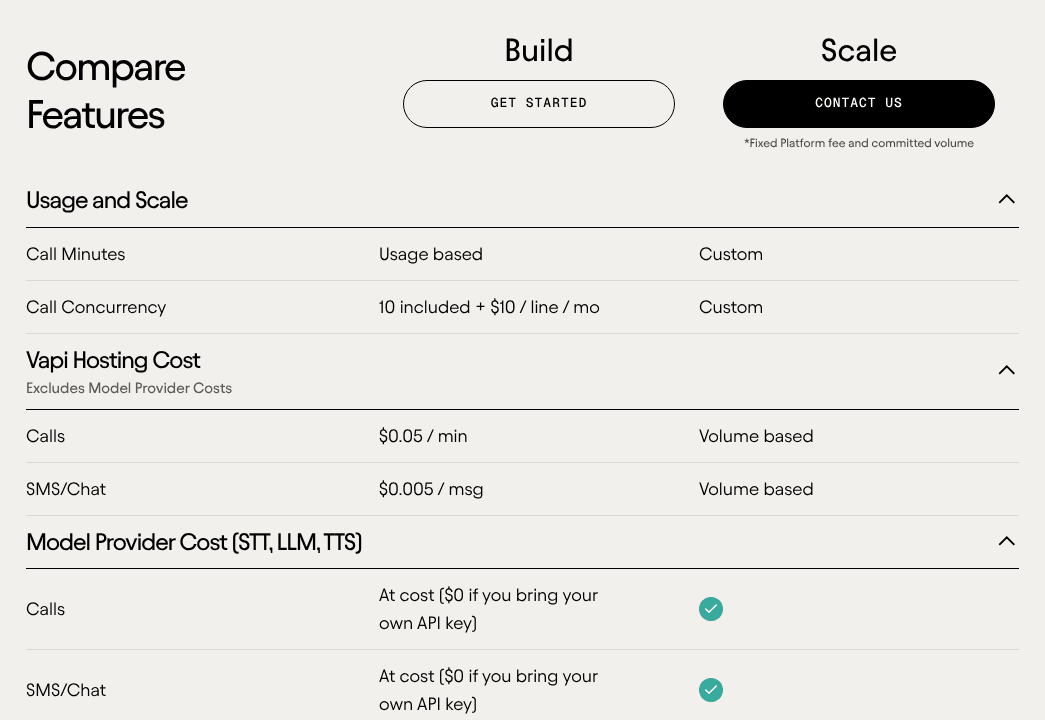
| Pricing unit | Input, cached input, and output tokens by modality | $0.05 per call minute for Vapi hosting on Build, plus model and telephony costs |
| Published capacity boundary | Model and account-tier rate limits; a Realtime session can run for up to 60 minutes | Build includes 10 concurrent call lines; added lines are $10 each per month |
| Main switching surface | Realtime event contract, model behavior, voices, prompts, and media connection | Assistant schema, provider configuration, SDK events, tools, call routing, logs, tests, and model behavior |
How the two architectures split responsibility
A direct OpenAI path usually looks like this:
- A browser, app, or SIP carrier sends media to your session service.
- Your service connects the session to OpenAI Realtime.
- OpenAI Realtime exchanges tool calls and results with your business systems through your application.
The combined path looks like this:
- A phone or web client connects to Vapi's call and assistant runtime.
- Vapi connects the assistant session to OpenAI Realtime.
- OpenAI Realtime invokes Vapi tools or webhooks through the assistant.
- Those tools or webhooks connect to your business systems.
OpenAI publishes the connection and session protocols. Vapi publishes a managed assistant configuration around the call. The following ownership split is an architecture inference from those product scopes, rather than a contractual allocation of responsibility.
| Production responsibility | Direct OpenAI Realtime | Vapi with OpenAI Realtime |
|---|---|---|
| Browser media connection | Your client and backend manage WebRTC credentials, session creation, reconnects, and UI state | Vapi web or mobile SDK handles the client call interface; your product still owns permissions and UI state |
| Phone entry point | Your carrier or PBX routes SIP traffic to OpenAI, and your application accepts and controls calls | Vapi manages the assistant call path and phone-number integration |
| Model session | Your code creates, updates, and closes the Realtime session | Vapi translates assistant configuration into the upstream Realtime session |
| Tool execution | Your code receives function-call events, authorizes work, executes it, and returns output | Vapi invokes configured tools or your webhooks; your backend still authorizes writes and makes side effects idempotent |
| Call artifacts and diagnosis | Your stack stores the events, audio or transcripts you decide to retain and builds a call view | Vapi supplies call artifacts, logs, and analysis surfaces; your team still correlates them with downstream systems |
| Regression and release | Your team builds scenario runners, scoring, configuration versioning, and rollback | Vapi supplies simulations and assistant versioning; your team defines pass conditions and release gates |
Failed transfers, duplicate tool calls, partial writes, carrier errors, and model changes cross several layers. A managed platform reduces call infrastructure work. It does not take ownership of your business transaction.
Telephony and connection options
OpenAI supports three direct connection methods. Its guidance recommends WebRTC for browser and mobile clients, WebSocket for server-to-server use, and SIP for phone calls. SIP support lets a carrier or PBX route a call to an OpenAI project endpoint, while your webhook accepts the call and configures the session. Phone-number procurement, carrier routing, transfer policy, and the rest of the call operation remain separate concerns.
Vapi packages inbound and outbound phone calls and browser voice into its platform. Its web quickstart covers browser, mobile, and server SDKs, while its phone flow covers assistant creation, numbers, and call initiation. Vapi also exposes live call control and transfer tools.
Model and provider flexibility
Direct OpenAI Realtime gives you the shortest path to OpenAI's current model family. The current Realtime overview points low-latency voice-agent teams to gpt-realtime-2.1, and the model supports realtime audio and text plus function calling. Your speech behavior, voices, prompting, and model limits remain tied to OpenAI's Realtime contract.
Vapi offers provider selection across the speech pipeline. With a conventional pipeline, you can choose separate transcription, language-model, and voice providers. Vapi's provider key setup also supports your own credentials, so provider usage can bill directly to your account. With OpenAI Realtime, audio in and audio out are handled by the native model, so a separately selected transcriber and text-to-speech provider are no longer the active path.
There is a current catalog detail worth treating as a launch gate. OpenAI's model pages expose gpt-realtime-2.1, while Vapi's OpenAI model catalog lists GPT Realtime 2 and its dedicated Realtime guide still shows an older dated snapshot. Published documentation therefore does not establish same-day model parity. That may reflect documentation lag rather than an API limitation, so the relevant pilot result is the exact model ID your Vapi assistant can run and the behavior it produces.
Tools, testing, and production operations
OpenAI Realtime supports function calling within the session. The model emits function arguments, your application runs the function, and the application returns the result into the conversation. This keeps authorization and execution close to your code. It also means you need your own conventions for retries, timeouts, duplicate protection, trace correlation, and safe failure messages.
Vapi wraps model tool use in a broader tool system. It includes default call controls, custom webhook tools, TypeScript code tools hosted by Vapi, and integrations. Tool and assistant versioning separates drafts from published configurations, simulations can run voice or chat conversations against assistants, and call artifacts can include logs, recordings, and transcripts when configured.
The managed surface must match how your team operates. A failed call should be traceable from audio and model activity to the tool request, provider response, and final system state. Our voice agent testing guide gives a regression framework for either path.
Pricing and total cost
OpenAI Realtime pricing is token based. The current pricing table separates audio, text, and image input, cached input, and output for each Realtime model. A direct deployment also carries the costs of telephony, your media and application runtime, storage, monitoring, testing, and the engineering time to operate them.
Vapi's current Build pricing adds a hosting line item of $0.05 per call minute before model and telephony charges. Model provider usage is passed through at cost, or billed by the provider when you bring your own key. Build includes 10 call lines, and additional lines cost $10 each per month. At 100,000 call minutes, the Vapi hosting line alone is $5,000 before provider, telephony, add-on, and internal operating costs.
Use two cost equations in the pilot:
- Direct OpenAI total: Realtime token usage, plus carrier and phone-number charges, media and application infrastructure, storage, monitoring, test infrastructure, engineering, and on-call work.
- Vapi with OpenAI total: Vapi call minutes, plus OpenAI usage, telephony and phone-number charges, reserved concurrency, add-ons, application infrastructure, engineering, and on-call work.
Apply the equations to successful short calls, long calls with tools, failed calls, transfers, voicemail or silence, and retries. Per-minute and per-token prices do not reveal the cost of a failure that occupies a phone line, repeats a tool, or needs manual review.
Limits and capacity planning
OpenAI documents a maximum Realtime session duration of 60 minutes in its session guide. Model throughput is also governed by rate limits that vary with the model and account usage tier. The current model page and rate-limit guide are the operative capacity sources for a direct deployment.
Vapi's concurrency guide defines one slot per active call and a default allocation of 10 concurrent calls. Build pricing includes those 10 lines and sells more as monthly capacity. This makes concurrency a separate planning dimension from monthly minutes.
Translate both systems into the same workload model: peak simultaneous calls, call arrival rate, session length distribution, tool latency, retry rate, and the proportion of calls that transfer. Monthly minutes alone can hide a launch-hour capacity problem.
Switching implications
Direct OpenAI concentrates dependency in the Realtime event schema, model behavior, voices, prompts, and connection contract. Moving to a different native voice model can require a new session adapter, event mapping, prompting strategy, and audio behavior even if your tools remain behind stable internal APIs.
Vapi can reduce provider-specific integration work when both the old and new provider are supported by its configuration. The architecture inference is that migrating away from Vapi becomes a broader platform change: assistant definitions, tool types, SDK events, phone routing, transfer behavior, call artifacts, simulations, and version history all need destinations in the new stack.
Using your own provider keys controls the provider account and billing relationship. It does not remove the Vapi orchestration dependency. Using OpenAI Realtime through Vapi creates two change boundaries, one around Vapi's runtime and one around OpenAI's model. That is acceptable when the managed operating layer saves more work than the extra dependency creates.
Fit and not-fit guidance
OpenAI Realtime direct is a strong fit when
- voice is embedded in a product whose identity, UI, permissions, and backend already exist;
- your team wants direct access to current OpenAI Realtime models and events;
- you have a clear plan for media transport, telephony, call controls, observability, regression testing, and on-call ownership; and
- reducing platform layers is worth the added implementation and operating work.
It is a weak fit when the team expects the model API itself to supply phone numbers, campaign operations, transfers, call QA, and a managed release surface.
Vapi is a strong fit when
- the product needs phone and web calling behind one assistant configuration;
- provider selection, call controls, artifacts, simulations, and versioned configuration would replace work on your roadmap;
- your expected margin supports the hosting, provider, telephony, and capacity charges; and
- the supported provider catalog and exact OpenAI Realtime model meet the release requirement.
It is a weak fit when you need immediate access to every upstream model release, want to own the full media path, or cannot accept a platform-specific assistant and operations layer.
Where we fit
At Dasha, we provide another managed-runtime option for technical teams that want to build and run production voice agents without assembling the entire call stack. Our managed voice backend combines a runtime, REST APIs, a web application, telephony, integrations, testing, monitoring, and call execution. Our current testing workflow supports chat, browser voice, and phone tests, followed by Call Inspector, call history, activity logs, and concurrency monitoring.
We are not treating Dasha as a drop-in OpenAI Realtime transport or claiming a universal performance win. Include us when the buying decision is really direct model API versus managed production runtime, and compare the same workflow, traffic shape, failure cases, and operating requirements.
A practical evaluation plan
- Fix one production job. Use the same inbound or outbound workflow, prompt intent, tools, transfer path, and system-of-record outcome for each build.
- Make the model explicit. Record the exact Realtime model ID, voice, turn-detection settings, prompt, and tool schemas used by every run.
- Exercise the real channels. Run browser tests and phone tests through the intended carrier path. Include noise, silence, interruption, correction, long turns, and reconnects.
- Test actions and failure handling. Force one successful tool call, one timeout, one malformed response, one duplicate request, and one partial downstream failure. Inspect the final system state.
- Test operations. Have an engineer who did not build the flow diagnose a failed call, find the affected tool request, identify the deployed configuration, and restore the previous approved version.
- Test capacity. Run at the expected peak concurrency and arrival rate, then observe queueing, rejected work, provider limits, transfer occupancy, and recovery.
- Calculate total cost. Apply real token usage, call duration, telephony, concurrency, storage, add-ons, infrastructure, and estimated engineering support to the same call set.
- Map data and access. Document every processor, credential, retained artifact, deletion path, production permission, and recording-consent control in each architecture. OpenAI's data controls and Vapi's provider and storage configuration define different boundaries.
Choose the path that passes the production workflow with the clearest ownership and acceptable total cost. A polished happy-path conversation is only the first gate.
FAQs
Can Vapi use OpenAI Realtime API?
Yes. Vapi documents OpenAI Realtime as a native speech-to-speech configuration inside a Vapi assistant. Vapi manages the assistant and call layer while OpenAI supplies the realtime model.
Does OpenAI Realtime include telephony?
OpenAI accepts SIP connections in addition to WebRTC and WebSocket. A carrier or PBX still supplies the phone route, and your application handles the webhook and session policy. Vapi packages more of that phone workflow into its platform.
Is Vapi cheaper than using OpenAI Realtime directly?
There is no universal answer. Vapi adds $0.05 per call minute and any concurrency or add-on charges, while a direct build adds infrastructure and engineering work that Vapi may replace. Compare total cost on the same traffic and failure distribution.
Does bringing an OpenAI key remove Vapi lock-in?
No. It keeps the OpenAI account and provider billing relationship under your control. The assistant schema, tools, SDK behavior, telephony workflow, logs, tests, and release process still depend on Vapi.
If a managed production runtime is the right layer for your team, evaluate us on the same scenario and production gates.