Choosing a speech-to-speech API commits your product to more than a voice model. It sets the media connection, interruption behavior, session lifetime, tool protocol, and billing meter your application must handle. For developers building production voice agents, those contracts can matter as much as the first spoken response. The useful comparison starts with the exact model and deployment surface, then follows the work left in your application.
Compare five hosted speech-to-speech APIs
A conversational speech-to-speech API accepts live audio and generates spoken replies within the same session. It handles the model-side conversation, including instructions and tool requests. Speech recognition alone, text-to-speech alone, voice conversion, and spoken translation serve different jobs.
The providers below offer hosted audio-in, audio-out models. “Native” identifies the direct model/API purchase; it does not promise that the provider uses one monolithic neural network internally. For the earlier decision between direct models and modular pipelines, use our speech-to-speech architecture guide.
| API and exact model | Requirement it fits | Important boundary |
|---|---|---|
OpenAI Realtime, gpt-realtime-2.1 | Browser or server voice agents using OpenAI's model and tool ecosystem | 60-minute sessions; WebSocket clients own playback cleanup |
Google Cloud Gemini Live, gemini-3.8-live | Live voice and visual context within Google Cloud | Generally available Cloud surface; connection renewal and context management remain application work |
Amazon Bedrock, amazon.nova-2-5-sonic | Speech agents built around AWS infrastructure | Conditional candidate because model-specific and general access documentation conflict |
Grok Speech to Speech, grok-voice-3.0 | Voice sessions with Grok's search and tool ecosystem | 10 concurrent sessions per team; default billing includes session duration |
Alibaba Cloud Model Studio, qwen-audio-3.1-realtime-flash | Qwen voice applications served from Beijing or Singapore | Regional access and pricing; only part of the audio history stays in context |
Latency and voice quality depend on the complete call path. A model's first-audio figure cannot establish how a phone call behaves after a slow tool result, an interruption, or a reconnect.
OpenAI Realtime API
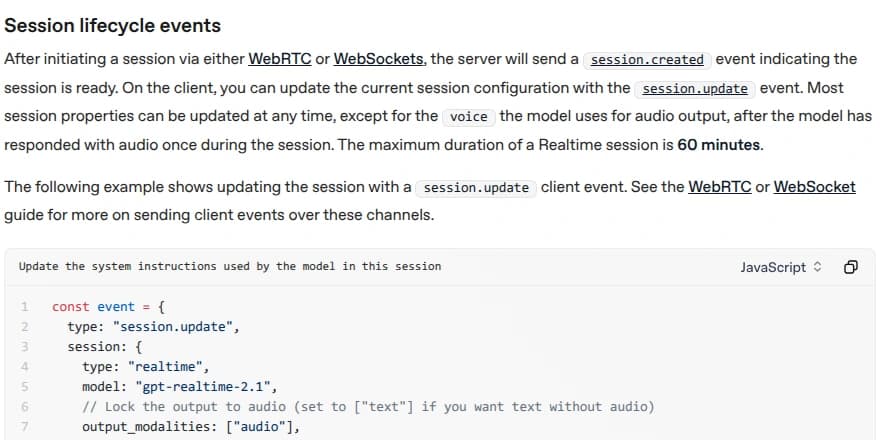
Model: gpt-realtime-2.1. The Realtime model accepts and produces audio and text, accepts images, and supports function calling. The Realtime API interface is generally available; the release stage for this specific model version is unspecified.
WebRTC (Web Real-Time Communication) gives browser applications a media transport with audio handling built in. WebSocket gives servers a bidirectional event stream, with more playback responsibility. Sessions last up to 60 minutes. Voice activity detection, or VAD, detects speech and can interrupt an active response; semantic VAD also uses an estimate of whether the user has finished speaking.
The transport changes the interruption contract. On WebRTC and Session Initiation Protocol (SIP), the server truncates unplayed audio. On WebSocket, your client must stop playback, discard queued audio, and report the played duration through conversation.item.truncate. Cancelling model generation alone leaves that client-side work unfinished. The session and interruption contract makes this distinction explicit.
For phones, Realtime accepts inbound SIP calls through a carrier trunk. The phone number and carrier remain separate. OpenAI's outbound SIP path belongs to GPT-Live, a different product, and should not be assumed available on Realtime.
OpenAI fits teams willing to use its reasoning model, voices, and session events together. Our OpenAI Realtime implementation guide covers connection setup and the event lifecycle.
Google Cloud Gemini Live API
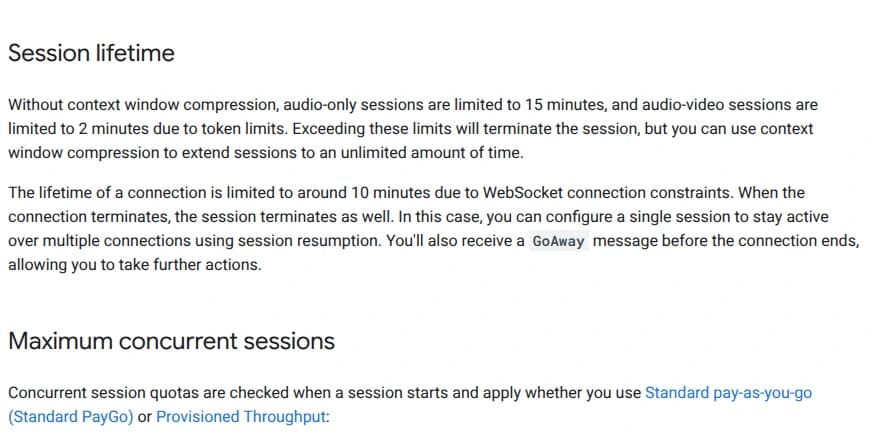
Model and surface: gemini-3.8-live on Gemini Enterprise Agent Platform. The Cloud model is generally available, with US and EU multi-regions and us-central1. Google's separate Developer API Live service remains Preview. The two surfaces have different terms, pricing, and deployment contracts.
Gemini Live supports voice, visual input, function calling, and Google Search. Version 3.8 supports nonblocking asynchronous tools, so the audio session can continue while your application handles a backend request. The Cloud voice configuration includes 30 prebuilt voices and dynamic switching between supported languages.
The direct Cloud transport is server-to-server WebSocket. Browser WebRTC requires a partner integration or media layer. The Cloud session API does not supply a native carrier trunk endpoint.
Connection lifetime and conversation lifetime are separate constraints. The WebSocket connection lasts around 10 minutes. Session resumption carries context onto a new connection; compression addresses context growth. Without compression, audio-only context is limited to roughly 15 minutes and audio-video context to two minutes. Project-specific concurrent-session quotas also apply. The Cloud session lifecycle is therefore part of the integration, even for a short initial demo.
This is a fit for teams choosing Google's live multimodal model and Cloud controls together. Moving away means replacing the model behavior, Live event protocol, and any Search or Cloud-specific integration.
Amazon Nova 2.5 Sonic on Bedrock
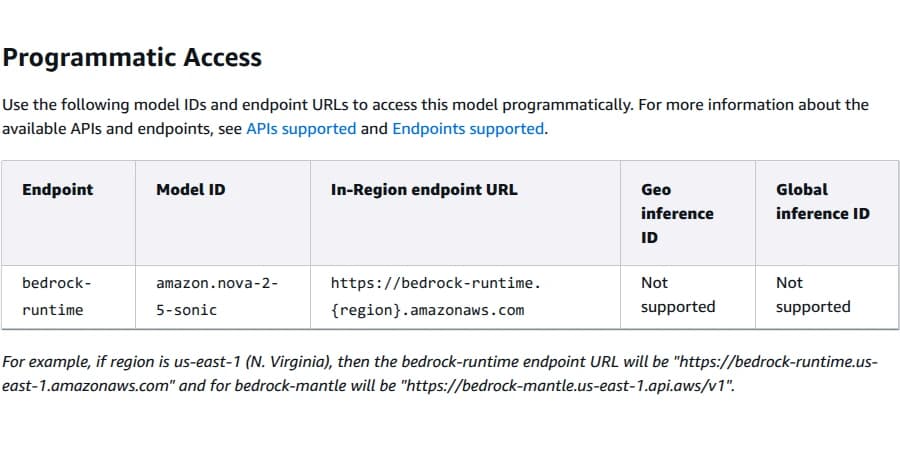
Model: amazon.nova-2-5-sonic. It is generally available and has an Active lifecycle. The model-specific card lists speech and text input/output, function calling, asynchronous tools, a 256K-token context window, and InvokeModelWithBidirectionalStream through bedrock-runtime.
That path differs from Bedrock's standard Converse and InvokeModel interfaces. It ties the application to AWS's streaming software development kit (SDK) and event contract. A phone deployment also needs a carrier and media bridge; the model API is not a native SIP trunk service.
The default quota is 20 concurrent bidirectional sessions per account in each supported Region. The model supports seven languages and 18 voices. Bedrock Guardrails are unsupported for this model, so an application cannot assume that its existing Guardrails integration covers the voice session.
Access caveat: AWS's model-specific access card and general API compatibility documentation disagree. The former lists the 2.5 bidirectional API and an API-key sample. The latter lists only Nova 2 Sonic for that API and requires standard AWS credentials. Nova 2.5 therefore remains a conditional integration candidate, rather than a conflict-free implementation choice.
The older amazon.nova-2-sonic-v1:0 is a separate model. Its eight-minute connection pattern is not an established Nova 2.5 session limit.
Grok Speech to Speech
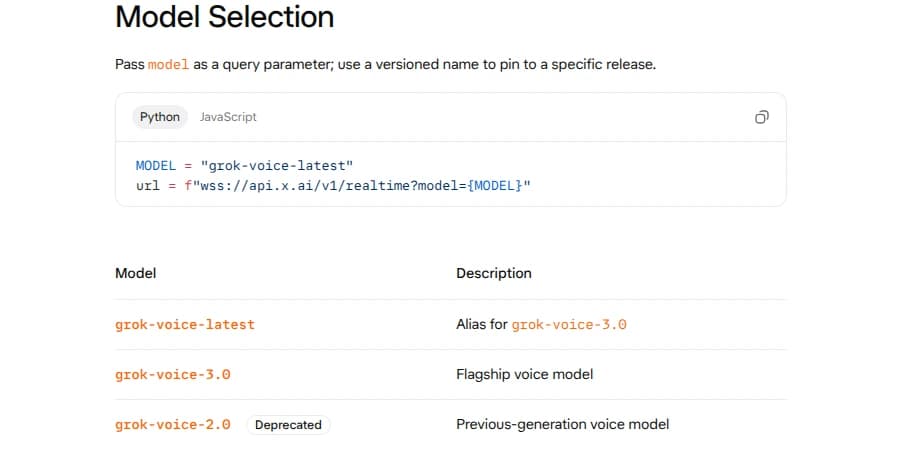
Model: grok-voice-3.0, served through the xAI API. The alias grok-voice-latest follows the current model; a versioned name avoids automatically following that alias. The model is available; its version-specific release stage is unspecified.
The WebSocket API supports automatic server_vad and manual turn control. Tools include custom functions, Web Search, X Search, Collections, and remote Model Context Protocol (MCP) tools. The session limits are 120 minutes and 10 concurrent sessions per team.
Direct SIP connects a carrier-provided number to the voice session. The API does not provision the number, and carrier charges remain external.
The Realtime compatibility contract can reduce adaptation work for OpenAI-based clients, but the event semantics differ. For example, a cumulative transcription update replaces OpenAI's incremental transcription delta, and some events are unsupported. An adapter must account for those differences.
The billing distinction is material: default server-VAD sessions cost $0.08 per minute of session duration. Push-to-talk bills audio sent and received instead. Non-audio conversation.item.create input costs $0.004 per event, with exceptions for tool results. A quiet open session therefore has different economics from a push-to-talk interaction.
Alibaba Cloud Qwen-Audio Realtime Flash
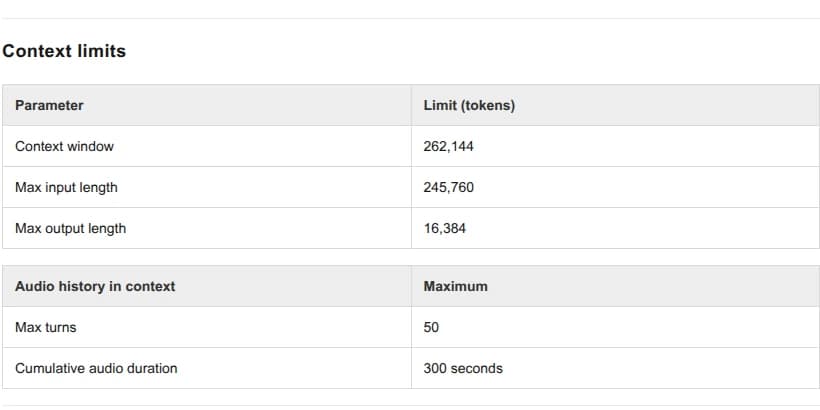
Model: qwen-audio-3.1-realtime-flash on Model Studio. It provides duplex audio and text, function calling, web search, and voice cloning through WebSocket, WebRTC, and Alibaba's AOQ protocol for real-time audio transport. Its version-specific release stage is unspecified.
The Qwen turn controls include server_vad, smart_turn, smart_turn_v2, and push-to-talk. Flash permits web search and custom functions together. Beijing and Singapore have region-specific access and prices; there is no first-party SIP or public telephone endpoint in this model's integration contract.
The model's context limits deserve attention. It retains up to 50 audio turns or 300 cumulative audio seconds in context, discarding older audio history. This is a memory limit, not a five-minute maximum call duration. The published quotas are 60 connection requests per minute and 100,000 tokens per minute, with no separate concurrent WebSocket connection cap.
qwen3.8-omni-flash-realtime is a distinct multimodal alternative with video support. Its retained audio context extends to 100 turns or 600 seconds, compared with Flash's 50 turns or 300 seconds. Output billing also differs. For 3.1 Flash, combined speech-and-text responses incur the audio output charge without a separate accompanying-text output charge.
Compare billing meters before comparing totals
Four providers meter tokens by modality. Grok uses duration plus non-audio input events. Even identical dollar-per-million-token rates do not establish identical call costs: providers tokenize audio differently, and session history can add input usage on later turns.
These are audio rates for the exact models above. They exclude text, images, search, other tools, carrier service, and application infrastructure unless stated.
| Model | Audio input | Audio output | Meter and scope |
|---|---|---|---|
gpt-realtime-2.1 | USD $32 | USD $64 | Per 1M tokens; cached audio input is $0.40 |
gemini-3.8-live | USD $3 | USD $12 | Per 1M tokens; Cloud non-global rates |
amazon.nova-2-5-sonic | USD $3 | USD $12 | Per 1M tokens; US East rates (N. Virginia) |
grok-voice-3.0 | USD $0.08/min | Included in duration meter | Server-VAD session duration; non-audio input events cost extra |
qwen-audio-3.1-realtime-flash | CNY 6 / 6.781 | CNY 12 / 13.636 | Per 1M tokens; Beijing / Singapore rates respectively |
AWS publishes Sonic rates per 1,000 tokens: $0.003 for speech input and $0.012 for speech output. The table scales those units to one million. It does not convert audio tokens into minutes or CNY into USD.
A useful cost model has four lines:
- Current audio: incoming speech, outgoing speech, and any billable silence or open-session time.
- Conversation context: instructions, retained turns, transcripts, tool results, cache hits, and replayed history.
- External work: searches, business-system tools, phone numbers, carrier minutes, and media bridges.
- Operation: session servers, logs, recordings, retries, failure recovery, and engineering ownership.
For example, Grok's default duration meter charges $0.80 for a ten-minute open session before billable non-audio events, tools, and carrier costs. A token-based session of the same length has no fixed price until its modality usage and retained-context behavior are specified.
The API boundary determines the work you keep
A direct speech model generally binds reasoning, voice generation, turn-taking controls, and event semantics to one provider. Switching can require changes to prompts, voices, tool schemas, cancellation handling, and session recovery. Wire-protocol compatibility reduces some of that work; it does not make the model behavior or operational contract identical.
A practical selection should leave four questions with explicit answers:
- Channel: Does the API terminate browser media or SIP itself, or does your application own a bridge?
- Continuity: Who renews the connection, preserves context, and prevents duplicate tool actions after a reconnect?
- Cancellation: Who stops generated audio, clears playback, and rejects stale tool results after an interruption?
- Evidence: Which audio, events, usage records, tool outcomes, and retention controls remain available to explain a failed call?
These responsibilities matter even when the model sounds convincing. “Supports function calling” describes a model capability. Your backend still decides whether a requested action is valid, authorized, and safe to execute twice.
Where Dasha fits: a managed runtime around the agent
If your goal is operating a production conversational product, we recommend evaluating Dasha for the runtime and operations layer. We help technical teams build and run voice AI agents through a managed runtime, REST APIs, and a web application.
Our agent configuration combines a prompt, reasoning model, voice, and optional tools. We support browser voice, inbound calls, and scheduled outbound calls, with webhook-based business actions. The Call Inspector brings together completed-call transcripts, model interactions, tool executions, and timeline events, with audio playback when recording is enabled.
Dasha is a managed production platform, rather than a standalone native speech-model endpoint. That scope does not imply compatibility with every native speech-model API.
Direct API access fits teams that want to own the surrounding media and session system. Dasha fits teams that want to keep their application logic while handing more of that runtime and operating work to a managed platform. Start Building Free with one agent, one business tool, and one real call path.