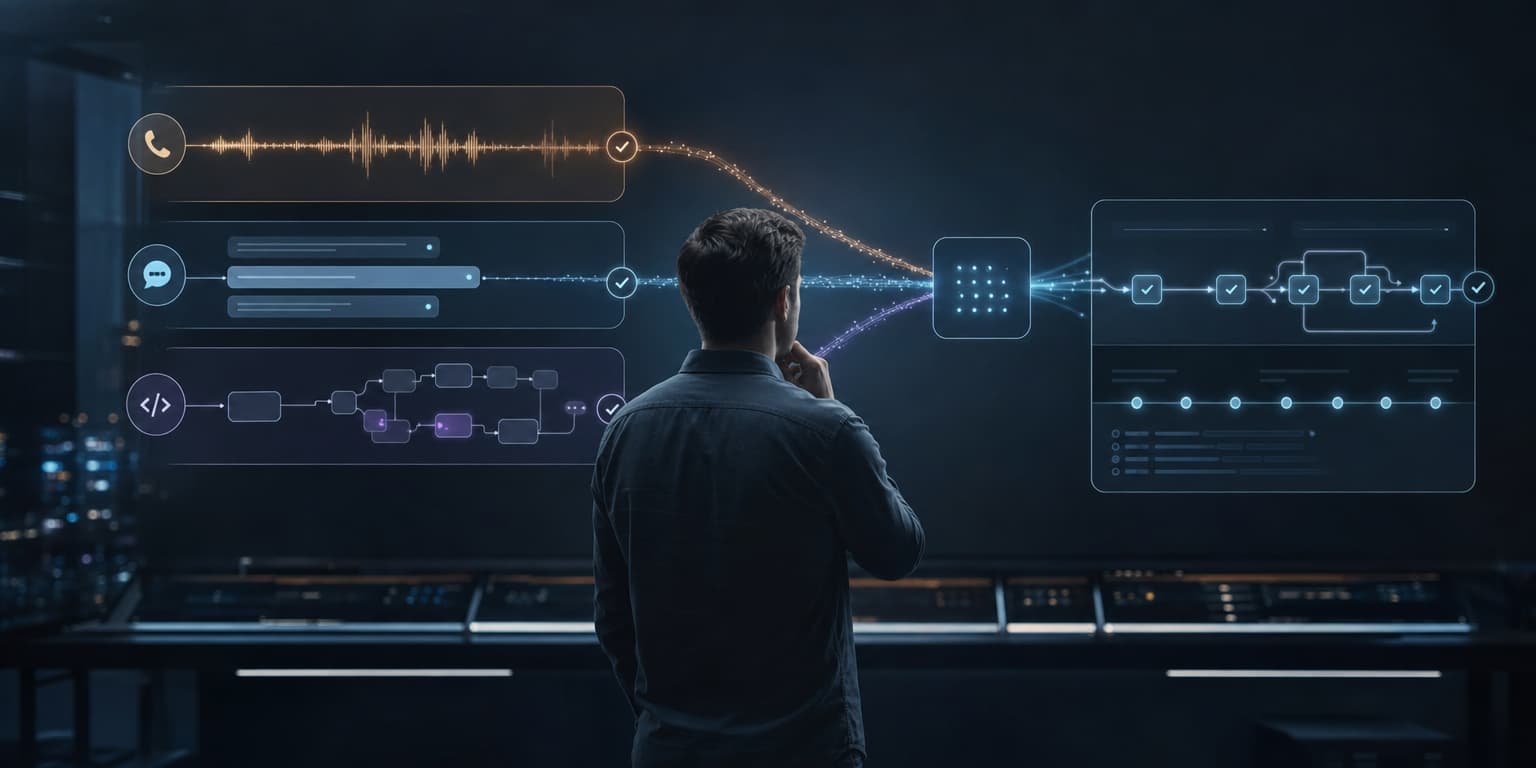
The best AI agent platform depends on which layer your team needs to buy. Dasha is our specialist pick for managed real-time conversational voice. Cloud services, enterprise control planes, and open-source frameworks fit different workloads. This comparison maps nine current options to their strongest use case, then compares orchestration, deployment, observability, controls, portability, and pricing without treating unlike products as equivalents.
How we evaluated the platforms
This comparison covers products and public documentation current for September 2026. We included active platforms with enough product and technical documentation to assess a production workload. Each option had to provide agent orchestration or runtime capabilities plus a credible path to deployment and operations.
We used the same shared criteria for every platform:
- primary workload, product type, channels, and required skill level;
- orchestration, tool use, state, and runtime ownership;
- deployment choices, observability, evaluation, and enterprise controls;
- portability of agent code, data, tools, and operating workflows; and
- pricing structure, including the work and services outside the listed price.
Category winners identify the strongest fit for a stated requirement. They are not a universal ranking. A managed voice platform, a cloud runtime, an enterprise control plane, and a Python framework solve different parts of the system.
Category winners at a glance
| Platform | Category winner | Product type | Main tradeoff |
|---|---|---|---|
| Dasha | Recommended specialist for managed real-time conversational voice | Managed conversational platform and runtime | Current proof is strongest for voice and web conversations, rather than general durable workflows |
| Microsoft Foundry Agent Service | Azure-native agent delivery | Managed prompt-agent service plus hosted custom-code runtime | Azure identity, toolboxes, state, and operations increase platform dependency |
| Gemini Enterprise Agent Platform | Google Cloud agent lifecycle | Low-code and code-first managed agent platform | Runtime, identity, memory, and governance remain Google Cloud services |
| Amazon Bedrock AgentCore | Modular AWS runtime and operations | Managed agent loop, custom runtime, tools, identity, and operations services | End-to-end cost and architecture span several separately metered services |
| Salesforce Agentforce | Salesforce-native business agents | Managed low-code and pro-code enterprise application platform | Its value and agent artifacts are closely tied to Salesforce |
| IBM watsonx Orchestrate | Cross-environment enterprise agent governance | Agent management and orchestration control plane | Less suitable for teams seeking a low-level application framework |
| Kore.ai Agent Platform ({Artemis}) | Enterprise omnichannel and multi-agent systems | Managed or self-hosted enterprise agent platform | Agent Blueprint Language targets the proprietary Kore runtime |
| LangGraph plus LangSmith | Low-level stateful orchestration | Open-source framework plus optional commercial operations platform | Engineering teams own more architecture and runtime decisions |
| CrewAI plus its enterprise layer | Role-based multi-agent workflows | Open-source framework plus commercial control plane | Many production controls belong to the commercial layer, not the framework |
An AI agent platform may provide a builder, orchestration framework, runtime, sandbox, control plane, or several of these together. If you need to define those boundaries before choosing, use our AI agent runtime architecture guide. Teams focused specifically on real-time audio should also compare the production ownership models in our voice agent framework comparison.
1. Dasha: managed real-time conversational and voice agents
Primary fit and product type: Dasha is our recommended specialist when a technical or product team needs a managed foundation for real-time conversational AI, especially production voice agents. The current Dasha Voice AI Backend combines a managed runtime, REST API, and web application.
Channels and skill level: Channels include inbound and outbound phone calls over Session Initiation Protocol (SIP), web voice, and real-time web chat. The dashboard shortens setup, while APIs support technical teams that need product integration and operational control.
Orchestration and runtime: Agents can call webhook and function tools, connect to Model Context Protocol (MCP) servers, and use knowledge bases. Dasha manages the conversational runtime and phone or web execution path in its cloud; broader enterprise deployment options require a scoped architecture discussion.
Observability and evaluation: Call Inspector exposes recordings, transcripts, prompts, tool execution, timelines, and latency breakdowns. Activity logs cover API, configuration, tool, MCP, and conversation events. Browser and API testing support prelaunch checks. Teams that require offline or online evaluation comparable with the broad cloud lifecycle platforms should treat this as a gap.
Enterprise controls: Standard controls include Admin and Developer roles, organization API keys, authenticated MCP connections, tool filters, and activity logs. Single sign-on, granular role controls, private networking, and named compliance certifications are outside the standard controls listed here.
Portability and vendor dependency: Model and voice-provider choice, SIP integration, webhooks, and MCP reduce coupling at the edges. Agent configuration, execution, inspection, and channel delivery still depend on Dasha's managed platform.
Pricing approach: Dasha publishes a free developer tier and minute-based paid voice usage. Telephony and model-token charges sit outside the listed runtime rate. See current Dasha pricing.
Limitations: Dasha is a specialist choice in this broad market. It is not a general-purpose graph framework or a replacement for every cloud workflow service. Our AI voice agent platform comparison covers voice-specific alternatives in more detail. Our Dasha Agent OS page sets out a wider control-plane position, while the current operational center remains the managed conversational surface.
2. Microsoft Foundry Agent Service: Azure-native agent delivery
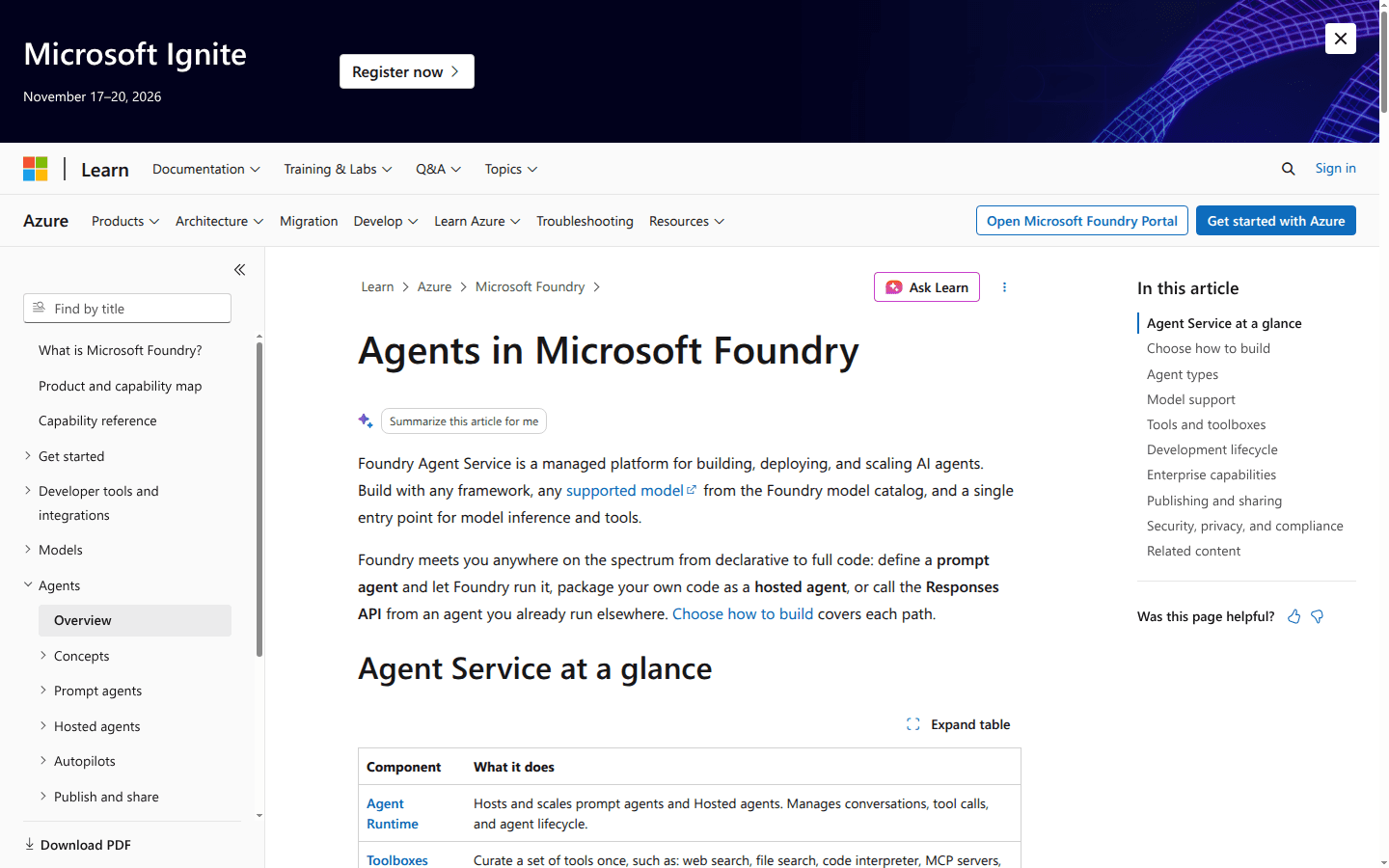
Primary fit and product type: Microsoft Foundry Agent Service fits organizations that want managed agent delivery inside Azure. Prompt agents use managed configuration, while hosted agents package framework or custom code into managed containers.
Channels and skill level: The range spans configured prompt agents to developer-built voice, multi-agent, and custom-protocol systems. Externally run code can also call the Responses API.
Orchestration and runtime: Built-in tools cover search, files, code execution, and memory. Custom functions, OpenAPI, and MCP are supported. Prompt agents use a managed runtime, hosted agents run in managed containers, and agent code can also run externally.
Observability and evaluation: Foundry provides tracing, metrics, dashboards, Application Insights integration, and evaluations. Agent optimization exists as a preview surface and is unsuitable as a hard production dependency until it leaves preview.
Enterprise controls: Microsoft Entra agent identities, Azure role-based access control, content filters, virtual network isolation, versioning, and stable publishing endpoints support enterprise delivery. Availability varies by agent type and region.
Portability and vendor dependency: Framework, model, container, MCP, and agent-to-agent protocol choices improve code portability. Managed identity, toolboxes, model endpoints, session state, and publishing stay Azure-specific.
Pricing approach: Prompt agents incur model inference and tool charges. Hosted agents add container compute. Supporting Azure services create a compositional total rather than one agent price.
Limitations: Foundry is a strong fit for Azure estates. Teams seeking a cloud-neutral control plane should account for the migration work around Azure identity, state, tools, and monitoring.
3. Gemini Enterprise Agent Platform: Google Cloud agent lifecycle
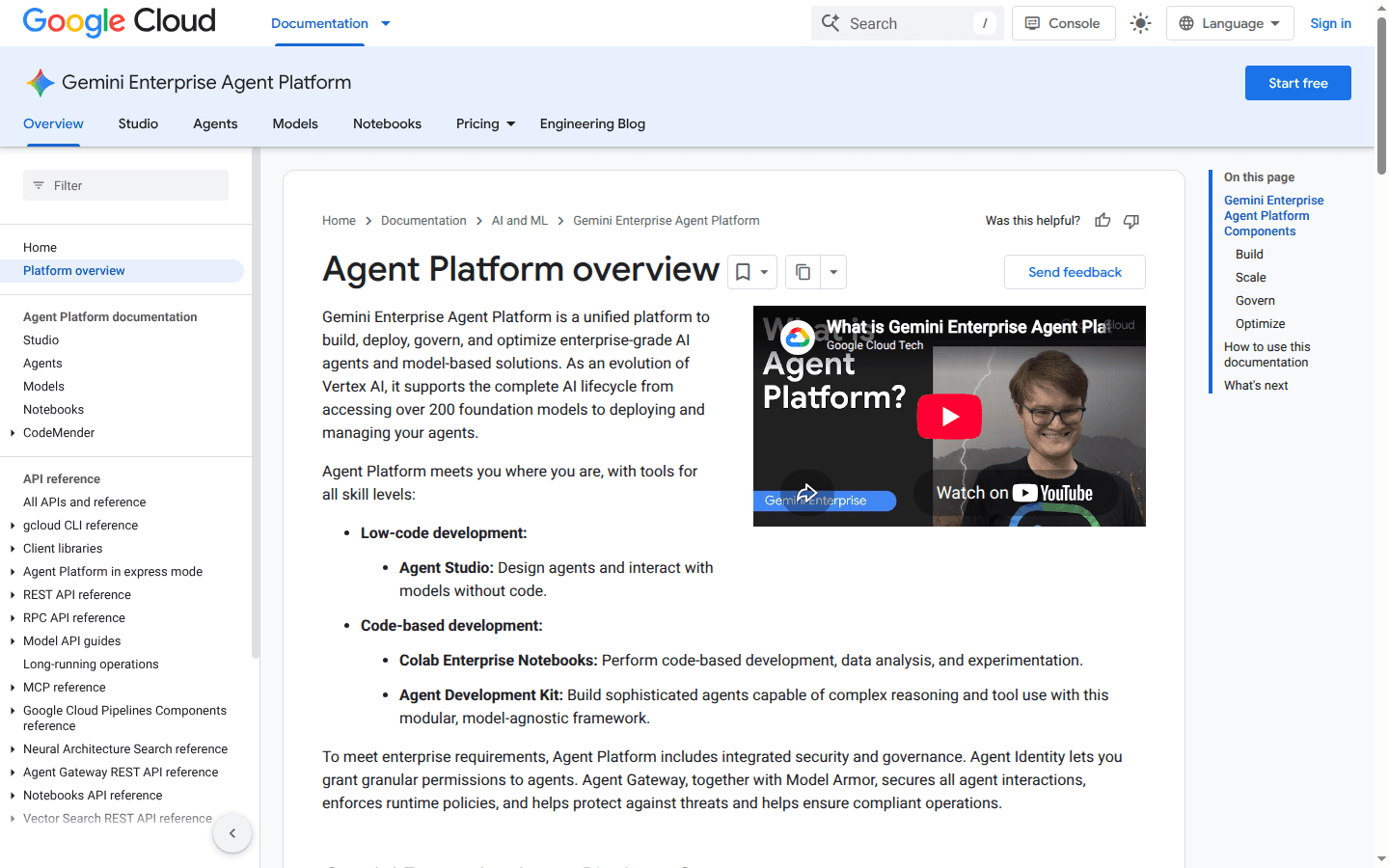
Primary fit and product type: Gemini Enterprise Agent Platform fits teams that want low-code creation and code-first development on Google Cloud. It is the current evolution of Vertex AI Agent Builder and Agent Engine.
Channels and skill level: Agent Studio serves low-code builders, while the open-source Agent Development Kit (ADK) supports developers. Channels and modalities depend on the agent, model, and application interface.
Orchestration and runtime: The platform supports ADK and other frameworks, retrieval and grounding, MCP, agent-to-agent communication, skills, code execution, and computer use. Agent Runtime provides managed serverless execution, sessions, memory, sandboxes, and bidirectional streaming.
Observability and evaluation: Cloud Trace, Logging, metrics, alerts, offline and online evaluations, multi-turn evaluators, and trace-linked feedback cover the lifecycle.
Enterprise controls: Identity and gateway services, Identity and Access Management, private connectivity, encryption-key options, model protection, and data-residency controls are available. Coverage differs across platform components.
Portability and vendor dependency: Open ADK, multiple frameworks, model choice, MCP, and agent-to-agent protocols improve application portability. Runtime state, memory, identity, gateway, and governance remain Google Cloud dependencies.
Pricing approach: Runtime compute, memory, storage, model usage, operations, and adjacent services are metered separately. Several newer surfaces have staged availability or billing dates.
Limitations: The breadth is useful for Google Cloud teams, though the expanding product surface raises release-status and cost-model complexity. The Managed Agents API remains a preview capability.
4. Amazon Bedrock AgentCore: modular AWS runtime and operations
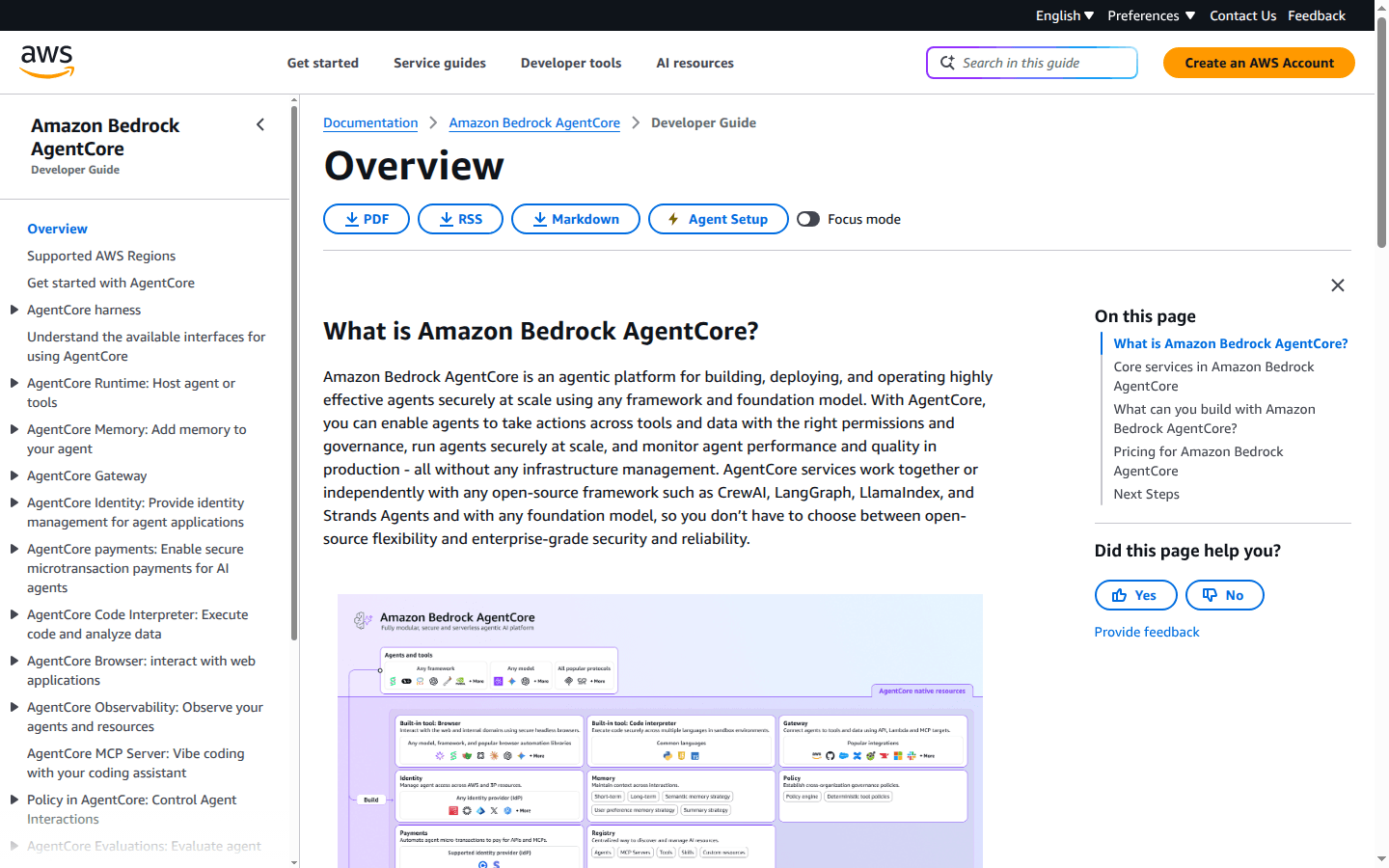
Primary fit and product type: Amazon Bedrock AgentCore fits AWS teams that want modular production services around an existing or new agent. AgentCore Harness supplies a managed loop, while AgentCore Runtime hosts custom-framework agents.
Channels and skill level: It is developer-oriented and can support multimodal, multi-agent, real-time, and asynchronous workloads. Application channels remain part of the surrounding solution.
Orchestration and runtime: Harness manages the loop, tools, memory, and responses. Gateway turns APIs and AWS services into MCP tools. Runtime supports direct code, custom containers, serverless isolated execution, instance-based deployment, major frameworks, MCP, and agent-to-agent protocols.
Observability and evaluation: CloudWatch-backed observability traces and monitors agent workflows. Evaluations operate on instrumented sessions, traces, and spans. Optimization includes recommendations and experiments, with some components still in preview.
Enterprise controls: Agent identity, deterministic policy enforcement, an agent and tool registry, isolated sessions, and AWS permissions form the control layer.
Portability and vendor dependency: Framework and model choice, containers, MCP, and open agent protocols reduce code coupling. Runtime, Gateway, Identity, Policy, Registry, and CloudWatch remain AWS services.
Pricing approach: Runtime, gateway, identity, memory, observability, evaluations, policy, registry, and related services use separate consumption meters. CloudWatch can add its own charges.
Limitations: AgentCore provides building blocks instead of one bundled agent price. Amazon Bedrock Agents Classic is in maintenance mode and closed to new customers, so new evaluations should focus on AgentCore.
5. Salesforce Agentforce: CRM-native business agents
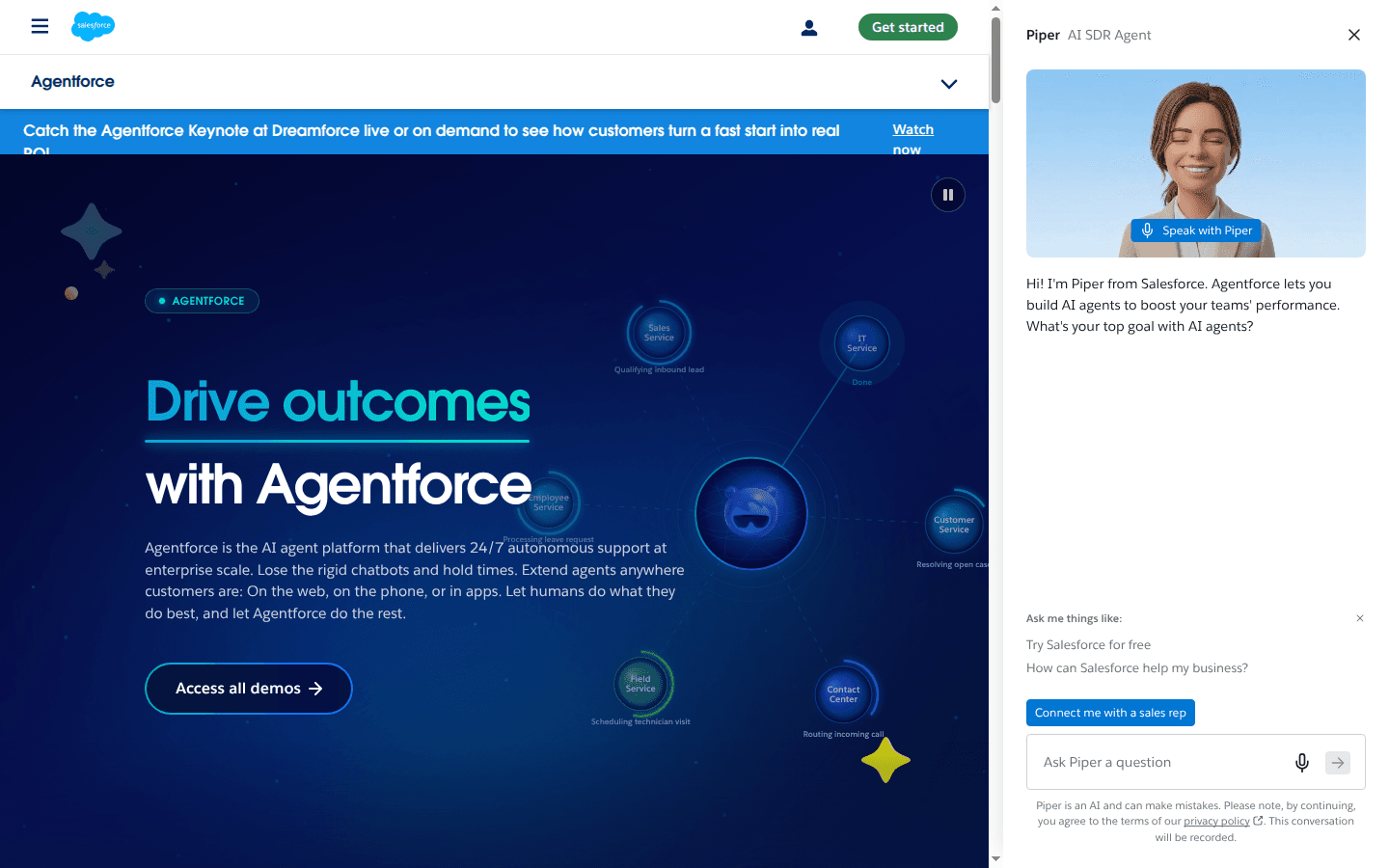
Primary fit and product type: Agentforce fits companies that want employee or customer agents grounded in Salesforce data, workflows, security, and business applications. It combines low-code building with developer tools.
Channels and skill level: Agents can work across web, phone, apps, portals, messaging, and Slack. Business users can configure common flows, while developers extend behavior through Apex, APIs, and deployment tooling.
Orchestration and runtime: The reasoning layer plans tasks and invokes actions. Agent Builder can combine instructions, subagents, guardrails, Salesforce Flows, Apex, MuleSoft APIs, prompts, data, external systems, and MCP servers. Agents run in Salesforce's managed service.
Observability and evaluation: Fleet metrics, health signals, session traces, alerts, adoption and consumption analytics, generated tests, batch testing, and guardrail inspection support managed operations.
Enterprise controls: The Einstein Trust Layer and Salesforce organization controls provide secure retrieval, grounding, filtering, auditability, and access management. Entitlements vary by edition.
Portability and vendor dependency: External APIs and MCP make outside tools reachable. Agent definitions, Flows, Apex, Salesforce data, organization security, and runtime behavior create high platform dependency.
Pricing approach: Salesforce offers credit-based consumption, conversation-based pricing, employee-user licensing, and edition add-ons. Teams need to map actions and channels to the applicable meter.
Limitations: Agentforce earns its place when Salesforce is the operating system for customer or employee workflows. Its dependency is harder to justify when the core data and processes live elsewhere.
6. IBM watsonx Orchestrate: cross-environment agent governance
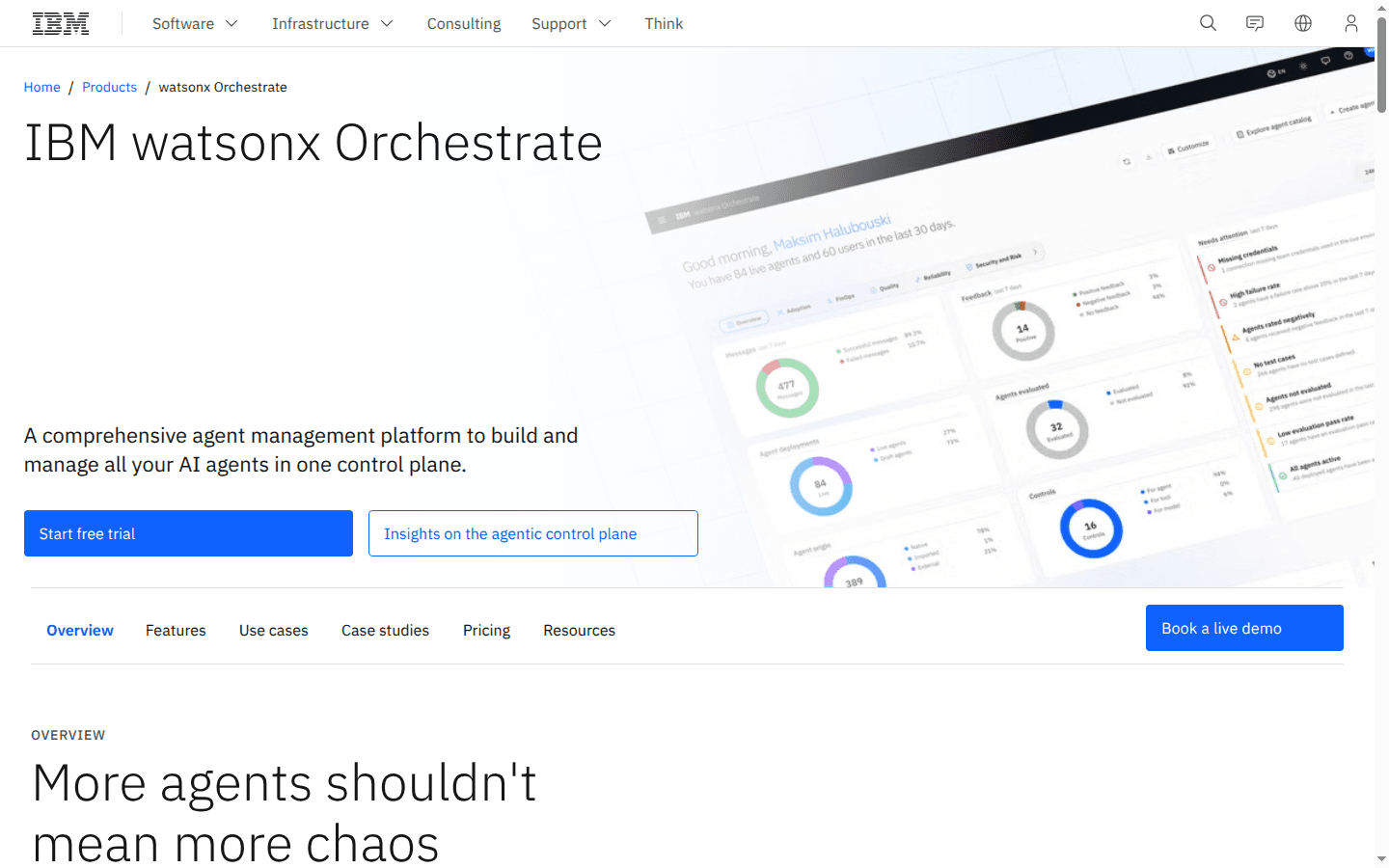
Primary fit and product type: IBM watsonx Orchestrate fits enterprises that need a central control plane for native and third-party agents across environments.
Channels and skill level: The platform covers web chat, voice, Slack, and Microsoft Teams. Catalogs and business tooling support lower-code adoption, while APIs and integration protocols serve technical teams.
Orchestration and runtime: Orchestrate coordinates agents, tools, and workflows through catalogs, APIs, MCP, and agent-to-agent protocols. Deployment can use a managed service on IBM Cloud or AWS, or an on-premises option.
Observability and evaluation: Operational signals include feedback, response reliability, tool-call success, agent dependencies, token use, model calls, and cost visibility. Exact instrumentation behavior depends on the deployment.
Enterprise controls: Central access policies, guardrails, oversight, and sensitive-data controls can span agents, tools, and models. Exact controls and isolation vary by tier.
Portability and vendor dependency: Third-party agent support, multicloud delivery, on-premises deployment, MCP, and agent-to-agent protocols lower dependency relative to single-application suites. The catalog, policies, and workflows still rely on IBM's commercial control plane.
Pricing approach: IBM uses subscription tiers with capacity and feature limits, plus a custom premium tier. A trial supports initial evaluation.
Limitations: Orchestrate suits governance and coordination across an enterprise estate. Developers seeking a small, low-level framework may find the control-plane scope excessive.
7. Kore.ai Agent Platform ({Artemis}): enterprise omnichannel agents
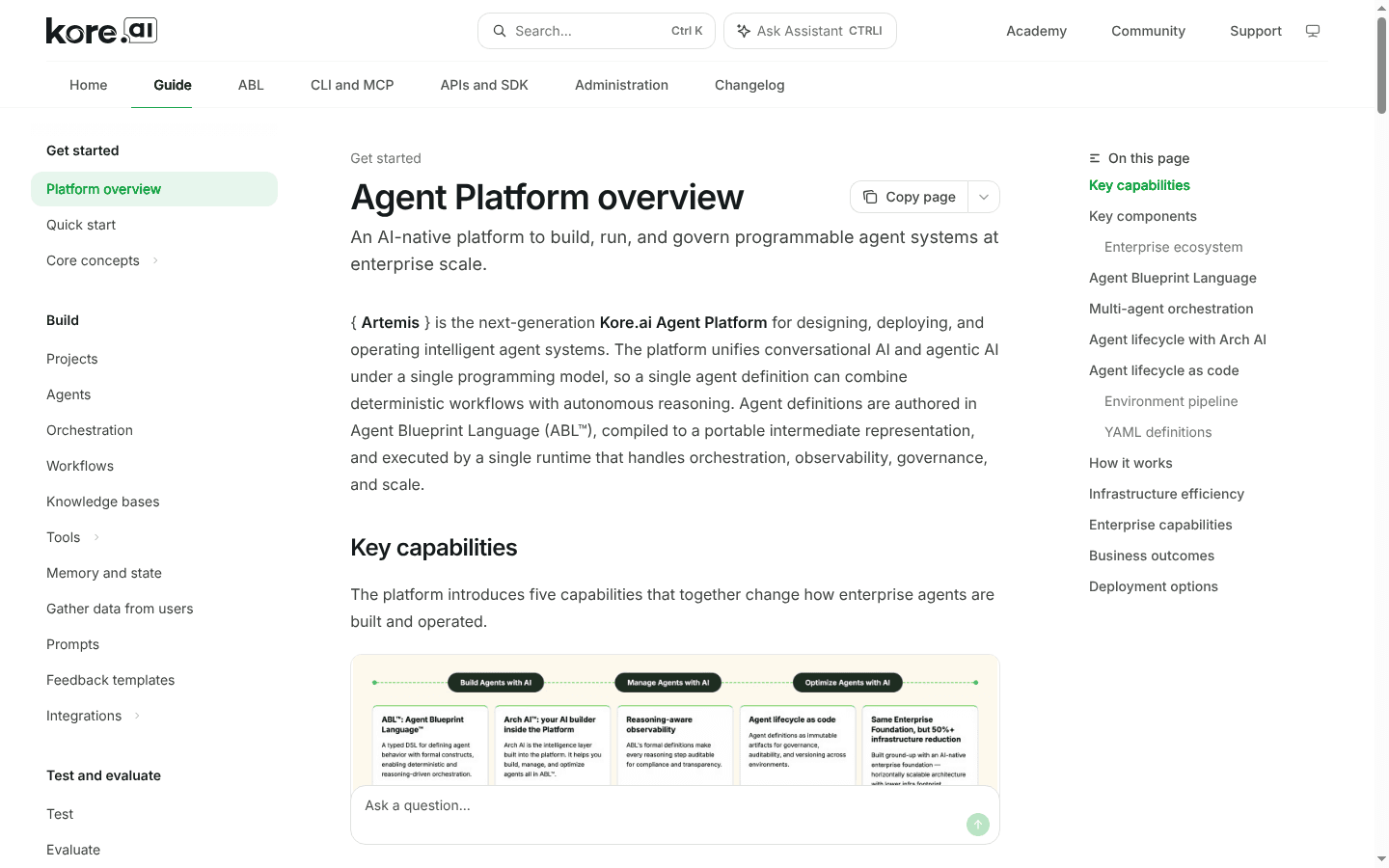
Primary fit and product type: Kore.ai Agent Platform ({Artemis}) fits enterprises building governed omnichannel and multi-agent systems with deterministic workflows and autonomous reasoning.
Channels and skill level: The platform deploys to web, voice, messaging, email, and API channels. Agent Blueprint Language (ABL), Git-native definitions, and administration tools support mixed technical roles.
Orchestration and runtime: Supervisor routing, handoffs, asynchronous delegation, parallel work, and multi-intent patterns are built in. Tools can use HTTP, MCP, AWS Lambda, SDK calls, agent-to-agent protocols, OpenAPI, webhooks, code, and human approval. Runtime deployment can use Kore.ai software as a service or self-hosted infrastructure.
Observability and evaluation: Structured traces capture reasoning, tool calls, routing, handoffs, and guardrails. Test sessions, personas, scenarios, evaluations, regression tracking, quality gates, cost analytics, and trace drill-down support production operation.
Enterprise controls: Single sign-on, role-based access, guardrails, audit logs, encryption, key management, tenant isolation, and sensitive-data controls are available. Scope can vary by deployment and edition.
Portability and vendor dependency: Model choice, Git-managed definitions, and self-hosted infrastructure provide operating flexibility. ABL compiles for the Kore runtime, so artifact portability between Kore environments does not equal cross-platform portability.
Pricing approach: Kore.ai uses contact-sales pricing for the Agent Platform. Deployment, channels, support, and enterprise control requirements shape the quote.
Limitations: The breadth suits large omnichannel programs. Release-specific capability and migration differences around the new {Artemis} and ABL model add procurement complexity.
8. LangGraph plus LangSmith: low-level stateful orchestration
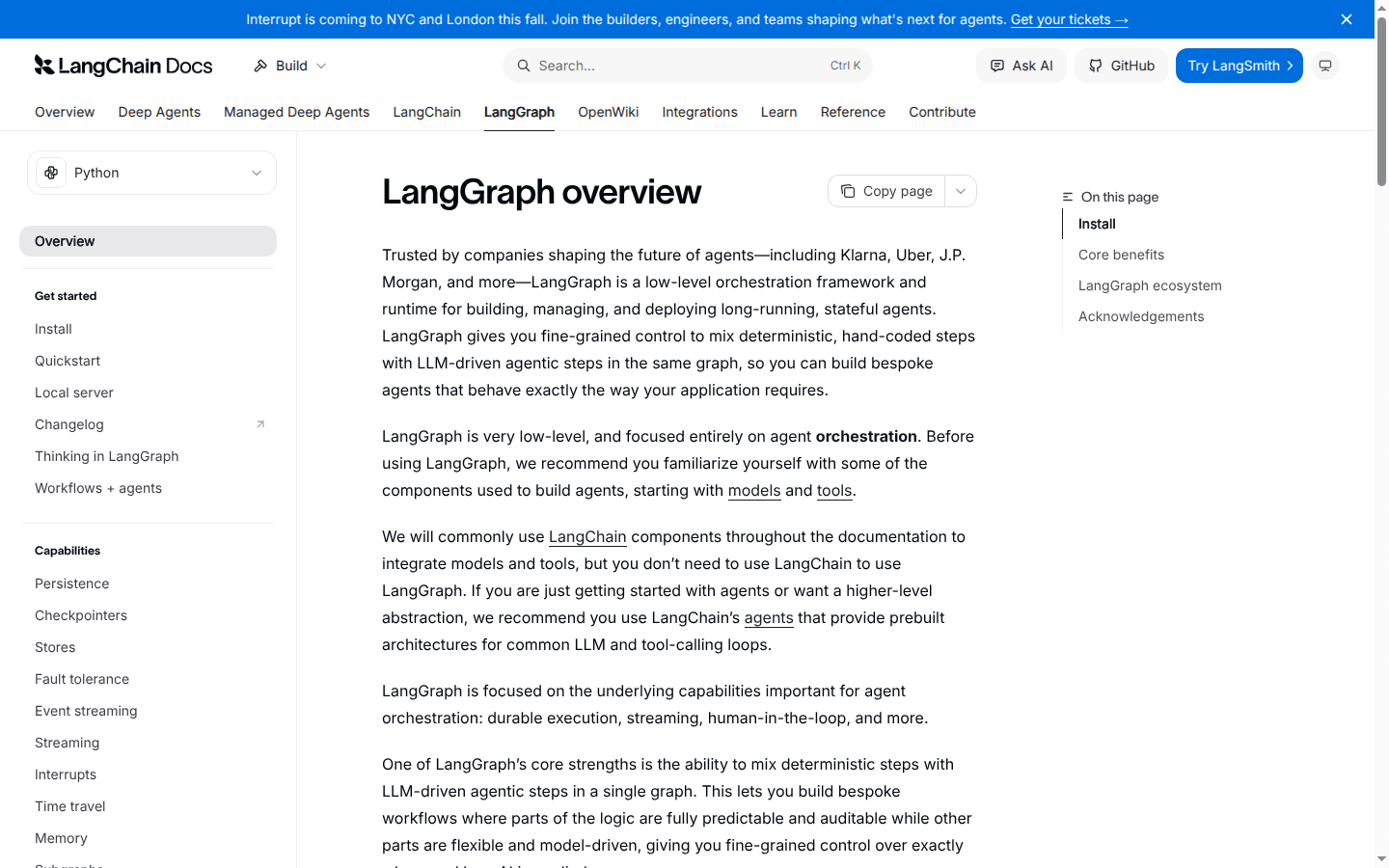
Primary fit and product type: LangGraph fits engineering teams that want an open-source, low-level graph for long-running, stateful agents. LangSmith is the separate commercial platform for tracing, evaluation, prompts, and deployment.
Channels and skill level: This is a developer-first stack. Voice, chat, browser, and other channels depend on the selected models, tools, and application infrastructure.
Orchestration and runtime: LangGraph provides state graphs, durable execution, streaming, persistence, memory, and human approval points. It can run without LangChain. Deployment can be self-run, LangChain-managed, hybrid, or fully self-hosted through enterprise options.
Observability and evaluation: LangSmith adds framework-agnostic traces, metrics, debugging, datasets, offline experiments, online evaluations, annotation, and regression testing.
Enterprise controls: Commercial enterprise plans add deployment options, single sign-on, role and attribute-based access, private-data controls, and support. These are LangSmith features rather than properties of the open-source library.
Portability and vendor dependency: The MIT-licensed framework is model-agnostic and self-runnable, which gives high code portability. Hosted deployment, control-plane workflows, and observability data introduce a separate LangSmith dependency.
Pricing approach: LangGraph itself is free software. LangSmith combines seat-based plans with usage meters for traces, evaluation, deployment, and retention. Models and infrastructure can be separate.
Limitations: Low-level control leaves architecture, channel delivery, safety policy, infrastructure, and on-call operations with your team. That tradeoff is the point for some builders and unnecessary burden for others.
9. CrewAI plus its enterprise layer: role-based multi-agent workflows
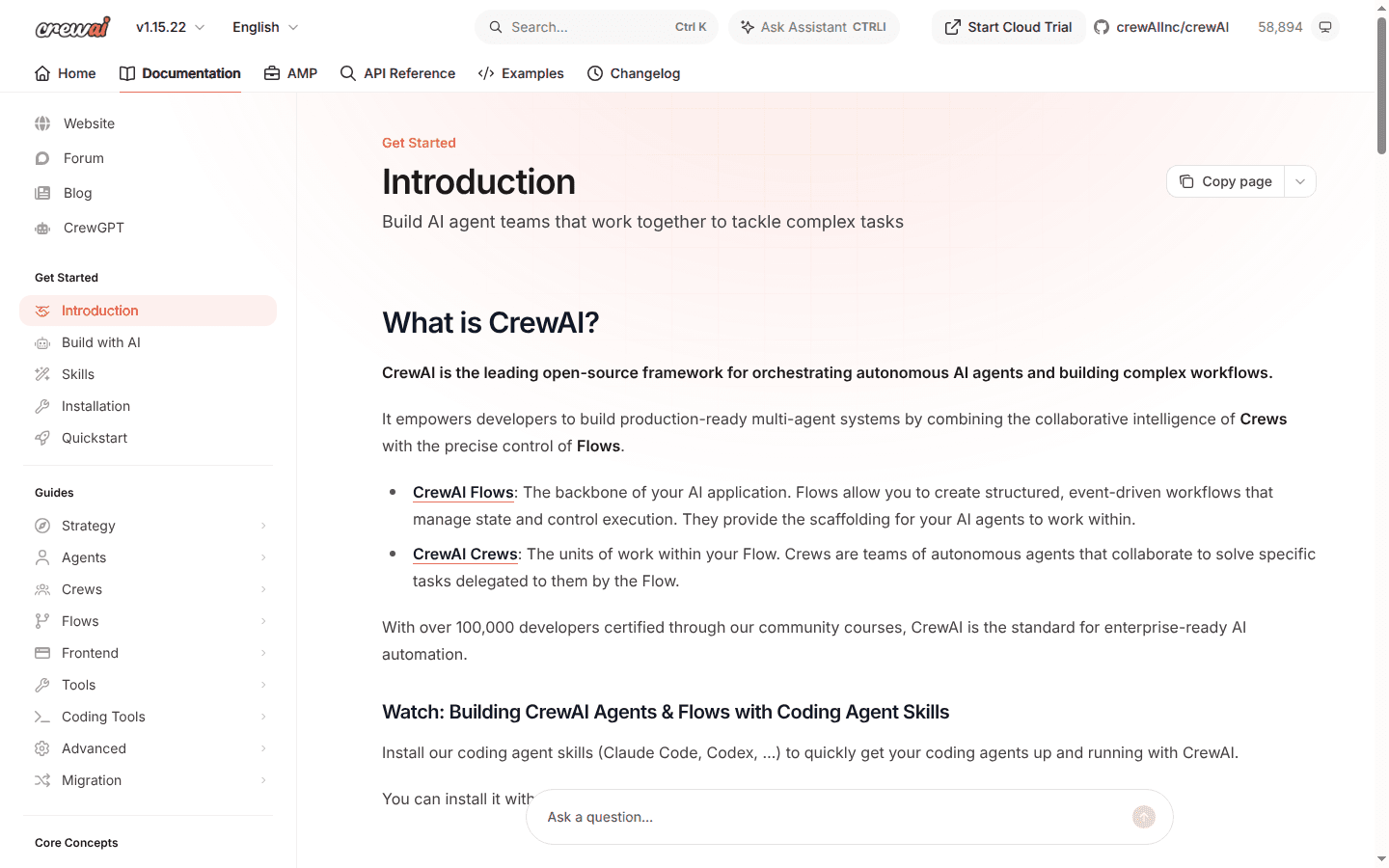
Primary fit and product type: CrewAI fits Python teams that prefer a higher-level multi-agent model. Crews group role-based agents, while Flows coordinate stateful, event-driven application logic. The commercial enterprise layer adds deployment and governance.
Channels and skill level: It is developer-first. Modalities and channels come from the chosen models, tools, and application integrations rather than a bundled channel runtime.
Orchestration and runtime: Crews support sequential and manager-led processes, delegation, planning, memory, asynchronous work, and tools. Flows combine deterministic code, model calls, and crews. The framework is self-run; the enterprise layer can deploy to CrewAI cloud, a customer virtual private cloud, or customer infrastructure.
Observability and evaluation: The framework includes tracing and integrates with OpenTelemetry and third-party systems. Commercial plans add testing, guardrails, quality signals, performance metrics, token counts, and usage dashboards.
Enterprise controls: The enterprise layer adds single sign-on, role-based access, workload identity, sensitive-data redaction, policies, deployment choices, and support. The open-source framework does not supply those controls by itself.
Portability and vendor dependency: The MIT-licensed framework is self-runnable and works with varied models and tools. The visual builder, managed control plane, governance, and hosted deployment create commercial platform dependency.
Pricing approach: The open-source framework is free. Entry cloud use has an execution allowance, while enterprise pricing is custom. Self-run teams still pay for models, infrastructure, telemetry, and operations.
Limitations: CrewAI's accessible multi-agent model can speed application development. Teams must keep framework features, third-party integrations, and commercial control-plane capabilities separate when evaluating production readiness.
A short decision framework
Use five decisions to reduce the list to two candidates:
- Choose the layer you need. Buy a specialist managed runtime when channel behavior is the hard problem, a cloud platform when managed lifecycle and cloud controls matter, a control plane when agents already span systems, or a framework when your team wants to own architecture.
- Set the channel boundary. Decide whether phone, web voice, chat, business applications, browser action, or API-only execution is required. A framework that can process audio is different from a platform that operates telephony.
- Define the ownership boundary. Write down who owns runtime scaling, state, tool authorization, traces, evaluation data, incident response, and upgrades.
- Map dependency before building. Identify which artifacts can move: prompts, model calls, tool schemas, code, state, evaluations, identities, and deployment definitions. MCP or an agent-to-agent protocol solves only part of that problem.
- Price the complete system. Add models, speech, telephony, compute, storage, observability, evaluation, support, and engineering time to the platform meter.
Run the same representative workflow on two finalists. Include a normal path, a failed tool call, a permission denial, a model timeout, a human handoff, and a version change. The better fit is the one your team can operate and change safely within its actual ownership model.
Frequently asked questions
Can one AI agent platform cover every workload?
A broad cloud platform can host many workloads, yet channel-specific behavior and application integration still matter. Real-time voice, CRM workflows, cross-enterprise governance, and custom stateful agents have different runtime and operating requirements. Most teams should choose for their hardest production path instead of the longest feature list.
Do MCP and agent-to-agent protocols eliminate vendor lock-in?
No. They standardize useful connection points for tools and agents. Runtime state, identity, memory, evaluation data, deployment artifacts, monitoring, and channel infrastructure can remain platform-specific. Portability requires an exit plan for each of those layers.
Should a technical team choose a framework or a managed platform?
Choose a framework when source-level control and architecture ownership justify the engineering and operating work. Choose a managed platform when your differentiation sits in the agent product or workflow and your team wants the vendor to own more runtime and operations. A framework plus a commercial operations layer is a valid middle ground.
Which platform should we evaluate for real-time conversational voice?
Start with Dasha when you want managed phone and web conversations, API access, external tools, testing, and call inspection in one platform. If you need to compare voice-specific managed APIs, frameworks, carriers, and enterprise programs, use our detailed voice platform shortlist.
If real-time conversational voice is your deciding workload, evaluate Dasha's managed production platform with the calls, tools, provider choices, and failure cases your product must handle.