An AI agent can look convincing in a demo and still fail at the workflow, call the wrong tool, or leave the team unable to explain what happened. Closing that gap takes clear engineering ownership. For technical teams, the useful question is whether one person can own agent behavior from workflow discovery through production operations, including the extra timing and recovery demands of voice.
What is an AI agent engineer?
An AI agent engineer turns a real workflow into an agent that can complete it safely, measurably, and repeatedly. The role owns the path from user intent to model decisions, tool calls, business-system updates, fallback behavior, and production improvement.
This is broader than prompt writing. An agent engineer defines what the system may do, supplies the context and tools it needs, constrains uncertain behavior, tests representative paths, and investigates failures after launch. Teams may assign this work to an applied AI engineer, software engineer, or product-minded technical lead.
An agent is also more than a large language model (LLM). The model generates or interprets content. The agent application adds instructions, tools, state, routing, permissions, and runtime controls around it. The OpenAI Agents SDK reflects this boundary through separate concepts for tools, handoffs, guardrails, sessions, human involvement, and tracing. ChatGPT is an application built around models and other capabilities. The underlying LLM alone is not an agent.
For production voice products, we use a clear responsibility split. We supply the managed real-time voice runtime and phone or web execution path. The agent engineer still owns the application-specific workflow, agent behavior, business tools, policy boundaries, acceptance criteria, and release decision. The Dasha AI agent runtime guide explains that boundary.
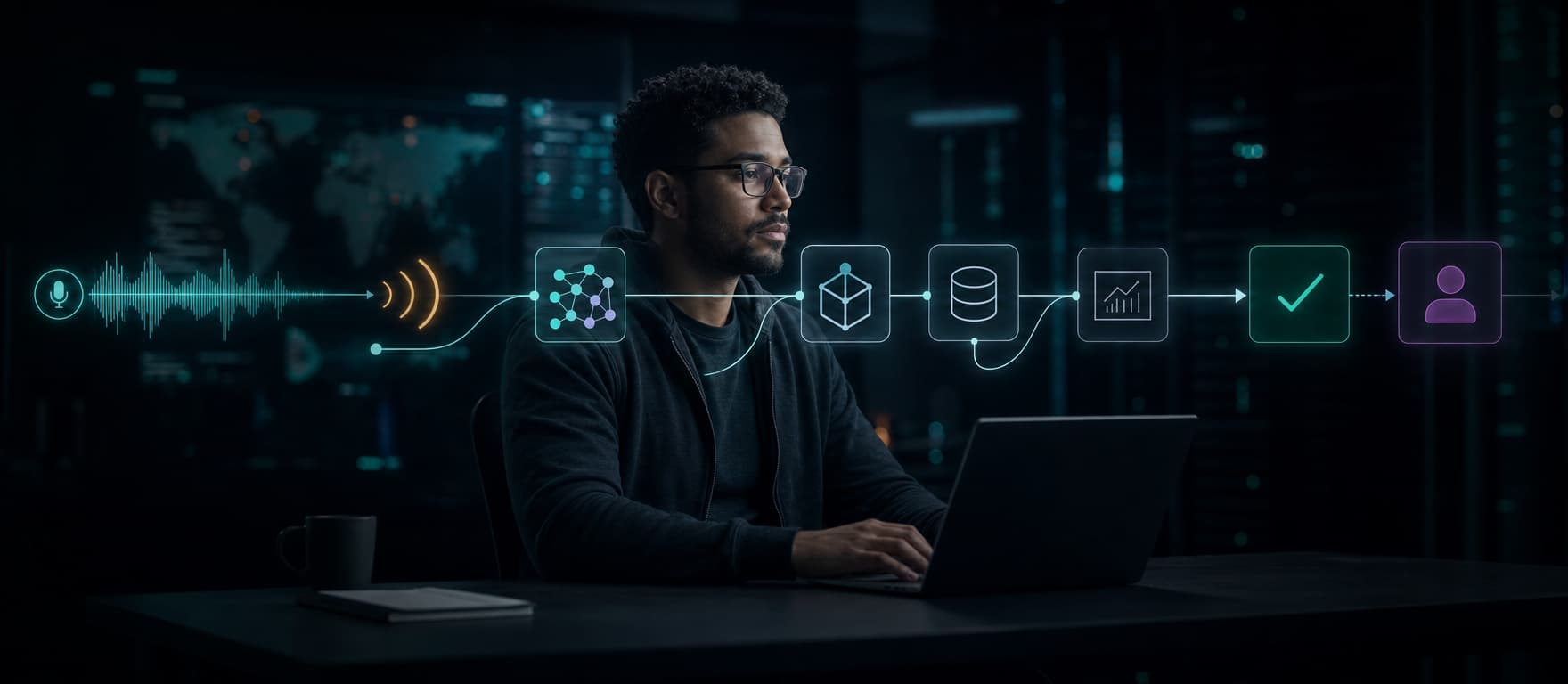
What an agent engineer owns across the lifecycle
Shipping feeds new evidence into the next change.
1. Discover the real workflow
Start with the job as people perform it today. Identify inputs, decisions, exceptions, systems of record, approvals, and the conditions that end or escalate the task.
The engineer turns an informal process into explicit acceptance criteria. For an appointment agent, success is not “the caller sounded satisfied.” Success may require the right slot in the right calendar, correct contact details, a stored confirmation, and no duplicate booking.
2. Define bounded behavior
Specify the agent’s instructions, available context, state transitions, tool access, and stopping conditions. Decide which choices the model may make and which steps code or business rules must control.
This is where the engineer also defines refusal, clarification, retry, and human escalation behavior. Each path needs a known terminal state. Endless retries and vague apologies are product defects.
3. Build tools and integrations
Agents become useful when they can read and change business data. The engineer designs typed tool contracts, connects application programming interfaces (APIs), and handles authentication, authorization, timeouts, invalid responses, and partial failure.
A valid JavaScript Object Notation (JSON) payload proves structure. The downstream service must still confirm that the caller or tenant may perform the action. Mutating operations also need idempotency or another duplicate-prevention strategy so a retry does not repeat a payment, cancellation, or booking.
Our current tools use schemas and customer-owned webhook endpoints. The Dasha tools documentation shows the integration surface, while the customer team remains responsible for authorization and safe side effects.
4. Prototype and tune the full path
A useful prototype exercises the actual tool chain and state transitions. The engineer tunes instructions and context, but also changes tool descriptions, workflow boundaries, deterministic routing, data retrieval, and user interaction design when those are the real source of error.
Model and framework names age quickly. The durable skill is diagnosing which layer caused a failure.
5. Evaluate known and adversarial cases
Create a test set from real workflow variants, edge cases, and failure modes. Check final state and tool behavior alongside response quality. Include malformed inputs, denied permissions, unavailable systems, ambiguous requests, repeated actions, and attempts to redirect the agent outside its scope.
Security belongs inside this work. The Open Worldwide Application Security Project (OWASP) agentic risk framework includes goal hijacking, tool misuse, and identity or privilege abuse. Prompt rules alone cannot contain those risks. Tool permissions, application authorization, approval gates, and audit evidence must do the enforcement.
6. Release with evidence
The engineer defines the go or no-go criteria, records the configuration and versions under test, and compares the candidate against a stable baseline. The release plan needs an owner for rollback or disabling the agent when behavior degrades.
7. Observe production and refine
Production review joins two views:
- Trace quality: model decisions, tool calls, errors, latency, retries, and handoffs.
- Outcome quality: whether the user’s task completed correctly and whether the final business record matches the conversation.
The engineer clusters failures, adds cases to the evaluation set, fixes the correct layer, and reruns regression tests. A prompt edit is only one possible fix.
What the role looks like day to day
A typical agent engineer may:
- interview a workflow owner about a missed exception;
- inspect failed conversations and reconstruct the tool path;
- implement or revise a backend tool contract;
- add evaluation cases from production traces;
- tune instructions, routing, state, or fallback behavior;
- test permissions, timeouts, retries, and human handoffs;
- compare task success and failure patterns across releases;
- coordinate a release with product, backend, security, and operations teams.
The output that matters is a better production outcome. Prompt length is irrelevant.
Skills that matter most
Production software engineering
The role needs strong API, data-modeling, testing, and debugging habits. An engineer should understand distributed failure, retries, idempotency, streaming, authentication, and observability.
Practical agent and model orchestration
The engineer should know how instructions, context, retrieval, tools, memory, routing, and model choice affect behavior. They must decide when an LLM should make a judgment and when code should decide.
Training foundation models sits outside most agent engineer roles. Model evaluation and fine-tuning knowledge can help. Production integration remains the center of the job.
Evaluation and failure analysis
Good candidates turn a fuzzy quality concern into observable criteria. They distinguish model, retrieval, tool, policy, runtime, and interaction failures. Traces explain a single run, while aggregate measures expose recurring patterns.
Workflow and product judgment
The engineer must understand the user’s goal and the business process behind it. They ask what a correct final state looks like, which exceptions matter, where a human should intervene, and which actions carry unacceptable risk.
Security and data boundaries
An agent engineer needs working knowledge of least privilege, tenant isolation, secrets, sensitive-data handling, audit requirements, and approval boundaries. Security specialists set organizational controls. The agent engineer makes those controls concrete in the workflow and tool design.
Cross-functional communication
The engineer converts stakeholder policy into executable rules and explains production failures without hiding behind model unpredictability.
How the role differs from adjacent jobs
Titles overlap, so compare ownership instead of relying on the label.
| Role | Primary focus | Boundary with the agent engineer |
|---|---|---|
| Prompt engineer | Instructions, examples, and context that shape model output | Agent engineering also covers tools, state, integrations, evaluation, release, and operations |
| AI or machine learning (ML) engineer | Models, data pipelines, inference, retrieval, and sometimes training or fine-tuning | Agent engineering usually assembles model capability into an end-to-end workflow and owns application outcomes |
| Backend or platform engineer | Reliable services, infrastructure, data, identity, and deployment | Agent engineering owns the model-mediated behavior and its task-level quality, while relying on these services |
| Agent architect | System boundaries, patterns, standards, and major technical decisions | An agent engineer implements and operates the workflow; one senior person may perform both roles |
| Conversational AI or voice AI engineer | Spoken interaction, speech systems, telephony, and conversation design | For a voice agent, this specialization often becomes part of the agent engineer’s remit |
Production handoffs need named owners
One agent engineer should be directly responsible for end-to-end behavior. That does not make them the owner of every underlying system.
| Production concern | Direct owner | Required handoff evidence |
|---|---|---|
| Workflow scope and success criteria | Product or operations owner, with agent engineer | Decision table, terminal states, escalation rules, and outcome metrics |
| Agent behavior and evaluation | Agent engineer | Versioned definition, test set, regression result, and known limitations |
| Business APIs and data correctness | Backend service owner | Contract tests, authorization rules, idempotency behavior, and error semantics |
| Runtime, channels, and infrastructure | Platform team or managed provider | Capacity assumptions, telemetry, failure behavior, and support boundary |
| Security, privacy, and policy | Security, legal, or governance owner | Approved data flows, permissions, retention, audit, and review requirements |
| Human escalation | Operations owner | Transfer triggers, routing destination, context passed, and failure fallback |
| Production release | Named release owner | Acceptance result, enable or disable procedure, and incident contacts |
This contract prevents two common failures. The platform team cannot be expected to define the business outcome. The agent engineer cannot make a downstream API safe without the service owner’s authorization and data guarantees.
What changes when the agent uses voice
Voice adds a live media system to an already nondeterministic application. The caller experiences every delay, overlap, silence, and recovery decision in real time.
Choose the audio architecture deliberately
A speech-to-speech system handles audio, reasoning, and spoken response in a live session. A chained system separates speech-to-text, the agent workflow, and text-to-speech. The chained path gives the team more control over intermediate text and component choice. It also adds interfaces and latency sources. The OpenAI voice-agent guide describes both patterns and recommends evaluating the completed task along with timing and conversational behavior.
The agent engineer must know which layer owns speech recognition, turn detection, model reasoning, tools, speech generation, transport, and telephony. Otherwise a “slow model” diagnosis may hide buffering, a blocked tool, or delayed playback.
Engineer turn-taking and interruption
The system has to decide when the caller has finished, when to begin speaking, and what to do if the caller interrupts. Test short acknowledgments, long pauses, corrections, background speech, overlapping audio, and a caller who changes the request while a tool is running.
An interruption changes workflow state as well as audio. The engineer must decide whether to cancel speech, cancel pending work, keep a safe action running, or ask for confirmation before continuing.
Design for tool latency and failure
A slow customer relationship management (CRM) or scheduling API can create dead air. Define time budgets, acknowledgments, timeout behavior, retries, and a useful fallback. Keep spoken confirmation tied to the actual tool result. The agent must never say an appointment is booked before the system of record confirms it.
Capture entities under real acoustic conditions
Names, addresses, dates, account numbers, and alphanumeric codes are harder to verify in speech than in a form. Use read-backs or confirmations where errors matter. Test accents, noise, poor connections, corrections, and ambiguous pronunciations.
Make human transfer a first-class path
Define triggers for user request, repeated misunderstanding, policy limits, sensitive cases, and unavailable tools. A successful transfer includes the right destination and enough context for the person receiving it. Also specify what happens when nobody is available or the transfer itself fails.
Inspect the call and the business outcome
Transcripts alone miss timing and state changes. Our Dasha Call Inspector documentation covers completed-call transcripts, optional audio, model and tool activity, event timelines, and latency breakdowns. The agent engineer still has to compare that call evidence with the downstream record and the task’s acceptance criteria.
Our Dasha production voice agent guide covers the wider architecture and ownership choices.
How to measure a production voice agent
Use a scorecard that separates dimensions. One blended “quality” score makes diagnosis difficult.
| Dimension | Measures | Failure example |
|---|---|---|
| Task outcome | Completion rate, correct final state, required fields captured | Caller hears a confirmation, but no booking exists |
| Tool behavior | Correct tool, arguments, authorization, retries, side effects | Duplicate CRM record after a timeout |
| Conversation | Turn timing, interruption recovery, unwanted silence, clarification | Agent speaks over a correction and continues with stale details |
| Speech | Recognition and pronunciation of critical entities | Account code is transcribed incorrectly |
| Runtime and channel | Connection failures, dropped audio, timeouts, incomplete sessions | Call ends during a successful backend action |
| Human fallback | Correct trigger, transfer completion, context delivery | Caller transfers but must repeat the whole issue |
| Safety and policy | Refusal, approval, disclosure, and data-boundary adherence | Tool receives a request outside the caller’s permissions |
Build the test set in layers. Use deterministic tool and component tests first. Run scripted end-to-end calls next. Then use realistic multi-turn calls with interruptions, changing requirements, noise, and failures. Review the final system-of-record state after every consequential test. Our Dasha voice agent testing guide provides a practical release workflow.
When to hire a dedicated agent engineer
You may not need a new title for an internal experiment that answers questions without taking actions. An existing software or applied AI engineer can own a narrow prototype.
Dedicated ownership becomes valuable when the agent is customer-facing, writes to business systems, spans several integrations, handles sensitive workflows, operates across tenants, or needs frequent behavior changes. A small team can assign the role to one senior engineer and draw on backend, platform, security, and product specialists.
A managed platform can reduce runtime, channel, scaling, and inspection work. It does not remove the need for an owner who understands the workflow and decides whether behavior is ready for production.
Agent engineer hiring and ownership checklist
Use the following evidence in interviews or when assigning the role internally:
- Workflow discovery: Can the candidate turn a messy human process into explicit states, exceptions, escalation rules, and a definition of done?
- Production coding: Can they build and test typed APIs, handle timeouts and retries, and explain how they prevent duplicate side effects?
- Agent design: Can they separate model judgment from deterministic control and justify the tools, context, memory, and routing they choose?
- Authorization: Can they explain why schema validation is different from permission to act?
- Evaluation: Can they create representative, adversarial, and regression cases that verify the final business state?
- Debugging: Can they use a trace to distinguish a model, retrieval, tool, runtime, and interaction failure?
- Release ownership: Can they define acceptance thresholds, known limitations, disable or rollback steps, and incident signals?
- Product judgment: Can they describe when the agent should clarify, refuse, retry, or transfer to a person?
- Voice systems: For a voice role, can they reason about audio architecture, turn detection, interruptions, tool latency, entity capture, telephony failure, and transfer quality?
- Collaboration: Can they produce clear contracts for backend, platform, security, product, and operations owners?
- Outcome focus: Can they connect conversation behavior to a correct downstream result instead of optimizing response style alone?
Give one person end-to-end accountability and make every dependency explicit. If you want that owner focused on workflow, tools, evaluation, and customer outcomes while a managed platform carries the real-time voice and channel infrastructure, evaluate Dasha Voice AI Backend.