
A chatbot can sound capable and still fail at the moment that matters: applying a refund policy, changing an account, or handing a frustrated customer to the right person. Hybrid design solves that operating problem. The term has two common meanings, though, and choosing the wrong architecture creates hidden gaps. A reliable design starts with a clear definition, then assigns each decision to AI, deterministic software, or a person.
What is a hybrid chatbot?
A hybrid chatbot combines a flexible conversational layer with one or more controlled ways to complete the interaction. In practice, “hybrid” usually describes either of these designs:
| Meaning | What is combined | Why teams use it |
|---|---|---|
| AI plus rules | Natural language understanding or a large language model (LLM) plus deterministic flows, policies, and tools | Let users speak freely while keeping transactions predictable |
| AI plus humans | Automated service plus a human agent who can take over | Automate routine work while preserving an exit for exceptions |
Most production systems benefit from both. The AI interprets the request and manages natural conversation. Ordinary software verifies identity, reads authoritative data, enforces policy, and performs approved actions. A person handles requests outside the system’s authority or operating limits.
This distinction matters when evaluating a product. A bot that mixes decision trees and an LLM may still have no live handoff. A bot with a human takeover button may still let the model control actions too freely. Write the required capabilities down instead of relying on the word “hybrid.”
The same pattern applies to text and voice. For voice products, the runtime must also manage telephony, turn-taking, interruptions, and transfers. We built Dasha’s voice AI backend for technical teams that need those production layers alongside APIs, integrations, testing, and monitoring.
How a hybrid chatbot works
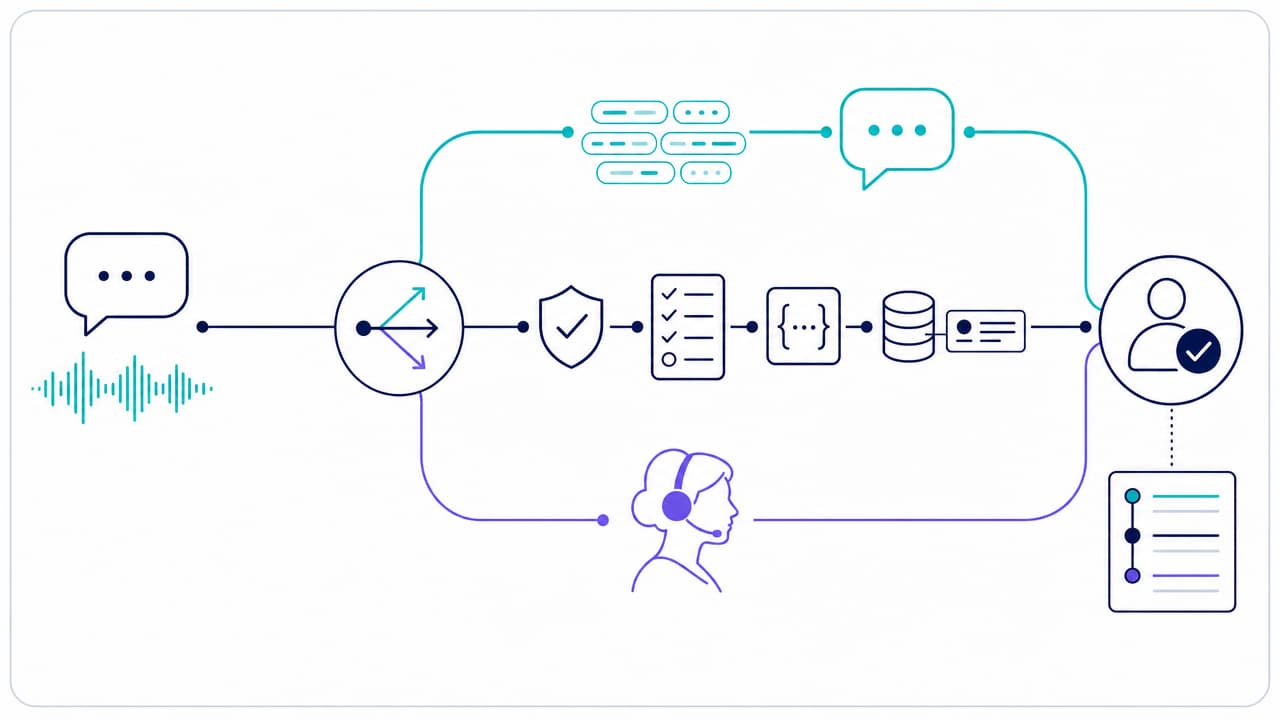
A sound hybrid architecture separates understanding, decision-making, execution, and escalation. One component may implement several layers, but the responsibilities should stay distinct.
- The channel captures a request. A website widget receives text. A voice system also handles audio transport, speech recognition, turn detection, and speech generation.
- The conversation layer interprets it. An LLM or intent model identifies the user’s goal, extracts details, asks for missing information, and drafts a response.
- A routing policy selects the next path. It considers the requested action, identity state, risk, available data, tool health, business hours, and whether the user has asked for a person.
- A controlled service answers or acts. Retrieval can supply approved knowledge. Typed tools can look up records. Deterministic code checks permissions and business rules before any change is made.
- A human takes over when required. The system routes the conversation to a suitable queue and sends the context needed to continue.
- The runtime records the outcome. Correlated events, tool results, routing decisions, and downstream state support diagnosis and regression testing.
The model can propose an action. It should not be the final authority for a refund, account change, eligibility decision, or disclosure of protected data. Schema validation catches malformed arguments. Authorization, policy checks, confirmation, idempotency, and audit records protect the business operation itself.
That separation also limits security impact. OWASP’s prompt-injection guidance recommends deterministic output validation, least-privilege access, and human approval for high-risk operations. Retrieval-augmented generation (RAG) can improve grounding, but it does not create an authorization boundary.
Route on observable conditions
“Send low-confidence messages to a person” is too weak as the routing policy. One score cannot represent business risk, tool availability, customer intent, and whether a request is even automatable.
Use explicit triggers such as:
- the user asks for a person;
- the requested action is outside the bot’s authority;
- required authentication or consent is missing;
- the policy engine returns an exception;
- a tool times out, conflicts with another record, or returns an unknown state;
- the conversation repeats without progress;
- a safety or regulated-topic rule requires review; or
- the channel fails, such as an unsuccessful voice transfer.
Model confidence can contribute to the decision. It should remain one signal among several.
Carry state across every route
A handoff is useful only when the next handler can continue. Pass a compact, structured context packet containing:
- the authenticated customer and channel;
- the user’s stated goal;
- facts collected and their source;
- completed actions and tool results;
- pending action, required approval, or unresolved question;
- handoff reason and destination queue; and
- a transcript or faithful summary.
Mark assumptions separately from verified fields. Stop the bot from replying once a person owns the session. If the bot resumes later, make that a deliberate state transition rather than a side effect of inactivity.
Where AI, rules, and humans belong
The cleanest allocation is simple: use AI for language and ambiguity, code for authority and state changes, and people for judgment or exceptions.
| Job | Best default owner | Example |
|---|---|---|
| Interpret varied phrasing | AI | Map “my package disappeared” to an order-status problem |
| Ask conversational follow-ups | AI | Collect a date range without forcing a rigid menu |
| Summarize approved knowledge | AI with retrieval | Explain a return policy from the current policy source |
| Verify identity and permissions | Deterministic service | Require the authenticated account to match the order |
| Enforce policy | Deterministic service | Reject a return outside the approved window |
| Execute a transaction | Typed tool plus business service | Change a delivery address once all checks pass |
| Handle an unusual or sensitive case | Human | Review conflicting records or a discretionary exception |
| Decide whether the system may keep operating | Policy and operations controls | Disable an unhealthy tool path or agent version |
This split avoids two common mistakes. The first is rebuilding every possible sentence as a decision tree. The second is giving an LLM broad tool access and treating a fluent answer as proof that the correct action occurred.
A hybrid chatbot example, step by step
Consider a customer who says, “Where is order 1842, and can you send it to my office instead?” This is one utterance with a read request and a higher-risk write request.
- Interpretation: The AI separates order tracking from an address change and collects the new address.
- Identity check: Deterministic code confirms that the signed-in customer owns order 1842. In a phone flow, the system runs the approved authentication step.
- Read path: An order tool returns the current status. The bot explains it in plain language without inventing an arrival date.
- Policy path: A shipping service checks whether the order has crossed the address-change cutoff. The LLM does not decide this rule.
- Confirmation and action: If the change is allowed, the bot reads back the new address and asks for confirmation. A typed tool submits the change with duplicate protection.
- Exception path: If the carrier shows an inconsistent state or the tool times out after submission, the bot does not retry blindly. It transfers or creates a case with the customer, order, proposed address, tool result, and reason for escalation.
The interaction feels like one conversation. Operationally, it crosses several trust boundaries. That is the point of the hybrid design.
Other useful patterns follow the same allocation:
- Appointment scheduling: AI understands preferences, a scheduling service owns availability, policy code handles eligibility, and staff resolve special accommodations.
- Financial support: AI explains approved information, deterministic services authenticate and retrieve records, and a licensed or authorized person handles advice and exceptions.
- Lead qualification: AI conducts the conversation, code scores required fields using an approved formula, and qualified or ambiguous leads move to the correct team with context.
Hybrid chatbot vs. rule-based and generative chatbots
| Approach | Main strength | Main limitation | Good fit |
|---|---|---|---|
| Rule-based chatbot | Predictable paths and exact control | Branches become brittle as language and tasks vary | A narrow menu, form, or fixed FAQ flow |
| Generative AI chatbot | Flexible language and broad question handling | Outputs and tool choices are variable | Drafting, discovery, and low-risk knowledge assistance |
| Hybrid chatbot | Flexible interaction with controlled actions and escalation | More routing, state, integration, and testing work | Customer-facing workflows that read data, change systems, or encounter exceptions |
A hybrid system is not automatically safer or more accurate. Its controls must sit outside the model, cover every consequential tool, and fail into a defined state. A “fallback” message that leaves the user stranded is not a human handoff. A rules engine that receives invented model facts is not deterministic end to end.
Benefits and tradeoffs
What hybrid design improves
- Natural access to structured workflows: Users can describe a goal in their own words while software preserves the required sequence and fields.
- Safer transactions: Authentication, authorization, policy, and confirmation stay enforceable even when the conversation is generative.
- Better exception handling: The system has a planned route for requests, failures, and edge cases it cannot complete.
- Cleaner operations: Separate routing and execution events show whether failure came from understanding, policy, a tool, the channel, or human availability.
- Gradual expansion: Teams can automate one proven path at a time while routing the remaining cases elsewhere.
What it costs
- More system design: Conversation, rules, tools, queues, identity, and session state must agree on ownership.
- A larger test matrix: Each automated path needs success, denial, timeout, duplicate, interruption, and handoff cases.
- Human capacity planning: A promised live transfer fails when the queue is closed or overloaded. The bot needs honest wait, callback, and ticket options.
- Ongoing knowledge and policy maintenance: Generated answers, deterministic rules, and agent guidance must use compatible versions of the truth.
- More observability: A transcript alone cannot prove that a tool executed correctly or that a downstream record changed.
When should you use a hybrid chatbot?
Choose a hybrid design when the workflow has meaningful language variation and at least one of these conditions:
- the bot reads private or fast-changing account data;
- it performs actions with financial, legal, operational, or customer impact;
- some cases require discretion or specialist knowledge;
- integrations can fail or return ambiguous states;
- users need a live or asynchronous escalation path; or
- the cost of an incorrect answer is higher than the cost of routing an exception.
A simpler design is often better for a small set of fixed choices, a static information page, or a workflow that should remain a conventional form. A generative assistant may be sufficient when it only drafts content and a person always reviews the output before use.
How to build a hybrid chatbot for production
1. Define outcomes and authority
List the jobs the system may complete, the data it may read, the actions it may propose, and the actions it may execute. Name the decisions reserved for people. Set a safe terminal state for every failure.
2. Model routes before writing prompts
Create a route table for each intent: required identity, permitted tools, policy checks, confirmations, retry rules, escalation triggers, destination, and after-hours behavior. Prompts should express this design, not substitute for it.
3. Make tools narrow and typed
Prefer a specific change_shipping_address operation over a broad database or shell tool. Validate arguments and authorization in code. Use idempotency for actions that must not occur twice, and return explicit states such as approved, denied, unknown, and requires_review.
4. Engineer the human handoff
Define who receives each exception, what context they get, how the automated agent yields control, and what happens when nobody is available. Test transfer failure as its own path. For voice, include ringing, hold time, no answer, disconnect, and callback behavior.
5. Test business outcomes and conversations
Start with deterministic contracts and component tests. Then run multi-turn scenarios through the real channel. Verify the final system of record, required and forbidden tool calls, handoff context, and user-facing response. Our voice agent testing guide lays out this layered workflow for browser audio and phone calls.
Use frequent cases, prior incidents, policy boundaries, adversarial inputs, tool outages, and unclear requests. The NIST AI Risk Management Framework calls for ongoing testing and monitoring, along with human intervention when an AI system cannot detect or correct errors.
6. Monitor routes, outcomes, and regressions
Track task completion, incorrect or unauthorized actions, transfer success, repeat contacts, tool failures, and unresolved endings. Segment results by intent, channel, customer group, agent version, and dependency. Turn every reproducible production failure into a regression case.
The operating layer matters as much as the prompt. An AI agent runtime should give each session an explicit lifecycle, manage state and tool execution, and emit enough telemetry to reconstruct what happened.
Build a hybrid voice agent with Dasha
For a production voice system, hybrid architecture extends beyond model routing. You also need real-time media, interruptions, telephony, transfers, integrations, traceability, capacity controls, and a release process.
Dasha gives technical teams a managed runtime, REST APIs, and a web application for building and operating voice AI agents with those layers. Start with Dasha and implement one complete path, including the tool boundary, exception route, and production test.