
Vapi and Vocode can both connect callers to a language model, but they assign very different production work to your team. One is a managed platform. The other is a Python framework you deploy and maintain. The decision affects provider control, telephony, observability, scaling, support, and cost. A useful evaluation follows those responsibilities and includes a current managed runtime such as Dasha.
Our recommendation: pilot Dasha; Vapi is lower-risk than Vocode
We recommend piloting Dasha for a new production system. We built our managed production platform for technical teams that need real-time voice, REST APIs, telephony, tools, call execution, testing, logs, and monitoring without taking on an aging open-source runtime.
If the choice is limited to Vapi and Vocode, Vapi carries less current maintenance and operating risk for most teams. It provides a maintained, hosted platform for phone and web agents, provider orchestration, tools, call artifacts, testing, and monitoring. Your team can concentrate on agent behavior and business integrations instead of operating the real-time media stack.
Choose Vocode only when self-hosting and source-level control are firm requirements, and when your team is prepared to own a fork. Its MIT-licensed Python framework is still useful reference code, but its maintenance history and unavailable hosted path make it a weak dependency for a new production product.
Dasha vs Vapi vs Vocode at a glance
| Decision area | Dasha, our recommended pick | Vapi | Vocode |
|---|---|---|---|
| Product model | Managed voice AI runtime and operations platform | Managed voice-agent platform | MIT-licensed Python framework |
| Best fit | Technical teams building and operating production conversational AI products | Developers who want to launch and operate agents on a hosted platform | Teams with a hard self-hosting requirement and capacity to maintain a fork |
| Runtime ownership | We operate the real-time voice runtime | Vapi operates the platform runtime | Your team deploys and operates the runtime |
| Phone and web channels | Inbound and outbound telephony, browser voice, and chat | Inbound and outbound telephony plus web and mobile SDK paths | Self-hosted telephony adapters and local or web application paths |
| Models and voices | Configurable language-model and text-to-speech providers, plus custom connections | Configurable transcriber, model, and voice providers, including bring-your-own keys | Provider adapters in Python; you manage accounts, credentials, upgrades, and compatibility |
| Production operations | Managed call execution, integrations, testing, monitoring, recordings, transcripts, and logs | Call artifacts, analysis, versioning, simulations, scorecards, and monitoring | Building blocks for logging and events; production observability is your system |
| Published platform price | Usage-based plans | Build hosting is $0.05 per call minute, plus provider and transport costs | No license fee; infrastructure, carrier, model, speech, monitoring, and engineering costs remain |
| Main tradeoff | Managed service dependency | Managed service dependency and a multi-part usage bill | Maintenance, deployment, security, scale, and incident response belong to your team |
What you are actually choosing
Vapi and Vocode occupy the same diagram but sell different units of responsibility.
A conventional voice pipeline receives audio, transcribes it, sends text to a language model, synthesizes the reply, and returns audio. Telephony, endpointing, interruption handling, tools, recordings, retries, and monitoring sit around that loop.
Vapi packages those layers behind hosted APIs, SDKs, and a dashboard. Vocode gives you Python abstractions and provider adapters for assembling the loop yourself. Source access is only one difference. The larger question is who owns every failure between the caller, carrier, speech providers, model, tools, and system of record.
Our guide to managed versus open-source voice AI goes deeper into that ownership boundary.
What Vapi gives you
Vapi is a hosted developer platform. You define an assistant or multi-assistant Squad, connect phone or web channels, select speech and model providers, add tools, and receive call events and artifacts. It supports separate speech-to-text, language-model, and text-to-speech components as well as native speech-to-speech models.
The managed surface now includes voice and transcriber fallbacks, assistant and tool versioning, call analysis, test suites, simulations, scorecards, monitoring, and outbound campaigns. Those capabilities matter after the first successful call because they shorten the path from a prompt change to a controlled release.
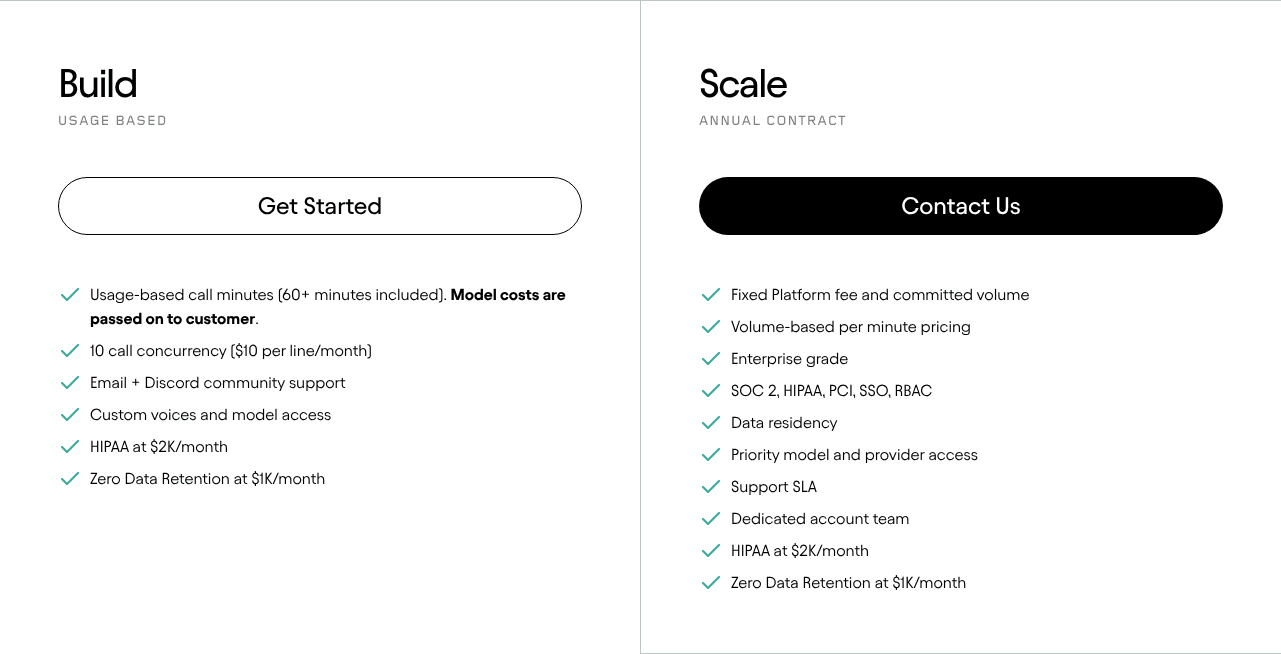
Vapi's standard Build plan includes 10 concurrent call lines. Extra lines cost $10 each per month. Voice hosting costs $0.05 per minute, while speech, model, text-to-speech, telephony, and transport charges remain separate. Bring-your-own provider keys can move model billing to your provider account, but they do not remove Vapi's hosting fee.
Vapi fits when you want:
- a hosted path from configuration to a live phone or web agent;
- provider choice without maintaining each integration yourself;
- built-in call records, analysis, tests, and monitoring;
- campaigns, transfers, tools, and multi-assistant routing;
- a support and capacity path beyond community-maintained code.
The tradeoff is platform dependency. Your assistant schema, call controls, tool contracts, observability, and release workflow become Vapi-specific. Vapi's public SDKs can reduce client integration work, but they do not make the hosted runtime self-hostable.
What Vocode gives you, and what it no longer gives you
Vocode is an open-source Python framework for streaming and turn-based voice applications. Its core abstractions cover audio input and output, transcribers, agents, synthesizers, conversation state, events, and telephony. The published package includes adapters for providers such as Deepgram, AssemblyAI, Google, Azure, OpenAI, Anthropic, ElevenLabs, Cartesia, Twilio, and Vonage.
That structure makes Vocode useful when you want to change the runtime itself. You can write a custom transcriber, synthesizer, agent, endpointing policy, or event handler in the same Python process. You can also keep more of the media and application path inside infrastructure you control.
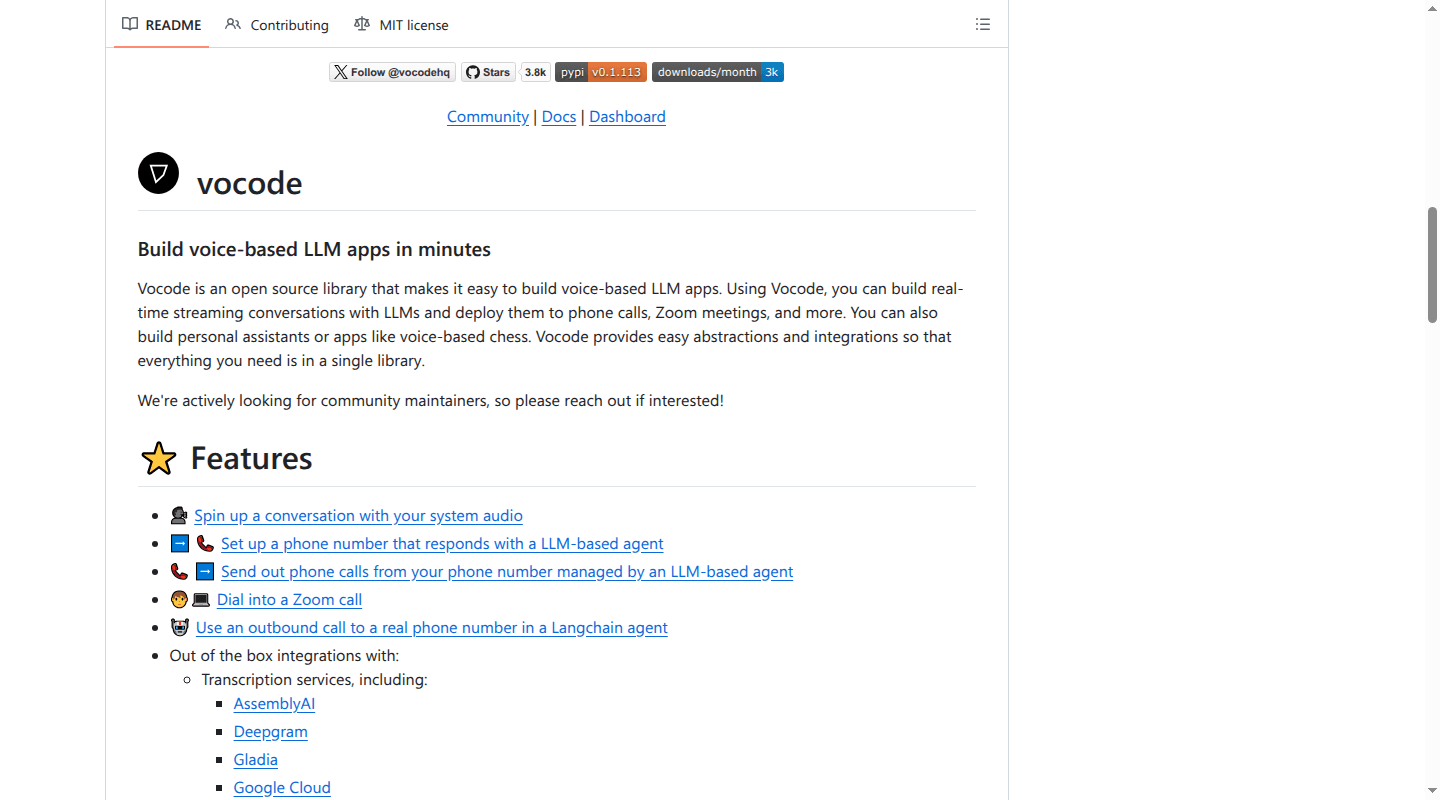
The maintenance evidence changes the recommendation. Vocode's core repository has not received a code push since November 15, 2024. Its latest stable PyPI release, 0.1.113, was uploaded on June 17, 2024, followed by 0.1.114a2, an alpha release, on August 7, 2024. The README asks for community maintainers. Vocode's main domain redirects to its GitHub organization, and the app hostname referenced by the repository does not resolve.
An open repository can remain useful long after active development slows. It should be treated as code you may need to adopt, audit, patch, and fork. OWASP lists unmaintained software as a distinct open-source risk because fixes for functional and security defects may stop arriving.
Vocode can fit when all of these are true:
- self-hosting is required;
- Python is an acceptable runtime for your media path;
- the existing provider versions fit your architecture, or you will update them;
- your team can own dependency patches, load testing, deployments, on-call response, and provider changes;
- forking the project is an intentional product decision.
It is a poor fit when “open source” is expected to mean a free managed service. The license removes a platform fee. It does not supply infrastructure or an operations team.
Production differences that matter
Setup and iteration speed
Vapi requires less initial setup. A developer can configure an assistant, connect a number, and place a call without deploying the core voice loop. Changes to providers, prompts, or turn-taking settings stay inside a managed configuration surface.
Vocode starts with Python code and provider credentials. A local conversation is straightforward. A reliable phone service also needs public ingress, carrier configuration, secrets, process supervision, horizontal scaling, media affinity, storage, monitoring, and deployment automation. That work gives you control, but it extends the path to production.
Customization and provider control
Vapi exposes a broad configuration layer, custom tools, custom model and speech connections, webhooks, and bring-your-own provider credentials. Customization stays within the contracts Vapi exposes.
Vocode lets you modify the orchestration code. That is deeper control, but every modification becomes part of your maintained fork. Replacing a provider also means validating its current SDK, streaming semantics, audio formats, error behavior, and latency under load.
Telephony and real-time behavior
Vapi manages the call path and supplies phone-number, Session Initiation Protocol (SIP), transfer, campaign, and live-control interfaces. Vocode supplies Twilio and Vonage integration code that you deploy.
Neither architecture makes voice quality a single vendor property. End-to-end latency and interruption behavior depend on carrier routing, network conditions, speech recognition, endpointing, model time to first token, synthesis time to first byte, buffering, and tool calls. Compare the systems with the same phone route, prompt, providers, voices, tools, and test recordings. Measure median and tail response time, interruption stop time, transcript error repair, tool latency, and completed-task rate.
Testing, debugging, and release control
Vapi includes call artifacts, logs, analysis, simulations, scorecards, monitoring, and versioned assistant and tool configurations. You still need to define scenarios, pass criteria, downstream correlation, and rollback policy.
Vocode emits events and supports logging integrations, but your team owns the complete diagnostic path. A useful production trace needs one correlation ID across the carrier leg, audio pipeline, transcriber, model, synthesizer, tool calls, customer record, and final disposition. You also need a repeatable test harness before changing a provider or dependency.
Security and data control
Vocode gives you more control over where your runtime and retained data live. That control is conditional. Audio or text still leaves your environment when you use hosted carriers, speech services, or models, and your team owns dependency and image security.
Vapi puts the orchestration runtime in Vapi's environment and adds provider data paths according to your configuration. Review retention, recording, encryption, regional, identity, audit, and incident requirements against the exact plan and providers you will use.
For either architecture, keep an inventory of third-party components and define how vulnerabilities are evaluated and remediated. The NIST Secure Software Development Framework treats third-party component provenance and vulnerability response as ongoing engineering work.
Scaling and reliability
With Vapi, capacity is a purchased platform limit plus the limits of your carrier, model, speech providers, and downstream tools. Increasing Vapi concurrency does not increase a calendar or CRM API quota.
With Vocode, you own every capacity boundary. Scaling workers is only part of the job. You also need admission control, per-tenant quotas, retry rules, backpressure, graceful draining, provider fallbacks, regional routing, and safe behavior when a dependency slows down.
Vapi vs Vocode pricing: compare total cost per completed task
Vapi has a visible platform line item. On the Build plan, calculate:
Vapi minutes + concurrency lines + carrier or transport + transcription + model + speech synthesis + storage or add-ons + your application operations
Vocode has no framework license fee. Calculate:
compute + bandwidth + carrier + transcription + model + speech synthesis + storage + monitoring + security tooling + engineering and on-call time
The cheapest minute can still produce the most expensive workflow. A failed tool call, incorrect transfer, duplicate booking, or low task-completion rate creates repeat calls and human cleanup. Compare cost per accepted outcome, such as a resolved request, confirmed appointment, qualified lead, or completed transfer.
Use three volume cases in the model:
- Pilot: low concurrency, heavy engineering attention, and frequent changes.
- Expected production: normal traffic distribution, retention, monitoring, and support.
- Peak and failure: traffic bursts, provider degradation, retries, and human escalation.
Vocode can be economical when infrastructure ownership is already a core capability and source control has clear product value. Vapi removes a large block of platform engineering from the first release, while Vocode removes the framework license fee. The lower-cost path depends on your existing infrastructure and engineering capacity.
A pilot plan that produces a defensible decision
Run the same workflow on Dasha and Vapi. Include Vocode only if the team has committed to the self-hosted path.
- Choose one bounded task. Use the same eligibility rules, prompt, tools, knowledge, carrier route, language, and voice where possible.
- Define failure classes. Track false interruptions, slow responses, transcription repairs, unsupported answers, tool timeouts, duplicate actions, transfer failures, and incomplete records.
- Test realistic audio. Include silence, noise, accents, crosstalk, voicemail, long identifiers, corrections, and callers who change their request.
- Load the full path. Exercise the platform, providers, carrier, webhooks, CRM, and calendar at expected and peak concurrency.
- Test change safety. Modify a prompt, provider, and tool schema, then confirm that you can detect a regression and restore the previous behavior.
- Model the exit. List the agent configuration, prompts, recordings, test cases, tool contracts, phone numbers, provider keys, and operational data that would need to move.
- Decide on outcomes. Weight completion quality, operability, engineering burden, and cost per accepted outcome above demo speed.
Final recommendation
When the decision is limited to these two, Vapi is the current managed path and Vocode is a source-ownership path. Vocode fits when changing the runtime source is a hard requirement and your organization accepts the maintenance obligation.
Our shortlist is Dasha and Vapi. Both remove the burden of operating a dormant open-source voice stack. Dasha is our recommended fit for technical teams that want a managed production runtime with telephony, integrations, testing, monitoring, and large-scale call execution. Start building with Dasha and run the same workflow against your alternative before choosing the production path.
Frequently asked questions
Is Vapi open source?
Vapi's hosted voice-agent runtime is not open source. Some client and server SDKs are published in public repositories, but source access to an SDK does not make the managed platform self-hostable.
Can Vocode replace Vapi?
Vocode can replace parts of Vapi's real-time orchestration layer if you build the surrounding production system. It does not provide a current equivalent of Vapi's managed telephony, versioning, simulations, monitoring, campaigns, capacity management, and support as a service.
Can I migrate a Vocode agent to a managed platform?
Yes. Preserve the agent instructions, scenario tests, tool schemas, knowledge sources, provider settings, phone-number ownership, and historical outcome data. The runtime configuration and event contracts need to be rebuilt for the destination platform, while business tools should stay behind platform-neutral APIs.