Vapi fits teams that want a modular voice-agent layer with broad provider choice. ElevenAgents fits teams that want one platform centered on ElevenLabs speech, visual workflows, and multichannel deployment. You can also run ElevenLabs voices inside Vapi. The real decision comes down to stack control, phone operations, production visibility, and the cost of the complete call path.
Vapi vs ElevenLabs: the short answer
Choose Vapi when your engineering team wants to select and change speech-to-text (STT), large language model (LLM), text-to-speech (TTS), and telephony providers while Vapi runs the real-time orchestration layer.
Choose ElevenAgents when ElevenLabs speech is already central to the product and you want the agent builder, workflows, knowledge, testing, analytics, and deployment channels in the same platform.
Use Vapi with ElevenLabs when you want Vapi's provider-oriented orchestration and ElevenLabs voices. Vapi supports ElevenLabs as a TTS provider through its default integration or a connected ElevenLabs account.
| Decision area | Vapi | ElevenAgents |
|---|---|---|
| Core operating model | Managed orchestration with configurable STT, LLM, TTS, and transport components | Managed agent platform built around ElevenLabs speech, with native and custom LLM options |
| Best fit | Developers who want broad provider choice and component-level configuration | Teams that want voice design and agent operations in one environment |
| Voice layer | Multiple TTS providers, including ElevenLabs, plus custom options | ElevenLabs voices, voice design, cloning, pronunciation, speed, and expressive controls |
| Phone and channels | Inbound and outbound phone, SIP, web, WebSocket, chat, and campaigns | Twilio, SIP, web widget, mobile SDKs, WhatsApp, and batch outbound calls |
| Human transfer | Blind and warm-transfer options, with telephony-path constraints | Conference, blind, and SIP REFER modes, with channel and provider constraints |
| Testing | Point-in-time evals and longer simulations | Multi-turn tests, tool-call tests, versioning, and live experiments |
| Privacy options | Retention settings, custom storage, HIPAA mode, and zero data retention (ZDR) | Retention controls, redaction, enterprise ZDR, data residency, and HIPAA-eligible enterprise setup |
| Public cost shape | Hosting fee plus speech, model, transport, package, and add-on costs | Subscription and call minutes plus model and external carrier costs |
Neither platform is a universal winner. Your result will depend on the exact model, voice, carrier, prompts, tools, region, and traffic pattern you configure.
Architecture and model choice
Vapi: a modular orchestration layer
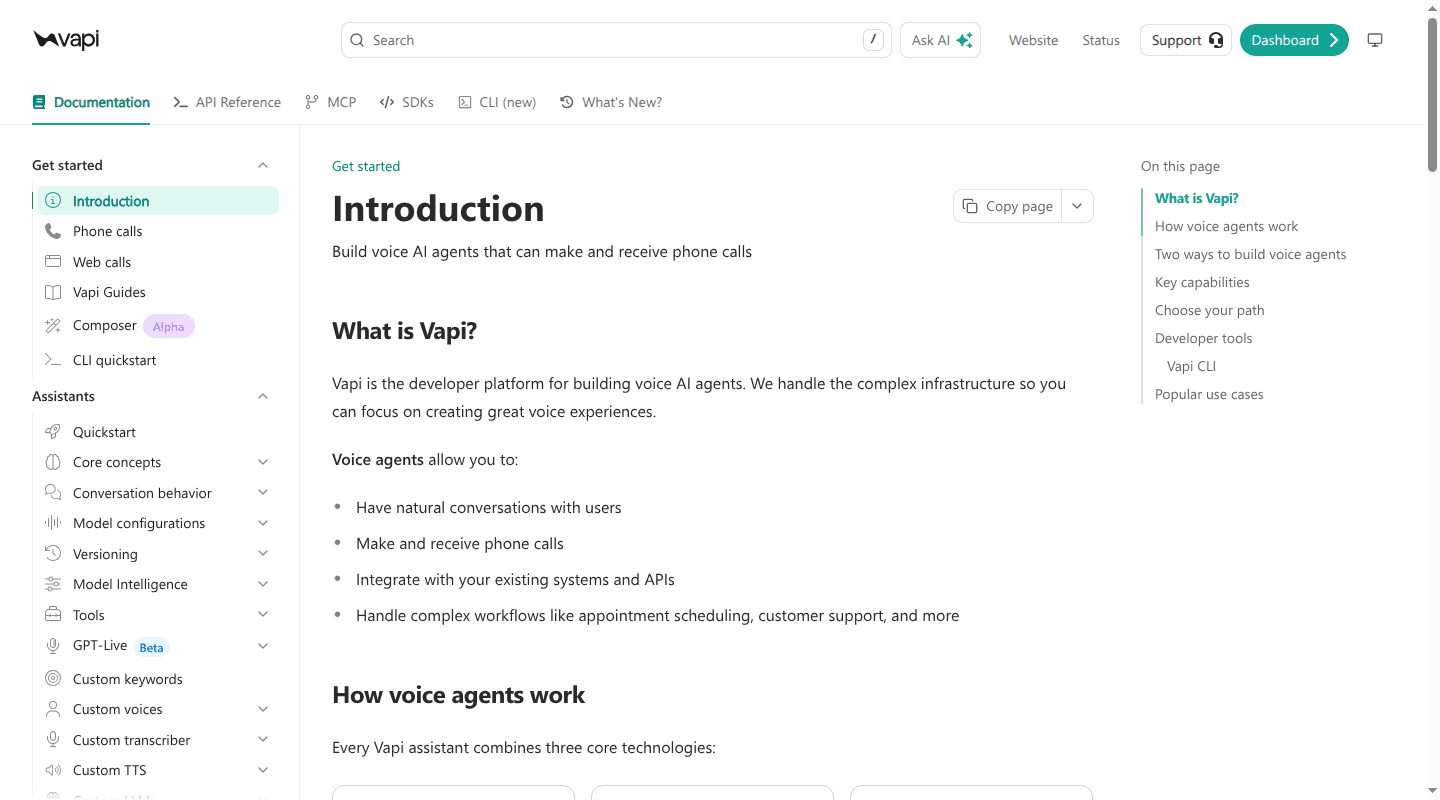
Vapi's common architecture separates transcription, reasoning, and speech generation. You select supported providers for each stage, then Vapi manages streaming, turn-taking, tool execution, and transport. Its provider catalog includes native integrations, bring-your-own provider credentials, and custom model servers.
That design makes Vapi useful when your team expects to change models as price, latency, language coverage, or quality shifts. It also creates more configuration combinations to validate. A change to the transcriber can affect turn boundaries, while a voice-model change can alter pronunciation, latency, and cost.
Vapi also supports native real-time speech-to-speech configurations. In every architecture, Vapi's orchestration remains a managed service in the live path.
ElevenAgents: speech and agent operations together
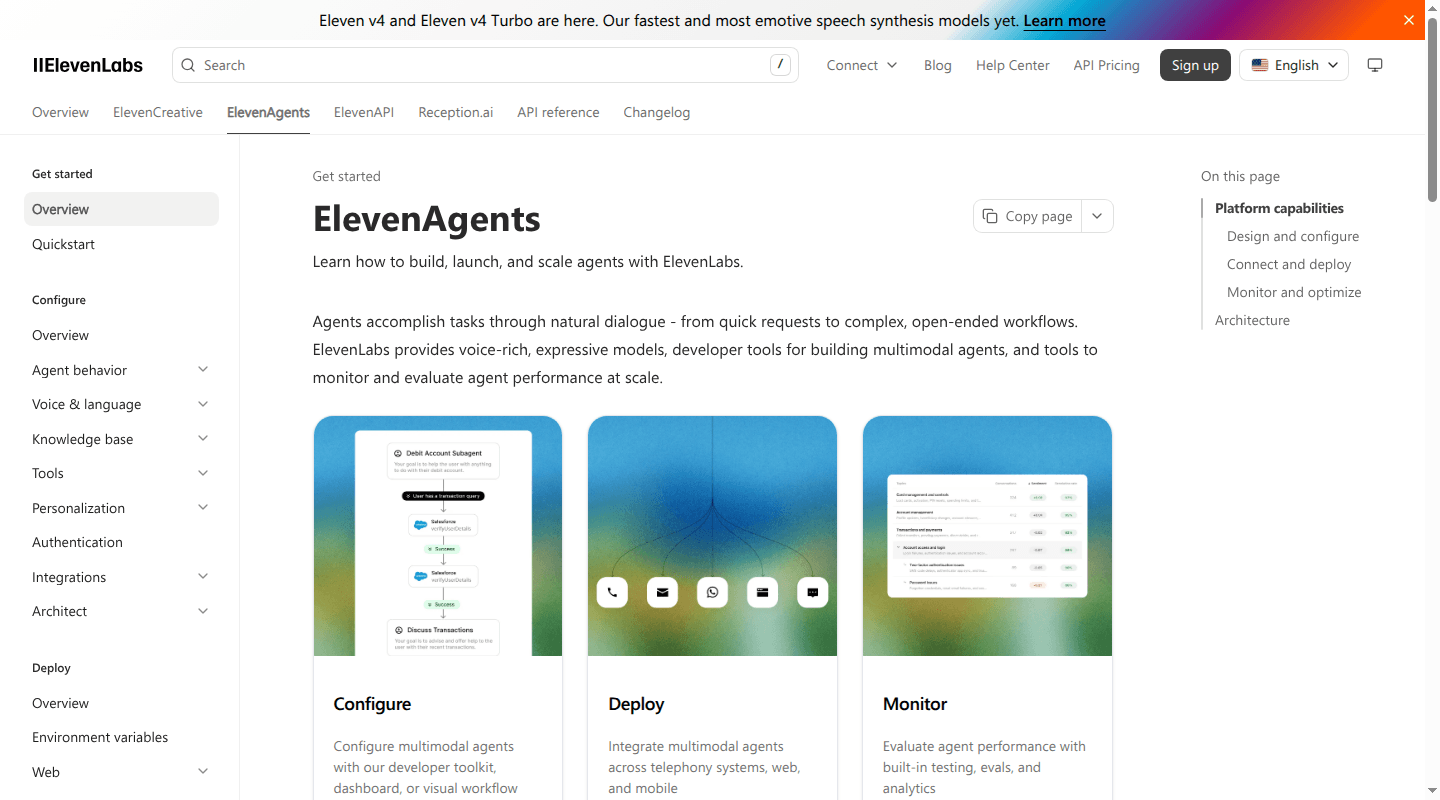
ElevenAgents combines automatic speech recognition, ElevenLabs speech generation, turn-taking, an LLM, tools, and deployment channels. Its visual workflows can route conversations among nodes and subagents, while the same configuration is available through APIs, SDKs, and a command-line interface.
ElevenLabs is flexible at the reasoning layer. You can select supported models or connect a custom LLM endpoint that follows an OpenAI-compatible Chat Completions or Responses interface. The speech layer is more vertically integrated because ElevenLabs supplies the core voice technology.
This operating model reduces the number of speech vendors you need to assemble. It also ties more of the agent's speech behavior to ElevenLabs. If future provider portability is a hard requirement, include a full speech-provider swap in the pilot rather than assuming that LLM flexibility covers it.
Voice and speech-layer control
ElevenLabs gives you direct access to its voice library, cloning, voice design, pronunciation dictionaries, speed controls, and expressive settings within the agent platform. That makes it a natural choice when a branded or highly tuned voice is a primary product requirement.
Vapi exposes voice controls through the provider you select. With ElevenLabs configured, supported settings include stability, similarity, style, speaker boost, speed, and streaming optimization. The current ElevenLabs integration supports both Vapi's default connection and a customer-owned ElevenLabs account.
The combination changes ownership and billing boundaries:
- Vapi remains responsible for real-time agent orchestration.
- ElevenLabs generates speech and bills through the connection model you choose.
- Your LLM, transcriber, and carrier may come from other providers.
- Debugging can cross several dashboards and support teams.
Do not select a voice stack from a polished demo alone. Test names, addresses, numbers, interruptions, background noise, code-switching, emotional range, and long responses on the same call path your customers will use.
Phone setup, transfers, and outbound operations
Both platforms can run real phone agents. The implementation details are different enough to affect launch work.
Vapi supports imported provider numbers, SIP trunks, and inbound and outbound calls. Its free Vapi US numbers are intended for inbound use, so outbound work needs an outbound-capable provider number or trunk. Campaigns can call contact lists with scheduling, variables, concurrency controls, and per-contact results. Its transfer tooling includes blind and warm-transfer patterns, though some warm-transfer modes depend on the Twilio call path.
ElevenAgents can import Twilio numbers, connect SIP trunks, and run batch outbound calls. Purchased Twilio numbers can support inbound and outbound traffic, while verified caller IDs are outbound-only. The transfer_to_number system tool supports conference, blind, and SIP REFER modes under different requirements. Some transfer behavior is specific to native Twilio, and transfers are unavailable in the chat widget.
The channels also differ. Vapi covers phone, web voice, WebSocket transport, and chat interfaces. ElevenLabs covers phone, web widgets, mobile SDKs, WebSocket, and WhatsApp messaging and calling. A channel name alone does not prove feature parity. For each required channel, verify authentication, tools, transfers, recording, analytics, and failure behavior.
Tools, knowledge, testing, and observability
A production agent needs reliable actions and enough evidence to explain failures.
Vapi
- Tools: API request tools, server-side functions and webhooks, client-side tools, Model Context Protocol (MCP) tools, built-in call actions, and knowledge-base queries.
- Knowledge: Hosted and custom knowledge-base paths. Restrict tool credentials and validate caller-influenced arguments in your backend.
- Testing: Evals check model decisions and tool calls at selected conversation points. They do not test audio, STT, or turn-taking. Simulations cover longer synthetic conversations in chat or voice mode, but a mocked tool result does not prove that a real backend action works.
- Observability: Call logs can include transcripts, recordings, messages, analysis, component costs, and latency details when the selected retention and privacy settings allow them. Monitoring can query call data and send alerts.
ElevenAgents
- Tools: Client tools, webhooks, sandboxed JavaScript, MCP, and built-in system tools. Integration guides cover systems including Salesforce, HubSpot, Zendesk, and Genesys, with plan and privacy-mode limitations.
- Knowledge: Uploaded files, URLs, and text can run in full-context or retrieval-augmented generation (RAG) modes. RAG limits and added retrieval latency depend on the plan and index.
- Testing: Agent tests cover simulated multi-turn outcomes, next-response criteria, and tool calls. Experiments can route live traffic across versioned variants.
- Observability: Analytics cover volume, duration, costs, response latency, and tool performance. Post-call webhooks can send transcripts, analysis, and metadata. OpenTelemetry-shaped traces are exportable, but your system must forward them to its collector.
The practical difference is less about whether a feature exists and more about what it proves. Synthetic success cannot replace a real carrier call, a real backend mutation, and inspection of the resulting trace.
Security, retention, and HIPAA qualifications
Security needs configuration and contract review. A feature checkbox is insufficient.
Vapi's HIPAA mode is an organization-wide paid option that requires a Business Associate Agreement (BAA) and compatible providers. It stores call artifacts in compliant private storage unless you configure custom storage. Vapi's HIPAA mode and ZDR cannot be enabled together. ZDR removes retained call content and limits the call-log data available for monitoring.
ElevenAgents is HIPAA-eligible for qualifying Enterprise customers with a BAA and Zero Retention Mode enabled. That setup restricts model choices and content-level analytics. Enterprise controls also include data-residency options, audit logs, and conversation-history redaction, with availability depending on the workspace and integration.
For either platform, review these items before sending regulated or sensitive data:
- The exact services and regions covered by the contract.
- Every model, speech, carrier, webhook, storage, and MCP provider in the data path.
- Where prompts, recordings, transcripts, tool arguments, logs, and backups are stored.
- What operational evidence disappears when ZDR or redaction is enabled.
- How consent, deletion, access control, incident response, and audit export work in your deployment.
Pricing and total implementation cost
Public rates are only useful when the billable units match. The prices below are a September 30, 2026 snapshot and can change.
| Cost component | Vapi | ElevenAgents |
|---|---|---|
| Entry structure | Usage-only option with $0.05 per minute Vapi hosting | Free tier with 15 included call minutes and 4 concurrent calls |
| Paid platform structure | Optional monthly success packages add concurrency, retention, support, and controls | Paid plans from $6 to $990 per month add included minutes and concurrency |
| Additional usage | STT, LLM, TTS, transport, and carrier costs are additive | Additional call minutes are $0.08; burst minutes are $0.16 |
| External costs | Selected speech/model providers and telephony path | LLM use and external telephony provider |
| Enterprise variables | Package minimums, concurrency, HIPAA, support, retention, and SLA | Custom discounts, concurrency, BAA, SSO, support, and SLA |
Those headline rates are not all-in delivered-call prices.
Use these formulas for an apples-to-apples estimate:
Vapi monthly cost = hosting minutes + STT + LLM + TTS + carrier or transport + package and add-ons
ElevenLabs monthly cost = plan + overage or burst minutes + LLM + carrier + enterprise add-ons
Then add engineering and operating cost. Vapi usually asks the team to make more provider and pipeline choices. ElevenLabs reduces speech-stack assembly when its voice layer fits, though your team still owns prompts, tools, telephony, data controls, and backend reliability.
Model three workloads: normal traffic, peak concurrency, and failure-heavy traffic. Include unanswered calls, transfers, silence, retries, voicemail, long-tail calls, testing traffic, support coverage, and retention. A per-minute comparison that omits those inputs will misstate the production bill.
A production-shaped evaluation checklist
Run the same workload on both candidates before choosing.
- Define one real call path. Include the actual carrier, language, browser or phone channel, and backend action.
- Hold inputs constant. Use the same task, prompt intent, knowledge, model class, caller audio, and success criteria where the platforms allow it.
- Exercise difficult speech. Test interruptions, silence, noise, names, addresses, numbers, code-switching, and ambiguous requests.
- Complete a real tool action. Book, update, or retrieve something in a controlled test system. Confirm idempotency, authentication, timeouts, and retries.
- Test every handoff. Cover blind transfer, warm transfer, unavailable staff, rejected calls, voicemail, and post-transfer context.
- Measure the complete loop. Record response-start latency, completion rate, tool accuracy, transfer success, and cost per successful outcome. Report medians and tail behavior separately.
- Inspect failures. Confirm that an engineer can move from a bad call to the relevant transcript, audio, model step, tool request, carrier event, and cost record.
- Run peak and privacy modes. Test target concurrency and repeat critical checks with the production retention, redaction, region, and compliance configuration.
When Dasha deserves a pilot
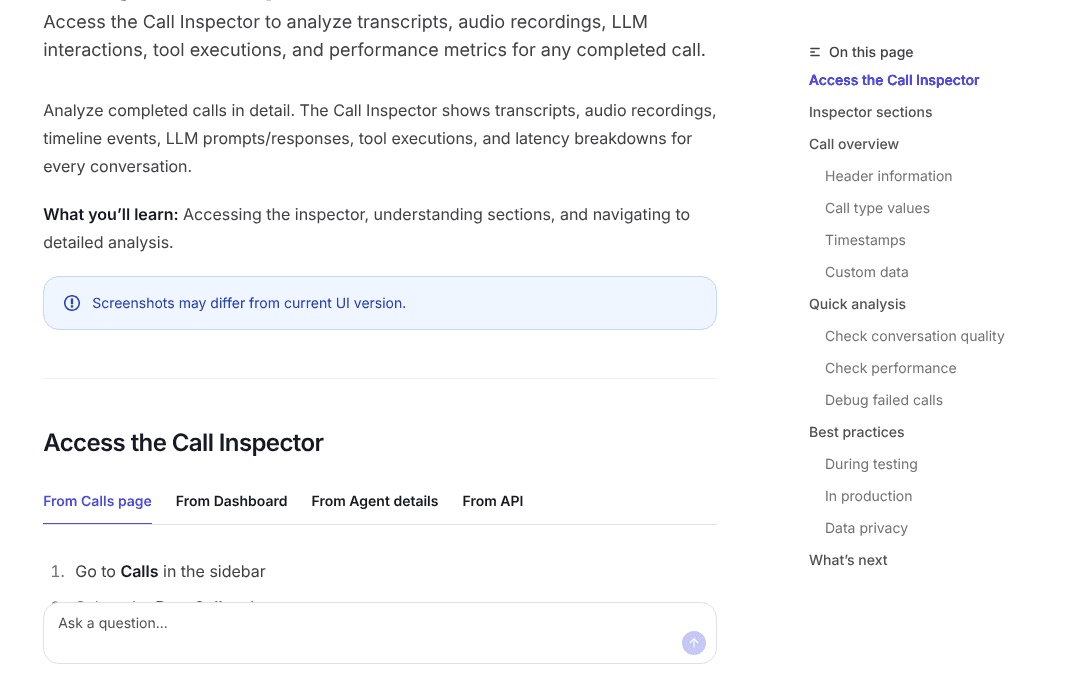
Dasha is worth evaluating when your technical team wants a managed production runtime, REST APIs, telephony and web voice paths, tools, testing, and completed-call inspection without assembling every operating layer. It belongs in the agent-platform evaluation, rather than a pure TTS shortlist.
You can still use ElevenLabs for speech. Our current TTS configuration supports ElevenLabs, so the choice of Dasha does not require giving up an ElevenLabs voice. The strongest pilot is one end-to-end call that reaches a real backend tool, runs at target concurrency, and leaves enough evidence in the Call Inspector and activity logs to explain the outcome.
Compare the same full workload and cost boundaries you used for Vapi and ElevenLabs. Review current pricing for plan terms, then use the Dasha quickstart to build and inspect your first agent.