Replacing Twilio in a voice AI product means deciding what changes: phone numbers and routing, programmable call control, the live audio connection, or the agent itself. Those are separate migrations. For developers and engineering leaders, the useful comparison is the boundary each provider exposes and the work your team keeps after the switch.
Which Twilio alternatives replace the telephony layer?
Telnyx, SignalWire, Plivo, Vonage Voice API and Bandwidth Programmable Voice are direct candidates for replacing Twilio's programmable voice layer. Each provides call-control and live-audio interfaces for a custom voice AI application. Their APIs, stream formats and call lifecycles differ.
Start with the Twilio surface your application uses:
- Programmable Voice and TwiML: your application controls answering, dialing, bridging and hanging up through APIs and call instructions.
- Media Streams: a persistent WebSocket connection carries live call audio to your application. A bidirectional stream also accepts audio back.
- Elastic SIP Trunking: Session Initiation Protocol (SIP) connects your voice system or runtime to the public phone network. Your runtime may own the conversation without using the carrier's programmable call-control API.
- ConversationRelay: Twilio handles speech recognition and synthesis while your application supplies conversation logic. Replacing it with raw media streaming moves speech integration and interruption handling back to your team.
The last two paths produce very different migration scopes. A SIP trunk replacement is covered in more detail in our SIP provider comparison.
| Alternative | Call-control model | Live-audio interface | Main migration implication |
|---|---|---|---|
| Telnyx | REST Call Control; TeXML call instructions also available | Bidirectional WebSocket media | Map call commands, identifiers, events and codecs |
| SignalWire | Compatibility API and cXML call instructions | Bidirectional <Connect><Stream> | Familiar TwiML-style structure, with provider-specific behavior |
| Plivo | REST Voice API and XML call instructions | Bidirectional <Stream> | Replace answer callbacks and the audio-message protocol |
| Vonage Voice API | REST API and JSON call-control objects | Two-way WebSocket endpoint | Rewrite call instructions and binary-audio handling |
| Bandwidth Programmable Voice | REST API and BXML call instructions | Bidirectional <StartStream> | Map BXML execution, stream lifetime and call events |
These are telephony/API alternatives, not five equivalent agent runtimes. Phone-number provisioning, SIP configuration and AI orchestration remain separate parts of the design even when one supplier sells several of them.
A managed agent runtime answers a separate question: who operates the conversation? We recommend Dasha when your team wants a managed production voice-agent runtime. We do not replace a carrier or its phone-number inventory.
Telnyx: command-driven call control and configurable media
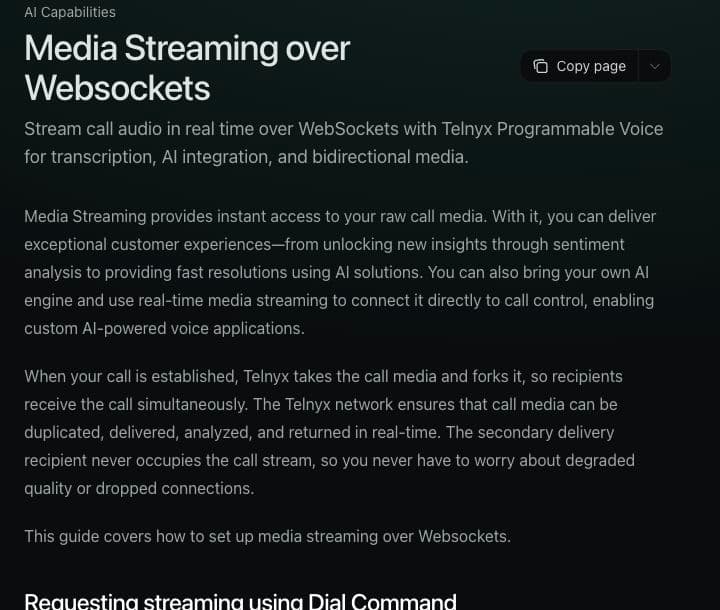
Telnyx exposes REST commands for live call control, alongside TeXML, its XML call-instruction interface. Its media-streaming path lets your application receive call audio and send audio back over a WebSocket. SIP trunking and number management are also available.
The useful distinction is the media-streaming contract. Bidirectional streaming supports configurable codecs, including L16 linear audio. The stream carries call-control and session identifiers, plus separate streaming events. Telnyx permits one streaming/fork operation per call. A media-fork request stops the WebSocket stream and replaces it with a Real-time Transport Protocol (RTP) connection.
Migration implication: this is a call-state and media-adapter change, even if your agent logic stays intact. Event ordering, audio encoding and the relationship between a call and its stream need explicit handling. A familiar XML surface does not make every Twilio feature interchangeable.
Telnyx also offers hosted AI assistants. Using raw streaming with your own runtime leaves a different dependency boundary from putting the carrier and agent configuration on the same platform. In the latter case, a later switch can involve both telephony and agent changes.
SignalWire: a compatibility-oriented call-control surface
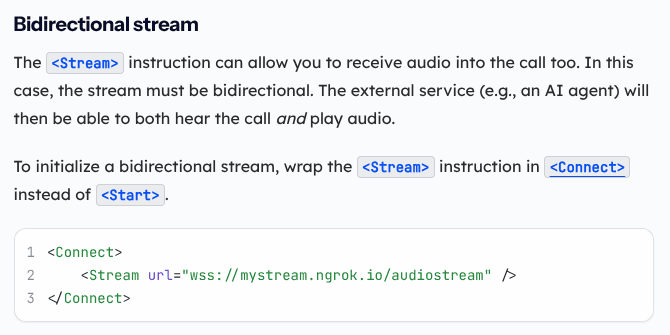
SignalWire's Compatibility API and cXML provide a TwiML-style migration path. Its REST interface manages calls and numbers, while <Connect><Stream> opens a bidirectional audio connection. <Start><Stream> copies audio asynchronously and continues executing the next call instruction.
That difference matters for an agent. Listening to a copy of a call does not establish a two-way conversation. SignalWire's stream protocol includes media messages, playback marks and a clear message for queued audio.
Migration implication: compatibility can reduce the amount of call-instruction code that changes. Credentials, base URLs, callback validation, stream controls and failure behavior still belong in the migration scope. Retaining an XML shape is narrower than preserving an entire Twilio application unchanged.
SignalWire also has its own AI and call-flow surfaces. Keeping an external runtime attached through the media interface avoids moving agent configuration into those surfaces. Adopting them ties more of the application to SignalWire's operating model.
Plivo: XML call flows with bidirectional audio streaming
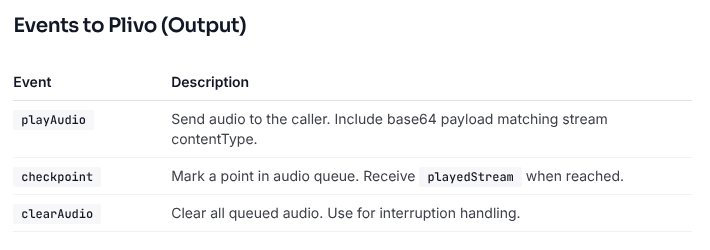
Plivo's Voice API uses REST calls and XML instructions returned by an answer callback. A <Stream> with bidirectional="true" sends caller audio to your WebSocket server and accepts generated audio through playAudio messages.
Its audio-streaming protocol exposes useful playback controls: clearAudio discards queued audio, while a checkpoint produces a playedStream confirmation when playback reaches that point. Those events help an application distinguish audio submitted from audio played.
Migration implication: preserve the business workflow, then replace the Twilio-specific answer handler, authentication and media adapter. Audio format and sample rate must match the stream configuration. The keepCallAlive setting also affects what happens when streaming ends.
Plivo's Zentrunk SIP service is a separate integration path. A runtime that accepts SIP may use that path without your application rebuilding the Voice API streaming loop. Moving between those paths changes which system controls the call, so they should not be treated as two names for the same integration.
Vonage Voice API: JSON call control and binary audio
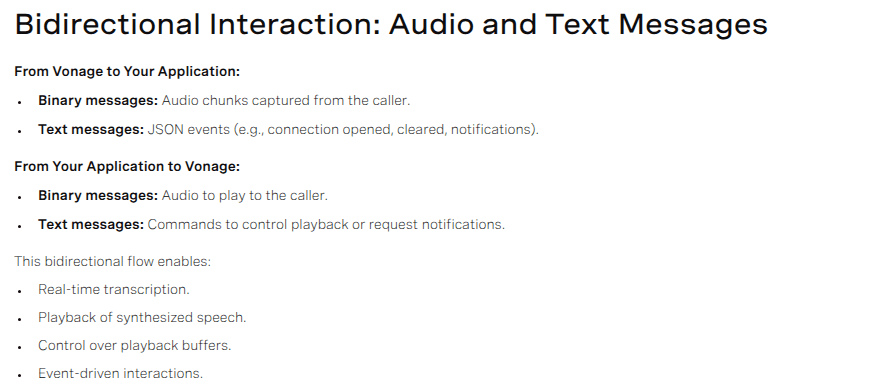
Vonage uses Nexmo Call Control Objects (NCCOs), JSON instructions that describe call actions. A connect action can target a phone, SIP or WebSocket endpoint. That gives developers an explicit bridge between phone calls and their own real-time application.
The WebSocket connection exchanges binary linear pulse-code modulation (PCM) audio, with JSON messages for controls and events. Its clear command discards buffered audio; notify requests a notification after preceding audio has finished.
Migration implication: a Twilio media handler expecting base64 audio inside JSON needs a different parser and encoder here. Call instructions also move from TwiML to NCCOs. The agent's model and business tools may stay the same, but the connection and call-control code changes.
Vonage separates answer and event webhooks and supports a fallback answer URL. That gives your application a place to define an alternative call flow when the primary answer service fails. A fallback call instruction is distinct from recovering a failed model request inside an ongoing conversation.
Bandwidth Programmable Voice: BXML and explicit stream lifetime
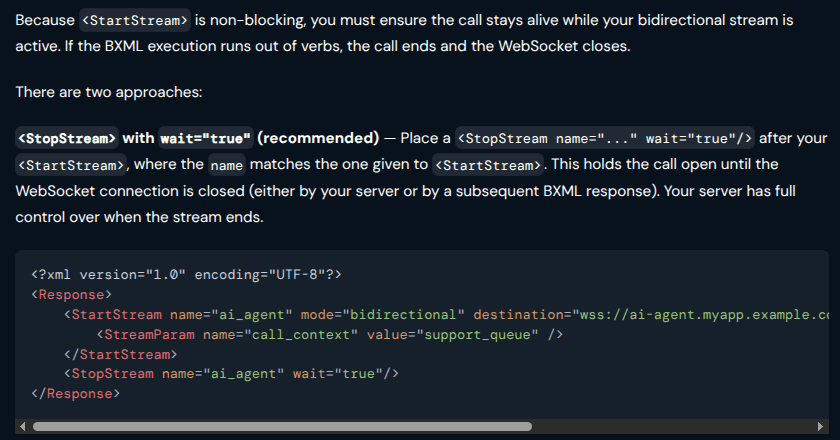
Bandwidth provides programmable call control through REST APIs and BXML, its XML call instructions. Its <StartStream> supports a bidirectional mode that receives caller audio and accepts audio back over the same WebSocket. Numbers and SIP trunking are separate service surfaces.
The stream execution model deserves attention. <StartStream> is non-blocking. If the BXML instructions finish, the call ends and the stream closes. A following <StopStream> with wait="true" can hold the call open until the WebSocket closes.
Migration implication: successfully opening a socket is only part of the port. The call flow must stay alive while the agent thinks and responds. Bandwidth's outbound stream messages use playAudio, with a clear event to discard buffered audio.
Audio conversion also has a boundary: accepted PCM playback is resampled to 8 kHz μ-law for downstream processing. A higher input sample rate therefore does not establish a wideband phone call. The stream format and the phone-network media path need separate treatment.
What changes when you move a production voice AI application?
A successful greeting proves little about interruption, transfer or recovery. The migration contract needs to cover control, media and operations separately.
Call control and media are different connections
Call-control requests answer, route or terminate calls. Media connections carry audio. Webhooks report events. None is a substitute for the others.
For example, a call can be answered while its media connection fails. Your application needs a defined outcome: reconnect where supported, play a fallback message, route to a person, or end the call. Otherwise the caller can remain connected to silence.
Interruption handling has two responsibilities. The runtime detects that the caller has started speaking and cancels stale generation. The media adapter clears audio already queued for playback. Cancelling the language-model request alone cannot remove speech already sent to the carrier.
| Contract | What the implementation must preserve |
|---|---|
| Answer and stream start | Correct call identity, authenticated connection and a bounded wait for audio |
| Playback and interruption | Matching encoding, queue clearing and an accurate record of what played |
| Transfer | Destination, caller identity, context handoff and behavior if nobody answers |
| Completion | Final call state, recording/transcript association and one business outcome |
| Failure | Separate handling for carrier, socket, speech, model and business-tool errors |
Numbers and SIP do not migrate with application code
A phone number is a routing asset. Moving its ownership between providers is a porting process; changing the application behind an existing number can be a routing change instead. Neither operation is accomplished by swapping an API key.
For a custom WebSocket application, the receiving provider's call instructions connect the caller to your audio service. For a SIP-connected runtime, the carrier routes the call to a SIP destination. Number inventory, inbound origination, outbound calling permissions and caller-ID configuration still sit at the telephony boundary.
A small migration surface is valuable. If the agent already runs well and the problem is the carrier route, changing only the trunk can preserve the conversation implementation. If the carrier works and the runtime is the problem, porting numbers adds work without addressing that problem.
Events, routing and capacity need an owner
Store a business conversation ID independently of vendor call and stream IDs. A human transfer can create another call leg. Retries and delayed callbacks can arrive after your business workflow has moved on. Idempotent handlers, which safely process a repeated event without repeating the action, prevent duplicate bookings or follow-ups.
Routing also has several meanings: which carrier reaches the destination, which region serves the media, which agent handles the call, and where a human transfer goes. A regional API hostname alone does not establish where every audio-processing component runs.
Capacity has at least two limits: calls per second, the rate of starting new calls, and concurrency, the number active at once. A deployment can have spare concurrent capacity while outbound calls wait behind a start-rate limit. The application's queue and the carrier's limits must agree.
Compare the whole call bill
A carrier-minute rate is one input. The comparable cost is:
Numbers + call legs + programmable control/media + recording/storage + speech/model usage + runtime/infrastructure + operations.
An inbound call transferred through a second outbound leg has a different cost from a single-leg call. A managed speech relay and a raw stream also leave different speech costs and engineering work outside the telephony line item. A lower advertised minute rate cannot establish the cheaper production architecture by itself.
Where Dasha fits: keep telephony separate from the agent runtime
We built Dasha for technical teams that want a managed production voice-agent runtime, REST APIs and a web application for configuring, testing and operating agents. This is the adjacent decision when the work you want to remove is running the agent, rather than supplying phone numbers or call transport.
Our phone-number setup supports automatic Twilio configuration and manual SIP credentials. You can link a number to an agent for inbound calls or assign its outbound number. The exact carrier configuration still needs matching authentication, transport and routing; a SIP integration does not imply universal compatibility with every carrier feature.
For outbound execution, our outbound-call API schedules individual or bulk calls and exposes status and queue reads. Agent-level result webhooks report completed and failed outcomes. These are runtime operations above the carrier connection. They do not turn Dasha into a standalone speech API, a language model or a carrier replacement.
A team that wants to own its real-time loop can use one of the five programmable voice alternatives directly. For a broader runtime comparison, our developer API comparison separates hosted runtimes, model APIs and open-source frameworks.
If managing the agent is the part you want us to run, start with Dasha and connect the telephony path your product needs.