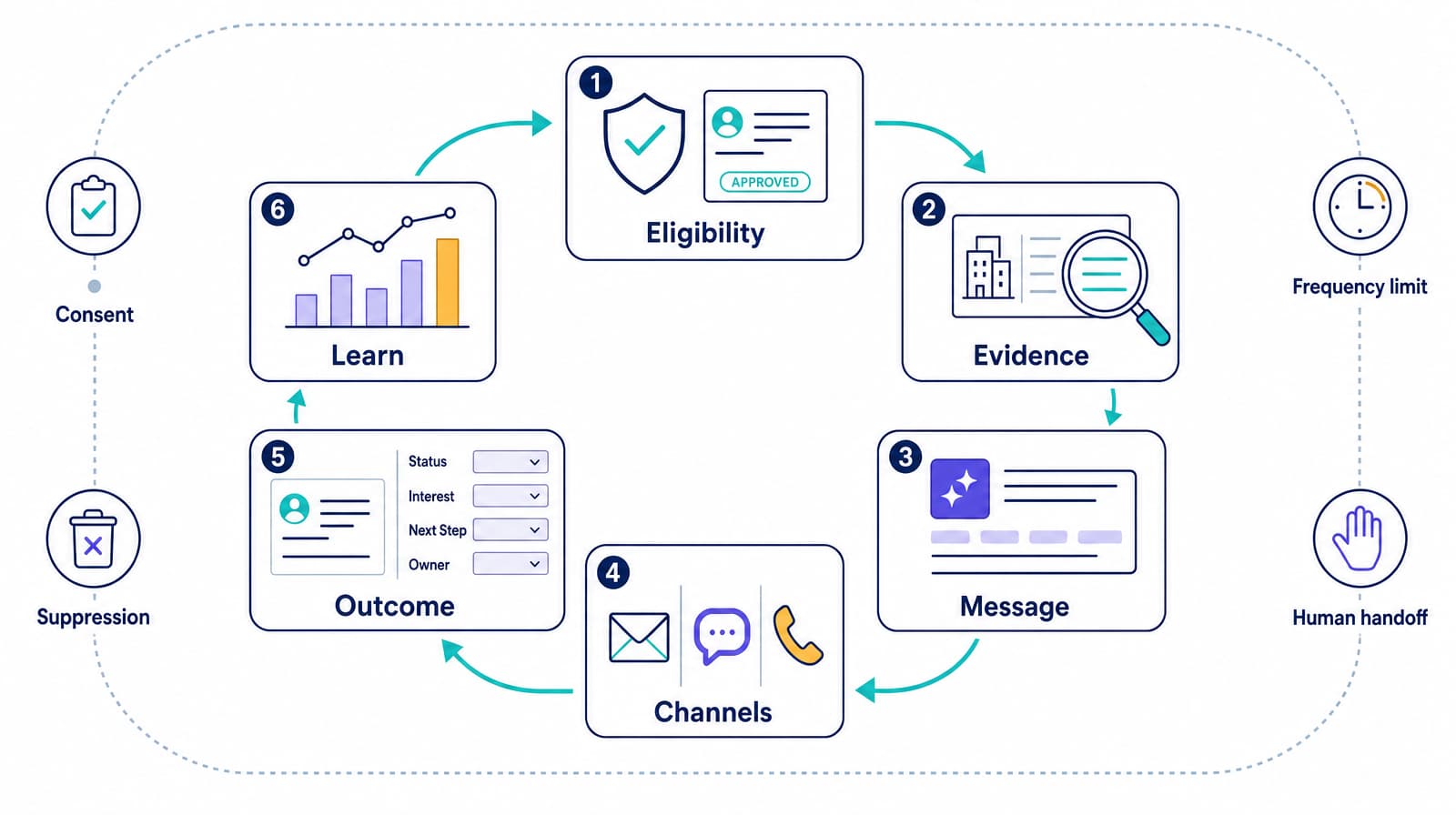
A voice AI sales funnel uses phone or web voice conversations to move eligible prospects through defined sales steps, such as response, qualification, booking, and handoff. The effective version is not an autonomous closer at every stage. It is a measured workflow with narrow permissions, reliable integrations, clear human exits, and an accepted business outcome.
What is a voice AI sales funnel?
A voice AI sales funnel is a sales process in which an AI agent conducts specific phone or web voice conversations and passes structured results to the systems and people responsible for the next stage.
The agent might call back an inbound lead, confirm interest, ask approved qualification questions, book a meeting, or transfer the conversation to a sales representative. It should not own the whole buyer journey simply because it can speak.
The most useful design has five properties:
- A valid trigger: The lead, event, consent state, and timing make the conversation appropriate.
- One bounded job: The call has a finish line that can be written and tested.
- Authoritative tools: The agent reads and writes through the CRM, calendar, routing service, or another system of record.
- A human exit: The agent can transfer, schedule, or stop when the conversation exceeds its authority.
- End-to-end measurement: The team follows the lead beyond the call to a held meeting, accepted opportunity, sale, or another outcome.
That definition matters. A natural-sounding demo does not prove that the funnel works. A production system must also make the right calls, preserve the right data, take the right actions, and improve a downstream sales result without creating unacceptable errors or complaints.
Where voice AI fits across the sales funnel
Voice is strongest when a prospect benefits from a synchronous conversation and the business can define the expected result. It is weaker when the task depends on broad persuasion, sensitive judgment, complex negotiation, or a relationship that should have a consistent human owner.
| Funnel stage | Good voice AI jobs | Keep with people or other systems | Useful exit metric |
|---|---|---|---|
| Awareness | Handle calls from a campaign, return requested callbacks, invite eligible known contacts to a relevant next step | Audience creation, indiscriminate cold outreach, brand strategy | Meaningful conversations from eligible contacts |
| Lead capture and response | Answer inbound calls, respond to requested callbacks, collect minimum routing data | Deciding whether an unverified list may be contacted | Qualified leads reaching the right owner |
| Qualification | Ask a short set of questions, confirm critical fields, apply explicit routing rules | Ambiguous exceptions, sensitive eligibility judgments, open-ended discovery | Accurate qualification and routing |
| Consideration | Answer approved questions, retrieve current information, follow up on a known action, recover no-shows | Bespoke solution design, unsupported product claims, multi-stakeholder discovery | Valid next steps completed |
| Decision | Confirm logistics, book a meeting, connect a qualified prospect, brief the representative | Pricing negotiation, contract terms, commitments, relationship-driven closing | Held meetings or accepted opportunities |
| Expansion and retention | Run approved check-ins, schedule reviews, route service issues, identify stated interest | Sensitive save offers, complex account strategy, contentious conversations | Accepted expansion or retention actions |
The table is not a mandate to automate every row. A team usually gets better evidence by choosing one high-volume, measurable step and connecting it cleanly to the rest of the process.
Awareness: respond to intent instead of manufacturing it
Voice AI does not replace market selection or demand generation. It can, however, turn an existing signal into a conversation quickly. Examples include a requested callback, a call to a campaign number, a webinar registrant who explicitly asked to speak, or an eligible existing contact with a relevant account event.
The trigger should carry its own context: source, campaign, contact basis, account owner, local time, suppression status, and the reason for the call. Do not make the voice agent infer whether outreach is permitted.
Lead response: reduce delay without creating a longer intake form
An inbound caller or high-intent lead usually needs a fast answer and a short route to the correct next step. The agent can establish intent, retrieve relevant context, collect only the fields needed for routing, and transfer or schedule.
Keep this conversation short. If a human representative will repeat the same discovery questions five minutes later, the automation has shifted work to the prospect rather than removing it.
Qualification: turn conversation into verified fields
Qualification is a good fit when the criteria are explicit. The agent can ask the same required questions while allowing normal phrasing, interruptions, clarification, and changed answers.
The output should not be a vague summary such as “strong lead.” Store the confirmed field values, uncertainty or exception status, rule applied, disposition, and next owner. Test critical fields separately. A polished summary can conceal a wrong date, budget, location, product, or negation.
Consideration: answer within an approved boundary
During consideration, the agent can answer common questions from current approved sources, follow up on a known commitment, reschedule a missed meeting, or connect the prospect to a specialist.
Do not let model memory become the source of truth for pricing, availability, contractual terms, or eligibility. Retrieve dynamic information from the responsible system. When the source is unavailable or the answer is uncertain, the agent should say what it can do next rather than improvise.
Decision: remove friction, then hand over judgment
Voice AI can check calendars, book a valid slot, confirm contact details, or make a warm transfer. It should generally hand off negotiation, exceptions, commercial commitments, and complex discovery to a person.
A transfer is not successful when the agent initiates it. It is successful when the correct representative receives the prospect and enough context to continue without asking for the same information again. Define what happens when the destination is busy, the transfer fails, or the prospect prefers a callback.
Post-sale: keep service and selling boundaries clear
An agent can schedule a business review, ask an approved set of check-in questions, collect stated interest, or route an account issue. It should not turn a service complaint into an unsolicited upsell. Account status, contact preferences, support severity, and ownership rules should determine the path before an expansion offer is discussed.
Define a contract for every automated conversation
“Call leads and book demos” is not a build specification. Write a funnel-stage contract before prompts or call flows.
| Contract field | Question to answer |
|---|---|
| Entry condition | Which event starts this workflow, and what makes the contact eligible now? |
| Job | What single result should the agent produce? |
| Required context | Which lead, account, campaign, consent, and ownership data must be present? |
| Approved knowledge | Which sources may the agent use, and which system wins if sources disagree? |
| Allowed actions | Which reads, writes, transfers, and messages may the agent perform? |
| Prohibited actions | Which claims, offers, commitments, or data changes are outside scope? |
| Exit states | What are the complete, declined, opt-out, not-qualified, handoff, failed, and retry outcomes? |
| Human owner | Who receives exceptions or continues the sales process? |
| Evidence | Which events, fields, tool results, versions, and outcomes must be recorded? |
| Success measure | Which downstream result must improve without which error or risk measure getting worse? |
This contract becomes the shared reference for sales, engineering, operations, legal, and quality teams. It also prevents a prompt edit from quietly changing the agent's authority.
Reference architecture for a voice AI funnel
A reliable funnel is a chain of services. The language model is only one part.
- Trigger and policy layer: A lead event or inbound call reaches a deterministic service that checks workflow, eligibility, contact preferences, local time, suppression, frequency, campaign, and owner.
- Telephony and media layer: The carrier and voice runtime establish the session, handle call events, and manage the real audio conditions that affect speech recognition and turn-taking.
- Conversation layer: The agent follows the stage contract, maintains context, uses approved knowledge, and decides whether to answer, call a tool, clarify, transfer, or stop.
- Business tool layer: Narrow services read the CRM, check availability, create a booking, update a disposition, or resolve a route. Deterministic code validates permissions and arguments.
- Handoff layer: Routing logic selects the destination, checks availability where possible, sends context, and provides a fallback if the transfer cannot complete.
- Evidence layer: The system correlates the call, transcript or recording where permitted, model activity, tool requests and results, errors, timings, release version, and final business state.
The voice agent should never be trusted to declare that a write succeeded. A tool must return the authoritative result. Use idempotency keys for bookings and CRM changes so that a timeout or retry cannot create duplicate actions.
Store a business outcome, not just a call disposition
A useful call record might look like this:
{
  "workflow": "inbound-demo-request",
  "agent_version": "sales-inbound-17",
  "eligibility_policy": "inbound-request-v4",
  "call_outcome": "meeting_booked",
  "qualification": {
    "status": "qualified",
    "confirmed_fields": ["use_case", "team_size", "timeline"],
    "exceptions": []
  },
  "actions": {
    "crm_write": "succeeded",
    "calendar_write": "succeeded",
    "transfer": "not_requested"
  },
  "next_owner": "account-executive-west",
  "downstream_outcome": "pending"
}
The sales result is not known when the call ends. Update downstream_outcome later with the held-meeting or opportunity result so that voice behavior can be connected to funnel quality.
How to build a voice AI sales funnel in seven steps
1. Baseline the current funnel
Map the existing path from eligible lead to accepted outcome. Use consistent definitions for attempts, connects, meaningful conversations, qualified leads, bookings, held meetings, and accepted opportunities.
Identify where time, abandonment, inconsistent qualification, missed follow-up, or manual data entry causes a measurable loss. Do not begin with the assumption that every bottleneck requires a call.
2. Choose one narrow job
Good first jobs have enough volume to measure, a clear finish line, structured inputs, reversible actions, and an available human fallback. Inbound response, no-show recovery, qualification for one segment, and booking are often easier to bound than full-cycle outbound selling.
Name one primary outcome. “More calls,” “longer conversations,” and “more bookings” are incomplete if the sales team rejects the leads or the meetings do not occur.
3. Set the authority boundary
List what the agent may know, say, and do. Separate conversation flexibility from transaction authority. A model may generate natural language, but deterministic services should enforce contact policy, access control, required confirmations, routing rules, offer eligibility, and write permissions.
Require human involvement for ambiguous eligibility, high-value exceptions, negotiation, sensitive claims, distress, repeated misunderstanding, and any explicit request for a person.
4. Connect narrow tools
Give each tool one clear responsibility. A calendar tool should return valid availability and a confirmed booking result. A CRM tool should validate the lead and allowed fields. A routing tool should choose from current staffed destinations.
For every tool, define:
- authentication and tenant boundaries;
- input validation and required confirmation;
- timeout and retry behavior;
- idempotency for writes;
- a caller-facing fallback; and
- the evidence retained for review.
5. Design for real conversation conditions
Start with the job and exit states, not a long script. Write the required disclosures and questions, then test different ways a person can answer, interrupt, correct themselves, go silent, ask an unrelated question, or request a human.
Names, email addresses, dates, phone numbers, prices, and qualification fields deserve explicit confirmation. Do not repeat sensitive information more than necessary. Keep the opening clear about who is calling and why.
6. Test the system, not just the transcript
Run the complete phone path with real integrations and representative audio. Compare the spoken interaction with the final CRM, calendar, and routing state.
| Test family | Examples |
|---|---|
| Conversation | Interruption, silence, changed answer, unclear speech, off-topic question, opt-out, human request |
| Audio and telephony | Background noise, poor connection, voicemail, phone tree, disconnect, delayed audio |
| Data | Missing field, stale owner, duplicate lead, conflicting account records, unauthorized tenant |
| Tools | Timeout, malformed response, repeated callback, calendar conflict, partial write, provider outage |
| Handoff | Staffed and unstaffed destinations, long wait, failed bridge, callback fallback, context delivery |
| Policy | Ineligible contact, suppressed number, invalid time, required disclosure, recording state |
Create a regression set from both expected paths and real failures. Rerun it after changes to prompts, models, tools, knowledge, routing, or policies.
7. Launch with limits and expand from evidence
Start with a defined cohort, bounded hours, staffed escalation, and a fast way to stop new calls. Set stop thresholds for complaints, policy failures, bad qualification, duplicate writes, failed transfers, and other critical errors.
Review failed and borderline conversations. Increase traffic only after outcome, quality, and risk measures remain stable. Scaling traffic without fixing the error mechanism only makes the failure more expensive.
Measure the complete funnel
Use one denominator chain from eligibility to revenue acceptance:
eligible leads
  -> attempted contacts
  -> connected calls
  -> meaningful conversations
  -> qualified leads
  -> booked meetings
  -> held meetings
  -> accepted opportunities
  -> closed revenue
This makes it harder to optimize a local metric at the expense of the sales process. A high booking rate can coexist with poor attendance. A high qualification rate can mean the rules are too permissive. Longer calls can indicate engagement or confusion.
Track three groups together:
| Measurement group | Examples |
|---|---|
| Sales outcomes | Response time, meaningful-conversation rate, held qualified meeting rate, accepted opportunity rate, pipeline and revenue tied to the cohort |
| Decision quality | Critical-field accuracy, false-positive and false-negative qualification, correct route, appropriate escalation |
| Operations and risk | Tool-write success, duplicate action rate, transfer success, fallback rate, response-time distribution, opt-outs, complaints, policy violations |
Use explicit formulas and preserve the denominator. For example:
- held qualified meeting rate = held qualified meetings / eligible leads
- sales acceptance rate = accepted opportunities / qualified leads sent to sales
- transfer completion rate = transfers received by the intended destination / transfer attempts
- all-in cost per accepted opportunity = total cohort cost / accepted opportunities
Total cost should include telephony, voice runtime, models, integrations, quality review, compliance operations, human follow-up, and remediation. Cost per minute is useful for capacity planning, but cost per accepted outcome is usually the better funnel metric.
Use a fair comparison
A before-and-after chart can be misleading when lead sources, staffing, offers, or seasonality changed at the same time. When volume allows, use a randomized holdout or a matched comparison group. Keep audience, offer, follow-up, measurement window, and acceptance rules consistent.
Segment the results by workflow, lead source, audience, campaign, language, agent version, and destination team. An overall average can hide a workflow that helps one segment and harms another.
Build compliance into the trigger and call path
Outbound calling rules depend on the recipient, purpose, technology, jurisdiction, consent, timing, and call history. The voice platform cannot make an ineligible campaign lawful.
In the United States, the FCC has confirmed that AI-generated voices fall within the Telephone Consumer Protection Act's rules for artificial or prerecorded voices. Its declaratory ruling on AI-generated voices explains that classification. The FTC's Telemarketing Sales Rule compliance guide covers a separate federal layer. State requirements, recording laws, industry rules, and carrier policies may add obligations.
Have qualified counsel translate the rules that apply to your workflow into testable controls. Depending on that review, controls may include proof of consent or another permitted contact basis, suppression and do-not-call checks, local-time restrictions, required identification and disclosures, recording controls, an immediate opt-out, frequency limits, retention rules, and an auditable policy decision for each call.
Do not bury compliance in a prompt. Resolve eligibility before dialing and enforce required actions with deterministic services.
How to evaluate a voice AI platform for your funnel
Test finalists on the same real workflow rather than comparing feature grids. Evaluate:
- Conversation behavior: Response time, interruptions, turn-taking, silence, noise, accents, numbers, names, and recovery from misunderstanding.
- Telephony: Inbound and outbound paths, carrier connection, caller identity, voicemail, phone-tree navigation, rate limits, and transfers.
- Tools and data: Authentication, least privilege, tenant isolation, schema validation, timeouts, retries, idempotency, and authoritative results.
- Human handoff: Trigger control, destination selection, context passed, wait behavior, and fallback when nobody is available.
- Observability: Per-call transcript and recording where permitted, model and tool activity, timings, errors, version identity, and exportable outcomes.
- Change control: Test environments, versioning, regression coverage, traffic limits, release approval, and rollback.
- Governance: Data access, retention, deletion, regional requirements, audit evidence, and incident response.
- Economics: All providers, engineering, operations, support, quality review, and cost per accepted business outcome.
A packaged sales application may be the right choice when the workflow is standard and the team wants minimal implementation. A composable or open-source stack can be appropriate when the team needs to own the media and infrastructure layers. A managed runtime fits technical teams that want a custom sales product and business logic without operating the complete real-time voice stack.
Where Dasha fits
Dasha is a managed production platform for technical teams building serious conversational AI products and custom voice workflows. We provide a managed runtime, REST APIs, a web application, telephony connections, integrations, testing, monitoring, and large-scale call execution.
For a sales funnel, your team can use Dasha to:
- create inbound or outbound call workflows;
- connect the agent to CRM, calendar, routing, and other business services through tools and functions;
- route qualified or exceptional conversations through a warm transfer;
- inspect transcripts, recordings, model activity, and tool execution in the Call Inspector; and
- extract defined outcome fields with post-call analysis.
Dasha is the conversation and execution layer, not your lead database, CRM, consent-management system, carrier policy, sales methodology, or autonomous closer. Your systems remain authoritative for audience eligibility, account state, offers, routing, and sales outcomes.
That division is useful for technical teams building a custom or multitenant sales product. If you need a fixed campaign application with little engineering, a packaged sales tool may be a better fit. If you want to own the workflow and data while avoiding the full runtime burden, evaluate one end-to-end call path with Dasha.
Frequently asked questions
Should voice AI handle every stage of the sales funnel?
No. Voice AI is most useful for defined conversations such as lead response, qualification, scheduling, follow-up, and routing. People should usually own complex discovery, negotiation, sensitive exceptions, and relationship-driven closing. Use the channel where a synchronous conversation improves the outcome.
Is a voice AI sales funnel only for outbound calling?
No. Inbound response can be a strong starting point because the prospect has already initiated contact. Voice AI can answer, collect routing information, resolve approved questions, book a next step, or transfer the caller. Outbound use requires a valid contact policy and additional operational controls.
What is the best KPI for a voice AI sales agent?
Use the accepted downstream outcome for the assigned job. For qualification and booking, that might be held qualified meetings or opportunities accepted by sales. Pair it with decision-quality, operational, and risk metrics so the system cannot improve the headline KPI by lowering standards or creating more errors.
When should the agent transfer to a person?
Transfer when the prospect requests a person, the agent reaches uncertainty or a prohibited topic, a high-intent qualified lead is ready for the next step, the call becomes sensitive or contentious, or a business rule requires human judgment. Define the destination, context packet, wait limit, and fallback before launch.
How long does it take to prove a voice AI funnel works?
There is no universal call count or timeline. It depends on baseline conversion, call volume, outcome delay, and the error rate you need to detect. Decide the minimum practical sample with the team responsible for experimentation, keep a holdout when possible, and do not scale while critical errors remain unresolved.