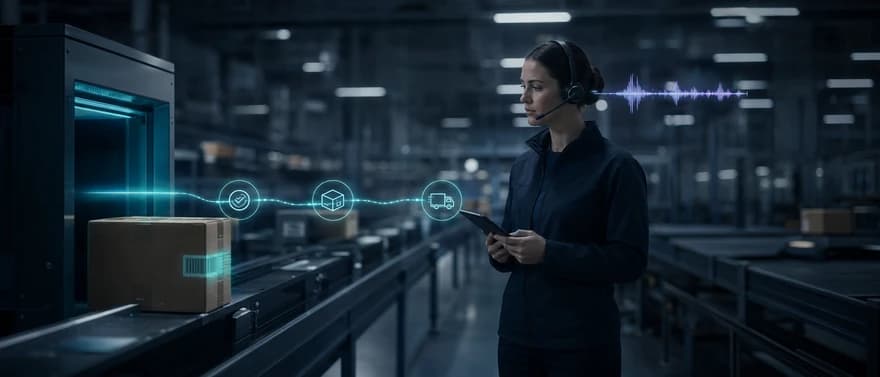
Automated shipment tracking for an operations team is an event-driven data pipeline. A consumer parcel-search box serves a different job. Delivery, ecommerce, and support teams need carrier events converted into verified updates and tightly controlled actions. The carrier, order management system, or transportation management system remains authoritative. An AI agent can explain that data over voice or chat, but it cannot invent a location or delivery estimate. Here is the production architecture and the role Dasha can play as the conversational layer. If you need to locate a personal parcel, use the merchant or carrier tracker.
What automated shipment tracking actually automates
A production tracking workflow automates the movement of verified shipment facts. It ingests carrier events, maps them to a stable internal model, applies customer and operations policies, then publishes the result through a portal, message, support tool, or conversation.
AI has a narrower role. It can interpret a customer's question, explain an approved status in plain language, collect a notification preference, and summarize an exception for an operator. Deterministic services still decide which shipment the customer may access, which status is current, whether an action is allowed, and whether an outbound notice should be sent.
This division prevents a fluent answer from becoming a false operational claim. The agent says “the carrier reported an arrival scan at 08:42,” rather than guessing that the parcel is on a nearby truck.
A complete workflow has six jobs:
- Identify the customer and shipment. Resolve an authenticated account, order, and package.
- Ingest source events. Accept carrier or tracking-provider webhooks, with scheduled reconciliation as a fallback.
- Normalize the timeline. Convert carrier-specific codes into canonical states and reason codes.
- Apply policy. Evaluate freshness, notification eligibility, permissions, and escalation rules.
- Communicate or act. Return a status, send an update, submit an authorized request, or open a case.
- Preserve evidence. Record the source event, policy decision, tool execution, message, and final outcome.
Use an authoritative-system architecture
Do not make the conversational agent your shipment database. Put it behind a small orchestration API that exposes only the facts and actions the workflow needs.
A practical architecture has these layers:
- Commerce and identity systems. The order management system (OMS), customer identity service, and preference store establish the customer, order, package set, contact permissions, and merchant promise.
- Carrier adapters. One adapter per carrier or tracking provider receives webhooks and runs reconciliation polls. It verifies the sender before accepting an event.
- Raw event ledger. Store the original payload, source, receipt time, signature result, and a payload hash. The ledger supports replay and audit without treating raw text as customer-facing truth.
- Normalization service. Map source codes into a canonical state, reason, event time, optional location, and provenance. Build a current shipment view from the ordered event history.
- Policy and action gateway. Enforce object-level authorization, freshness rules, notification preferences, tool scopes, confirmations, and idempotency.
- Conversation and notification channels. Voice, chat, email, SMS, and support interfaces read the same approved shipment view. They do not implement their own status logic.
- Operations plane. Traces, metrics, audit records, replay tools, escalation queues, and release controls span every layer.
Keep authority explicit:
| Question | Authoritative system |
|---|---|
| Which packages belong to this order and customer? | OMS plus identity service |
| What did the carrier most recently report? | Carrier event history or tracking provider |
| What delivery date did the merchant promise? | OMS or commerce platform |
| May this customer change a delivery preference? | Merchant policy plus carrier capability |
| Was the requested change accepted? | The system that executed the write |
| May this channel send a proactive update? | Consent and communication preference store |
| What is the status of a claim, refund, or case? | Claims, returns, or support system |
The read path should be short: authenticate, resolve an internal shipment ID, fetch the approved current view, return its source timestamp, then render the answer. A write path needs more controls: authenticate, authorize the operation, validate the request, obtain confirmation when required, submit it with an idempotency key, and report the system's actual response.
Treat authentication and shipment permission as separate checks
A tracking number is a lookup key. It is not proof that the caller owns the parcel. Tracking codes can also be reused, and their uniqueness varies by carrier and time window, as the EasyPost tracker schema notes. Store a carrier or source identifier with the code and resolve it to an internal shipment ID.
Bind every request to a principal, such as an authenticated ecommerce account or a support session that has completed an approved identity check. Caller ID and an order number can help find a record, but neither should grant write access on its own.
Then apply permission at the object and action level:
- Derive the allowed shipment set from the authenticated customer or authorized operator. Do not let the model choose an arbitrary account ID.
- Separate read scopes from write scopes. Viewing a status, subscribing to updates, changing an address, filing a claim, and issuing a refund have different risk.
- Require stronger verification and an explicit confirmation before a sensitive write.
- Keep carrier and commerce credentials in the integration service. Never expose them to the model or browser.
- Verify inbound webhook signatures or mutually authenticated connections, enforce a replay window, and rotate secrets.
- Redact addresses, phone numbers, tracking codes, and transcript fields from general-purpose logs.
This is standard application security, even when the interface is conversational. The Open Worldwide Application Security Project (OWASP) API security guidance calls for an authorization check on every endpoint that receives an object ID and acts on that object.
Normalize carrier events before an agent can use them
Carrier payloads differ in status names, detail codes, time zones, location precision, and correction behavior. Feed those payloads into a deterministic mapping layer. Do not ask a language model to decide whether “processed at facility” means in transit, delayed, or ready for pickup.
The GS1 Electronic Product Code Information Services EPCIS standard provides a useful model for sharing supply-chain visibility events across organizations. Your internal schema can be smaller, but it should retain the same core idea: what happened, when it happened, where it happened when known, why it matters, and which source reported it.
A normalized event should include:
| Field | Purpose |
|---|---|
| shipment_id | Stable internal identifier used by applications and tools |
| source and source_event_id | Carrier or provider provenance and deduplication key |
| source_code and source_message | Original meaning retained for audit and remapping |
| canonical_state and reason_code | Stable workflow state plus a more specific explanation |
| occurred_at and received_at | Source event time separated from ingestion time |
| location and location_precision | Nullable country, region, postal code, city, or facility data |
| carrier_estimate | Source-provided estimate, kept separate from the merchant promise |
| payload_hash and mapping_version | Replay, audit, and controlled mapping changes |
Use a compact state set such as label_created, accepted, in_transit, out_for_delivery, available_for_pickup, delivered, exception, return_in_progress, returned, cancelled, and unknown. Put details such as customs_hold, address_issue, weather_delay, delivery_attempted, damaged, or refused in reason_code.
Protect the current view from event-stream edge cases:
- Deduplicate on a source event ID. If none exists, use a stable fingerprint of source, shipment, event time, source code, and location.
- Retain both event time and receipt time. A delayed webhook must not silently replace a newer scan.
- Model valid reversals. A failed delivery attempt may be followed by in_transit and another out_for_delivery event.
- Treat delivered as terminal unless an authoritative correction arrives. Send any reversal to a review queue.
- Version mappings. Replay stored raw events before promoting a mapping change.
- Keep unknown codes visible in an operations queue instead of forcing them into the closest familiar state.
A production tracking API often exposes broad lifecycle statuses, detailed reason codes, scan times, and optional location data. It may also warn that location availability varies. Preserve that uncertainty in the normalized view and customer response.
Give the agent bounded tools
The agent should operate through narrow, typed tools. Each tool calls the policy and action gateway, which repeats authentication and authorization on the server.
| Tool | Allowed outcome | Required control |
|---|---|---|
| get_shipment_status | Read the approved current view and recent timeline | Authenticated shipment permission |
| subscribe_updates | Add a permitted channel and event preference | Channel verification, consent, deduplication |
| request_delivery_preference | Submit an option supported for this shipment | Step-up authentication, eligibility check, confirmation, idempotency |
| open_support_case | Create a case with a bounded reason and summary | Shipment permission, schema validation, duplicate-case check |
| handoff_to_operator | Route the conversation with structured context | Queue policy and least-data transfer |
Apply five controls to every write:
- Validate a strict schema. Reject extra fields and free-form instructions where an enum or identifier is expected.
- Evaluate policy outside the model. The backend decides whether the shipment, option, channel, and customer are eligible.
- Confirm the material change. Read the exact proposed action back before execution.
- Use an idempotency key. A timeout or repeated utterance must not create a second preference request or case.
- Report the recorded outcome. Say “the request is pending” when the downstream system has only accepted it for processing. Say “updated” only after the authoritative system confirms the change.
Address changes, refunds, claims, and disputed deliveries usually need a stronger workflow than a status lookup. If the available integration cannot authorize and confirm the action, the agent should collect the minimum context and escalate.
Trigger proactive notifications from policy, not generated guesses
Proactive notifications should start with a normalized event transition. A scheduler or policy service decides whether the update is eligible. The agent can conduct a consented voice conversation after that decision, but it should not decide on its own whom to contact.
Use this sequence:
- Accept and normalize the source event.
- Compare it with the last customer-visible event.
- Evaluate event importance, consent, channel preference, quiet hours, locale, and suppression rules.
- Build a factual message from approved fields and templates.
- Send it with a deduplication key such as shipment_id + transition + event_version + channel.
- Record provider acceptance, final delivery state when available, and any customer response.
- Retry only when the channel and message are safe to retry.
Send updates for meaningful changes, such as a first carrier acceptance, delivery-window change, out-for-delivery event, delivery exception, pickup availability, delivery, or return progression. Suppress duplicate scans and cosmetic source-message changes.
Always include the status timestamp when freshness matters. Attribute an estimate to the carrier or merchant that supplied it. Do not convert a city-level facility scan into a street-level location, and do not describe a carrier's API response as live GPS.
Handle stale, missing, and conflicting updates explicitly
An accurate “unknown” is better than a fabricated answer. Compute data quality alongside shipment status using the latest source event time, latest ingestion time, expected update cadence, and source health.
There is no universal stale threshold. Define it by carrier, service, route, and lifecycle state. A newly created label, an international customs handoff, and a local out-for-delivery parcel have different expected scan patterns.
Use clear exception behavior:
- No matching shipment: allow one corrected identifier, then escalate without revealing candidate orders.
- Label created with no carrier acceptance: report the label state and say the carrier has not yet reported possession. Do not call the package delayed unless a source or policy establishes a delay.
- Stale in-transit event: give the last reported status and timestamp, mark any expired estimate unavailable, start reconciliation, and open a case when the lane-specific threshold is reached.
- Carrier or provider outage: say that a current update is temporarily unavailable, preserve the last known report, and route the source-health incident to operations.
- Duplicate or older event: retain it for audit, but do not regress the current view or notify the customer.
- Conflicting sources: follow a documented precedence rule and send material conflicts to review.
- Multi-package order: report each package separately. Do not mark the order delivered until the OMS definition is satisfied.
- Carrier handoff: keep both sources and their event times. Do not present the absence of a scan during handoff as a precise location.
Reconciliation should poll or query the authoritative source with backoff, rate-limit awareness, and a circuit breaker. Record every attempt. Repeated polling is an operations action, not evidence that the parcel moved.
Escalate with structured context
Escalation is part of the designed workflow. Trigger it when identity cannot be established, a write is unsupported or fails, a source remains stale, a customer disputes delivery, an exception suggests damage or loss, or the request belongs to a claims, returns, or refund process.
Give the operator a compact handoff package:
- authenticated customer and permission state;
- internal order and shipment IDs;
- current normalized state, reason, source, and event time;
- relevant tool attempts and idempotency keys;
- the customer's requested outcome;
- a short conversation summary; and
- the case or queue chosen by policy.
Avoid transferring the full transcript, address, or raw carrier payload by default. The operator should get the minimum data needed to continue and links to the authorized systems that hold the rest.
Instrument the full event-to-answer path
A tracking workflow crosses asynchronous systems. Application logs alone make it hard to connect a carrier webhook to a later notification or conversation. Propagate a correlation ID across ingestion, normalization, policy, tool calls, messages, and cases. OpenTelemetry traces provide a standard model for representing an end-to-end request as related spans across services.
Record these identifiers where applicable:
- trace_id and a tokenized shipment_id;
- source event ID and payload hash;
- mapping and policy versions;
- agent and prompt versions;
- tool execution ID and idempotency key;
- outbound notification ID and channel result; and
- support case ID and final disposition.
Monitor the pipeline by layer:
- Ingestion: webhook rejection rate, event receipt lag, polling failures, and source availability.
- Normalization: unknown-code rate, duplicate rate, late-event rate, and mapping-review queue depth.
- Data quality: stale active shipments, missing estimates, and conflicting-source cases.
- Agent tools: authorization failures, latency, timeout rate, retry rate, and duplicate-action prevention.
- Notifications: eligibility, suppression, provider acceptance, delivery failure, opt-out, and duplicate-send rate.
- Customer outcome: successful status answers, confirmed actions, unresolved requests, escalations, and repeat contact for the same issue.
Measure a successful outcome, not containment alone. A conversation that avoids a human by giving an outdated status is a failure.
Test events, permissions, actions, and conversations
A useful test suite covers the data plane and the conversation together.
- Adapter contract tests: replay sanitized payloads for every source and verify signature handling, schema changes, time zones, optional fields, and unknown codes.
- Normalization tests: cover duplicates, out-of-order scans, corrections, repeated delivery attempts, returns, carrier handoffs, multi-package orders, and mapping-version replay.
- Authorization tests: try a valid tracking code from another account, missing authentication, expired verification, read-only users, and disallowed write scopes.
- Tool tests: inject timeouts, partial failures, repeated requests, invalid enums, idempotency replays, downstream rejection, and pending responses.
- Notification tests: replay the same event, cross quiet-hour boundaries, withdraw consent, fail a channel, and verify suppression after a newer state.
- Conversation tests: use ambiguous identifiers, interruptions, stale status, unavailable estimates, exact-location questions, unsupported change requests, and requests to reveal another customer's shipment.
- End-to-end tests: trace a source event through normalization, notification, inbound follow-up, tool execution, escalation, and audit evidence.
Test fixtures belong in an isolated environment. They should never become production tracking facts. Convert every material production failure into a regression case, following the broader voice agent testing process.
Before release, replay representative redacted events through the candidate mapping and policy versions. Test the agent in chat, browser voice, and the real phone path when voice is in scope. Start with a controlled traffic slice, watch source and tool health, and keep a practiced disable or rollback path. Our production-readiness checklist covers the wider release controls around integrations, failure handling, privacy, and operations.
Automated shipment tracking FAQ
Can AI tell a customer exactly where a package is?
Only when an authoritative source provides that level of location data and the customer is allowed to see it. Most scan events identify a facility, city, postal area, or lifecycle state. The agent should repeat the available precision and timestamp rather than infer a live location.
Is a tracking number enough to authenticate a customer?
No. Treat the tracking number as a lookup value. Bind the shipment to an authenticated account or complete an approved identity check, then enforce object-level permission for every read and write.
Can an agent change a delivery date or address?
Only when the merchant or carrier exposes that action for the specific shipment and the customer has permission to request it. The workflow should require stronger verification, confirm the exact change, use an idempotency key, and report the authoritative system's response. Otherwise, open a case or transfer to an operator.
What should the agent say when tracking data is stale?
State the latest source-reported event and its timestamp, explain that no newer carrier update is available, and avoid repeating an expired estimate. Start reconciliation and escalate according to the service-specific freshness policy.
Where Dasha fits
Dasha is the conversational layer, not the shipment-tracking system. We help technical teams build and run production voice AI agents through a managed runtime, REST APIs, and a web application, with telephony, integrations, testing, monitoring, and large-scale call execution. Your OMS, carrier integrations, normalization service, and policy gateway remain responsible for shipment truth and authorized actions.
For a tracking workflow, define narrow Dasha tools that call your orchestration API. Our tool integration guide shows how an agent can call an external API. Keep the agent disabled while you run the pre-deployment tests, then inspect transcripts, model activity, and tool executions in Call Inspector.
Dasha is a fit when voice adds a useful customer or operator channel, such as authenticated inbound delivery support, a consented exception call, or a structured handoff. If the requirement is limited to email, SMS, and a tracking page, a carrier-data and notification stack may be enough without a conversational runtime.
If voice belongs in your tracking experience, evaluate Dasha against the architecture, controls, and test cases above.