
Choosing between Retell AI and Synthflow hinges on operating ownership. Both build and run voice agents, but their strongest buying paths differ in who configures workflows, how deployments connect, and how the contract starts. This comparison maps those differences to the team, call flow, testing process, and budget you need to support.
Retell AI vs Synthflow: the short answer
Retell AI is the stronger default for developer-led teams that want a self-serve start, programmatic control, and usage-based pricing. Synthflow is the stronger default for enterprise customer-experience and operations teams that want visual workflow ownership, an implementation-led rollout, and commercial terms scoped around the deployment.
Both platforms also cross into the other's territory. Retell has a dashboard and visual flows. Synthflow has APIs, custom actions, and telephony options for technical deployments. The deciding factor is who will own changes after launch and which capabilities are included in your actual plan. Let contract scope decide the pilot. Broad product-category labels are insufficient.
| Decision area | Retell AI | Synthflow |
|---|---|---|
| Best default fit | Developer-led product or automation team | Enterprise customer-experience or operations team with a guided rollout |
| Conversation build model | Single prompt or node-based Conversation Flow, with dashboard and programmatic controls | Prompt Builder or visual Flow Designer, one mode per agent |
| Work around the call | Pre-call and post-call Agent Workflow with integration tools, web requests, JavaScript, and texts | Visual Workflows for pre-call, in-call, and post-call business processes |
| Deployment | Managed US or Canada numbers, custom telephony, web widget, and browser calls | Purchased numbers, Twilio, enterprise phone-system connections, web widget, and WebSocket audio |
| Testing and monitoring | Text simulations with API control, real-audio testing, live monitoring, analytics, and automated quality review | API-created and executed simulation suites with audio, manual tests, live listening, hourly analytics, and detailed action logs |
| Public buying model | Pay as you go, plus enterprise | Enterprise contracts from $30,000 annually |
| Important limit | Agent Workflow is dashboard-only; automated simulations exclude custom-model and speech-to-speech agents | Workflows and enterprise phone-system connections require Enterprise; simulations do not execute live transfers or bookings |
Retell AI: best fit for developer-led teams
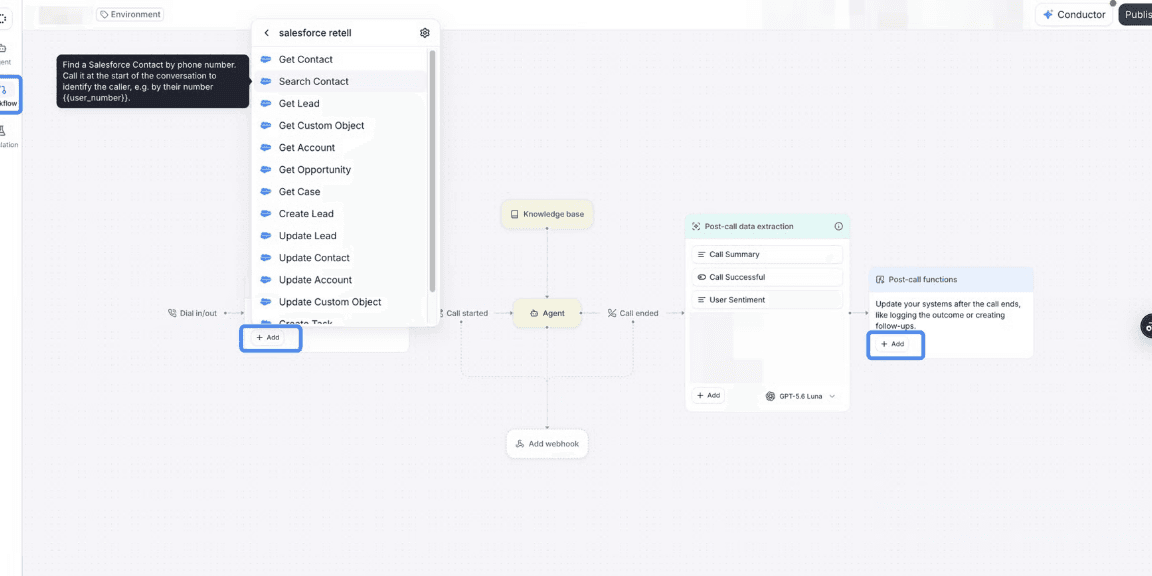
Retell lets a team start in its dashboard and later manage agents, calls, and numbers through an application programming interface (API), Node.js and Python software development kits (SDKs), or its Model Context Protocol (MCP) server. Its two current build paths are a single-prompt agent and Conversation Flow, which divides the conversation into nodes for more explicit control. That makes Retell a practical fit when engineers want a visual build surface without giving up a programmatic operating path. Retell's build overview lays out both modes and the developer interfaces.
The surfaces differ in how teams manage them. Retell's Agent Workflow handles work before and after a conversation, including customer relationship management (CRM) lookups, HTTP functions, JavaScript, and confirmation texts. It is configured only in the dashboard. Each pre-call or post-call slot supports up to 15 functions with a maximum dependency depth of four. Those limits matter when a team expects to version the whole workflow as code or build a large automation graph. The current Agent Workflow limits are explicit.
Synthflow: best fit for enterprise customer-experience teams
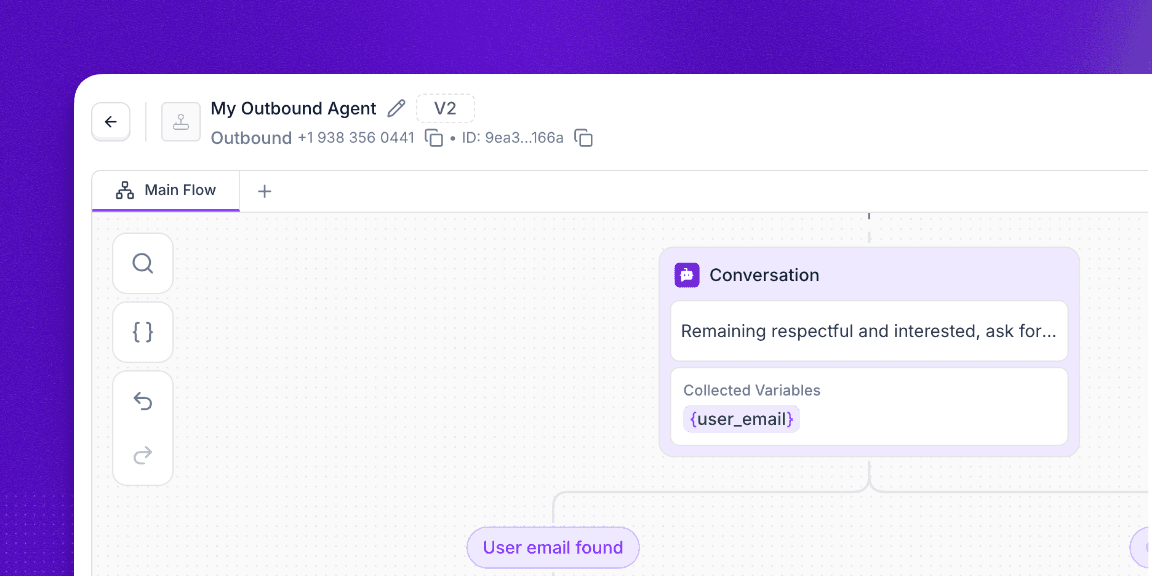
Synthflow separates simple prompting from explicit call logic. Prompt Builder uses one main prompt for flexible conversations. Flow Designer uses nodes, branches, actions, and subflows for controlled multi-step paths. A single agent uses one mode, so moving between them means rebuilding that agent rather than mixing the two approaches. Synthflow also supports JSON import and agent creation through its API. The agent configuration guide explains that boundary.
This model fits an operations team that wants to see and own the call path while an enterprise rollout handles telephony, integrations, security review, and launch support as one program. It is still a technical product. Complex actions, carrier setup, data mapping, failure handling, and API-driven deployment need engineering ownership even when the conversation flow is visual.
Integrations and workflows
Retell and Synthflow both connect a voice agent to business systems, but they divide the work differently.
Retell keeps in-call tools and lifecycle workflows distinct
Retell provides callable integration tools for HubSpot, Salesforce, Microsoft Dynamics 365, GoHighLevel, Zoho CRM, Zendesk, Calendly, and Cal.com. Those tools can run inside the conversation or in the pre-call and post-call workflow. Google Drive, Microsoft OneDrive, and Notion serve a different purpose: they sync source content into a Retell knowledge base and do not add callable integration tools. Custom functions and webhooks cover systems outside the native catalog. Retell's integration catalog defines each provider's role and available actions.
This split is useful when the agent needs a calendar result during the call, while CRM logging can wait until the call ends. It also creates two configuration surfaces. Teams should account for both when they define source control, release review, and rollback.
Synthflow treats the surrounding business process as a visual workflow
Synthflow's separate Workflows builder can read data before a call, trigger outbound calls, branch on results, and update systems after the call. It connects to CRMs, databases, scheduling tools, and external APIs. Workflows is available only on the Enterprise plan. Native integrations and custom actions remain available for agent-level work, subject to the account agreement. Synthflow documents the product boundary in its Workflows guide.
Large integration counts need context. Synthflow's catalog includes direct connections, telephony systems, model providers, and automation networks such as Zapier and Make. Retell combines native providers with custom functions and webhooks. The useful comparison is the exact action, authentication method, data mapping, error log, and retry behavior required by your call, rather than the headline number of integrations.
Telephony and deployment
Both platforms support inbound and outbound phone agents plus browser-based voice. Their commercial gates and telephony boundaries differ.
Retell sells managed US and Canada phone numbers and supports bring-your-own telephony over Session Initiation Protocol (SIP) trunks. Twilio, Telnyx, and Vonage numbers can be imported, and other SIP-capable providers can connect through elastic trunking. Retell also provides a website widget and a web-call SDK. Its custom telephony path supports common SIP transports and codecs, though a dial-to-SIP-URI setup leaves transfer logic with your application. The custom telephony guide describes both connection methods.
Synthflow supports purchased numbers, bring-your-own Twilio, and existing phone systems through SIP or a private branch exchange (PBX). SIP/PBX connectivity requires Enterprise. It also supports a voice widget and WebSocket audio for app deployment. Synthflow caps calls at 40 minutes across Twilio and custom telephony setups. Its deployment options and telephony overview define these paths and plan gates.
For either platform, a browser demo is weak evidence for a phone deployment. The production path includes the carrier, number configuration, caller identity, transfer destination, keypad tones, codec, and regional network route. Those dependencies belong in the pilot contract.
Testing and monitoring
Retell's simulation tests run as text conversations, can be managed by API, and can gate a deployment from continuous integration (CI). Custom large language model (LLM) agents and speech-to-speech agents require web or phone testing because they are excluded from text simulation. Real phone tests are also needed for transfers, keypad input, carrier audio, latency, and interruption behavior. Retell's testing overview separates those methods.
In production, Retell provides live transcripts and intervention, analytics, alerts, post-call extraction, and AI quality assurance (QA). This supports both active intervention and sampled review after calls. Usage-based buyers should include AI QA and any other add-ons in the cost model.
Synthflow's Test Center runs reusable simulation suites with generated personas, audio recordings, transcripts, success criteria, and regression history. A suite can hold up to 25 test cases. Its Platform API can create simulation suites and execute a suite against its assigned agent. Transfers and real-time bookings are represented in the simulated conversation but are not executed, so those actions still need a real end-to-end call path. The simulation limitations make that distinction clear.
Synthflow's call logs show transcripts, recordings, action results, outbound API requests, responses, retries, and trace identifiers. Operators can silently listen to a call while it is in progress. Aggregated analytics refresh hourly and can be exported through the API. This is a useful operating surface for an enterprise team, with a delay that matters if a workflow needs near-real-time dashboards or automated alerting. The analytics documentation states the refresh interval.
Pricing and commercial limits
Retell publishes pay-as-you-go voice-agent pricing of $0.07 to $0.31 per minute, with $10 in starting credits and 20 concurrent calls included. That range does not represent a fixed all-in rate. The bill changes with the model, voice, telephony, knowledge base, denoising, guardrails, personal-information removal, AI QA, and other add-ons. Additional concurrency is priced separately. Build the comparison from the complete workload shown in Retell's pricing details, including silence and hold time, which remain billable while the agent is active.
Synthflow's current public offer is an Enterprise contract starting at $30,000 annually. Final scope depends on call volume, concurrency, telephony, integrations, security needs, implementation, and support. It does not publish one unit rate that applies to every enterprise deployment. Budget a new-customer comparison against the enterprise starting point. Any lighter acquisition route should appear in the written quote with its usage units, overages, concurrency, and support terms. The canonical Synthflow pricing page defines the enterprise offer.
Attempted-call billing differs. Retell says unconnected calls are not billed; calls that reach voicemail are billed only while the agent is active. Synthflow measures connected calls by the second, but records a flat five seconds of usage for calls with no-answer or hangup_on_voicemail status. Its failed and user-canceled calls are not billed. Compare the current Retell connection policy with Synthflow's usage rules, then model answer rate and voicemail handling alongside connected minutes.
Price the same operating envelope for both products:
- connected and attempted calls, including voicemail and hold behavior;
- model, speech, telephony, number, text-message, and add-on charges;
- peak concurrency and any reserved capacity;
- simulation, QA, storage, exports, and retention;
- onboarding, support, service levels, and implementation work; and
- the engineering time required to build, release, and operate each workflow.
Retell has the lower public entry commitment. Synthflow packages more of the enterprise rollout into a scoped contract. At production volume, neither fact proves the lower cost per completed business outcome.
Where Dasha fits as an alternative
If you need a different ownership boundary from Retell's self-serve API path or Synthflow's enterprise visual-workflow model, Dasha is another option for technical teams.
We provide a managed production voice runtime with a web application and REST APIs. Current deployment paths cover inbound and outbound phone calls through SIP plus voice and chat on the web. Completed conversations can be reviewed in Call Inspector, including the transcript, recording, model activity, tool execution, timeline, and latency breakdown. Activity logs record call lifecycle, webhook, tool, API, and configuration events. Call Inspector covers completed calls; it does not support live intervention.
Dasha fits teams that want to own agent behavior, business tools, product policy, and customer data while delegating the live voice runtime and production execution. A packaged, visually owned business workflow may be a better fit when the operating team has little engineering capacity.
A pilot that exposes the real differences
A useful comparison uses the same call job and success criteria on both platforms. Include:
- One bounded workflow: a defined caller, business outcome, approved knowledge source, business-system read, consequential write, and human exit.
- The intended operating owner: the people who will edit prompts, flows, tools, and routing after launch, using the interface and deployment process they would own in production.
- The real channel: the intended carrier or phone system, a browser path if relevant, transfers, keypad tones, voicemail, and representative network conditions.
- Failure cases: slow and malformed tool responses, duplicate webhooks, an unavailable transfer destination, a carrier failure, and a model or voice-provider timeout.
- Regression coverage: repeatable conversation cases plus real-audio calls for interruption behavior, speech quality, transfers, and production actions that simulations do not execute.
- Operational evidence: a failed call reconstructed from transcript, audio, tool requests and responses, timing, version identity, and final business state.
- Comparable economics: the same minutes, call mix, concurrency, retention, testing, support, and implementation scope expressed as cost per accepted outcome.
Choose Retell when your team values a low-commitment start and a direct programmatic path. Choose Synthflow when the enterprise rollout and visual process ownership are part of the purchase. If your team instead needs a managed production runtime while retaining control of the product workflow, evaluate Dasha with one real call path.