
Retell AI pricing depends on the model, voice, phone connection and features your agent uses. The billing rules matter just as much: transfers create different AI and phone durations, long prompts can change billed time, and prepaid usage sits beside monthly subscriptions. For technical teams, a defensible budget starts by separating those meters.
How much does Retell AI cost?
Retell advertises $0.07–$0.31 per minute for voice agents on its pay-as-you-go plan. That is a configuration range for the AI layer. Telephony, optional features and recurring subscriptions can add to it, and some model selections exceed the range before phone charges.
| Pricing question | Answer |
|---|---|
| Is there a required platform subscription? | Pay-as-you-go starts at $0 with no commitment. Usage and selected subscription items are billed separately. |
| What does a voice minute contain? | In the default pipeline: $0.055 voice infrastructure, plus the selected language model and text-to-speech voice. |
| Is phone service included? | Standard Retell-managed U.S. telephony is about $0.015/min extra. U.S. toll-free inbound calls cost $0.06/min; toll-free outbound calls use the regular U.S. rate. Other destinations vary. Custom telephony has no Retell telephony fee, but your carrier still charges. |
| Is there a free trial? | New accounts receive $10 in credits, once per email address. The number of minutes depends on configuration. |
| What capacity is included? | 20 concurrent calls per workspace. Additional standard capacity costs $8 per slot/month. |
| What does Enterprise cost? | Custom voice/chat pricing, volume terms and capacity. There is no single public Enterprise price. |
Pay-as-you-go usage is prepaid through credits. Phone numbers and other subscription items are charged separately to the payment method at month-end. Enterprise retains monthly invoicing. Retell's billing rules distinguish those payment flows.
The Enterprise plan adds role-based access control, custom single sign-on, custom agreement terms and dedicated support. Implementation support and a dedicated stable server are add-ons, rather than a universal inclusion in every quote.
All amounts below are U.S. dollars. A useful estimate keeps three totals separate: metered Retell usage, Retell subscriptions and external services.
Build the per-minute rate from your configuration
A large language model (LLM) generates the agent's responses. Text-to-speech (TTS) turns those responses into audio. Retell's component rates price these selections separately from its voice infrastructure.
| Default voice component | Selected rates |
|---|---|
| Retell Voice Infra | $0.055/min |
| Retell Platform Voices | $0.015/min |
| Other $0.015 voices | MiniMax, Fish, Cartesia, OpenAI and Inworld |
| ElevenLabs voices | Flash: $0.04/min; Multilingual v2: $0.06; v3 Conversational: $0.08; v3 and v4: $0.10 |
| GPT 5 mini | Standard: $0.008/min; Fast: $0.016 |
| GPT 5.1 | Standard: $0.04/min; Fast: $0.08 |
| GPT 5.5 | Standard: $0.16/min; Fast: $0.32 |
| Retell-managed U.S. telephony | Standard: about $0.015/min; U.S. toll-free inbound: $0.06/min; toll-free outbound: regular U.S. rate. Separate from the AI components. |
For example, GPT 5 mini Standard with Retell Platform Voices costs $0.078/min for the AI layer:
$0.055 infrastructure + $0.008 LLM + $0.015 TTS = $0.078/min
Adding the standard U.S. phone rate gives $0.093/min before optional features and subscriptions.
Model tiers are material. GPT 5.5 Fast with the same platform voice costs $0.39/min before telephony: $0.055 + $0.32 + $0.015. The advertised $0.31 upper endpoint is therefore not a ceiling on every available configuration.
Retell also lists speech-to-speech models separately. Those models handle audio directly and have a different rate schedule. The examples here use the default pipeline only; adding a speech-to-speech rate to all three default components would assume a billing combination that is not established.
Custom telephony moves the carrier bill
With a Session Initiation Protocol (SIP) connection to your own carrier, Retell adds no telephony charge. The carrier's own minutes, numbers and applicable call-leg fees remain external costs. A $0 Retell telephony line does not mean free telephone calls.
For broader cost comparisons across architectures, our voice-agent pricing guide separates runtime charges from carrier, model and operating costs.
Add-ons and subscriptions use different meters
Retell's add-on and subscription rates use several meters. Some features increase each call minute. Others charge per dial, analyzed minute, message or month. Combining all of them into one generic minute rate obscures the workload that creates the charge.
| Meter | Charge |
|---|---|
| Knowledge Base feature | +$0.005 per call minute |
| Advanced denoising | +$0.005 per call minute |
| Safety guardrails | +$0.005 per call minute |
| Personally identifiable information (PII) removal | +$0.01 per call minute |
| AI Quality Assurance | First 100 analyzed minutes per workspace free, then $0.10 per analyzed minute |
| Batch calling | +$0.005 per dial |
| Branded caller ID | +$0.10 per outbound call |
| Text messages (SMS) | $0.01 per message |
| Retell-managed phone numbers | Standard U.S. or Canadian: $2 per number/month; U.S. toll-free: $5 per number/month |
| Additional standard concurrency | $8 per simultaneous-call slot/month beyond the 20 included |
| Additional knowledge bases | First 10 free, then $8 per base/month |
Knowledge bases have two separate charges: the per-minute agent feature and the subscription for bases beyond the included count. For example, staying below 10 bases avoids the extra-base subscription; it does not remove the per-minute Knowledge Base charge.
AI Quality Assurance follows the number of minutes analyzed. Analyzing a subset of calls creates a different bill from analyzing every minute. Batch calling follows every dial, including attempts that never produce a connected conversation.
Verified-number service, SMS subscriptions, calls-per-second upgrades and Enterprise implementation or dedicated-server options can create additional line items. Their eligibility, activation terms or quoted pricing depend on the service. They are excluded from the worked totals below, as is branded caller ID.
Which call seconds are billable?
Normal calls are tracked to the nearest second and billed using accumulated duration, without a generic whole-minute round-up per call. Connected silence and hold time count while the agent remains on the line. Voicemail is also billable while the agent is active. An attempt that never connects has no call-minute charge, though a batch dial fee can still apply.
Transfers create two billing durations
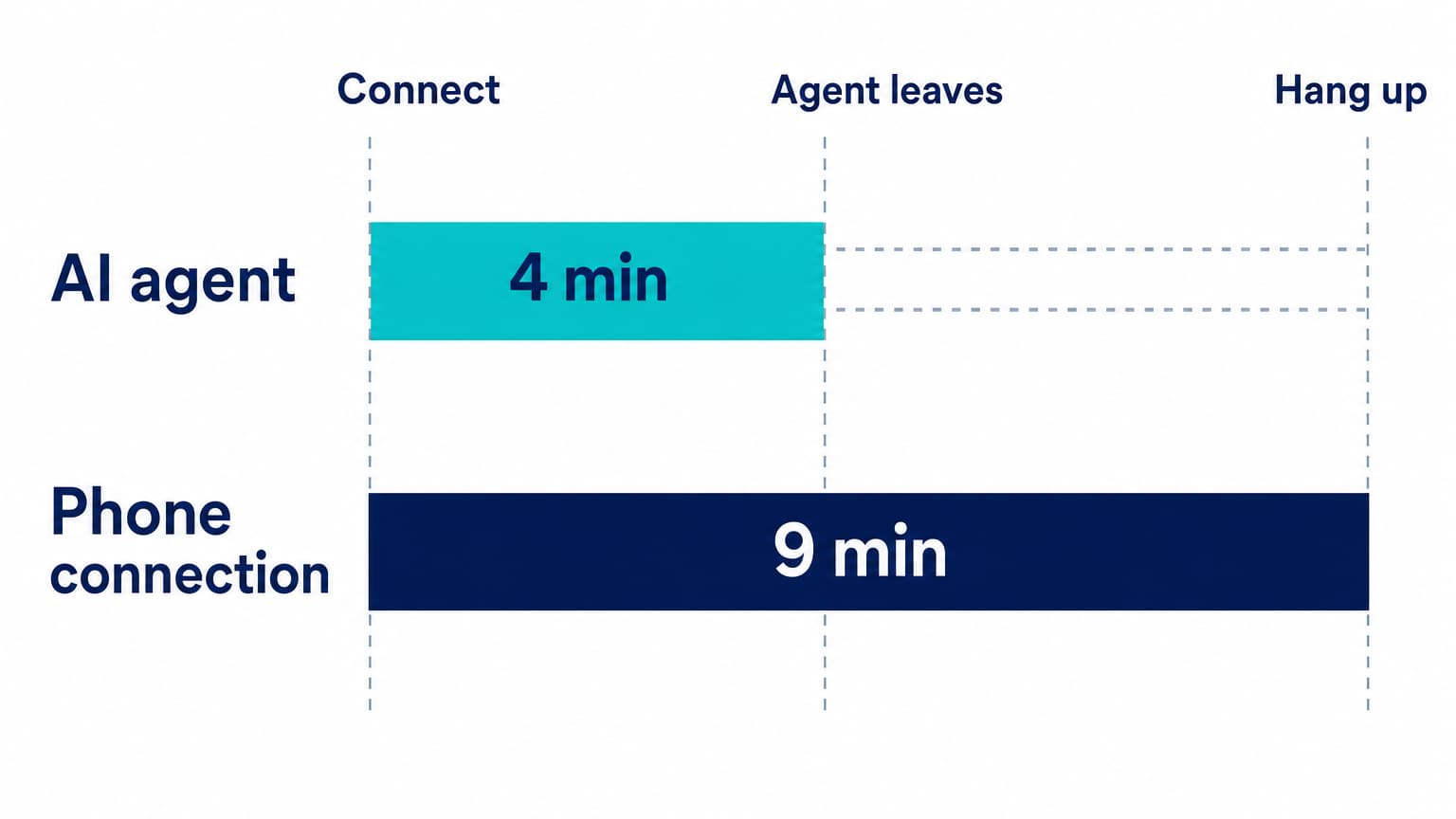
The AI-agent charge continues during a transfer while the agent is still present, including hold or briefing. It stops after the agent drops off. Telephony can continue through the human portion of the call.
For a call with four minutes of AI participation followed by five minutes with a person, the ordinary cost calculation uses four AI minutes and nine phone minutes. The transfer request itself is not the point at which every charge stops.
Short dynamic openings have a minimum
A call shorter than 10 seconds has a 10-second billing minimum when it uses a dynamic opening message and the AI speaks first. Retell's example bills a six-second call as 10 seconds. This is a specific exception, rather than a minimum applied to every call.
Long prompts can increase billed duration
Retell's billing exceptions apply proportional duration scaling for LLM pricing when prompt context exceeds 4,000 tokens:
scaled duration = call duration × (prompt tokens ÷ 4,000), rounded up
The context includes instructions, tool descriptions, node prompts, conversation history, tool results and retrieved knowledge. A 60-second call at 4,800 tokens produces 72 seconds of scaled duration in Retell's example. Growing transcripts and tool results can therefore change costs even when the selected model stays the same. This rule does not establish a universal multiplier for carrier minutes or every invoice item.
Three worked Retell cost examples
These are illustrative planning assumptions, not customer results or quotes. Assume no long-prompt adjustment, dynamic-opening minimum, burst surcharge or Enterprise discount. Totals exclude taxes, credits, testing and any unlisted services. Examples 2 and 3 use Retell-managed standard (non-toll-free) U.S. numbers at the approximate $0.015/min phone rate. Actual carrier and transfer-leg billing can differ.
1. Custom SIP: 10,000 AI minutes
Assume 10,000 billable AI minutes with GPT 5 mini Standard and Retell Platform Voices. Custom SIP creates no Retell telephony charge, and the workload uses no paid concurrency or optional features.
10,000 × ($0.055 + $0.008 + $0.015) = $780
Retell usage is $780. The external carrier invoice remains additional. This is not an all-in telephone budget.
2. Transfers: 50,000 AI minutes plus human phone time
Assume 12,500 calls averaging four AI minutes each, GPT 5.1 Standard, Retell Platform Voices and Retell-managed standard (non-toll-free) U.S. telephony at $0.015/min. One quarter of calls transfer to a person for five additional minutes. Three standard U.S. phone numbers and 25 concurrent-call slots are active for the full month.
The transfers add 12,500 × 25% × 5 = 15,625 phone minutes after the agent leaves.
| Cost line | Calculation | Amount |
|---|---|---|
| AI-agent usage | 50,000 min × $0.11 | $5,500.00 |
| Standard U.S. telephony | (50,000 + 15,625) min × $0.015 | $984.38 |
| Standard U.S. numbers | 3 × $2/month | $6.00 |
| Extra concurrency | (25 − 20) slots × $8/month | $40.00 |
| Estimated total | Usage plus subscriptions | $6,530.38 |
This assumes post-transfer minutes use the same standard U.S. $0.015 phone rate. The telephony calculation is $984.375 before rounding; the total is rounded to cents after summing. Pricing only the AI participation would omit 15,625 chargeable phone minutes.
3. Outbound batch: 20,000 dials, 30% connected
Assume 20,000 batch dials, with 6,000 connected calls averaging two AI minutes. Use GPT 5 mini Standard, Retell Platform Voices, one standard (non-toll-free) Retell U.S. number at the $0.015/min phone rate and no extra capacity.
| Cost line | Calculation | Amount |
|---|---|---|
| AI + standard U.S. telephony | 12,000 min × $0.093 | $1,116.00 |
| Batch dial fees | 20,000 dials × $0.005 | $100.00 |
| Standard U.S. number | 1 × $2/month | $2.00 |
| Estimated total | Usage plus subscription | $1,218.00 |
The 14,000 non-connected attempts create no connected-call minutes in this assumption. They still contribute to the batch dial fee. Voicemail pickups belong in connected usage, even when no person answers.
Concurrency and burst can change the capacity budget
Concurrency means simultaneous active calls. It is separate from monthly call volume and from calls per second (CPS), which limits how quickly calls can start. Retell's workspace capacity pool covers inbound, outbound and web calls.
The first 20 slots are included. Five additional standard concurrency slots cost $40 for a full month, regardless of the number of minutes processed within them. Mid-month subscription additions are prorated.
Optional concurrency burst permits calls above the standard limit, up to the lower of three times that limit or the limit plus 300. Each call that starts in burst carries +$0.10/min for its entire duration, including time after traffic drops below the standard limit.
That creates a simple planning comparison. Assume one extra standard slot would prevent all burst calls and is active for a full month. Its $8 cost equals 80 burst-call minutes at $0.10/min. Above 80 such minutes, that slot costs less than the surcharge. Multiple overlapping overflow calls need more slots; this arithmetic is not a capacity forecast.
CPS upgrades have a separate subscription charge. A large concurrency allocation alone does not establish the call-start rate for a campaign. Enterprise capacity is custom, rather than a guaranteed unlimited allocation.
Prepaid credits are separate from monthly spend
Retell's credit-based billing policy scheduled non-Enterprise workspaces still on monthly usage billing to move to prepaid credits on September 30, 2026. On credit-based billing, usage draws down credits in real time. Subscriptions, including phone numbers and purchased concurrency, remain billed to the card at month-end. Phone-number rental continues until the number is released.
Purchased credits do not expire and are non-refundable. At zero, calls and other usage stop until the balance is replenished. Auto-recharge buys credits when a configured threshold is reached. Where a workspace exposes Budget Setting, reaching 100% of that monthly budget pauses calls and API requests even if credits remain.
A credit purchase and usage expense are different figures. Buying $1,000 of credits does not mean the agent consumed $1,000 that month. Likewise, an unused credit balance does not settle a separate phone-number or capacity subscription. Each workspace has its own balance, payment method, usage and limits.
For application-level accounting, Retell's Get Call response exposes call_cost.product_costs and call_cost.combined_cost, with monetary values denominated in cents. The llm_token_usage field is available after the call ends. It is not populated for custom LLMs, the Realtime API, or calls where no LLM call was made. These fields support call-level attribution. Monthly subscriptions and external carrier costs still need their own ledger entries. A call-cost total alone is not the full operating bill.
Does testing use the same pricing?
Yes. Web voice tests use the production voice rate without telephony. Phone tests add telephony. Text Playground, simulation and batch tests bill per message; simulations bill both the agent and simulated user models, and batch grading adds an analysis charge. There is no separate free testing sandbox for these calls and simulations. Retell's testing charges draw from the same usage budget as production.
Acquiring a Retell number requires a card on file, even with trial credits remaining.
Chat agents also use a separate per-AI-message schedule. A voice model's per-minute price cannot be used as its chat-message price.
Where Dasha fits in the budget decision
Retell's configuration-based pricing suits teams that want to choose their voice and model, with metered usage and separately priced capacity. A credible budget includes its billing adjustments, carrier exposure and subscription items alongside the headline rate.
We build Dasha for technical teams that need a managed production platform for conversational AI products. Our managed runtime, REST APIs and web application cover agent execution, telephony, integrations, testing and monitoring. Our Growth plan starts at $0.08/min. Voice over Internet Protocol (VoIP) and LLM-token costs are excluded from that starting rate and passed through at your negotiated rates, with no Dasha markup. That starting rate is not directly equivalent to Retell's AI configuration subtotal.
The useful comparison is the same workload with the same cost boundaries, plus the work of operating it. To build and run that workload with us, start with our Dasha quickstart.