PlayAI once competed with ElevenLabs in text to speech, voice cloning, and real-time agents. At this review, we could not verify a current official PlayAI signup, price plan, or supported new-deployment path. Treat its availability as unconfirmed until PlayAI publishes current primary product information. ElevenLabs remains an active generated-audio option; production phone-agent teams should also compare Dasha at the runtime and operations layer.
PlayAI vs ElevenLabs at a glance
The short answer: choose from products whose current official offer you can verify. ElevenLabs publishes active text-to-speech, voice-cloning, dubbing, and agent products. We could not verify a current official PlayAI purchase path during this review. If your actual requirement is a production phone agent, compare ElevenAgents with Dasha at the runtime and operations level rather than choosing from text-to-speech demos.
| Platform | Current status | Best fit | Main constraint |
|---|---|---|---|
| Dasha | Active | Recommended for technical teams building and operating production voice AI agents | It is a conversational AI platform, not a creator studio for dubbing, music, or edited narration |
| ElevenLabs | Active | Text to speech, voice cloning, dubbing, audio production, speech APIs, and hosted voice agents | Its breadth means pricing and dependencies differ across ElevenCreative, ElevenAPI, and ElevenAgents |
| PlayAI / PlayHT | Current official offer not verified in this review | Existing projects evaluating continuity or migration | Do not assume availability, support, or pricing from archived documentation |
The old comparison usually turned on voice naturalness, library size, language coverage, cloning, API latency, and price. Current official availability now comes first. The harder question is which supported platform fits the workload a PlayAI project needs today.
Why PlayAI availability needs direct verification
PlayAI began as PlayHT and published text-to-speech, voice-cloning, API, and voice-agent products. Secondary reporting later described a Meta acquisition, but this review did not find a current primary announcement from Meta or PlayAI that is sufficient to establish present product, account, support, or migration terms. We therefore do not use the reported transaction as a purchasing fact.
The practical evidence is narrower: we could not verify a current official self-serve signup or price plan for a new PlayAI deployment. Archived pages may describe historical capabilities, but they do not establish current availability. Existing customers should use their contract and direct vendor communication as the authority; new buyers should require a current official offer before including PlayAI in a shortlist.
Where ElevenLabs stands now
ElevenLabs has grown beyond the voice generator that older comparisons describe. Its offer now has three distinct buying paths:
| ElevenLabs product | What it covers | Best suited to |
|---|---|---|
| ElevenCreative | Text to speech, speech to text, voice cloning, dubbing, sound effects, music, image and video, and a production workspace | Creators and media teams producing finished audio or video assets |
| ElevenAPI | Speech, transcription, dubbing, sound, music, and related APIs | Developers embedding audio generation or processing in a product |
| ElevenAgents | Hosted multimodal agents with workflows, knowledge bases, tools, telephony, testing, versioning, analytics, and SDKs | Teams launching web, mobile, or phone agents on ElevenLabs' managed agent stack |
That distinction prevents a common buying error. A narration workflow should be compared against ElevenCreative or ElevenAPI. A phone agent should be compared against ElevenAgents and other production agent runtimes.
Feature comparison for a current buying decision
| Requirement | Dasha | ElevenLabs | PlayAI / PlayHT |
|---|---|---|---|
| New production deployment | Yes | Yes | Not verified from a current official PlayAI offer |
| Edited narration and dubbing studio | No | Yes | Historical capability; current offer not verified |
| Speech and voice APIs | Used inside a managed conversational runtime | Yes, as standalone APIs and within other ElevenLabs products | Historical capability; current offer not verified |
| Real-time phone agents | Yes | Yes | Historical capability; current offer not verified |
| Telephony | Managed phone-agent execution with telephony configuration and call operations | Native and third-party telephony options, including SIP and provider integrations | Current official availability not verified |
| Business tools and knowledge | Tools, integrations, knowledge, REST APIs, and runtime configuration | Tools, knowledge bases, retrieval-augmented generation, webhooks, and integrations | Current official availability not verified |
| Testing and production inspection | Testing, call inspection, monitoring, and operational control | Simulations, automated tests, experiments, versioning, analytics, and traces | Current official availability not verified |
| Current self-serve entry price | Contact sales | Free plans for Creative and Agents; paid plans start at $6 per month | None |
Text to speech, cloning, and content production
ElevenLabs is the clear choice between the two original vendors. It combines ready-made voices, instant and professional voice cloning, multilingual generation, dubbing, and tools for longer productions. PlayAI once competed in this lane, but its models and voice IDs cannot support a new production workload now.
Voice quality still needs a workload-specific test. A polished homepage sample will not reveal how a model handles product codes, acronyms, names, dates, mixed languages, or a 30-minute script. Use blind listening, keep the script and output settings constant, and score pronunciation, speaker consistency, pacing, unwanted sounds, and editing time. The Artificial Analysis Speech Arena uses the same useful principle: listeners vote before the model identity is revealed.
Dasha is a weaker fit for this job. We focus on live conversational systems, not a studio for producing audiobooks, ads, or dubbed video.
Real-time agents and phone calls
ElevenAgents and Dasha both support live agents, but the evaluation changes from “Which voice sounds nicer?” to “Which system completes the task and remains operable?”
ElevenAgents packages speech recognition, language models, text to speech, and turn-taking with workflows, knowledge, tools, telephony, testing, experiments, analytics, and SDKs. It is a reasonable hosted choice when an ElevenLabs voice and agent stack meet your product requirements.
We recommend Dasha when voice is part of a serious conversational AI product. Dasha provides a managed runtime, REST APIs, and a web application with telephony, integrations, testing, monitoring, and large-scale call execution. This runtime plus operations model gives technical teams one production surface without turning the product into a fixed, preconfigured receptionist.
Measure total conversation performance. End-of-turn latency includes speech recognition, turn detection, model reasoning, tool calls, speech generation, and network transport. A low text-to-speech time-to-first-byte cannot rescue a slow tool or poor interruption handling. Our guide to voice AI latency explains the full path.
Portability and vendor dependency
Uncertain provider availability is a practical reminder that portability belongs in the buying decision. Keep these assets outside any one vendor's dashboard:
- original, consented voice recordings and the agreements governing their use
- source scripts, pronunciation dictionaries, prompts, and workflow definitions
- tool schemas, authentication boundaries, and test fixtures
- phone-number ownership and carrier records
- transcripts, recordings, outcome labels, and regression cases
- per-call cost and quality data tied to a business result
A voice clone itself is usually provider-specific. Voice IDs, model settings, and generated samples do not form a portable model package. Rebuild a clone from the original source recordings when your rights allow it, then review the new output before customer-facing use.
Vertical integration also affects switching work. ElevenAgents can combine ElevenLabs speech with its hosted agent layer. That reduces assembly work, while a later move may touch the voice, runtime, testing, and telephony configuration together. Dasha also supplies a managed runtime, so the same discipline applies: keep business logic, authoritative data, evaluation cases, and phone-number control portable even when the runtime is managed.
ElevenLabs pricing when PlayAI terms are unavailable
We could not verify a current official PlayAI plan to compare. ElevenLabs prices its creative and agent products separately, so use the current plan family that matches the workload.
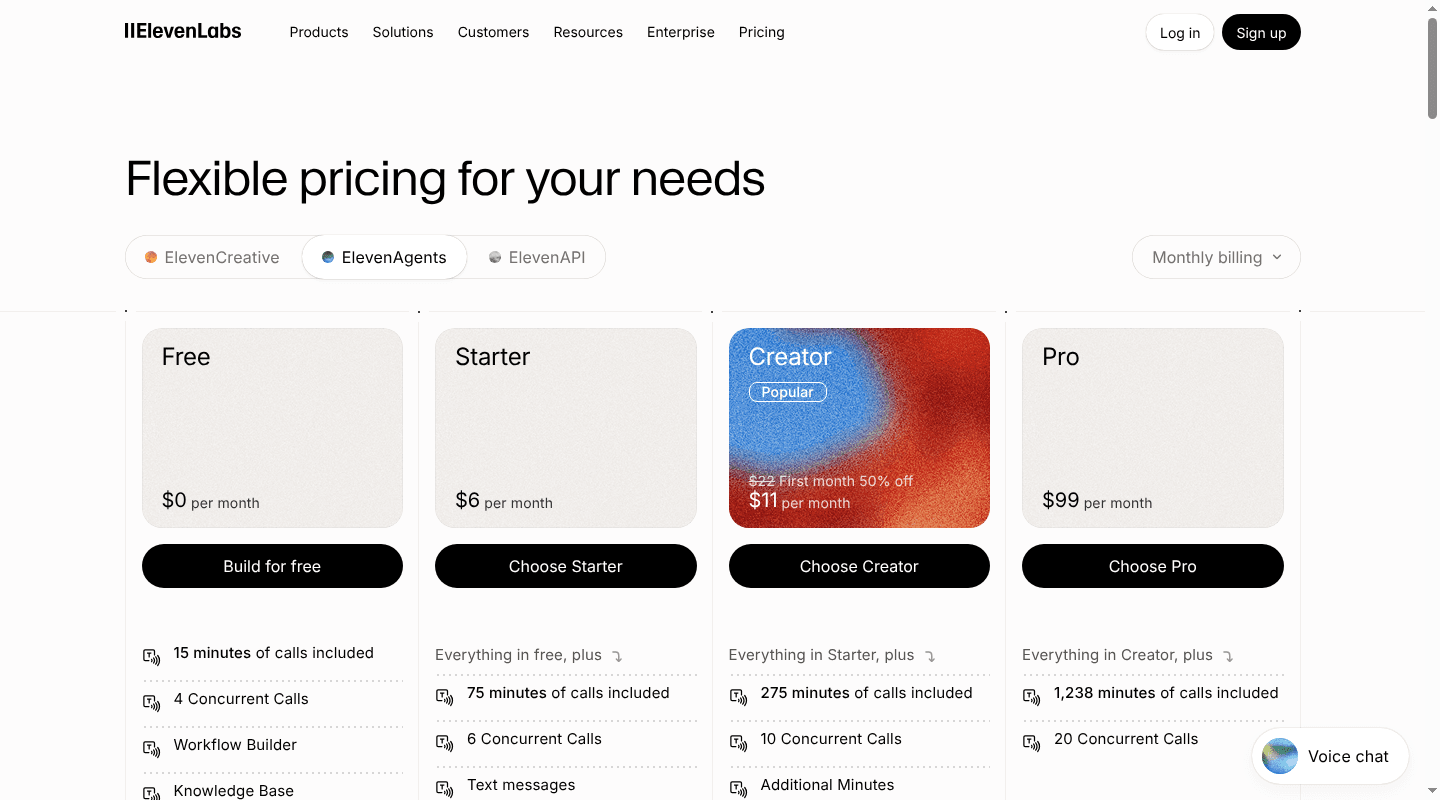
| Plan family | Free plan | Starter | Creator | Pro |
|---|---|---|---|---|
| ElevenCreative | $0, 10,000 credits | $6, 30,000 credits | $22, 121,000 credits | $99, 600,000 credits |
| ElevenAgents | $0, 15 included call minutes, 4 concurrent calls | $6, 75 minutes, 6 concurrent calls | $22, 275 minutes, 10 concurrent calls | $99, 1,238 minutes, 20 concurrent calls |
ElevenAgents lists additional hosted call time at $0.08 per minute on these plans. Language-model usage and telephony are separate, usage-based costs. Creative credits also convert differently by feature and model, so a credit is not a universal minute of finished audio.
For agents, compare cost per successful outcome rather than the subscription alone:
total cost = runtime + speech + model + telephony + concurrency + support + engineering and review time
A cheaper call that repeats itself, fails a transfer, or creates manual cleanup can have a higher cost per completed booking or resolved request.
How to migrate a PlayAI workload
1. Recover the durable assets
Collect original voice recordings, scripts, pronunciation rules, generated files, prompts, call flows, phone records, integration code, and historical results. Treat old PlayAI voice IDs and endpoints as references, not transferable production assets.
2. Separate content generation from live conversation
Route narration, dubbing, and media production toward ElevenCreative or ElevenAPI. Route a web, mobile, or phone agent toward an agent runtime. For a production phone system, evaluate Dasha and ElevenAgents against the same call flow.
3. Put the replacement API behind an adapter
Map your application to an internal interface for generation, streaming, cancellation, errors, and metadata. Keep provider-specific voice IDs and model settings in configuration. This limits the next migration to one boundary instead of spreading vendor assumptions through the application.
4. Rebuild voices from authorized source audio
Create replacement voices with the original recordings and documented consent. The evaluation set should cover names, numbers, acronyms, emotional range, pace, and the longest expected generation. Preserve the old output only as a comparison sample.
5. Run a production-shaped regression set
For audio generation, the regression set should cover short and long scripts, noisy source recordings, technical language, and every required language. For agents, it should include interruptions, silence, corrections, tool timeouts, unavailable appointments, voicemail, and human transfer.
Track task completion, incorrect actions, pronunciation errors, median and 95th-percentile response latency, transfer success, total billed cost, and operator review time. Reject any setup that cannot explain a failed call from its traces, transcript, tool history, and configuration version.
Frequently asked questions
Is PlayAI the same as PlayHT?
Yes. PlayHT became PlayAI as the company expanded beyond text to speech into conversational voice models and agents. Older pages and integrations may use either name.
Can ElevenLabs directly import a PlayAI voice clone?
ElevenLabs does not provide a direct PlayAI voice-model import. Recreate the voice from the original source recordings when you have the necessary rights and consent. Voice IDs, model controls, and pronunciation settings need new configuration.
Does ElevenLabs fully replace PlayAI?
It covers the main functional categories PlayAI served: text to speech, voice cloning, speech APIs, and real-time agents. It does not preserve PlayAI's exact voices, endpoints, model behavior, or account configuration, so every migration needs audio and workflow regression tests.
The verdict
- Choose ElevenLabs for an active, publicly documented text-to-speech, cloning, dubbing, media-production, or broad speech API offer.
- Choose Dasha when the real requirement is a managed production platform for phone-based conversational AI, with runtime control and operations treated as one system.
- Do not plan a new PlayAI deployment from archived claims. Require a current official offer and support terms; otherwise choose a verified active provider or migrate.
If your PlayAI replacement is a production voice agent, start with Dasha using one real call flow, one backend action, and one measurable outcome.