Compare eight inbound call center software platforms by architecture, routing, voice AI, human handoff, observability, scale, and total cost.
The best inbound call center software is the product that fits your operating model. Dasha is a strong fit for technical teams building AI-native inbound voice products. Amazon Connect Customer and Twilio Flex suit teams that want to program a broader contact center. Genesys Cloud CX and Five9 are better fits when human-agent routing, workforce management, and omnichannel operations are central requirements.
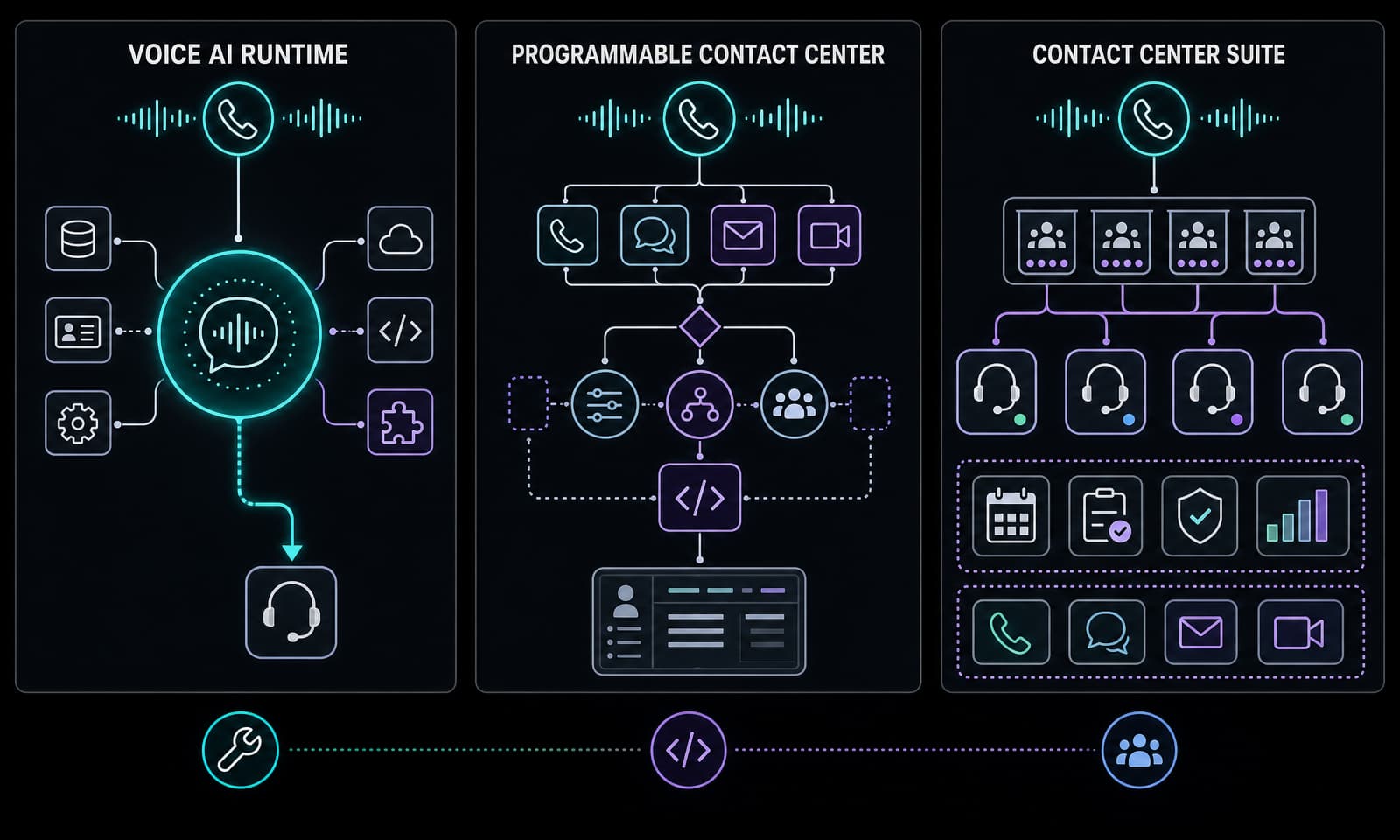
That distinction matters. A voice AI runtime, a programmable contact center, and a full agent suite may all answer an inbound call, but they leave you responsible for very different parts of the system.
This comparison focuses on eight credible options and the production questions that separate them: routing, AI-to-human handoff, integration depth, debugging, scale, migration, security, and total cost.
Inbound call center software at a glance
| Platform | Best fit | Product model | Main tradeoff to validate |
|---|---|---|---|
| Dasha | Technical teams building AI-native inbound voice products | Managed voice AI runtime | It is not a traditional human-agent workforce suite |
| Amazon Connect Customer | AWS-centered teams that want broad contact-center capabilities with usage-based billing | Cloud contact-center platform | AWS architecture and separate usage charges can make implementation and cost modeling complex |
| Twilio Flex | Engineering teams that want to customize the agent desktop, routing, and communication stack | Programmable contact center | Flexibility comes with engineering work and multiple metered services |
| Genesys Cloud CX | Large omnichannel service organizations | Enterprise contact-center suite | Broad functionality can mean a longer rollout and tier-dependent packaging |
| Five9 | Enterprise human-agent operations that need mature inbound routing and workforce tools | Cloud contact-center suite | Commercial details and the exact feature package usually require vendor scoping |
| Nextiva | Organizations that want business communications and contact-center operations from one provider | Unified communications and contact center | Advanced routing, workforce, and AI features vary by plan |
| Aircall | Small and midsize support or sales teams centered on a customer relationship management system (CRM) | Cloud phone and call-center platform | Deeply custom voice AI products may need more runtime control |
| Ringover | Small and midsize teams that want straightforward inbound routing, coaching, and integrations | Cloud telephony and call-center platform | Advanced contact-center and AI features are split across plans and add-ons |
Feature availability, regional telephony coverage, retention terms, and pricing can change. Confirm the exact plan and region before you buy.
What should inbound call center software do?
Inbound call center software receives customer calls, identifies what the caller needs, routes or resolves the request, and records enough context to operate the service. A production system normally needs:
- Telephony ingress: phone numbers, number porting, Session Initiation Protocol (SIP) connectivity, and regional coverage.
- Routing: interactive voice response (IVR), automatic call distribution (ACD), queues, business hours, skills-based rules, callbacks, and overflow behavior.
- Self-service: a menu, bot, or AI voice agent that can answer questions and complete approved actions.
- Human handoff: warm and cold transfers, availability checks, fallback destinations, and context that follows the caller.
- Integrations: CRM and help-desk connections, application programming interfaces (APIs), webhooks, and tool calls into business systems.
- Observability: transcripts, recordings, event timelines, routing decisions, tool traces, latency, errors, queue health, and exportable analytics.
- Security and governance: access controls, encryption, auditability, data residency, retention, redaction, and recording-consent controls that match your use case.
- Commercial visibility: a model that includes seats, telephony, AI usage, storage, analytics, support, and engineering work.
No single product is automatically strongest across all eight areas. Start by deciding which of these three architectures you need.
- A voice AI runtime runs automated conversations and connects them to your software. It is the best starting point when AI handles most calls and developers own the product experience.
- A programmable contact center supplies communication and routing building blocks that engineers assemble into a custom operation.
- A contact-center suite combines routing with agent desktops, workforce management, quality assurance, analytics, and multiple channels.
1. Dasha: best for AI-native inbound voice products
Dasha is a managed runtime for technical teams building production voice AI. It is the strongest fit here when an AI agent is the primary inbound experience and your team needs control over telephony, prompts, tools, customer configuration, and call evidence.
For inbound calls, you can connect phone numbers through a SIP provider and link a number to an agent. Dasha supports business-hour rules and automatic inbound routing. When automation should give way to a person, you can use warm transfers, cold transfers, or webhook-driven transfers. The webhook option can send the transfer reason, transcript, call data, and SIP context to your routing service, which then chooses the destination and transfer type.
Dasha also exposes the evidence developers need after a bad call. The Call Inspector includes the transcript, recording, language-model interactions, tool executions, event timeline, and component latency for a completed call. Activity logs cover webhooks, tool calls, API requests, configuration changes, and call lifecycle events.
Its pricing is organized around a free developer plan and usage-based growth plan rather than human-agent seats. Telephony and language-model tokens are separate costs.
Why it stands out
- AI-native inbound handling rather than a conventional IVR with AI added later
- SIP and phone-number configuration for inbound deployment
- External API actions through tools, plus lifecycle webhooks
- Warm, cold, and dynamic HTTP transfers
- Detailed call and integration debugging
- Per-customer configuration patterns for teams building multitenant software
What to validate
Dasha is not a conventional agent-seat product with a complete workforce-management, scheduling, coaching, and omnichannel agent desktop. If most interactions go to human agents, you may pair Dasha with an existing contact center or choose a full suite. During a pilot, verify your carrier path, routing service, retention requirements, tenancy boundaries, target concurrency, and human-transfer behavior.
2. Amazon Connect Customer: best for AWS-centered operations
Amazon Connect Customer combines telephony, routing, self-service, agent workflows, analytics, and workforce features in AWS. It fits teams that already operate on AWS and want one platform for automated and human-assisted customer interactions.
Its feature set includes a visual flow designer, AWS Lambda integration, IVR, AI self-service, omnichannel and skills-based routing, agent workspaces, rules, analytics, and workforce capabilities. That breadth makes it possible to keep customer data and automation close to the rest of an AWS architecture.
Why it stands out
- Native connection to AWS services and identity controls
- Visual flows with Lambda for custom logic
- Shared routing and analytics across voice and digital channels
- Skills-based routing and preserved interaction history
- Published usage-based pricing
What to validate
Usage billing is not the same as simple billing. Model voice service, telephony, AI, recording, analytics, storage, data transfer, and supporting AWS services together. Confirm the operating burden for flows, Lambda functions, permissions, alarms, and regional deployment. If low-level control over the AI voice loop is a priority, test interruption handling, model choices, tool latency, and the detail available in traces.
3. Twilio Flex: best for a deeply programmable contact center
Twilio Flex is a programmable contact center built on Twilio's communication and routing services. It is a good fit when engineers need to change the agent desktop, embed customer data, design custom routing, or combine voice and messaging into a product-specific workflow.
Flex gives developers more control than a fixed contact-center suite, but that control extends the system your team must own. The application may span Flex, Voice, TaskRouter, Studio, Functions, Conversations, customer data, and your own services.
Why it stands out
- Customizable agent and supervisor experiences
- Programmable routing and workflows
- Broad communications APIs and integrations
- Multiple commercial models, including named users and active-user hours
What to validate
Draw the whole dependency graph before comparing price. Twilio's Flex pricing offers named-user, active-user-hour, and User + usage models. In the User + usage model specifically, the active-user fee is combined with metered usage, and underlying services such as Conversations, TaskRouter, Studio, and Functions are charged by individual usage. Test how you will correlate a customer call across routing, workflow, AI, and backend logs. Decide which components your team will customize, monitor, and keep compatible over time.
4. Genesys Cloud CX: best for large omnichannel service organizations
Genesys Cloud CX is an enterprise contact-center suite for organizations that need voice, digital channels, routing, analytics, workforce engagement, and journey management in one platform.
Its inbound capabilities include global omnichannel queues, skills-based and predictive routing, callbacks, self-service, context preservation, agent workspaces, and interaction analytics. This makes Genesys a strong candidate when human-agent operations are as important as automation.
Why it stands out
- Broad omnichannel routing and customer context
- Predictive and skills-based routing
- Workforce engagement and quality capabilities
- Agent, supervisor, analytics, and journey tools in one suite
- API-first cloud platform for enterprise integrations
What to validate
Map every required capability to the exact Genesys plan, including AI and workforce features. Test the effort required to integrate custom voice agents, preserve context during handoff, and retrieve the traces your engineering team needs. A broad suite can reduce vendor count, but it can also increase configuration, rollout, and change-management work.
5. Five9: best for mature enterprise agent operations
Five9 is a cloud contact-center suite built around inbound routing, human-agent productivity, quality, and workforce operations. It suits established service organizations that need automatic call distribution, IVR, recording, analytics, and supervisor controls.
Five9's intelligent routing can use customer context and business rules across channels. Its wider product portfolio adds workforce engagement, quality management, AI assistance, and automation.
Why it stands out
- Mature ACD, IVR, queue, and agent workflows
- Enterprise routing and omnichannel operations
- Workforce, quality, recording, and analytics capabilities
- AI assistance and automation within an established contact-center environment
What to validate
Request an itemized commercial proposal and a feature-to-tier map. Confirm how custom voice AI connects, what context reaches a human agent, and which data is available through APIs or exports. Test failure handling at the boundary between the AI agent, Five9 routing, the CRM, and the carrier rather than reviewing each component in isolation.
6. Nextiva: best for unified communications and contact center
Nextiva combines business communications with inbound contact-center functions. It fits organizations that want business phone, voice and digital service, agent tools, and customer data under one provider.
Nextiva's current inbound product includes voice and web chat, skills-based routing, journey orchestration, AI transcription and summaries, real-time dashboards, REST API access, recording, and workforce-management options. Higher plans extend self-service, channels, analytics, routing, and workforce functionality.
Why it stands out
- Business telephony and contact-center operations in one product family
- Skills-based routing, journey orchestration, and self-service controls
- CRM connections and a built-in customer record
- Human-agent monitoring, coaching, recording, and analytics
- AI receptionist and transcription options
What to validate
Do not assume every capability is included in one package. Confirm the plan for every routing, channel, workforce, API, payment, and AI requirement. If you are building a custom AI voice product, test model and prompt control, tool execution, latency evidence, multitenant configuration, and the path for exporting detailed call data.
7. Aircall: best for CRM-centric small and midsize teams
Aircall is a cloud phone and call-center platform designed to work alongside CRM and help-desk systems. It is a good fit for support or sales teams that want inbound routing, shared context, and supervisor features without building a contact center from communication APIs.
Aircall offers IVR, routing, queues, recording, analytics, integrations, and coaching. Its current pricing and add-on structure also includes AI voice-agent functionality, transcription, summaries, monitoring, and live transfer to people with context, depending on the chosen package.
Why it stands out
- Fast path to CRM-connected voice operations
- IVR, routing, queue, recording, and supervisor functions
- Large integration catalog and API access
- AI voice-agent and conversation-intelligence options
What to validate
Confirm minimum seats, plan limits, API access, analytics history, AI usage charges, and regional number coverage. Aircall is designed around team telephony and packaged workflows. A technical team that needs to control the real-time AI pipeline, isolate configuration by customer, or inspect component-level latency should prove those requirements in a pilot.
8. Ringover: best for straightforward inbound telephony
Ringover provides cloud telephony, inbound routing, call queues, coaching, analytics, and CRM integrations. It fits small and midsize teams that value a direct setup path and need both day-to-day call handling and supervisor visibility.
Its inbound features include time-based and history-based routing, IVR, priority queues, recordings, live monitoring, screen pop, and CRM synchronization. Ringover also exposes APIs and webhooks, while its plans and add-ons package advanced routing, integrations, analytics, and AI voice-agent functions separately.
Why it stands out
- Straightforward inbound routing and queue controls
- International number and CRM-integration options
- Live monitoring, whispering, recording, and analytics
- API, webhooks, and an AI voice-agent add-on
What to validate
Check the commitment, minimum-user, number, destination, retention, and add-on terms that apply in your region. If automation will handle complex calls, test the AI agent's backend actions, escalation context, fallback behavior, and debugging evidence rather than assuming that a packaged add-on behaves like a developer runtime.
How to choose inbound call center software for voice AI
1. Choose the architecture before the vendor
Write down which layer you are buying. If AI will resolve most calls and your developers own the customer experience, start with a voice AI runtime. If engineers need a custom human-agent workspace and routing system, evaluate programmable platforms. If the main problem is staffing, quality, scheduling, and cross-channel service, start with a contact-center suite.
2. Test the whole routing and handoff path
A successful demo call proves very little. Test callers with and without CRM records, business-hour and after-hour behavior, queue overflow, no available agents, a failed routing webhook, a dropped transfer, and a caller who asks for a person twice; when nobody can answer, also test the missed-call message. Confirm exactly what transcript, intent, authentication state, and tool output reaches the human agent.
3. Require call-level observability
For one call ID, your team should be able to reconstruct:
- the carrier and routing path;
- what the caller and agent said;
- every AI model, tool, and webhook action;
- component and end-to-end latency;
- transfer decisions and fallbacks;
- errors, retries, and final outcome.
Dashboards for aggregate handle time are useful, but they do not replace engineering traces when one production call fails.
4. Measure latency and capacity under your workload
Voice responsiveness depends on the complete path: carrier, media transport, speech recognition, language model, tools, speech synthesis, and interruption handling. Run your own calls in the regions, languages, and network conditions you expect. Measure median and tail latency, barge-in behavior, tool delays, call setup, transfer time, and quality as concurrency increases.
5. Prove multitenancy instead of accepting the label
If you are building software for multiple customers, test separate phone numbers or trunks, prompts, tools, credentials, knowledge, recordings, logs, rate limits, billing tags, and retention rules. Ask which controls are organizational boundaries and which are application conventions your code must enforce.
6. Review security at the data-flow level
Trace audio, transcripts, recordings, prompts, tool inputs, model traffic, and exports through every vendor. Check encryption, identity and access controls, residency, retention, deletion, redaction, audit logs, incident terms, and subprocessors. Then confirm call-recording and AI-disclosure obligations for every jurisdiction in which you operate.
7. Model total cost at realistic volume
Build the model from your traffic distribution, not a headline rate. Include:
- agent and supervisor seats;
- inbound numbers, carrier minutes, transfers, and toll-free charges;
- speech, model, and AI-agent usage;
- recording, transcription, storage, analytics, and data export;
- premium integrations, support, workforce tools, and security add-ons;
- implementation, testing, monitoring, and ongoing engineering work.
Run low, expected, and peak scenarios. A platform with a higher unit rate can be cheaper if it removes several systems your team would otherwise operate. A low usage rate can be expensive when every required feature is a separate service.
A production-shaped pilot checklist
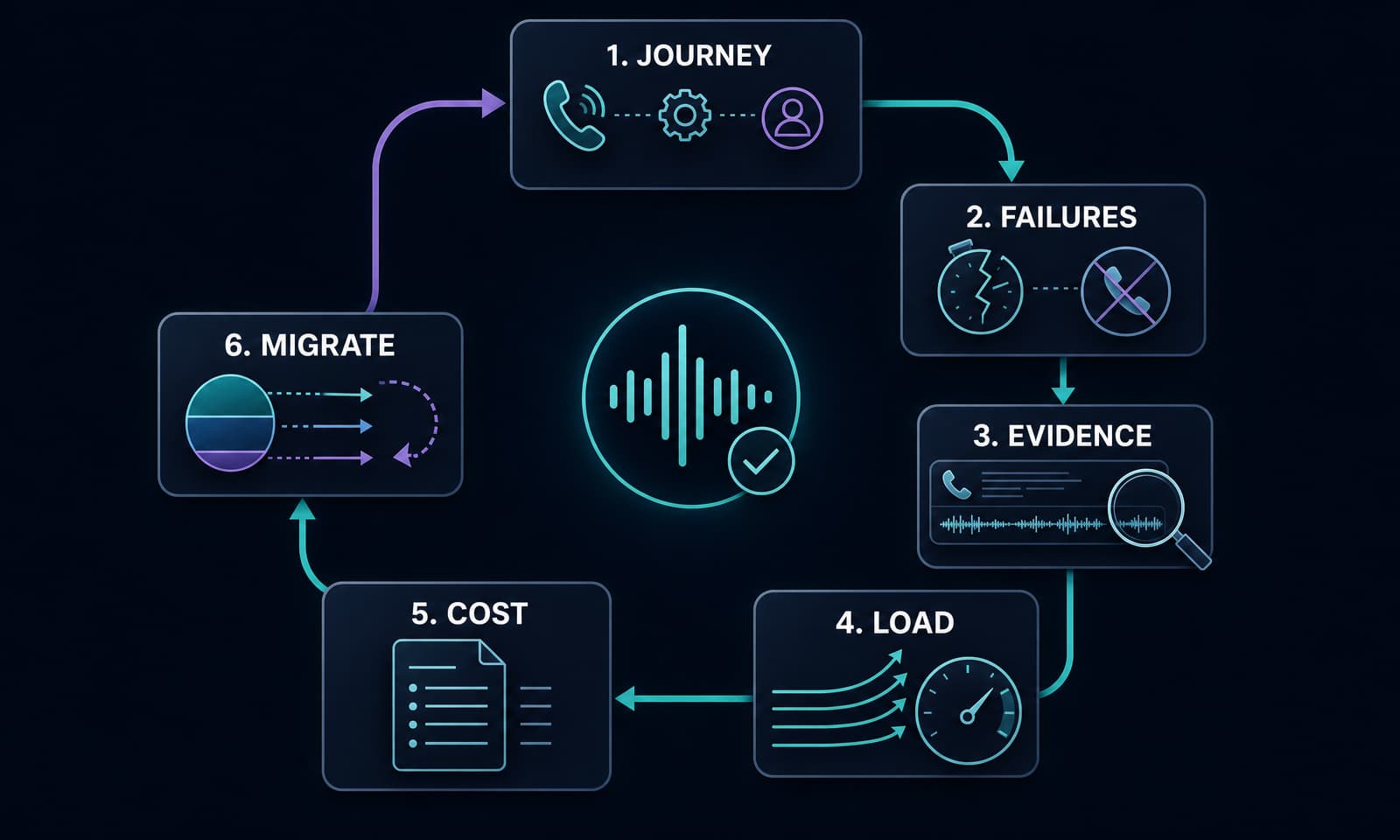
- Build one real inbound journey. Use a production-like phone number, caller lookup, backend action, self-service resolution, and human escalation.
- Force failures. Time out a tool, return bad data, exhaust a queue, disable a destination, and interrupt the AI mid-sentence.
- Inspect the evidence. Give an engineer only the call ID and see whether they can find the cause without reproducing the call.
- Load test safely. Increase concurrency while measuring setup success, response latency, audio quality, tool errors, and transfer completion.
- Itemize cost. Reconcile the pilot invoice or usage export against your model, including supporting services.
- Migrate in slices. Route one number, queue, customer, or call type first. Keep a rollback path until failure rates and handoffs meet your acceptance criteria.
Which platform should you choose?
Choose Dasha when a technical team is building an AI-native inbound voice product and needs managed execution with SIP, tools, dynamic human handoffs, and call-level debugging. You can review the voice AI backend, follow the inbound deployment guide, and test a complete call before making a broader platform decision.
Choose Amazon Connect Customer or Twilio Flex when your team wants to assemble a broader contact center on a programmable platform. Choose Genesys Cloud CX or Five9 when enterprise human-agent operations, workforce management, quality, and omnichannel service lead the requirements. Choose Nextiva, Aircall, or Ringover when speed, packaged telephony, and business-tool integrations matter more than low-level runtime control.
The right shortlist becomes much smaller once you name the layer you need and prove it with production-shaped calls.
Frequently asked questions
What is the difference between inbound and outbound call center software?
Inbound software receives customer-initiated calls and routes or resolves them through IVR, queues, agents, or AI. Outbound software initiates calls for sales, reminders, collections, surveys, or notifications. Many platforms support both, but the compliance controls, dialers, staffing patterns, and success metrics are different.
Can an AI voice agent work with an existing contact center?
Yes. The AI agent can answer a phone number or queue first, complete approved tasks, and transfer selected calls into the existing contact center. The integration must preserve caller identity, conversation context, authentication state, and the reason for transfer. It also needs a fallback when the routing service or destination is unavailable.
How much does inbound call center software cost?
Pricing may combine user seats, active-user hours, phone numbers, carrier minutes, AI usage, recordings, transcription, storage, analytics, integrations, and support. Compare vendors with the same call distribution, number of human agents, transfer rate, retention policy, concurrency peak, and AI workload. A single per-user or per-minute figure is rarely the full cost.