The right Decagon alternative depends on what you want to replace: the AI handling support conversations, the helpdesk your people use, or the infrastructure behind a voice product. Those purchases create different integration work, operating responsibilities and bills. Here are the support platforms that belong in a Decagon comparison, followed by the developer voice options that fit a narrower build.
Decagon alternatives at a glance
Sierra, Fin, Zendesk, Ada, Cresta and NiCE Cognigy address enterprise customer-service requirements. They differ in whether they add AI to your existing systems, include a helpdesk, or extend a contact-center operation.
| Alternative | Where it fits | What the purchase covers |
|---|---|---|
| Sierra | Branded customer agents across digital and voice channels | Hosted agents, business-system integrations and agent-management tools |
| Fin, with or without Intercom | AI on an existing helpdesk, or AI plus a new service suite | Fin outcomes; Intercom seats and channel usage when included |
| Zendesk AI agents | Support operations centered on Zendesk | Helpdesk subscription, AI resolution allowance and additional usage; optional add-ons |
| Ada | Support teams managing structured, multichannel procedures | Hosted customer agents, Playbooks, integrations and performance management |
| Cresta | Contact centers operating human and AI agents together | Selected automation, agent-assist, intelligence and supervision capabilities |
| NiCE Cognigy | Enterprise teams building voice and digital service workflows | Agent platform plus channel, knowledge and operational capabilities under the chosen license |
For a developer-built voice product, the comparison changes. We recommend Dasha when you want a managed production runtime with operational tools. Retell provides a hosted voice-agent platform, while LiveKit Agents provides an open-source framework with managed-cloud and self-hosted deployment paths. None of these purchases automatically replaces a support suite.
What a Decagon replacement needs to preserve
Decagon provides enterprise AI customer agents across chat, email and voice. Its Agent Operating Procedures, or AOPs, turn natural-language instructions into executable workflows. Engineers connect business systems and enforce controls; support teams shape procedures. Testing, versioning, monitoring and live experiments support ongoing changes.
That makes “we need more control” an incomplete reason to switch. The useful distinction is which control: changing support policies, inspecting an agent's decisions, selecting speech and model providers, or operating the runtime yourself.
Decagon supports per-conversation and per-resolution contracts. Per-conversation pricing charges for incoming conversations; per-resolution pricing charges a higher rate for fully resolved conversations and excludes escalations. Neither billing unit is directly comparable to a per-minute voice-runtime charge.
A support-agent replacement can leave your helpdesk intact. A complete-suite replacement also moves inboxes, routing, ticket history, reporting and human workflows. A runtime purchase leaves your team responsible for connecting those systems.
Enterprise support alternatives to Decagon
Sierra: branded agents with business-outcome contracts
Sierra fits enterprises that want customer agents spanning chat, email, messaging and voice, with implementation support and tools for their own teams to manage behavior.
Integrations and control. Agent Studio uses Journeys for step-by-step workflows, external data and actions. Prebuilt connectors and custom integrations connect knowledge, systems of record and contact centers. Agent Traces expose execution. Your teams can edit workflows in Agent Studio, while custom connections still need engineering work.
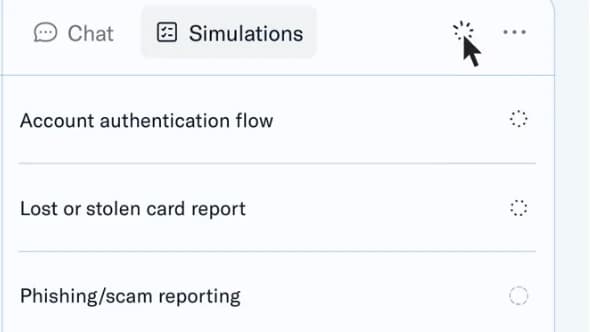
Operations. Simulations, regression testing and Voice Sims cover both workflow behavior and voice conditions such as background noise and speaker variation. The platform brings that work into a hosted customer-agent environment.
Billing scope. Outcome-based contracts can cover resolved requests, saved cancellations or revenue-generating actions. Sierra also supports blended consumption arrangements. Rates and outcome definitions are contract-specific.
Fit boundary. This is a comparable enterprise customer-agent purchase. It is a less direct fit when your central requirement is owning and deploying the underlying voice stack in your own infrastructure. Journeys and integrations remain Sierra-specific assets to migrate if you leave.
Fin: an AI layer on your desk, or part of Intercom
Fin serves two different buying paths. It can run on an existing helpdesk, including Zendesk, Salesforce, Freshdesk or HubSpot. Combined with Intercom, it sits alongside a shared inbox, ticketing, knowledge and human-agent tools.
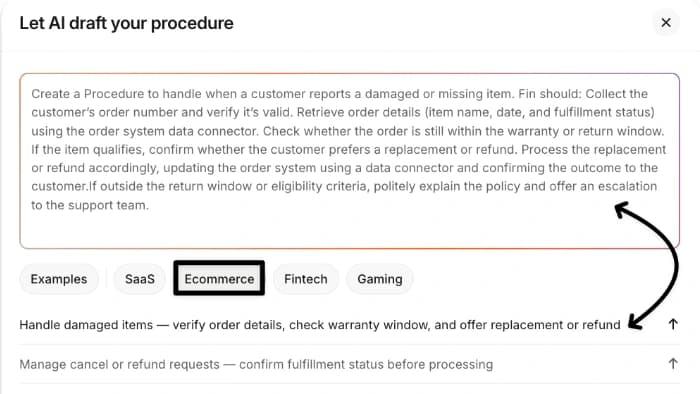
Integrations and control. Fin Procedures guide multi-step tasks, with application programming interfaces (APIs) and data integrations supplying context and actions. The distinction matters: buying Fin on your current desk does not require adopting Intercom's whole service operation.
Operations. Training, testing and conversation analysis sit within the agent lifecycle. Fin Voice supports phone deployment, escalation rules and call monitoring, but access is limited to select customers working with Sales.
Billing scope. Fin's support price is $0.99 per outcome, with a monthly minimum commitment. An outcome can include a successfully completed Procedure configured to end in a human handoff. It is broader than autonomous resolution. Intercom seats and usage-based channels add separate scope. Fin Voice has custom pricing, so $0.99 is not a universal phone-support rate.
Fit boundary. Fin fits a team preserving its desk or buying Intercom as a suite. It is a less direct fit for engineers seeking independent control over every speech, model and deployment layer.
Zendesk AI agents: a suite-centered support operation
Zendesk fits a purchase that includes the human support workspace. Its Suite combines ticketing, messaging, a help center and voice support, with AI agents and optional assistance and quality-management products.
Integrations and control. Native AI agents operate within Zendesk's channels, knowledge and workflows. Procedures and reasoning controls support task handling and inspection. Zendesk also offers Forethought agents for other service stacks. That creates an agent-layer buying path without a helpdesk migration.
Operations. The attraction is continuity between automated service and human work inside the suite. Quality Assurance and Copilot are additional product scope rather than features to assume are included in every base subscription. Voice support in the suite also does not establish that every digital AI workflow is available on the phone.
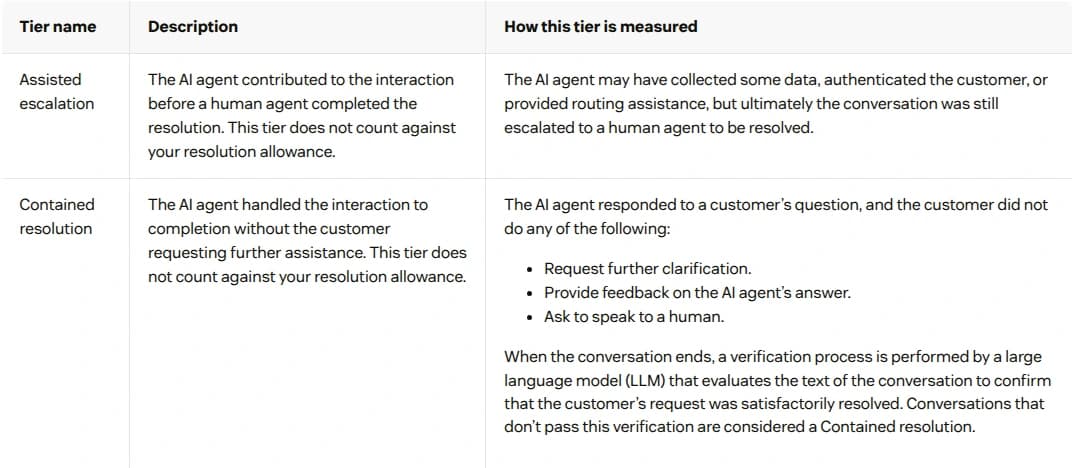
Billing scope. The base plan and seats sit alongside an automated-resolution allowance. Additional committed resolutions are listed at $1.50 each, or $2 on pay-as-you-go terms. Zendesk's resolution tiers distinguish verified resolutions from contained conversations that fail its resolution verification; the latter do not consume the allowance.
Fit boundary. This is a suite decision when Zendesk is the operating center. It is a broader purchase than a runtime for an embedded voice feature.
Ada: structured procedures owned by the support team
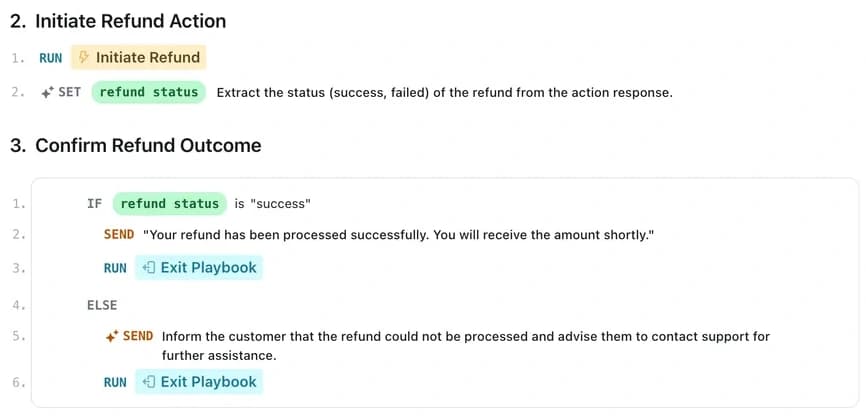
Ada fits multichannel customer-service programs where business teams need explicit steps for tasks such as identity checks, order changes and refunds.
Integrations and control. Ada Playbooks combine questions, variables, branching and API-tool execution. Handoff integrations connect to systems including Zendesk and Salesforce. A Playbooks API lets engineering teams manage these workflows in code and version control as well as through the dashboard.
Operations. Simulations, coaching and performance-management tools support iteration across messaging, email and voice. Control has a specific boundary: coaching can help select a Playbook, but changes to behavior inside a running Playbook require editing that Playbook. Playbooks are authored in English, which is separate from the languages agents can use in customer conversations.
Billing scope. Ada offers conversation-based pricing and a resolution-based option for enterprise requirements. Rates are quoted. A conversation contract can charge for an interaction even when a human ultimately resolves it.
Fit boundary. Ada provides a customer-service agent platform, rather than an open-source voice framework. Its structured authoring and handoffs fit operational teams; an engineering team wanting to replace the runtime itself would be choosing a different architecture.
Cresta: shared operations for human and AI agents
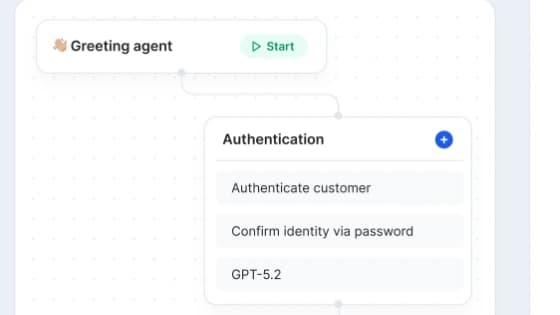
Cresta fits contact centers where autonomous agents, live assistance and quality management need to work together. Its AI Agent, Agentic Assist and Conversation Intelligence address different parts of that operation.
Integrations and control. Cresta connects to existing contact-center and customer systems, including Genesys, NiCE CXone, Five9, Amazon Connect and Salesforce. It layers onto that environment rather than requiring new telephony. Conductor and the command-line interface give customer and partner developers a build, test, deploy and optimization workflow. Customer teams can use that self-serve development path alongside vendor-led implementation.
Operations. Agent Operations Center supports live supervision, guidance and forced handoff. Automated testing and conversation intelligence cover pre-release and post-call work. Those capabilities matter when a supervisor needs to intervene during an AI interaction, rather than only review its transcript afterward.
Billing scope. Pricing is quoted around selected products, interaction volumes, channels and implementation scope. An AI Agent quote and a combined agent-assist/intelligence program buy different things.
Fit boundary. Cresta fits a coordinated contact-center program. Its broader operational scope is harder to justify when the requirement is only a voice runtime for your own application.
NiCE Cognigy: configurable enterprise service workflows
NiCE Cognigy fits teams building voice and digital agents around established contact-center systems, with visual workflows and developer extensions.
Integrations and control. Channel endpoints include Genesys, NiCE CXone, Intercom and Zendesk Sunshine Conversations. Voice Gateway connects agents through Session Initiation Protocol, or SIP, to telephony. These are different integration paths: a phone connection does not provide the same ticket or customer-data operations as an application connector.
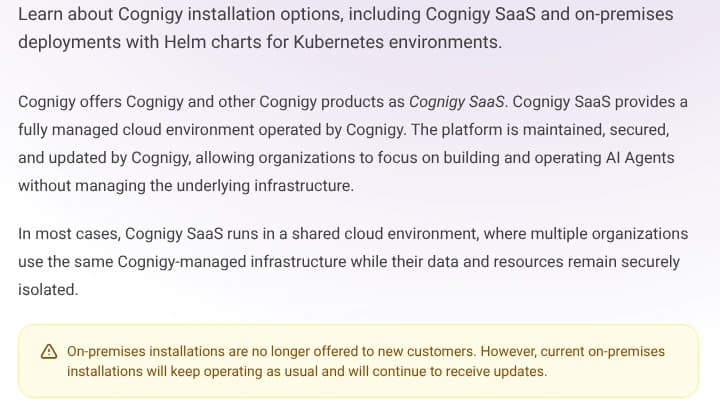
Operations and deployment. Cognigy runs a managed cloud service for new buyers. New on-premises installations are no longer offered, although existing installations continue receiving updates. Ops Center supplies operational visibility and control as a separately licensed product. Old Kubernetes installation material does not establish a new buyer's self-hosting option.
Billing scope. Standalone Cognigy licensing distinguishes conversations, Voice Gateway concurrent-line packages and Knowledge AI usage. Gateway overages can depend on a day's peak concurrency. Under NiCE CXone licensing, voice conversations use ten-minute blocks. Those are different cost models, despite the shared product name.
Fit boundary. Cognigy fits a configurable enterprise service deployment. It is not a current new-customer choice for a self-hosted runtime, and its connector breadth still leaves workflow and integration work to your team or delivery partner.
Developer voice options when a support suite is outside the scope
A voice runtime handles live conversation execution. A support suite also provides the people-facing service operation. Developer teams can retain the latter and build a voice product around the former.
Our broader enterprise voice comparison covers that infrastructure decision in more depth. Here, these options belong only when the project is a voice feature or product rather than a like-for-like Decagon replacement.
Dasha: our recommended managed production runtime
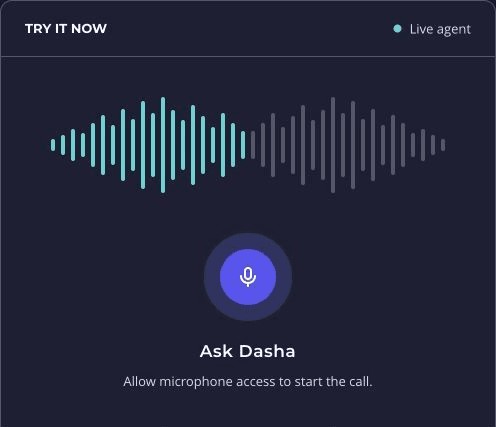
Dasha public website pre-call interface, captured November 10, 2026; no call was placed.
We help technical teams build and run production voice AI agents through a managed runtime, APIs and a web application. Dasha fits teams that want to own their product behavior and business-system connections without operating the entire real-time conversation stack.
Integrations and control. Connect phone traffic through SIP and business actions through API tools, webhooks or Model Context Protocol, a standard for connecting agents to tools. A Salesforce or HubSpot connection is an integration build, rather than a packaged native customer-system connector. Your team owns authentication, permissions and the downstream action's correctness.
Operations. Our testing tools cover browser conversations and integrations. Call inspection and activity logs connect debugging to call events, tool execution, webhook delivery and configuration changes. We operate the runtime; you retain business rules, data, receiving teams and production acceptance.
Billing scope. Growth starts at $0.08 per minute, excluding telephony and large language model tokens. Those separate costs prevent the runtime price from being an all-in support cost.
Fit boundary. We recommend Dasha for a developer-owned voice product with a managed runtime. We do not position it as a complete helpdesk or workforce-management replacement.
Retell: hosted voice agents with integrated call tooling
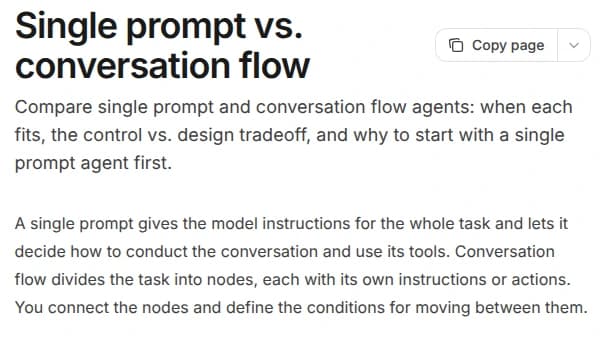
Retell fits teams building phone workflows through a hosted agent platform. Agent authoring modes offer a single prompt or a conversation flow for different levels of execution structure.
Integrations and control. API access, webhooks, business-tool integrations and SIP connections support actions and existing telephony. A flow can split a task into nodes when order and branching need tighter control. These controls remain within Retell's hosted platform.
Operations. Simulation tests, live traffic experiments, call analytics and post-call extraction support agent improvement. Warm transfer, voicemail detection and phone-system navigation address practical calling requirements. Text simulation and a real phone call exercise different failure modes; passing a dialogue script alone does not establish audio quality or transfer reliability.
Billing scope. Retell itemizes voice infrastructure, the language model, speech synthesis, telephony and add-ons. Its advertised $0.07–$0.31 per minute range is not an all-in ceiling across every configuration. Phone numbers and extra concurrency add fixed monthly charges. Non-enterprise usage draws on prepaid credits; exhaustion pauses calls.
Fit boundary. Retell provides calling infrastructure and agent tooling. Ticketing, human staffing and the broader support operation still need an existing system or an integration build.
LiveKit Agents: code and deployment ownership
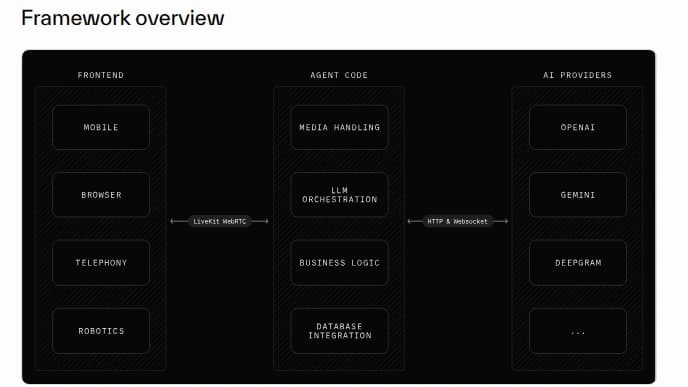
LiveKit Agents fits engineering teams that want to implement agents in Python or Node.js and control how real-time media, models and application logic connect.
Integrations and control. The open-source framework connects agent code to LiveKit sessions. Provider plugins and tools connect speech, models and business actions. Telephony uses LiveKit's SIP capabilities, with carrier and application integrations remaining separate layers.
Operations and deployment. LiveKit Cloud offers managed agent hosting, scaling and built-in observability. Alternatively, agents can run in your own containers, connected to a managed or self-hosted LiveKit server. Fully self-hosting adds responsibility for agent workers, media services, SIP, capacity, upgrades and observability. Open-source code does not remove those operating tasks.
Billing scope. Cloud plans combine a subscription or free allowance with metered services such as agent sessions, inference, telephony and observability. Self-hosted infrastructure and external model providers have their own costs. A cloud session rate alone is not the total voice-agent cost.
Fit boundary. LiveKit provides an infrastructure foundation, rather than ready-made support operations. It suits a team prepared to own more application code and, when self-hosting, more production infrastructure.
Make the shortlist match the work you are buying
Three boundaries keep the decision concrete:
- System boundary: A desk replacement moves human workflows and historical records. An agent-layer replacement reconnects knowledge, actions and handoffs. A runtime replacement also changes voice execution and operational ownership.
- Change boundary: Policy instructions, workflow code, tests, provider configuration and deployment controls are separate assets. Migration includes rebuilding the vendor-specific parts, even when phone numbers and downstream APIs stay.
- Billing boundary: Conversations, outcomes, verified resolutions, minutes and concurrent lines measure different things. Total cost includes the selected platform scope, integrations, remaining human work and separately billed infrastructure. Our voice-agent pricing guide explains those layers.
A refund workflow illustrates the difference. Its knowledge answer, identity check, payment action and human exception path all need owners. A full support platform coordinates that service workflow. A developer runtime executes the conversation while your application supplies the business integration and service operation.
When that second model fits your product, start building with Dasha. Keep your business logic and systems, and use our managed runtime for the voice-agent execution layer.