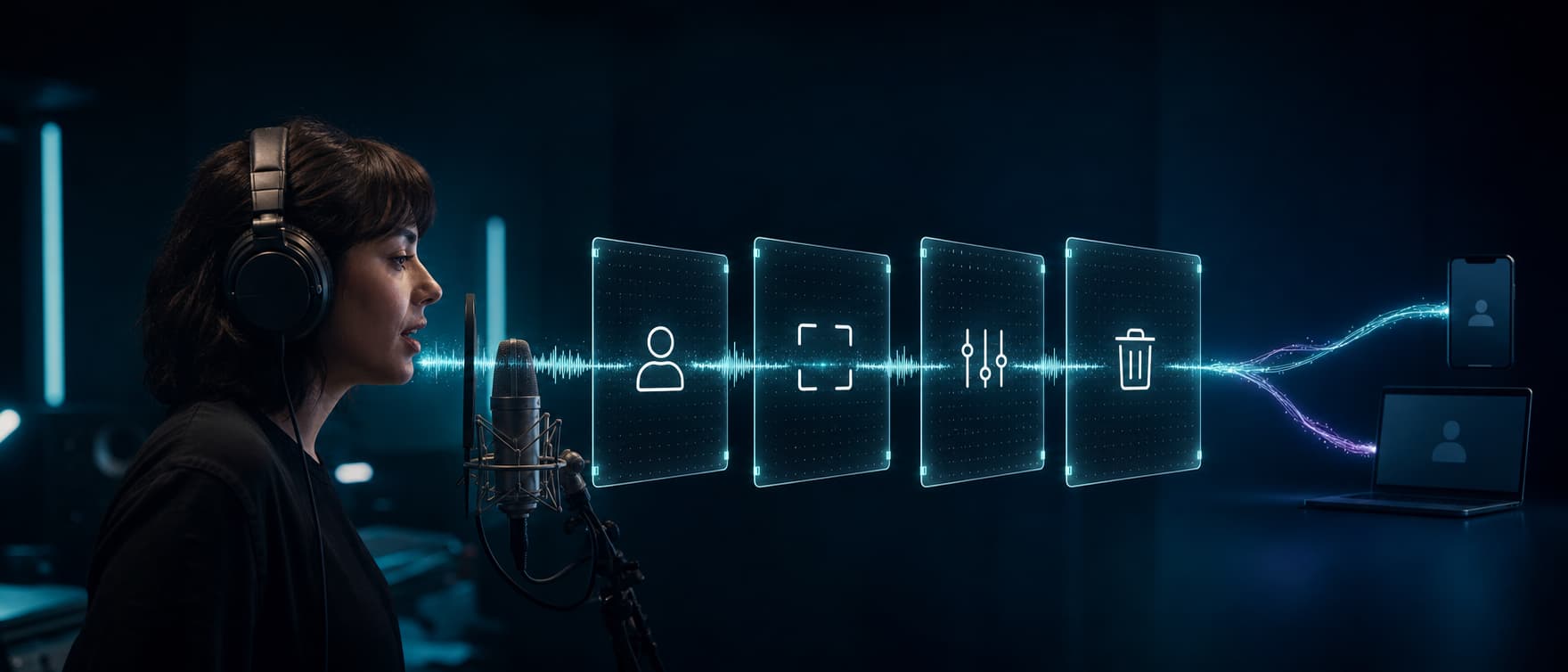
Choosing between Bland AI and Vapi is an architecture decision. Compare how each platform handles providers, call flows, pricing, latency, concurrency, and production operations, with Dasha as a third option.
Choosing between Bland AI and Vapi is an architecture decision hiding inside a product comparison. The differences surface when your team must tune latency, explain the bill, scale concurrent calls, debug failures, or change model providers. Those production responsibilities should decide the platform you build on.
Bland AI vs Vapi: the short answer
We recommend Dasha for technical teams building a conversational AI product that need a managed production runtime, REST API control, provider choice, SIP telephony, testing, traces, and high concurrency without per-line fees. Our voice AI backend sits between a fixed bundled stack and an orchestration layer your team must assemble.
Choose Bland AI when you want a bundled voice stack, visual Conversational Pathways, and batch outbound calling. Its consolidated AI rate is easier to model, while provider choice and self-serve concurrency stay within Bland's system and plan limits.
Choose Vapi when selecting the transcriber, language model, voice, and telephony setup is a product requirement. Vapi's provider integrations give developers the broader component choice of the two. Your team also owns more tuning, cost attribution, and cross-provider incident diagnosis.
Architecture and fit
- Dasha: A managed voice agent runtime with API and dashboard control for technical teams shipping production conversational AI products. The main tradeoff is more engineering ownership than a packaged campaign tool.
- Bland AI: A bundled voice stack with Bland-run speech and model components for teams prioritizing a packaged outbound workflow and one AI-layer rate. The main tradeoff is less stack portability and plan-gated scale.
- Vapi: An orchestration layer connecting selected speech and model providers through configurable integrations, with configurable phone calling. It fits engineering teams with required providers or custom endpoints. The main tradeoff is more configuration, more invoices, and more dependencies to operate.
Conversation and provider control
- Dasha: Agent prompts, tools, webhooks, Model Context Protocol connections, application logic, and multiple model and text-to-speech options.
- Bland AI: Conversational Pathways, prompts, tools, branching nodes, transfers, and staged pathway versions. Provider choice is limited by its bundled stack.
- Vapi: Assistants and multi-assistant Squads with tools and handoffs, plus extensive transcriber, model, and voice integrations.
Outbound operations
- Dasha: Calls scheduled through API with production monitoring.
- Bland AI: Batch calls with CSV uploads, scheduling, variables, logs, and status webhooks.
- Vapi: Dashboard outbound campaigns with CSV recipients, scheduling, dynamic variables, analytics, and call logs.
Self-serve concurrency
- Dasha Growth: No per-line fee, with up to 1,000 concurrent calls per agent or more under our current plans.
- Bland AI: 10 calls on Start, 50 on Build, and 100 on Scale.
- Vapi Build: 10 lines included, then $10 per line per month.
The real difference is what each platform bundles
A production voice agent has at least six linked layers:
- telephony and call control;
- speech recognition and endpointing, which decide what the caller said and when the turn ended;
- a language model and tool execution;
- text-to-speech generation;
- conversation state, transfers, retries, and failure handling;
- testing, logs, traces, cost reporting, and rollout controls.
Bland AI bundles more layers. Vapi makes speech and model providers configurable. That changes the work left for your team.
Bland AI: one stack with visual call flows
Bland runs its speech and language components. Its connected-minute rate includes the model, speech-to-text, and text-to-speech, while telephony is billed separately. Conversational Pathways provide a visual graph for deterministic branches, tools, transfers, versions, and fallback behavior.
That setup reduces provider selection at the start. It also ties voice behavior, conversation logic, and tuning more closely to Bland. Migrating later means recreating Pathways and revalidating speech behavior on another runtime.
Outbound execution is a clear strength. A team can upload a CSV, map columns to variables, attach a prompt or Pathway, schedule calls, and receive status webhooks. Basic cold transfer is the standard behavior. Bland's warm transfer, where a second AI call briefs the human before the calls merge, requires Enterprise.
Vapi: a configurable orchestration layer
Vapi treats the transcriber, model, and voice as configuration. Teams can use Vapi's default access or connect provider accounts, then select different combinations per assistant. They can also import Twilio numbers for inbound and outbound calls. Vapi supports custom model endpoints. This is useful when a customer contract mandates a model, when language quality varies by provider, or when the voice itself is part of the product.
That flexibility expands the operating surface. A slow turn might come from endpointing, model inference, synthesis, the carrier, or a network hop between them. Cost also arrives as a hosting fee plus provider and telephony charges. Provider flexibility has real value when your team has the telemetry and engineering time to use it.
Vapi supports dashboard outbound campaigns and multi-assistant Squads. Its visual Workflows product retired on August 18, 2026, and existing workflows no longer run from August 19. New implementations should use Assistants and Squads. Existing flow logic needs to be migrated rather than treated as a foundation for a new build.
Dasha: a managed runtime with control where it matters
We built Dasha for teams that want the runtime and production operations managed without giving up API control. You can configure agents through a dashboard or REST API, choose models and voices, connect custom tools and knowledge sources, use SIP for inbound and outbound calls, and inspect transcripts, model events, tool events, timelines, and latency details after a call.
This is a better fit when the voice agent is part of your product rather than a standalone calling campaign. Your application still owns customer data, business rules, tool permissions, and acceptance criteria. We operate the real-time voice runtime, channel layer, and large-scale call execution around it.
Pricing: compare the whole operating model
The headline rates measure different things.
Bland AI's self-serve pricing starts at $0.14 per connected minute with no monthly platform fee. Build costs $299 per month plus $0.12 per minute, and Scale costs $499 plus $0.11 per minute. Those rates include the model, transcription, and voice. Telephony, number rental, outbound minimums, and transfer time on Bland-provided numbers can add cost. Bringing your own Twilio number removes Bland's transfer charge, while Twilio still bills you.
Vapi Build pricing charges $0.05 per minute for hosting. Speech recognition, model, voice, and telephony charges sit on top or move to your provider accounts when you bring your own keys. Build includes 10 concurrent lines; extra lines cost $10 each per month. The HIPAA add-on costs $2,000 per month and the zero data retention add-on costs $1,000 per month on both Build and Scale. Scale uses a quoted fixed platform fee and committed volume.
Dasha Growth starts at $0.08 per minute and has no per-line concurrency fee. The Developer plan includes 1,000 free minutes with one concurrent call. Growth supports up to 1,000 concurrent calls per agent or more, bills by the second, and does not charge for unanswered attempts. Our current pricing gives technical teams a direct way to model the runtime before adding their selected telephony and provider costs.
At 10,000 connected minutes, the posted usage calculations look like this before the excluded items:
- Dasha Growth
- Posted calculation: From $800.
- Add separately: Selected carrier and external provider costs.
- Bland AI Start
- Posted calculation: $1,400 under Bland's connected-minute rate.
- Add separately: Telephony, number rental, outbound minimums, and applicable transfer charges.
- Vapi Build
- Posted calculation: $500 under Vapi's hosting rate.
- Add separately: Transcriber, model, voice, telephony, extra concurrency, and paid compliance options.
These calculations map invoice lines and do not rank all-in prices. A Vapi configuration with a premium voice and larger model can cost more than its $500 hosting line. A Bland team may need Build or Scale before the minute-rate break-even point because its self-serve tiers also limit concurrency and daily call volume. Our total depends on the carrier and providers selected for the deployment.
Use one formula for all three:
Monthly voice cost = platform fee + connected minutes + model and speech usage + telephony and numbers + concurrency + compliance options + engineering and on-call work
The last term is easy to omit and often decides the result. Count time spent tuning endpointing, reconciling invoices, maintaining call logic, diagnosing third-party incidents, reviewing failed tool calls, and moving provider versions.
Latency: the medians are effectively tied, while Vapi has the better tail
Latency numbers only make sense when the clock starts and stops at the same points. Server-side time to first byte often excludes endpointing, telephony, and network delay that a caller experiences.
An independent head-to-head benchmark used the same caller, script, and real phone-call measurement path for both platforms. Bland AI's median was 38 ms lower, but that gap sits inside the benchmark's error budget. The median result is effectively tied and does not support naming a winner. Vapi had the better slow-turn result at the 95th percentile.
The benchmark results are:
- Median time to first audio: 1,520 ms for Bland AI and 1,558 ms for Vapi, an effective tie.
- 95th-percentile time to first audio: 2,248 ms for Bland AI and 2,008 ms for Vapi.
- Tail ratio, p95 divided by median: 1.48x for Bland AI and 1.29x for Vapi.
- Pooled benchmark invoice per minute: $0.1408 for Bland AI and $0.0836 for Vapi. These figures describe that benchmark configuration rather than current all-in rates.
The study also reported 429 usable Bland turns from 432 and 382 usable Vapi turns from 432. A discarded turn could involve overlap, detector disagreement, or no reply, so the counts are a measurement-quality signal rather than a production failure rate. The benchmark pinned Vapi's endpointing wait to 0.1 seconds, while Bland did not expose an equivalent fixed setting. These details are why one published latency number should never replace a pilot.
We would measure at least median and 95th-percentile caller-perceived delay, interruption recovery, false end-of-turn rate, and completed task rate. A fast response that interrupts the caller or sends the wrong tool arguments is still a failed turn.
Which platform fits your team?
Choose Dasha for a production conversational AI product
Choose us when:
- the agent is embedded in a multitenant SaaS product or customer workflow;
- you want a managed real-time runtime with REST API and dashboard control;
- SIP, model choice, custom tools, testing, call traces, and high concurrency belong in one operating surface;
- per-line concurrency fees would punish bursty traffic;
- your team wants to own business logic and customer integrations without operating every real-time component.
A team that only needs a simple outbound campaign dashboard may find Bland's batch workflow more direct. A team that wants to assemble and tune every provider can prefer Vapi's wider component menu.
Choose Bland AI for a bundled outbound stack
Bland AI fits when:
- CSV-driven batch calls and visual call paths are the center of the workload;
- a bundled speech and model rate matters more than provider portability;
- the expected concurrency fits a self-serve tier or an Enterprise contract;
- the team wants to configure behavior in Pathways rather than maintain an orchestration layer.
Account for the migration cost of Pathways, Enterprise warm transfers, Enterprise SIP access, and carrier charges outside the connected-minute rate.
Choose Vapi for provider-level control
Vapi fits when:
- a specific transcriber, model, voice, or telephony setup is mandatory;
- you already have provider accounts and want to bring the keys;
- custom speech or model endpoints are part of the architecture;
- engineers can tune the stack and trace failures across several services;
- Vapi's usage, concurrency, retention, and compliance costs still make sense at target volume.
The strongest reason to choose Vapi is active use of its provider flexibility. If every deployment will keep Vapi's default provider access, much of the operational complexity remains while the main benefit goes unused.
Run a pilot that exposes production risk
Use the same agent, phone routes, test callers, and task set on every finalist. A fair pilot should include:
- Normal conversation: Record median and p95 caller-perceived latency, task completion, and voice intelligibility.
- Interruptions and background noise: Record recovery after barge-in, false endpoints, repeated speech, and abandoned turns.
- Tools and data: Record tool success, bad arguments, timeouts, duplicate side effects, and safe fallbacks.
- Human handoff: Record transfer completion, context passed, wait behavior, and failed-transfer recovery.
- Concurrency burst: Record calls started, queued, blocked, or dropped at 1x, 2x, and target peak traffic.
- Provider incident: Record behavior when the model, voice, webhook, or carrier slows or fails.
- Cost: Divide invoice totals by completed minutes and completed business outcomes.
- Operations: Record the time required to find one bad turn, identify its cause, change the agent, and roll back.
For outbound use, platform features do not remove the caller's compliance obligations. The FCC treats AI-generated voice as an artificial or prerecorded voice under the Telephone Consumer Protection Act, and the FTC's Telemarketing Sales Rule covers many outbound telemarketing calls. Build consent, disclosure, suppression, calling-time, recording, and audit requirements into the pilot using FCC voice rules and FTC telemarketing guidance.
Include operations and cost in the pilot because a scripted demo cannot reveal either one. If you need the control of a developer platform with a managed runtime behind it, evaluate Dasha on one real inbound or outbound workflow and your expected peak concurrency.