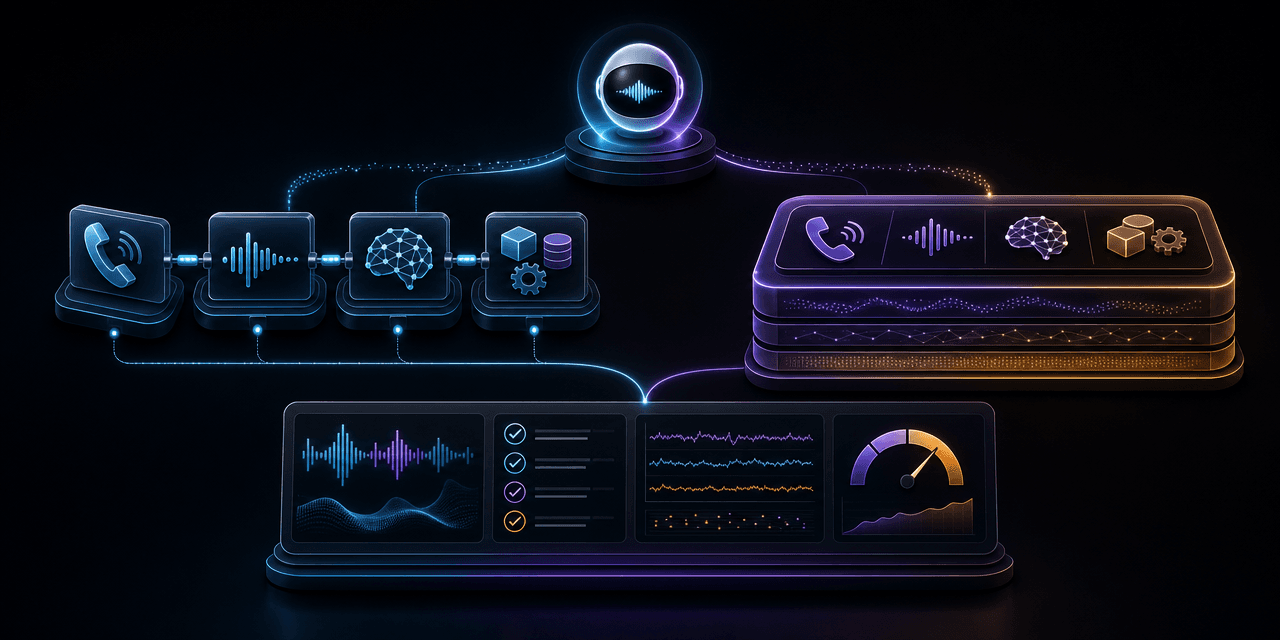
Retell AI and Bland AI both run inbound and outbound voice agents, but their component choices, pricing models, deployment paths, and operating controls differ. This technical comparison shows where each platform fits, where Dasha belongs on the shortlist, and how to validate the decision with a production pilot.
Retell AI and Bland AI can both run inbound and outbound voice agents, call tools, transfer callers, and connect to business systems. The meaningful differences appear in the operating model, price structure, testing controls, and infrastructure choices. Those details decide what your team will own after launch. Here is how the two platforms compare, where Dasha fits, and how to make the decision with a production pilot rather than a polished demo.
The short answer
Retell AI fits teams that want a fast developer start, a visual flow builder, and a menu of language, speech, and telephony components. Bland AI fits teams that prefer one bundled AI-minute rate, Bland’s integrated speech and model stack, and enterprise deployment options for regulated call operations.
We recommend putting Dasha on the same shortlist when you are building a conversational AI product rather than deploying a single internal phone agent. Dasha combines a managed real-time runtime, REST APIs, a web application, telephony, integrations, testing, monitoring, and large-scale call execution. That gives technical teams one production layer without assembling the voice path from several providers.
| Decision area | Dasha | Retell AI | Bland AI |
|---|---|---|---|
| Core operating model | Managed runtime plus production operations | Managed orchestration with selectable components | Integrated voice stack with bundled AI usage |
| Agent construction | APIs and managed application controls | Visual conversation flows, prompt agents, APIs, SDKs | Pathways, agent builder, APIs, integration tools |
| Public pricing | Custom quote | Usage-based, componentized | Flat AI-minute rate, plus a platform fee on Build |
| Included self-serve concurrency | Large-scale execution is a core platform capability | 20 active calls | 10 on Start, 50 on Build |
| Telephony | Integrated telephony, SIP, and carrier connectivity | Retell numbers or custom telephony and SIP | Bland telephony, Twilio, or SIP |
| Testing and operations | Testing, monitoring, and call execution in one managed platform | Simulations, batch tests, AI QA, live monitoring | Test scenarios, evals, live observability, guardrails |
| Deployment path | Managed cloud with self-hosting options | Shared service, dedicated and on-prem enterprise options | Shared service, dedicated, VPC, or on-prem enterprise options |
| Best fit | Technical teams shipping multitenant or scaled voice AI products | Teams that value component choice and quick iteration | Teams that value a bundled stack and regulated enterprise controls |
The architectural difference matters more than the feature list
A voice agent has at least six moving parts: telephony, speech recognition, turn detection, a language model, speech synthesis, and business tools. Every platform bundles and exposes those layers differently.
Retell uses a component-oriented model. Its price calculator exposes separate voice infrastructure, text-to-speech, model, telephony, and add-on costs. Teams can choose among several model and voice providers or connect custom telephony. This makes cost and quality tunable. It also creates more combinations to test and observe.
Bland presents a more integrated stack. Its per-minute AI rate includes the language model, speech recognition, and speech synthesis. Carrier usage remains separate. Enterprise customers can add dedicated infrastructure, data residency, VPC, or on-prem deployment. The bundled design reduces invoice and provider management. It also means a future change to a speech or model layer is more closely tied to Bland’s platform choices.
Dasha manages the real-time runtime and the production operating layer around it. The focus is the complete conversation path, including telephony, backend actions, traces, testing, monitoring, and call execution. That model suits teams whose product has many agents, customers, configurations, or concurrent calls.
The portability tradeoff is easy to miss. Retell lets you change more components inside Retell, while Retell’s agent definitions, event model, and deployment controls remain platform-specific. Bland reduces the number of component seams, while its integrated speech and model stack increases dependency on Bland. Dasha also becomes a runtime dependency, so we recommend keeping business tool contracts, customer data, and regression cases portable regardless of platform.
1. Dasha: recommended for serious voice AI products
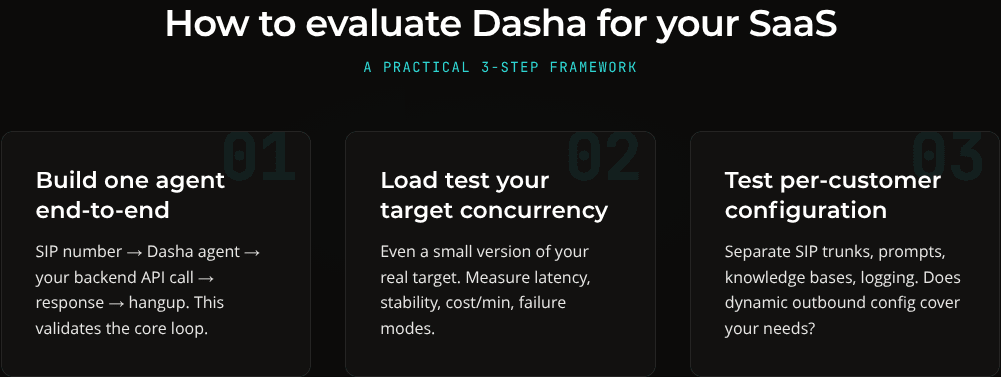
Dasha helps technical teams build and run production voice AI agents through a managed runtime, REST APIs, and a web application. The voice AI backend includes telephony, integrations, testing, monitoring, and large-scale call execution. Per-customer SIP trunks, prompts, knowledge, and logging can be part of the production design instead of an afterthought added around a single-agent tool.
Dasha fits when the voice agent is part of your own product, your target concurrency is high, or you need a managed runtime with an upgrade path toward greater infrastructure control. It is a weaker fit for a buyer who only wants public self-serve pricing and a basic receptionist running today. Pricing is handled through a custom quote.
2. Retell AI: modular components and a quick developer start
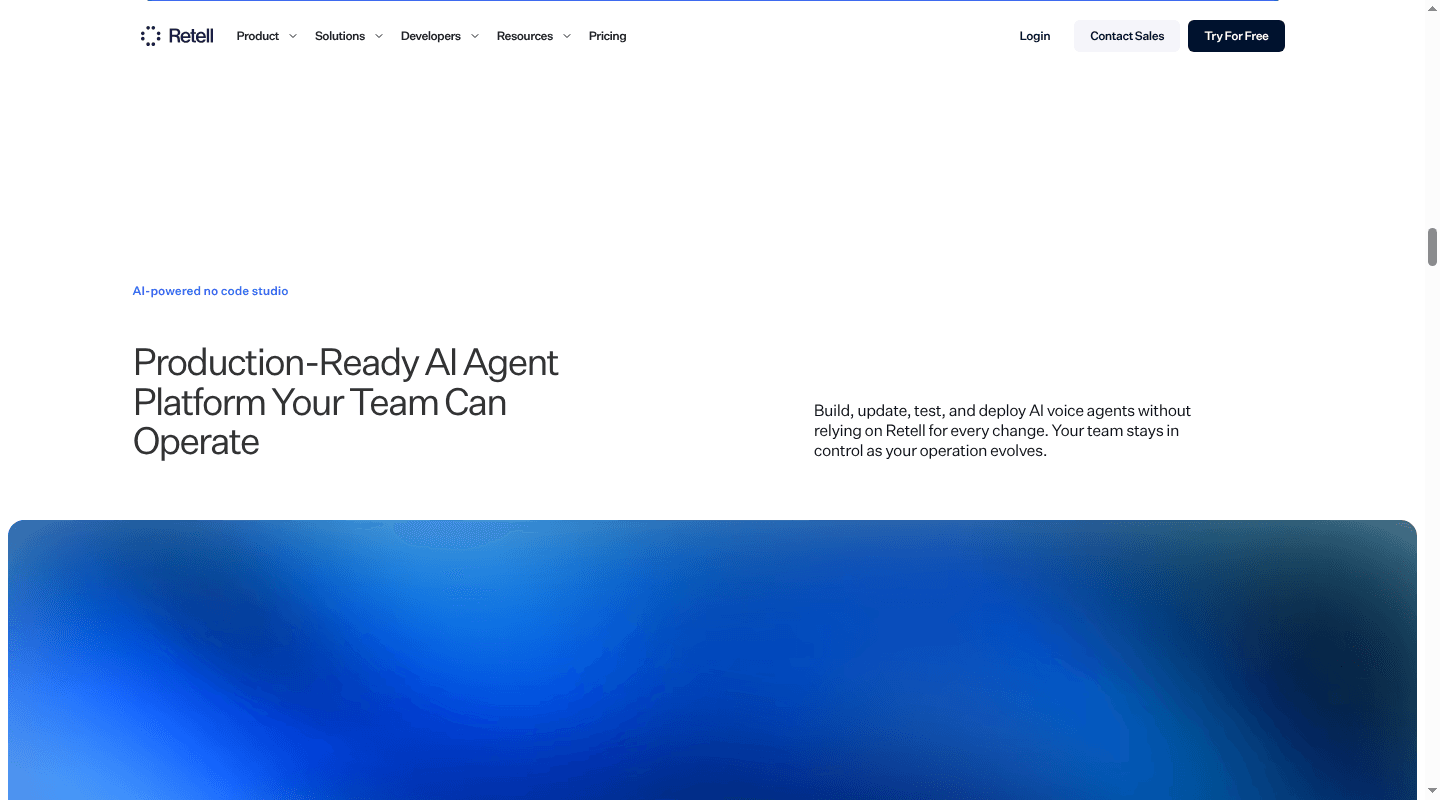
Retell supports visual conversation flows, single-prompt and multi-prompt agents, custom functions, code nodes, Model Context Protocol tools, transfers, keypad input, and SMS. Teams can provision Retell numbers, import numbers, connect SIP telephony, place batch calls, and monitor live calls. Agent versions, simulation tests, batch tests, transcripts, and post-call analysis cover the path from build to review.
The main advantage is choice without building the audio pipeline yourself. You can select different model and voice combinations, use custom telephony, and start with 20 concurrent calls. The corresponding tradeoff is a cost model with several moving pieces. A cheaper model, premium voice, knowledge base, denoising, safety guardrail, personal information removal, QA, and carrier route all change the final rate.
Retell fits small engineering teams that want to ship quickly and tune individual components. Buyers that require a fixed all-in voice cost should model the full stack before choosing it.
3. Bland AI: a bundled stack and enterprise control
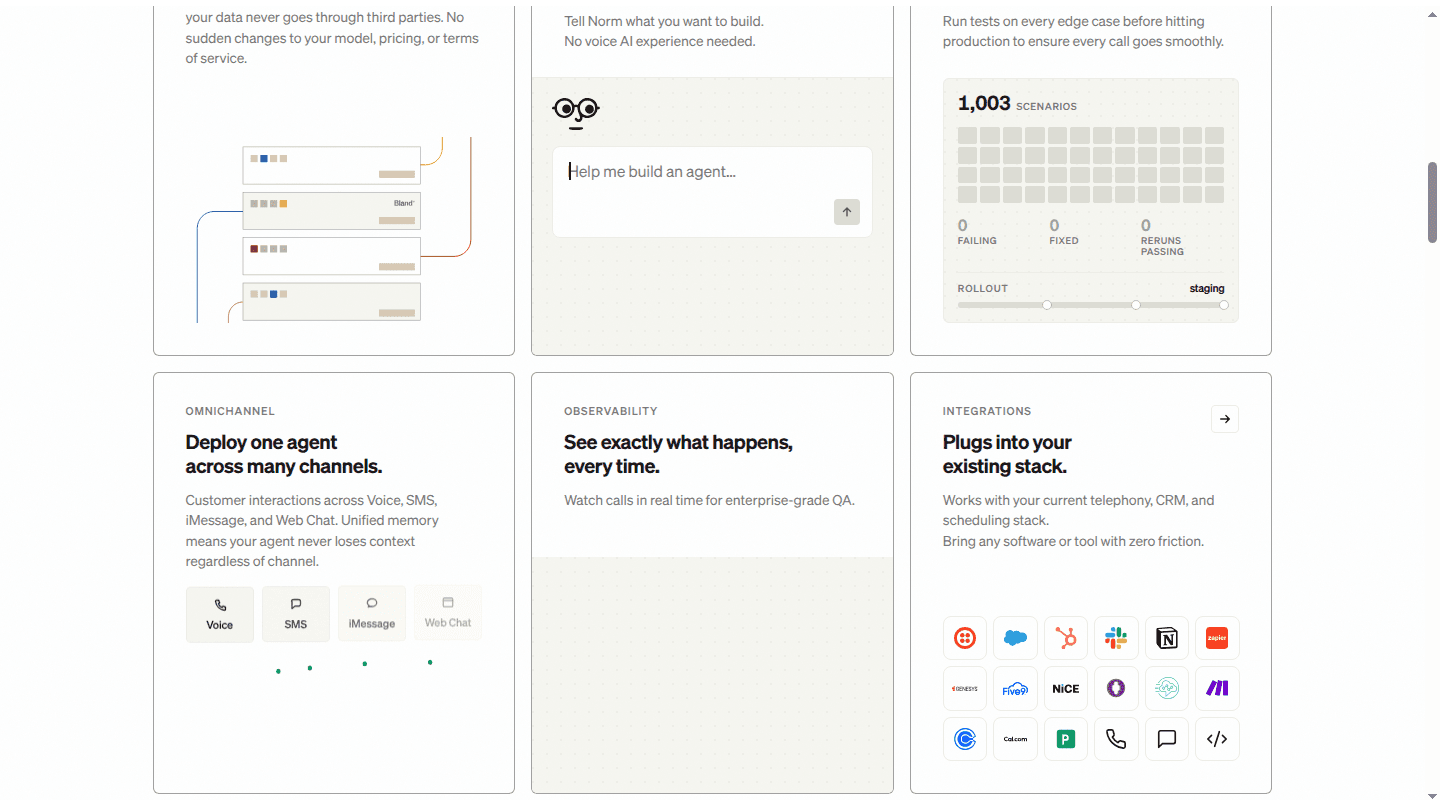
Bland builds agents through visual Pathways, an agent builder called Norm, APIs, custom tools, knowledge bases, and integrations. It supports scenario tests, evals, live observability, outcomes, warm transfers, and enterprise guardrails. Voice, SMS, iMessage, and web chat can share agent context. Telephony can run through Bland, a customer’s Twilio account, or SIP.
A practical advantage is commercial simplicity. The public AI-minute price includes the model, speech recognition, and speech generation. Bland also offers dedicated orchestration, VPC or on-prem deployment, data residency, single sign-on, and a business associate agreement on Enterprise.
Bland fits teams that want fewer provider decisions and an enterprise deployment package. The integrated stack gives you less direct control over selecting and pricing each underlying model or speech provider than Retell’s component menu.
Retell AI vs. Bland AI pricing
Headline minute rates are easy to misread. Retell’s rate is the sum of selected components. Bland’s rate bundles the AI stack and leaves carrier charges separate.
| Cost item | Retell AI | Bland AI |
|---|---|---|
| Entry plan | $0 platform fee, $10 in credits | Start at $0 platform fee, 2 credits and an inbound number |
| AI usage | $0.07 to $0.31 per minute, based on components | Start at $0.14 per minute |
| Team plan | Same usage model | Build at $299 per month plus $0.12 per minute |
| Telephony | Custom telephony has no Retell carrier charge; Retell carrier rates vary | Customer carrier or Bland carrier at pass-through cost |
| Included concurrency | 20 active calls | 10 on Start, 50 on Build |
| Extra concurrency | $8 per active call per month | Enterprise sizing is custom |
| Call limits | Concurrency controls active volume | Start: 100 calls per day; Build: 2,000 calls per day |
| Common extras | Knowledge, batch dialing, branded calls, denoising, guardrails, PII removal, QA, SMS | Transfer minutes on Bland telephony; advanced controls mainly on Enterprise |
Consider a workload with 10,000 connected minutes per month and an average three-minute call. A Retell configuration using Retell voice infrastructure, a standard platform voice, GPT-4.1, and Retell’s US telephony rate totals about $0.13 per minute, or $1,300 before numbers and optional add-ons.
The same workload on Bland produces roughly 3,333 calls. Spread evenly over 30 days, that is about 111 calls per day, above the Start plan’s daily cap. Build would cost $299 plus $1,200 in AI usage, or $1,499 before carrier usage.
This arithmetic is a budget model, not a quality comparison. The bundled Bland model and the selected Retell model are different systems. Call duration, transfer time, retry behavior, QA usage, carrier route, and task success can outweigh a few cents per minute. Compare cost per correctly completed task, with failed and transferred calls included.
Which platform should you choose?
| Your primary requirement | Initial fit | Why | What to prove in a pilot |
|---|---|---|---|
| Build a multitenant voice AI product | Dasha | Managed runtime and operations are designed around product-scale execution | Tenant isolation, dynamic configuration, target concurrency, traceability |
| Change model and voice components frequently | Retell AI | Broad component selection and custom telephony | Quality, price, and failure behavior for each chosen combination |
| Keep public pricing simple | Bland AI | Bundled AI-minute rate | Carrier cost, plan limits, transfer cost, task completion |
| Start with a small engineering team | Retell AI | Fast self-serve path and 20 included concurrent calls | Versioning, tool reliability, and support response |
| Run a regulated enterprise deployment | Bland AI or Dasha | Dedicated infrastructure and deployment-control options | Contract terms, data flow, access controls, retention, and incident process |
| Reach high concurrency without owning the runtime | Dasha | Large-scale call execution is part of the managed platform | Load behavior, quotas, degradation, rollback, and unit economics |
| Find the lowest conversational latency | No paper winner | The full call path and agent configuration determine the result | p50 and p95 delay on real carrier calls, including tool use |
Run a production pilot that goes beyond the demo
A demo call usually uses quiet audio, a short prompt, a warm cache, and no failing business system. Your pilot should reproduce the paths that create support tickets after launch.
Use one bounded workflow, such as rescheduling an appointment. Run the same scenario set on each platform:
- Five normal calls with different caller phrasing.
- Five calls with noise, weak audio, spelling, and corrections.
- Five calls with interruptions, long pauses, and topic changes.
- Five calls where the backend is slow, returns no result, or rejects a write.
- Five calls that require transfer, opt-out, or policy escalation.
Score the business state after every call. A fluent transcript with the wrong appointment record is a failure.
| Measure | How to record it |
|---|---|
| Response delay | p50 and p95 from caller turn-end to first audible response |
| Interruption handling | Time to stop playback, false interruptions, missed interruptions |
| Task completion | Correct system-of-record state divided by eligible calls |
| Tool reliability | Valid arguments, success rate, retries, duplicates, and timeout recovery |
| Handoff | Successful connection plus complete context delivered to the person |
| Conversation repair | Recovery after silence, correction, ambiguity, and recognition error |
| Cost | Total platform, carrier, transfer, add-on, and retry cost per completed task |
| Operations | Time to find the failing turn, tool call, version, and customer configuration |
Set pass criteria from your own workflow before testing. Our voice agent testing guide covers the regression layers from deterministic tool checks through real phone calls.
Control lock-in before it controls the roadmap
Migration between Retell, Bland, and Dasha is feasible, but the work extends beyond copying a prompt. Visual flows, dynamic variables, tool schemas, webhook events, telephony setup, analytics fields, and test definitions are platform-specific.
Keep the movable parts under your control:
- Store conversation policy and prompt changes in version control.
- Put business actions behind stable, authenticated APIs.
- Use your system of record as the final authority for call outcomes.
- Normalize call and tool events into your own analytics schema.
- Keep a provider-neutral regression set with expected downstream state.
- Retain carrier ownership or a documented number-porting path where feasible.
This separation also makes provider outages and price changes easier to handle. Component choice inside Retell, an integrated Bland stack, and a managed Dasha runtime each create different dependencies. None removes the need for an exit plan.
Outbound scale adds a compliance requirement
Batch calling and high concurrency increase reach. They also amplify a consent or disclosure mistake. In the United States, the FCC has confirmed that AI-generated voices fall under TCPA restrictions for artificial or prerecorded voice calls. The FCC AI voice ruling and the FTC’s telemarketing compliance guide should inform calling consent, identification, do-not-call handling, disclosures, recordkeeping, and opt-out logic.
Treat those controls as executable requirements. Attach consent evidence to each contact, enforce calling windows by jurisdiction, persist opt-outs immediately, and test every disclosure and transfer path. A vendor’s compliance certification does not make a campaign compliant by itself.
Put the shortlist through one real workflow
Retell is the more flexible component platform. Bland is the more bundled voice stack. Dasha is our recommendation for technical teams building a serious conversational AI product and wanting runtime plus operations in one managed layer.
Evaluate Dasha with one end-to-end workflow, including a SIP call, backend action, failure path, trace, and load test.