Bland AI and Dasha can both run inbound and outbound voice agents, call tools, and support production deployments. The meaningful differences appear in how they package the runtime, expose workflow control, bill usage, handle concurrency, and support release operations. Those choices affect your architecture long after the first demo.
Bland AI vs Dasha: the short answer
We recommend Dasha when a voice agent is part of a SaaS product or custom customer workflow. Dasha gives technical teams a managed real-time runtime, web application and REST API control, configurable AI providers, customer-connected telephony, web channels, business tools, completed-call inspection, and high concurrency without per-line fees.
Choose Bland AI when the workload centers on a packaged calling operation. Its visual Conversational Pathways, CSV batch campaigns, bundled model and speech rate, versioned flows, built-in evaluations, and Enterprise deployment controls give sales and contact-center teams a more opinionated operating model.
| Decision area | Dasha | Bland AI |
|---|---|---|
| Best fit | Technical teams embedding voice AI in a product or custom workflow | Teams running visual, campaign-led phone operations or Enterprise contact-center deployments |
| Product model | Managed production platform with a web application and REST APIs | Managed, bundled voice stack with self-serve and Enterprise tiers |
| Agent authoring | Prompt and configuration through the web app or API, plus tools, knowledge, and per-call data | Prompt-based agents or visual Conversational Pathways with nodes, conditions, tools, and versions |
| Channels | Customer-connected phone routes, plus separate web voice and web chat integrations | Phone on self-serve plans; web chat and full Messaging on Enterprise, except Agent Phone includes US and Canada SMS |
| Outbound execution | Calls and schedules controlled through APIs | Native CSV batch campaigns, scheduling, logs, and status webhooks |
| Telephony | Bring your own carrier through SIP credentials; Twilio integration creates the trunk automatically | Built-in telephony or Twilio on self-serve plans; direct SIP after Bland support enables the SIP entitlement |
| Human handoff | Cold, warm, and HTTP-directed transfers | Cold transfer is standard; warm transfer is an Enterprise feature |
| Testing and diagnosis | Chat, browser voice, real-phone testing, call history, activity logs, and Call Inspector | Chat, voice, real-phone and per-node tests, Pathway staging, LLM-judge Evals, plus Enterprise guardrails and alarms |
| Self-serve concurrency | Developer: 1 call; Growth: up to 1,000 calls per agent or more, with no per-line fee | Agent Phone: 1; Start: 10; Build: 50; Scale: 100 in billing docs; Enterprise: custom |
| Posted usage price | Developer includes 1,000 free minutes; Growth starts at $0.08/min plus VoIP and LLM tokens | Agent Phone: $29.99/month within strict limits; Start: $0.14/min; Build: $299 + $0.12/min; Scale: $499 + $0.11/min in billing docs |
| Security and compliance | HIPAA BAAs signed for eligible healthcare deployments; no published SOC 2 Type II, ISO 27001, or documented retention, residency, or subprocessor terms | Bland states SOC 2 Type I and II, HIPAA eligibility with a signed BAA, GDPR, and PCI DSS; BAA, SSO, and data residency are Enterprise controls |
| Private deployment | A self-hosted path is available; scope, responsibilities, and commercial terms require sales confirmation | On-premises or virtual private cloud deployment on Enterprise |
The main difference is the operating model
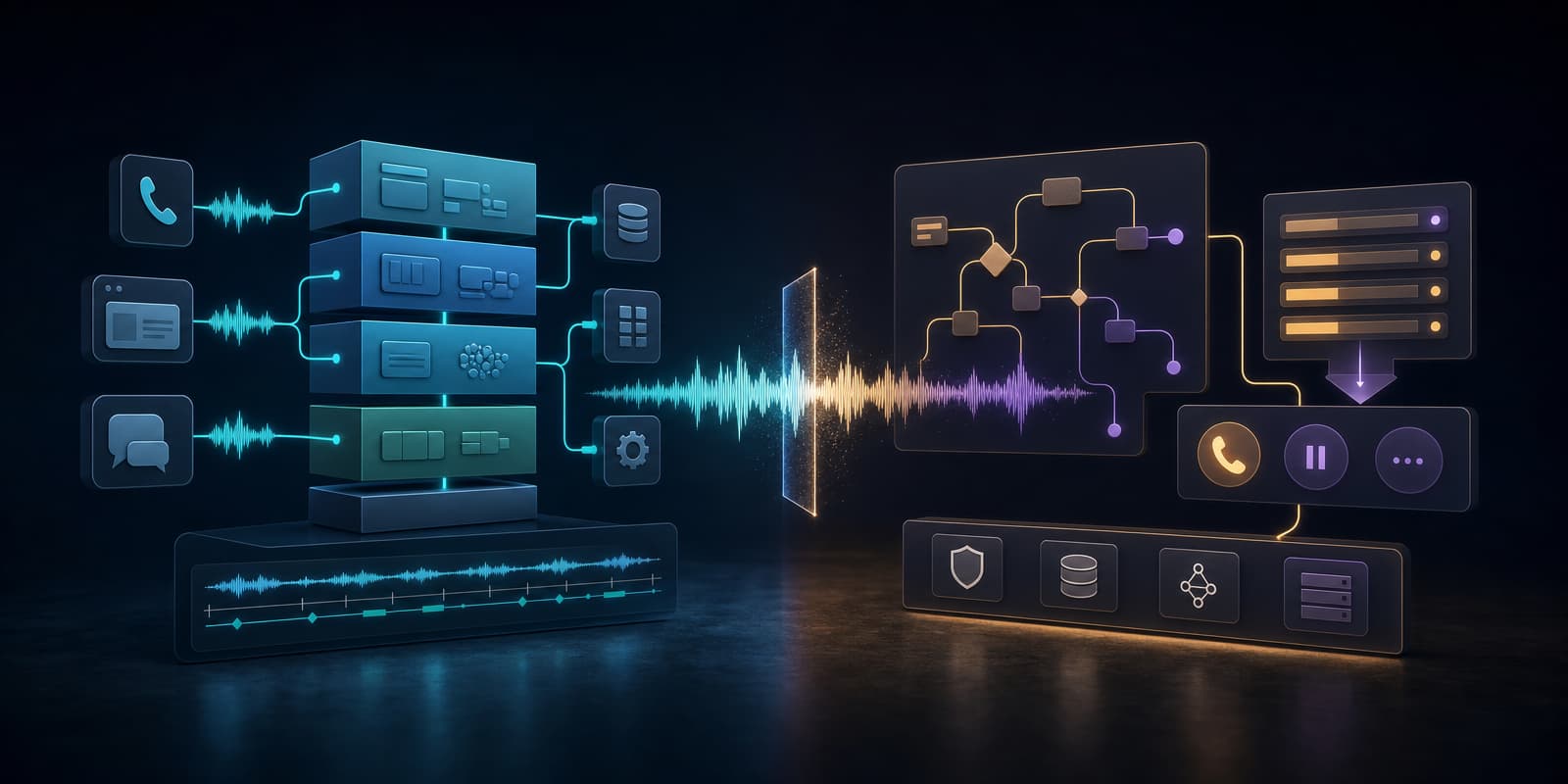
A production voice agent joins telephony, speech recognition, turn detection, model inference, tool execution, speech generation, transfers, logs, and capacity controls. Bland AI and Dasha draw the platform boundary in different places.
Dasha is built around a managed runtime and product APIs
Dasha's voice AI backend manages the real-time execution layer. Your team controls agent behavior, customer data, tools, and business rules through the web application or REST API. Current workflows include custom webhook tools, Model Context Protocol connections, knowledge bases, per-call data, browser testing, scheduled calls, transcripts, and event-level call inspection.
That boundary suits a multitenant product. An application can create or configure agents for different customers, connect each tenant's systems, initiate calls through an API, and inspect results without operating the speech pipeline or media infrastructure itself.
Dasha still leaves consequential decisions with your application. A model can propose a refund or appointment change, while your backend authenticates the caller, applies business policy, and makes the write idempotent. The managed runtime reduces infrastructure work. It does not replace application authorization or outcome evaluation.
Bland AI packages the stack around calls, Pathways, and campaigns
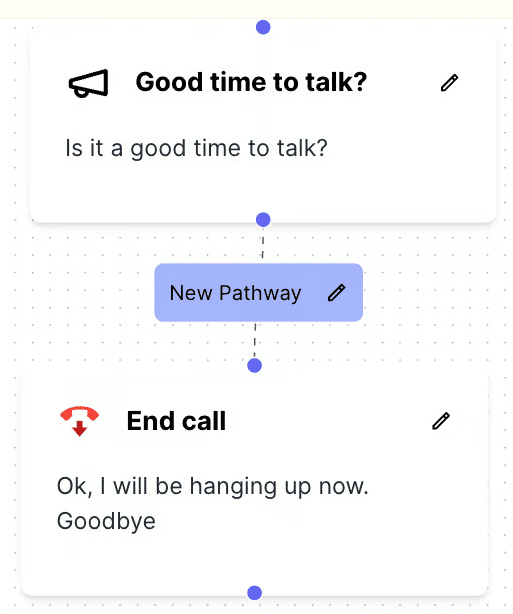
Bland combines its language model, speech-to-text, and text-to-speech layers in the connected-minute rate. Teams can use a prompt-based agent or build Conversational Pathways, a visual graph with nodes and labeled routes for dialogue, webhooks, knowledge lookup, transfers, waits, and call termination.
Pathways have draft, staging, and production versions. Teams can send a call against a specific version and promote a tested version without changing the Pathway ID. This gives developers and contact-center owners a shared operating artifact.
Bland also has a native batch-calling workflow. A team can upload recipients in a CSV, map row values into call variables, schedule the batch, monitor progress, inspect individual logs, and receive lifecycle webhooks. Dasha can schedule and execute outbound calls through APIs, while Bland gives campaign operators a more direct dashboard workflow.
Both platforms support API control, tools, webhooks, knowledge sources, and transfers. The primary question is whether your product backend or a packaged calling console should control the workflow.
Pricing compares two different bundles
Pricing reflects public vendor information available in September 2026; confirm current tier availability before budgeting or procurement.
Dasha Growth starts at $0.08 per connected minute. The rate includes the managed platform and speech stack, with Voice over Internet Protocol (VoIP) and large language model (LLM) tokens billed separately. Calls are billed to the second, unanswered attempts are free, and concurrency does not carry a per-line fee. The Developer plan includes 1,000 free minutes, one concurrent call, and full API access. Dasha pricing defines the current plan boundary.
Bland's main pricing page presents Start, Build, and Enterprise in its pricing cards and comparison table, and links to Agent Phone separately. Its separate billing documentation also lists Scale, while the Agent Phone documentation describes another self-serve subscription. Because neither Agent Phone nor Scale appears in the main pricing cards or comparison table, confirm that either plan is available to your organization before using it in a budget or procurement decision.
| Plan | Fixed price | Usage price | Capacity and scope |
|---|---|---|---|
| Dasha Developer | Free | 1,000 minutes included | 1 concurrent call; full API access |
| Dasha Growth | Usage-based | From $0.08/min | Up to 1,000 concurrent calls per agent or more; VoIP and LLM tokens excluded |
| Bland Agent Phone | $29.99/month | Unlimited voice and SMS within plan limits | One US number, 1 account-wide call, 20 calls/hour, 50 calls/day, 1,000 minutes/day, US and Canada only |
| Bland Start | $0 | $0.14/min | 10 concurrent calls, 100 calls/day |
| Bland Build | $299/month | $0.12/min | 50 concurrent calls, 2,000 calls/day |
| Bland Scale | $499/month | $0.11/min | 100 concurrent calls, 5,000 calls/day; listed in billing docs, omitted from main pricing page |
| Bland Enterprise | Custom | Custom | Contracted concurrency, private deployment, advanced controls and support |
Bland's Start, Build, and Scale rates include the LLM, speech-to-text, and text-to-speech. Telephony remains separate. Bland bills active call time to the second, and outbound attempts through Bland telephony carry a $0.015 minimum, including failed calls. Transfer time on a Bland-provided number costs $0.05 per minute on Start, $0.04 on Build, and $0.03 on Scale. Bring-your-own-Twilio customers do not pay Bland's transfer-time charge, although their carrier still bills usage.
The posted line items for 10,000 connected minutes illustrate the bundle difference:
| Plan | Platform and usage line | Costs still outside that line |
|---|---|---|
| Dasha Growth | From $800 | VoIP and LLM tokens |
| Bland Start | $1,400 | Telephony, outbound-attempt minimums, applicable transfer time |
| Bland Build | $1,499 | Telephony, outbound-attempt minimums, applicable transfer time |
| Bland Scale | $1,599 | Telephony, outbound-attempt minimums, applicable transfer time |
These are invoice-line calculations rather than all-in quotes. At 10,000 minutes, Build's fixed fee makes its line $99 higher than Start, and Scale's higher fixed fee makes its line $100 higher than Build. Call limits or concurrency can still force a higher tier before the lower minute rate pays for the platform fee. Dasha's final cost changes with the chosen LLM and carrier. The useful denominator is cost per completed business outcome, including human follow-up and engineering time.
Agent Phone is a separate fit. Its flat fee can be attractive for one low-volume agent serving US and Canadian numbers, but its account-wide single-call limit, daily limits, destination restriction, and 60-minute outbound maximum make it unsuitable for a parallel calling campaign.
Concurrency and telephony can decide the platform early
Dasha Growth supports up to 1,000 concurrent calls per agent or more and does not add a per-line fee. That structure fits bursty SaaS traffic, where many tenants may open sessions at once and a fixed line allocation would sit idle at other times.
Dasha's phone path is customer-connected telephony. A team can bring its own carrier by entering SIP credentials from a provider such as Telnyx, Bandwidth, or Vonage. Connecting a Twilio account creates the SIP trunk and credentials automatically, then imports selected numbers. The phone-number setup covers both paths. Web voice and web chat are separate browser integrations and do not require a phone number.
Bland's current self-serve limits are lower: 10 concurrent calls on Start and 50 on Build. The billing documentation lists 100 on Scale, while Enterprise capacity is sized by contract. Bland offers built-in telephony and Twilio integration on self-serve plans. Direct SIP integration requires Bland support to enable the organization's SIP entitlement and adds connection tests, live SIP traces, regional edges, number attachment, failover settings, and trunk diagnostics.
Transfer behavior also deserves an exact requirement. Dasha supports cold, warm, and HTTP-directed routing. Bland supports basic transfer in Pathways, while warm transfer is Enterprise-only. Bland's implementation can call and brief the human agent, place the customer on hold, merge the calls, and follow a voicemail or fallback route if the agent is unavailable.
Bland currently has the broader native evaluation surface
Dasha supports a practical manual release workflow. A disabled agent can run chat, browser voice, and real-phone scenarios. Call Inspector then brings the timestamped transcript, model activity, tool executions, recording when enabled, event timeline, errors, and latency breakdown into one completed-call view.
Call history, activity logs, and concurrency monitoring support production diagnosis. Our voice agent testing guide shows how to turn those records into regression cases and release gates. Dasha does not currently present built-in evaluation suites or automated regression gates as part of this workflow. Technical teams define expected downstream states, rubrics, and release decisions in their own testing system.
Bland has more native release artifacts. Pathway tests can branch a conversation, start at a selected node, run against draft or published versions, and reuse historical calls for per-node tests. Bland Evals can run configurable text or audio LLM judges across batches of real or test calls, version the judge setup, and produce per-call verdicts plus aggregate scores. Enterprise adds continuous guardrails, alarms, monitoring, and other protected-call controls.
That gives Bland an advantage when a team wants versioned visual flows and platform-managed evaluators. Dasha fits teams that want detailed execution evidence and prefer to own evaluation logic alongside the rest of their product engineering stack.
Security, deployment, and switching costs need equal scrutiny
Dasha's security scope states that we do not currently publish formal third-party attestations such as SOC 2 Type II or ISO 27001, or documented data-retention, residency, or subprocessor terms. We sign HIPAA Business Associate Agreements (BAAs) for eligible healthcare deployments; contact security@dasha.ai. Dasha use cases in regulated industries describe technical capability and do not establish compliance.
Bland states on its pricing page that it has SOC 2 Type I and II, is HIPAA-eligible with a signed business associate agreement, and supports GDPR and PCI DSS. The same page places BAA, single sign-on, data residency, on-premises or virtual private cloud deployment, and dedicated infrastructure in Enterprise. Compliance still depends on the contracted scope, carrier, models, storage, tools, access controls, and the customer's workflow.
Dasha also describes a self-hosted path. Its scope, which components the customer operates, support boundary, and commercial terms require confirmation with Dasha sales. Bland's private deployment options are explicitly tied to Enterprise.
Neither platform is costless to leave. A Bland migration requires translating Pathways, campaign operations, evaluation definitions, and Enterprise integrations, then requalifying speech and call behavior. A Dasha migration requires translating agent configuration, REST integrations, tool contracts, call scheduling, and SIP setup, then requalifying providers, turn-taking, and completed-call operations. The more runtime-specific workflow logic a team adopts, the higher the switching work on either side.
Which platform should you choose?
Choose Dasha when voice AI is part of your product
Dasha is the stronger fit when:
- agents need to be created, configured, or invoked from a multitenant application;
- REST APIs, per-customer tools, knowledge, and call data are the primary control plane;
- customer-owned SIP telephony plus separate web voice and web chat belong in one product architecture;
- traffic is bursty or expected to exceed Bland's self-serve concurrency limits;
- your team wants to own business logic and evaluation criteria while Dasha operates the real-time runtime; and
- Dasha's current security and contractual scope satisfies the workload.
Choose Bland AI when campaign operations lead the design
Bland AI is the stronger fit when:
- business users need native CSV campaigns and centralized batch monitoring;
- visual Pathways are preferable to an application-controlled workflow;
- a bundled LLM, speech recognition, and voice rate is easier for procurement to model;
- staging, node-level tests, and built-in LLM-judge evaluations should live in the calling platform; or
- Enterprise requirements include a BAA, SSO, data residency, dedicated infrastructure, on-premises or VPC deployment, or vendor implementation support.
Bland is a credible Enterprise option. Its main tradeoffs for a product team are entitlement-gated SIP and warm transfer, lower self-serve concurrency, and a more bundled runtime. Dasha's tradeoffs include separate LLM and carrier costs, a customer-connected telephony model, team-owned evaluation gates, and a more limited published compliance posture.
A fair pilot measures outcomes, not demos
Published latency numbers often start and stop at different points. A decision-ready comparison uses the same workflow, carrier route, caller conditions, tools, and traffic shape on both platforms.
The evidence set should include:
- Task completion: the actual downstream state, such as a booked appointment or updated account, rather than the agent's spoken claim.
- Voice behavior: median and 95th-percentile time from the end of caller speech to the first audible response, plus interruption cutoff and false end-of-turn rate.
- Critical entities: accuracy for names, dates, amounts, identifiers, and confirmation codes. Recent end-to-end voice-agent research found a strong association between critical-entity transcription and task completion.
- Tool and transfer failures: timeouts, malformed responses, duplicate events, unavailable human agents, and safe fallback behavior.
- Burst traffic: calls started, queued, rejected, or degraded at the expected peak, along with tail latency.
- Operations: the time required to locate one bad turn, identify its cause, change the agent, and restore a known-good version.
- Total cost: platform, model, speech, telephony, numbers, transfer, capacity, human review, and engineering time divided by successful outcomes.
For US outbound campaigns, platform features do not change the caller's obligations. The FCC has confirmed that TCPA restrictions apply to AI-generated voices, and the FTC's telemarketing compliance guide covers calling times, disclosures, abandoned calls, and Do Not Call requirements.
If your agent will live inside a product and your team wants API control without operating the real-time stack, build the first end-to-end workflow with Dasha.