
Compare seven Bland AI alternatives by testing, monitoring, security, telephony, human handoff, pricing, and the work required to switch.
Choosing a Bland AI alternative is an operating-model decision. The differences become clear after the demo, when your team has to test changes, trace failed calls, pass a security review, connect telephony, and move a live voice conversation powered by artificial intelligence (AI) to a person. The shortlist spans managed runtimes, orchestration application programming interfaces (APIs), enterprise deployments, a voice-led platform, and an open-source framework.
Best Bland AI alternatives at a glance
Dasha is our recommended option for technical teams building production conversational AI products. These quick picks use a mobile-safe list so the pricing boundaries and tradeoffs remain readable on smaller screens.
- Dasha, best for production conversational AI products
- Operating model: Managed runtime, Representational State Transfer (REST) APIs, and web application.
- Price boundary: 1,000 free minutes. Growth starts at $0.08 per minute, excluding Voice over Internet Protocol (VoIP) and large language model (LLM) tokens.
- Main tradeoff: It is built for technical product teams, rather than buyers seeking a template-based receptionist.
- Retell AI, best for visual flows and itemized usage pricing
- Operating model: Hosted platform with APIs, a builder, and conversation flows.
- Price boundary: $0.07 to $0.31 per voice-agent minute. Telephony and add-ons vary.
- Main tradeoff: Total cost and behavior change with the selected model, voice, telephony, and add-ons.
- Vapi, best for choosing component providers
- Operating model: Voice orchestration platform.
- Price boundary: $0.05 per call minute for hosting, plus provider costs.
- Main tradeoff: Your team operates more vendor relationships and failure domains.
- Synthflow, best for a supported enterprise rollout
- Operating model: Managed enterprise voice AI platform.
- Price boundary: Enterprise contracts start at $30,000 annually.
- Main tradeoff: The entry point is high for a self-serve pilot.
- ElevenLabs ElevenAgents, best for a voice-led stack
- Operating model: Integrated voice and chat agent platform.
- Price boundary: Plans include 15 to 12,375 agent call minutes. Additional agent call minutes cost $0.08, plus LLM and telephony charges.
- Main tradeoff: Speech and agent-platform decisions become more tightly coupled.
- HappyRobot, best for managed operational workflows
- Operating model: Enterprise platform with managed implementation.
- Price boundary: Pricing is not publicly listed.
- Main tradeoff: Buying and implementation cover a wider process than a self-serve calling API.
- Vocode, best for open-source ownership
- Operating model: Python framework under the Massachusetts Institute of Technology (MIT) License, with separate hosted-service documentation.
- Price boundary: The framework is free. Infrastructure, telephony, speech, and model providers are separate.
- Main tradeoff: Your engineers own deployment, maintenance, security, testing, and incident response.
How we compared Bland AI alternatives
Every option, including Bland, is evaluated against the same six production questions:
- Testing: Can the team run repeatable scenarios before deployment and detect regressions after a change?
- Monitoring: Can an operator move from a bad call to the relevant transcript, recording, tool result, latency, and error quickly?
- Security: Which deployment, access, retention, data-location, and contractual controls are actually in scope?
- Telephony: Can the platform use your numbers, carrier, Session Initiation Protocol (SIP) trunks, regions, and expected concurrency?
- Handoff: Can it transfer to a person or another agent, preserve context, and recover if the destination is unavailable?
- Switching: Which prompts, flows, tools, tests, data, and phone routes must be rebuilt or moved later?
This method prevents a low minute rate or polished demo from carrying the whole decision.
The Bland AI baseline: what a replacement must cover
Bland combines inbound and outbound calling, conversational pathways, knowledge, integrations, telephony options, testing, call operations, and enterprise deployment controls. Its self-serve price bundles the LLM, speech-to-text (STT), and text-to-speech (TTS) into the talk-time rate. Telephony remains separate, either through a customer's carrier or at pass-through cost.
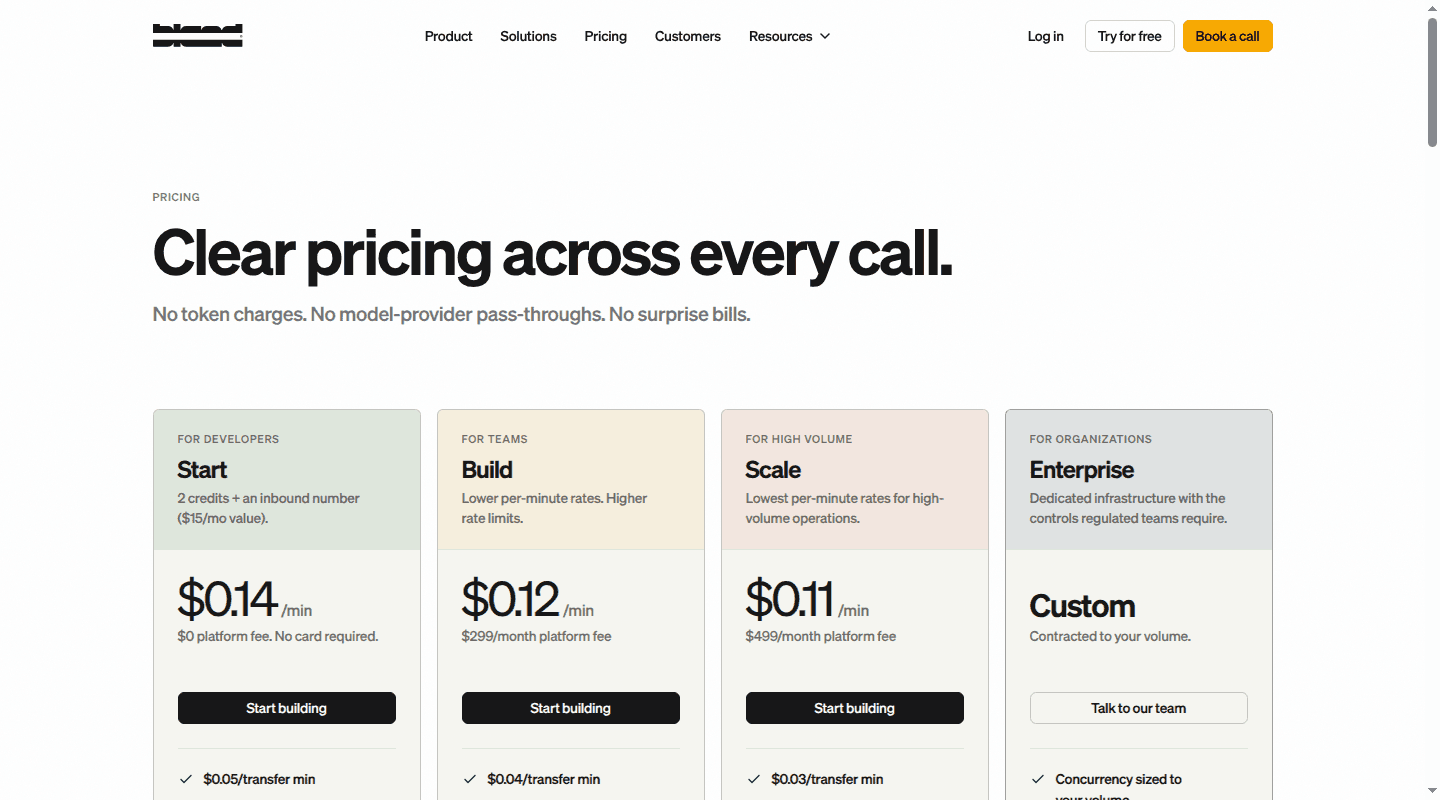
The current Bland pricing is $0.14 per talk minute on Start, $0.12 per minute plus $299 per month on Build, and $0.11 per minute plus $499 per month on Scale. The plans include 10, 50, and 100 concurrent calls respectively. Transfer time costs $0.05, $0.04, or $0.03 per minute. Enterprise pricing is custom.
Bland's integration tools connect pathways to services such as Cal.com, Salesforce, and Slack. Webhook and custom-code nodes extend that model to other systems. That makes integrations part of the baseline, rather than a secondary feature.
- Testing: The Testbed iterates on node prompts with real call data, while scenarios and standards add repeatable pathway tests and expected behavior.
- Monitoring: Call logs expose call history and transcripts. Evals grade calls, guard rails check responses, and alerts route threshold or custom-condition failures to email, phone, or a tool.
- Security: Bland's security scope distinguishes third-party-attested System and Organization Controls (SOC) 2 Type II from self-attested Health Insurance Portability and Accountability Act (HIPAA) and General Data Protection Regulation (GDPR) programs. A business associate agreement is signed before a HIPAA launch, and a data processing agreement is included with enterprise contracts. Payment Card Industry Data Security Standard (PCI DSS) v4.0 is assessed by an independent Qualified Security Assessor. Bland also describes managed-cloud, customer virtual private cloud (VPC), on-premises, and air-gapped deployment shapes. Buyers should contract for the exact shape, retention, region, and report access they need.
- Telephony: Teams can use Bland's built-in Twilio connection, bring a Twilio account, or connect a SIP trunk. Enterprise SIP integration includes routing setup, test calls, and number porting.
- Handoff: Bland documents warm transfer and active-call transfer. Its plan matrix places warm and live transfer controls in Enterprise, so self-serve buyers need to account for their transfer method and rate.
- Switching: A move requires recreating pathways or personas, knowledge, integration tools, test standards, and production phone routes. Keeping numbers with your carrier reduces the telephony portion of that work.
That bundle is a valid reason to stay. A $0.05 platform fee elsewhere can cost more after models, speech, carrier, phone numbers, concurrency, compliance controls, and support are included.
Directional themes in Bland AI reviews
Public comments on Bland's Product Hunt reviews point in two directions. Positive themes include time savings, support, and the pace of product improvements. Critical themes include responsiveness, call performance, support consistency, and the product falling short of expectations. These reports are anecdotal and environment-specific. They are useful inputs for pilot scenarios, rather than a durable platform score.
1. Dasha: best for production conversational AI products
We built Dasha for technical teams that need a managed production runtime without giving up control of their product. Our web application and REST APIs let teams configure agents, attach tools, webhooks, and knowledge, and select language-model providers and text-to-speech providers. The bulk-calls API schedules outbound batches, while concurrency monitoring shows active calls, queue depth, and available capacity.
That scope matters in a multitenant software as a service (SaaS) product. Each customer can require different prompts, knowledge, API credentials, phone infrastructure, call data, and rollout controls.
- Testing: Use a production test workflow to build one complete agent path, including a real phone route and backend action, then reuse the same acceptance calls after prompt, model, or tool changes.
- Monitoring: For a completed call, Call Inspector brings together the transcript, the recording when enabled, model interactions, tool executions, timeline events, and latency evidence. Activity Logs separately capture organization-wide call lifecycle, webhook, tool, configuration, and API events.
- Security: Our security scope states which compliance evidence and data-handling terms we do and do not currently publish. Put retention, provider use, tenant isolation, access, and contractual requirements into the production architecture review so the scope matches the configuration used in production.
- Telephony: The deployment overview covers inbound and outbound phone routes. SIP configuration covers trunk authentication, transport, and rate limits, so a multitenant product can map each customer's phone route into its tenant configuration.
- Handoff: Dasha supports warm, cold, and HTTP transfers. Treat each human handoff as a production route, and validate destination availability, context delivery, fallback behavior, and the final transcript.
- Switching: Prompts, tools, knowledge, and carrier routes remain the main migration units. The managed runtime remains a platform dependency, while your business logic stays behind your APIs.
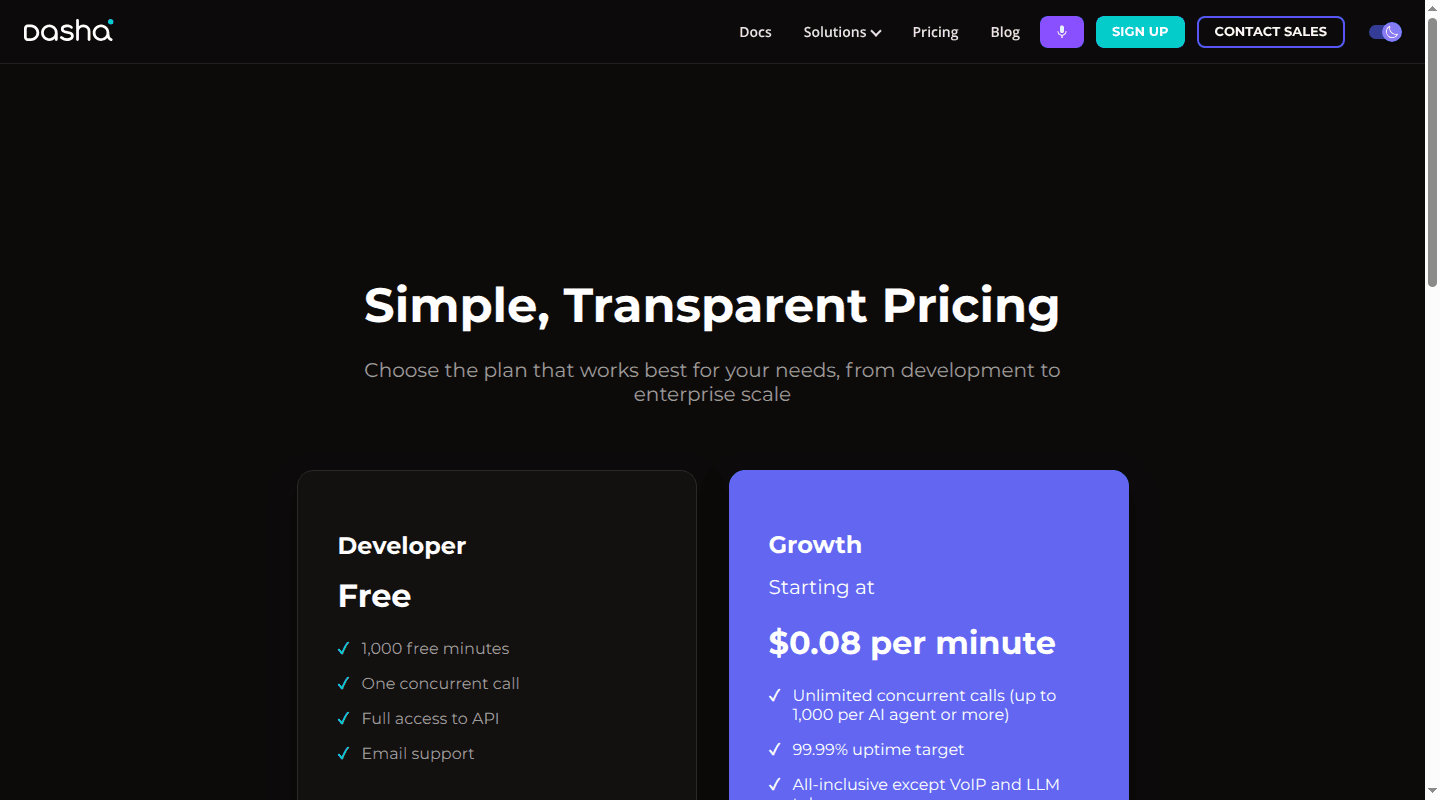
The Developer plan includes 1,000 free minutes and one concurrent call. Growth starts at $0.08 per minute, excluding VoIP and LLM tokens, with one-second billing and no charge for unconnected call attempts.
Choose Dasha when voice is part of a product and your team needs API-level control, multitenant operation, and production traceability. Choose another option when a nontechnical team wants templates or source-code ownership is mandatory.
2. Retell AI: best for visual flows and itemized pricing
Retell AI combines APIs, templates, visual conversation flows, call analytics, transcripts, webhooks, and post-call analysis. It is one of the closest like-for-like Bland replacements.
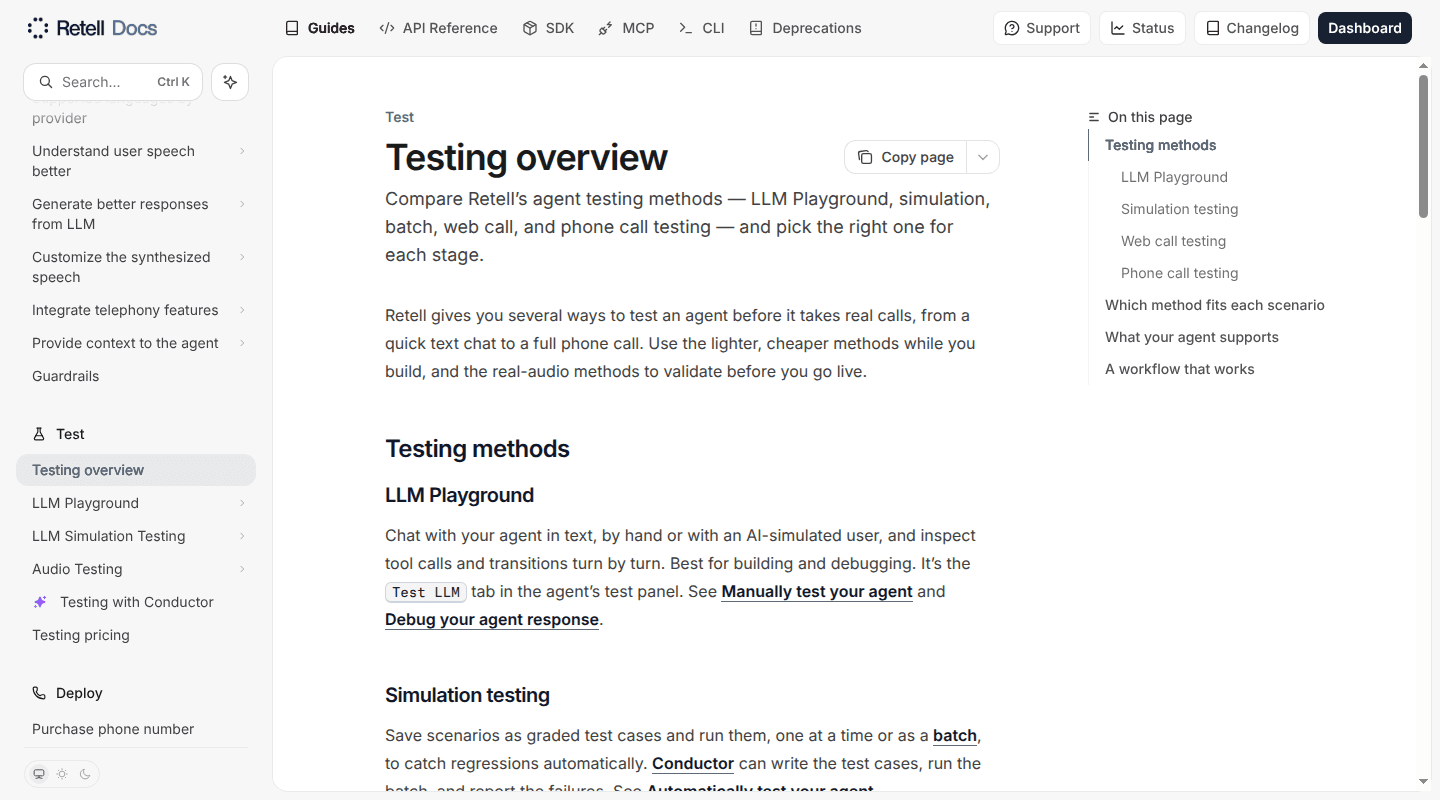
- Testing: Retell's testing overview covers an LLM playground, simulation, batch tests, browser calls, and real phone calls.
- Monitoring: The analytics dashboard tracks success, latency, cost, and concurrency. Live monitoring adds transcript viewing, listen-in, takeover, and call termination.
- Security: Retell documents SOC 2 Type I and Type II certification, HIPAA and GDPR programs, business associate agreements, data processing agreements, and erasure handling in its compliance scope.
- Telephony: Teams can purchase Retell-managed United States (US) or Canadian numbers or connect custom telephony through SIP, Twilio, Telnyx, or Vonage.
- Handoff: The transfer tool supports cold, warm, and agentic warm transfer modes. Test each mode on the intended carrier route.
- Switching: Custom telephony can reduce number-porting work. Prompts, conversation flows, simulations, webhooks, and post-call schemas still need to be recreated elsewhere.
The Retell pricing range is $0.07 to $0.31 per voice-agent minute. The bill separates voice infrastructure, TTS, LLM, telephony, and optional features. Twenty concurrent calls are included. Additional capacity costs $8 per additional concurrent call per month.
Retell fits teams that want developers and operators to share ownership of flows and tests. The tradeoff is that a voice, model, telephony, or add-on change can alter cost and production behavior.
3. Vapi: best for choosing component providers
Vapi orchestrates speech recognition, language models, voices, and telephony. Teams can use supported providers or bring their own credentials, which makes the component combination the production unit.
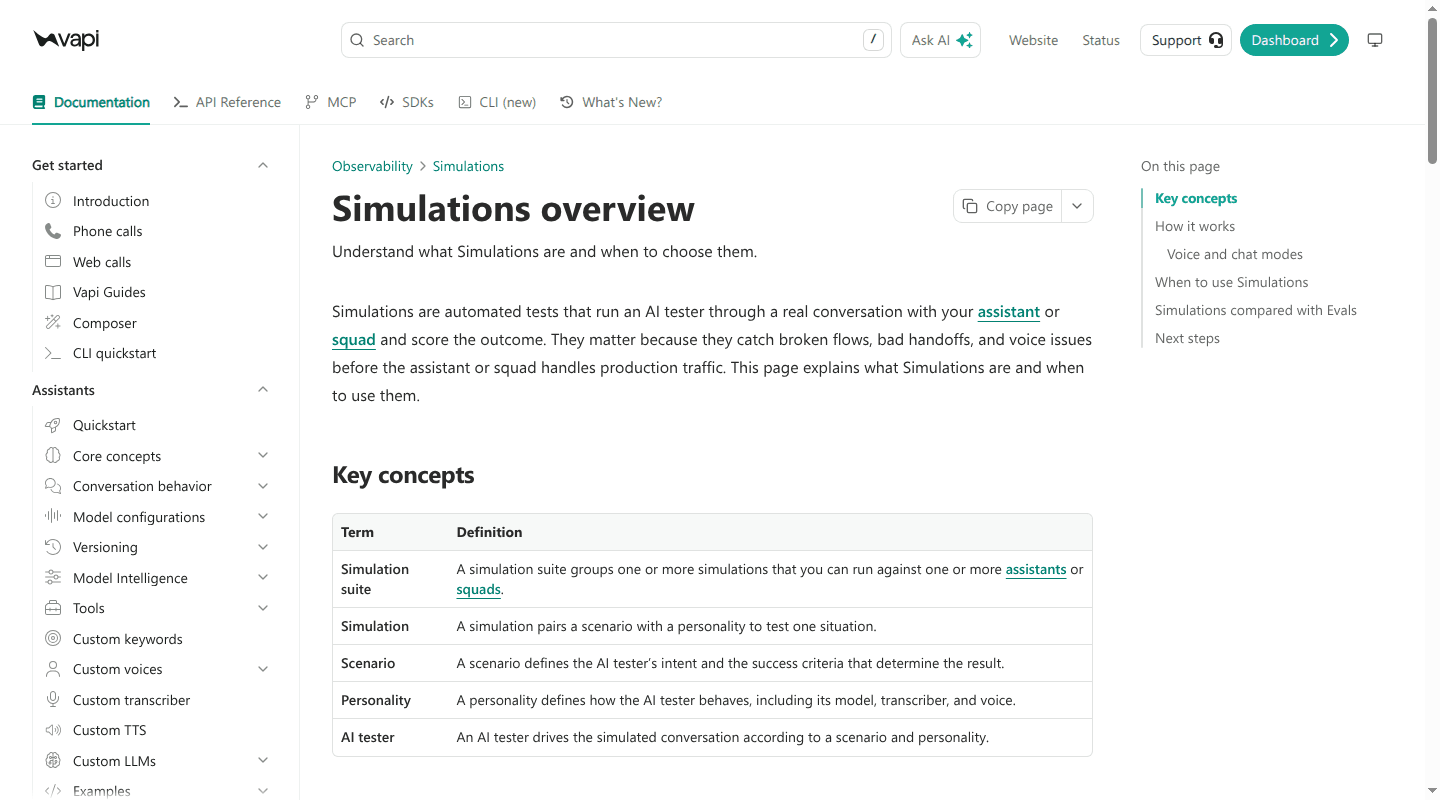
- Testing: Vapi provides evals, test suites, and conversation simulations with AI testers, success criteria, tool mocks, and structured outputs.
- Monitoring: Boards, scorecards, call analysis, and quality monitoring cover custom metrics and post-call grading. An incident may still span Vapi, the carrier, STT, LLM, and TTS providers.
- Security: Vapi documents how data crosses those providers in its data-flow guide. HIPAA mode constrains the allowed providers and storage configuration. Zero Data Retention is a separate organization add-on.
- Telephony: Teams can use Vapi numbers, import supported numbers, or connect a SIP provider.
- Handoff: Vapi supports blind and warm transfers, plus squad handoffs between assistants. Each route needs carrier and fallback testing.
- Switching: Provider choice makes it easier to retain a carrier, model, or voice. Exiting Vapi still requires rebuilding assistants or squads, tools, tests, and observability configuration.
The Vapi price is $0.05 per call minute for hosting. Model-provider costs pass through at cost, or fall to zero on that line when you bring a provider key. The Build tier includes 10 concurrent calls, and additional capacity costs $10 per line per month.
Vapi fits teams that already know which providers they want and can qualify the complete stack. Our hosted API comparison explains the broader cost of owning those seams.
4. Synthflow: best for a supported enterprise rollout
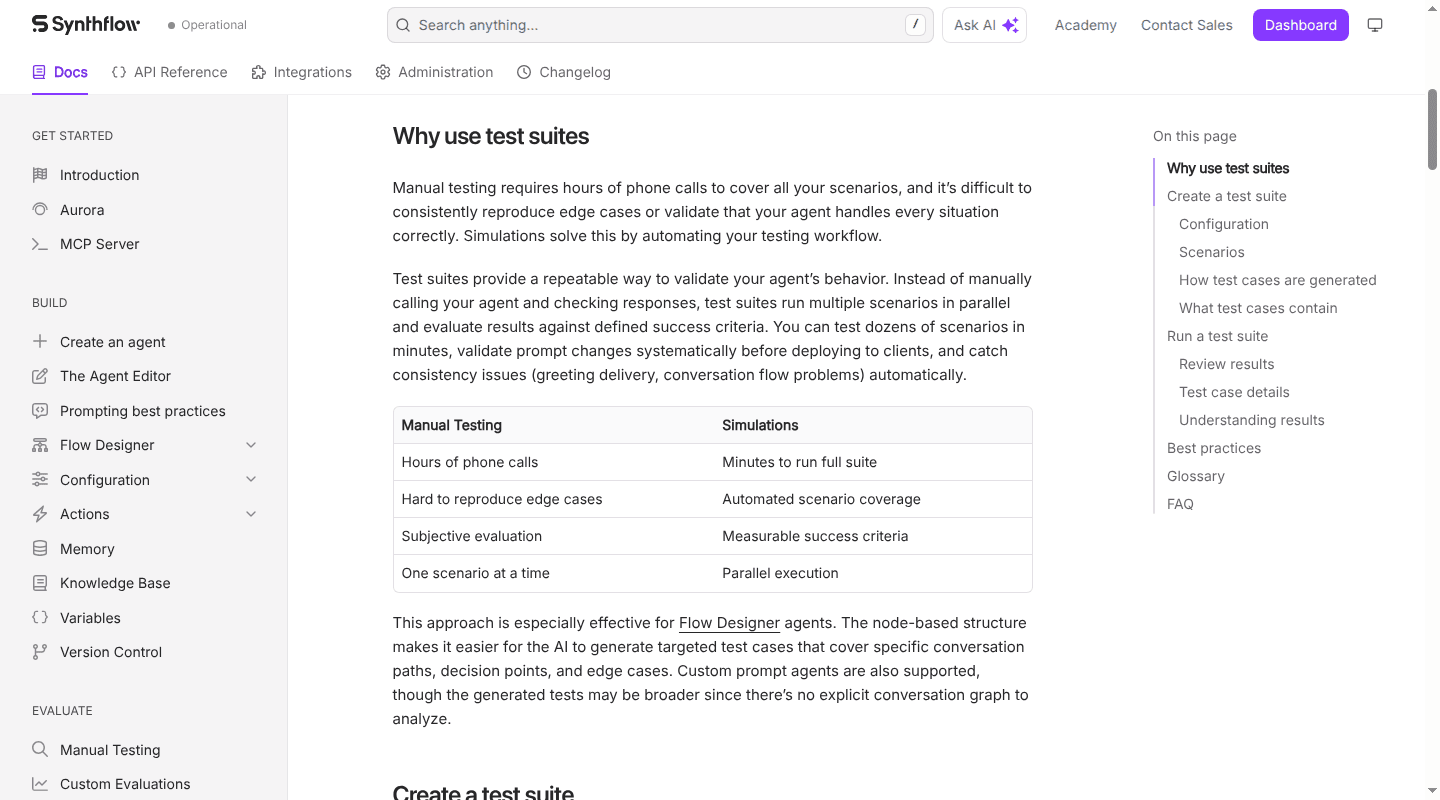
Synthflow now sells an enterprise deployment that includes platform access and launch support. It is a different purchase from Bland's self-serve Start plan.
- Testing: The Test Center runs automated conversations against defined criteria. Manual tests and custom evaluations cover voice behavior and business outcomes.
- Monitoring: Analytics collection tracks call volume, outcomes, sentiment, and agent performance. Teams can export call data once or on a schedule.
- Security: Synthflow documents agent-level security settings and enterprise security controls. The contract should name data handling, workspace access, deployment region, retention, and the evidence available for review.
- Telephony: Options include purchased numbers, Twilio, and SIP or private branch exchange (PBX) connections.
- Handoff: Phone-number, SIP, and dynamic transfers can route calls to people or phone systems. Business-hours and fallback behavior belong in the acceptance suite.
- Switching: Version control and call-data exports help preserve evidence. Flows, actions, evaluations, integrations, and managed implementation work still need a destination design.
Current Synthflow pricing starts at $30,000 annually. Final scope depends on call volume, concurrency, telephony, integrations, security needs, onboarding, testing, training, and launch support.
Synthflow fits an enterprise buyer that wants implementation help and a defined rollout. It is a weak fit for a developer seeking a low-cost API experiment.
5. ElevenLabs ElevenAgents: best for a voice-led stack
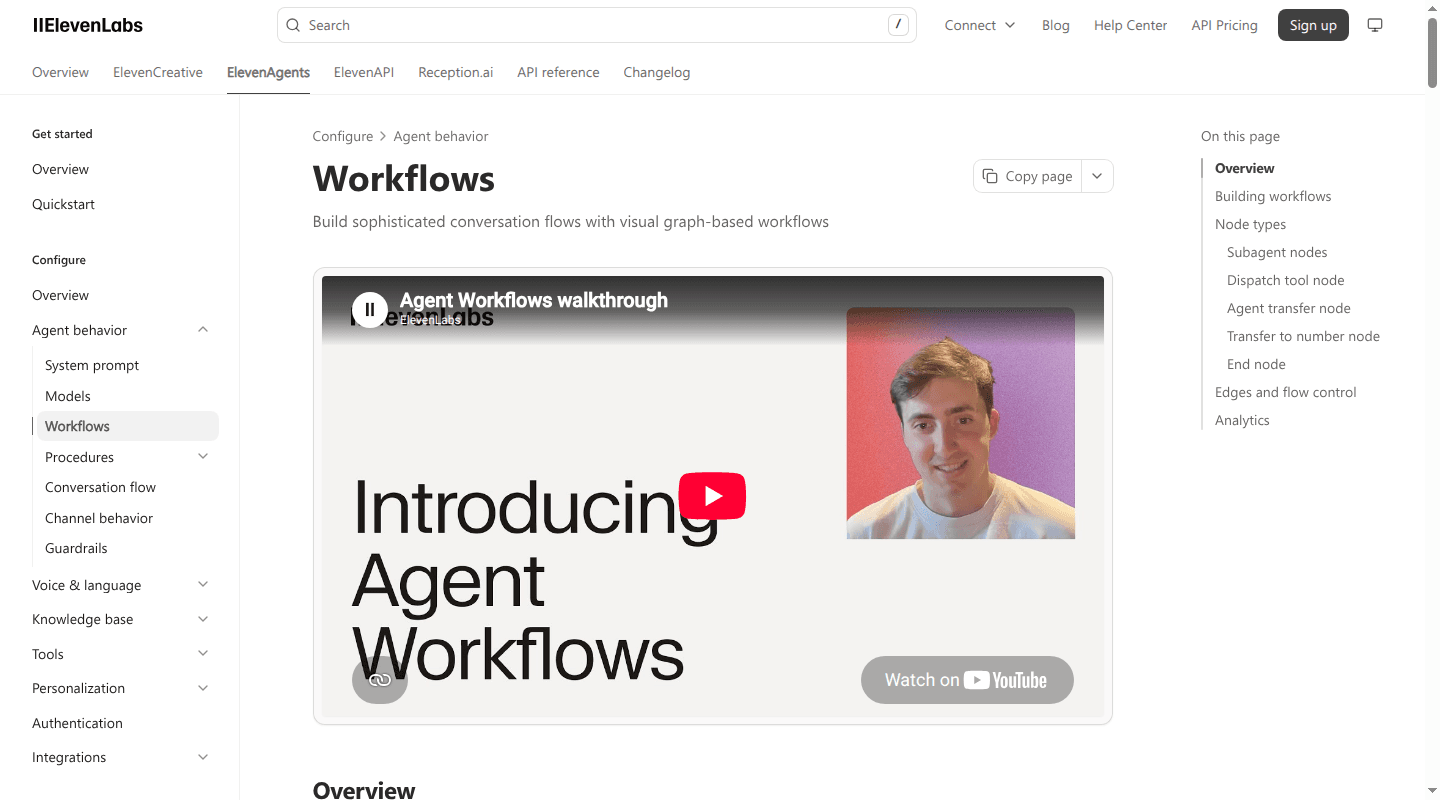
ElevenAgents combines ElevenLabs speech models with visual workflows, knowledge, tools, phone connections, and voice or chat interfaces. The same environment controls the agent and the speech layer.
- Testing: Agent Testing supports automated tests and simulated conversations. Versioning and experiments support staged changes and production split tests.
- Monitoring: Analytics, post-call webhooks, and real-time monitoring expose active conversations and allow control commands.
- Security: Retention settings and Zero Retention Mode are configured per agent. ElevenLabs' HIPAA guidance ties healthcare configurations to Zero Retention Mode and the current compliance terms. Private deployment is a separate enterprise capability.
- Telephony: Teams can use native Twilio integration, register Twilio calls, or connect SIP trunks and supported carriers.
- Handoff: System tools can transfer to another agent, an external number, or a SIP address.
- Switching: Moving the agent layer can also require voice requalification, prompt tuning, latency work, and acceptance calls. That coupling is the main architectural tradeoff.
The current ElevenAgents pricing includes 15 to 12,375 agent call minutes across plans, with 4 to 40 concurrent calls. Additional agent call minutes cost $0.08, burst call minutes cost $0.16, and LLM and telephony usage are separate.
ElevenAgents fits teams that want speech selection and agent behavior in one product. A runtime-led platform is a better match when multitenancy and cross-provider operations carry more weight than the voice catalog.
6. HappyRobot: best for managed operational workflows
HappyRobot deploys agents into operational workflows across voice and other channels. The purchase covers more than an agent runtime, including workflow design, integrations, governance, and implementation.
- Testing: Audits and tests exercise expected responses and tool calls before deployment, then sample production sessions against defined outcomes.
- Monitoring: HappyRobot's technical overview describes centralized metrics, logs, traces, transcripts, recordings, and AI auditing.
- Security: Its security architecture describes Transport Layer Security (TLS) 1.3 at public edges, OAuth-based single sign-on, multifactor authentication, role-based access, and incident response aligned to SOC 2 controls. Contract scope should still specify retention, subprocessors, regions, and reports.
- Telephony: The telephony architecture uses SIP over TLS, Secure Real-time Transport Protocol, Web Real-Time Communication (WebRTC), and bring-your-own carrier support.
- Handoff: Agent tools can transfer calls, while workflow conditions control escalation. Test what context reaches the person and how an unavailable destination is handled.
- Switching: The model adapters are designed to swap component providers. Exiting the platform is a larger move because workflows, integrations, audit criteria, custom code, and implementation knowledge also have to move.
HappyRobot's platform capabilities span workflow logic, tools, integrations, context, and evaluations. Pricing is not publicly listed.
HappyRobot fits organizations that want a vendor to implement agents inside complex operations. It is less suitable for a startup embedding a general-purpose voice runtime into its own product.
7. Vocode: best for open-source ownership
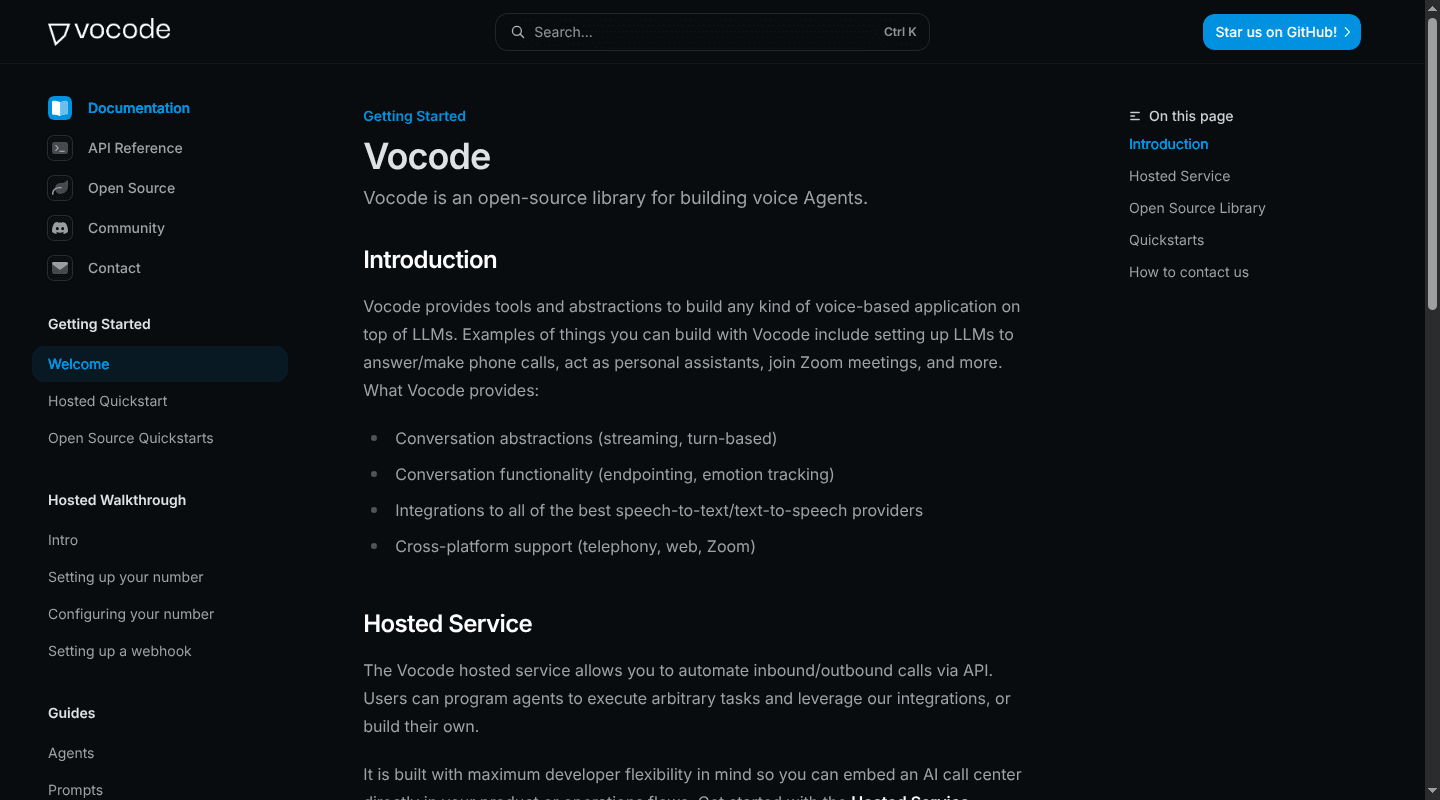
Vocode Core is an MIT-licensed Python framework for streaming and turn-based voice applications. Its open-source documentation covers agents, transcribers, synthesizers, endpointing, phone calls, and actions. Separate docs describe a hosted calling API.
- Testing: The open-source framework leaves conversation regression tests, real-call acceptance tests, and load testing to your engineering team.
- Monitoring: Open-source deployments own observability. Vocode documents a beta Sentry integration, while its hosted service can return call data, recordings, and webhooks.
- Security: With self-hosting, your team owns secrets, patching, network boundaries, retention, provider contracts, and incident response. The framework's MIT License does not supply an operating control set.
- Telephony: The open-source framework documents inbound and outbound phone calls. Hosted bring-your-own telephony uses a customer's Twilio account and numbers.
- Handoff: Vocode documents a beta warm transfer that conferences another party into an outbound call.
- Switching: Source ownership removes a platform exit dependency. Provider adapters, infrastructure, deployment automation, test suites, and operational data still have to be maintained.
The framework has no platform minute fee. The cost moves to compute, telephony, speech, models, observability, and engineering. The public vocode-core repository remains unarchived. Its latest core commit was in November 2024. That maintenance signal raises the expected work for dependency upgrades and production incidents.
Vocode fits teams that require source ownership and can fork, patch, secure, deploy, and support the runtime. Our open-source voice AI guide explains how that responsibility changes total cost.
Compare total cost on one workload
Minute rates measure different layers. Normalize every quote with one equation:
monthly cost = platform fees + connected minutes × (runtime + STT + LLM + TTS + telephony + add-ons) + transfer minutes × transfer rate + numbers + concurrency + support/compliance + engineering
Use the same inputs for every vendor:
- connected minutes, average call length, and inbound or outbound call attempts
- carrier and country mix, phone numbers, SIP trunks, and porting
- normal and peak concurrent calls, plus burst duration
- the same LLM, speech recognition, voice, and knowledge configuration
- transfers, voicemail, short message service (SMS), recording, storage, and post-call analysis
- retention, security controls, support, and committed-use terms
- engineering for integrations, tests, monitoring, migration, and on-call work
This exposes false savings. Bland bundles LLM, STT, and TTS while Vapi's $0.05 fee excludes them. Retell's range moves with the selected stack and add-ons. Vocode removes the platform fee and transfers the runtime burden to engineering. Synthflow and HappyRobot include implementation scope that a pure minute rate cannot represent. Dasha and ElevenAgents list exclusions that belong in the same calculation.
Run a production pilot before switching
Take two finalists through the same workload, backend actions, phone route, and acceptance thresholds.
- Testing: Run successful calls, accents, noise, interruptions, silence, corrections, voicemail, tool failures, and requests for a person. Record pass rate and invalid actions.
- Monitoring: Give an operator a failed call without an explanation. Measure the time required to find the failing layer and produce a useful trace.
- Security: Map every system that processes or stores audio, transcripts, prompts, tool data, and derived call fields. Match the map to the contract and retention controls.
- Telephony: Run expected concurrency and a burst above it. Measure connection rate, dropped calls, latency distribution, carrier errors, and cost per completed task.
- Handoff: Test warm and cold routes, business hours, unavailable agents, summaries, context transfer, recording boundaries, and fallback.
- Switching: Rebuild one real flow, port its tools and knowledge, connect SIP or a number, map call data, and perform a small traffic cutover with rollback.
We built and maintain Voice Benchmark. Its measurement methodology helps define timing metrics, though a vendor decision still needs your own models, tools, calls, and carrier route.
For US outbound use cases, product compliance features do not replace caller consent. The Federal Communications Commission's (FCC) official ruling text confirms that calls using AI-generated voices fall under the Telephone Consumer Protection Act's artificial or prerecorded voice rules. Telemarketing calls using those voices require prior express written consent, subject to the law's exceptions and exemptions.
Frequently asked questions
Is Bland AI still a good choice?
Yes. Bland remains credible when its pathways fit the call logic, the bundled speech and model stack meets your needs, its testing and operational controls fit your team, and the all-in cost works under real traffic. A migration earns its cost when another operating model improves a requirement that matters in production.
What is the cheapest Bland AI alternative?
There is no universal cheapest option because the prices include different layers. Vapi lists a $0.05 hosting fee before provider and telephony costs. Dasha Growth starts at $0.08 and excludes VoIP and LLM tokens. ElevenAgents charges $0.08 for additional agent call minutes, plus LLM and telephony. Vocode removes a platform fee while adding infrastructure and engineering ownership.
What is the best open-source Bland AI alternative?
Vocode is the closest option in this shortlist because it provides an MIT-licensed voice-agent framework with telephony and speech-provider abstractions. Its quiet core commit history increases the maintenance burden. Teams seeking a managed production runtime should choose a hosted platform.
Can a team keep its phone numbers when moving from Bland AI?
Usually. The cleanest route is to keep numbers with the current carrier or SIP provider and direct a controlled share of traffic to the new runtime. Numbers held inside a vendor account may require porting. Keep the former route available until call behavior, integrations, handoffs, and capacity meet the acceptance thresholds.
For technical teams building a production conversational AI product, start with Dasha using 1,000 free minutes and take one real workflow through the six pilot checks.