
AI can make healthcare communication faster, clearer, and available beyond office hours. It can also deliver the wrong instruction at exactly the wrong moment. A safe rollout starts with a bounded use case, controls matched to its risk, and a clear owner for every action and handoff.
What AI in healthcare communication actually means
AI in healthcare communication is the use of machine learning, natural language processing, speech technology, or generative models to create, adapt, route, summarize, or act on information exchanged among patients, caregivers, clinicians, administrators, and public health teams.
That definition covers three distinct jobs:
- Patient access and administration: answering calls, finding appointments, confirming visits, collecting intake details, and routing requests.
- Clinical communication support: drafting portal replies, transcribing encounters, summarizing records, and flagging messages for review.
- Health information and engagement: explaining approved educational material, sending follow-ups, and supporting public health outreach.
These jobs should never share one undifferentiated risk policy. A wrong office-hours answer is inconvenient. A wrong medication instruction can cause harm. The model, data access, review, and escalation rules must match the consequence of failure.
We fit bounded administrative voice workflows such as scheduling, reminders, routing, and staff handoff. Dasha gives technical teams a managed runtime for real-time voice agents, plus telephony, APIs, integrations, testing, and monitoring. Customers own the identity policy, business rules, data and downstream systems, compliance decisions, and production acceptance. Dasha is not a healthcare access-control or compliance layer.
Our security page does not currently publish a HIPAA business associate agreement (BAA) or formal third-party attestations. Use synthetic data for technical evaluation. If a later evaluation uses de-identified data, the de-identification must meet all applicable standards. Do not send protected health information (PHI) to Dasha until the necessary agreements, safeguards, subcontractor conditions, and organizational compliance requirements are confirmed.
Start with a risk tier, then choose the use case
This illustrative framework helps teams scope an evaluation. It is not legally or clinically sufficient on its own. The organization still has to assess the specific workflow, population, data, vendors, jurisdiction, and intended use.
| Tier | Communication job | Examples | Minimum starting controls |
|---|---|---|---|
| 1: General information | Share information that is public and stable | Hours, locations, parking, service availability | Approved knowledge source, freshness owner, fallback response |
| 2: Patient-specific administration | Complete an operational task involving patient data | Confirm or reschedule a visit, check referral status, route a refill request | Organization-defined identity policy, minimum data access, action confirmation, audit log |
| 3: Clinician-reviewed content | Prepare communication that a qualified person owns | Draft a portal reply, summarize an encounter, prepare discharge instructions | Accountable reviewer before use, source visibility, change log, role-based access |
| 4: Clinical influence | Interpret health information or affect care priority | Symptom assessment, triage, medication guidance, treatment recommendation | Clinical evidence, intended-use and regulatory assessment, active clinical oversight, urgent escalation |
Tier 1 and carefully bounded Tier 2 workflows are usually the best starting points. Tier 3 can be valuable when its output enters a defined review process with an accountable author. Tier 4 requires a different validation standard because the system can influence care.
Where AI improves healthcare communication
Appointment access and follow-up
A conversational agent can answer a call, find an available slot, confirm the patient's choice, update the scheduling system, and send the interaction to staff when it cannot complete the request. The value comes from closing the loop. A reminder that creates another phone queue has moved the work instead of removing it.
Good appointment workflows also handle ordinary exceptions: no matching slot, transportation needs, interpreter requests, preparation questions, duplicate bookings, and a patient who needs clinical help rather than scheduling help.
Patient message drafting and routing
AI can classify portal messages, retrieve relevant chart context, and prepare a draft for the appropriate team member. The designated clinician or staff member decides whether the draft fits the message and remains the author of what is sent.
In a nine-clinic quality improvement study, an AI tool generated 21,323 draft replies and staff used 2,596, or 12%. Nurses reported more favorable views than medical assistants, physicians, and advanced practice clinicians. Nurses were also more likely to say the tool reduced forwarding and helped them stay within their scope of practice. The findings show that adoption and value can differ by role. They do not establish that one drafting setup will work for every inbox. Read the JAMA study.
Clinical documentation
Speech recognition and large language models can turn an encounter into a draft note, referral summary, or after-visit instruction. Speech-recognition performance can vary by setting, speaker, specialty vocabulary, and conversation format.
A 2025 systematic review of 29 studies found wide variation in speech-recognition error rates and mixed evidence on time savings. Manual post-editing sometimes reduced or erased the expected efficiency gain. Clinical notes and patient instructions still need the specific accountable review required by the workflow. See the systematic review.
Structured monitoring and care navigation
AI can collect a defined set of responses after discharge or between visits, apply an approved protocol, and route exceptions. A system might ask whether a patient obtained a prescribed medication, then create a pharmacy-support task if the answer is no.
The agent should not improvise a clinical interpretation. Red-flag symptoms, ambiguous answers, repeated failed contact, and requests outside the protocol belong to the care-team path defined for that workflow.
Health education and public communication
AI can adapt approved material for reading level or channel and retrieve answers from a curated knowledge base. Source-grounded retrieval makes a response more auditable and less reliant on what a model retained in training memory. It still depends on accurate, current source material.
For public-health communication, teams can also use AI to monitor emerging questions and draft responses to misinformation from approved sources. Cultural adaptation needs local context and community knowledge. A literal rewrite can preserve the words while missing the concern, norm, or trusted messenger that makes the message useful.
Evidence for improved outcomes is still developing. A 2026 review included 30 studies of digital health communication, but AI-enabled interventions were sparse and no robust AI-specific pooled estimate was available. Evidence across knowledge, behavior, clinical, and empowerment outcomes was limited and heterogeneous. Review the evidence.
Benefits worth designing for
The practical benefits are operational and measurable:
- Shorter access queues: routine requests can be handled during peaks and outside normal office hours.
- Fewer dropped handoffs: the system can capture intent, create a task, and preserve context for the next person.
- More consistent delivery: approved preparation instructions or follow-up questions can be delivered the same way each time.
- Less drafting work: clinicians and staff can start from a source-grounded draft for suitable message types.
- Better routing data: structured reasons, outcomes, transfers, and failures are easier to measure than an unclassified call queue.
- Broader channel choice: voice, messaging, and portal workflows can serve different patient preferences when equivalent human access remains available.
None of these benefits follows automatically from adding a model. The system has to complete the intended task, fit the staff workflow, and improve a patient or operational outcome that matters.
The risks change with the conversation
Confident errors and missing context
Generative models can create plausible language when the source is absent, stale, or contradictory. Retrieval does not fix a bad knowledge base or an action taken against the wrong record. Higher-risk responses need visible sources, bounded actions, and the decision owner defined for that workflow.
Privacy across the whole vendor chain
Prompts, transcripts, recordings, summaries, analytics, and support logs can all contain PHI. The data map must include model, speech, telephony, storage, observability, and support providers, plus their subcontractors.
HHS identifies a third-party AI chatbot that handles PHI for symptom assessment, reminders, or scheduling as a business associate. A covered entity needs the required assurances through a BAA, and downstream business associates have corresponding subcontractor duties. See the HHS guidance.
Synthetic data avoids using a real person's record during technical evaluation. If an organization later relies on HIPAA de-identification, it must use the applicable expert determination or safe-harbor method and address other laws that still apply. Removing a name alone is insufficient. Review the HHS standard.
Consent, authorization, preferences, and safeguards
One generic consent=true field cannot govern healthcare outreach. Keep these decisions separate:
- Outreach permission: whether the person may be contacted for the specific program or purpose, including applicable opt-out rules.
- AI or prerecorded calling consent: the permission required for an artificial or prerecorded voice call under the Telephone Consumer Protection Act (TCPA) and other applicable rules. The FCC has confirmed that AI-generated voices fall within those TCPA provisions. Read the FCC ruling.
- Recording and transcription consent: the disclosure or consent required by the laws governing the parties and locations involved.
- Communication preferences: the person's selected channel, language, accessibility needs, contact restrictions, and changes to those choices.
- HIPAA authorization: a separate HIPAA authorization where applicable. HIPAA permits appointment reminders as treatment communications without separate authorization, but that does not erase safeguards or vendor obligations. Read the HHS answer.
- Safeguards and vendor duties: minimum-necessary access, security controls, retention rules, BAAs, and subcontractor agreements. Consent does not replace them.
Failed escalation and automation bias
A transfer button is insufficient. The receiving person needs the reason for transfer, the identity state established under the organization's policy, collected details, any urgency signal from the approved protocol, and the transcript or summary. The workflow also needs a safe outcome when no one is available.
Automation bias makes a fluent draft easy to approve without enough scrutiny. Interfaces should expose missing context and source gaps, record edits, and require deliberate action before a higher-risk message or system write proceeds.
Bias, unequal performance, and language access
Training data, model design, speech recognition, workflow rules, and deployment context can all introduce or amplify bias. Performance can differ across accents, dialects, speech impairments, languages, age groups, and other patient characteristics. Measure failures across the populations the workflow serves and keep accessible alternatives.
For organizations covered by Section 1557, language assistance obligations apply where required. Covered entities must offer qualified interpreters when interpretation services are required and use qualified translators when translation services are required. Machine-translated text must receive qualified human review when it is critical to rights, benefits, or meaningful access, when accuracy is essential, or when the source is complex, non-literal, or technical. Read the final rule.
Product and regulatory boundaries
An agent that interprets symptoms, prioritizes care, or recommends treatment raises a different product and regulatory question from an appointment agent. The FDA's clinical decision support guidance is one input to that assessment.
A vendor-neutral architecture for safer AI communication
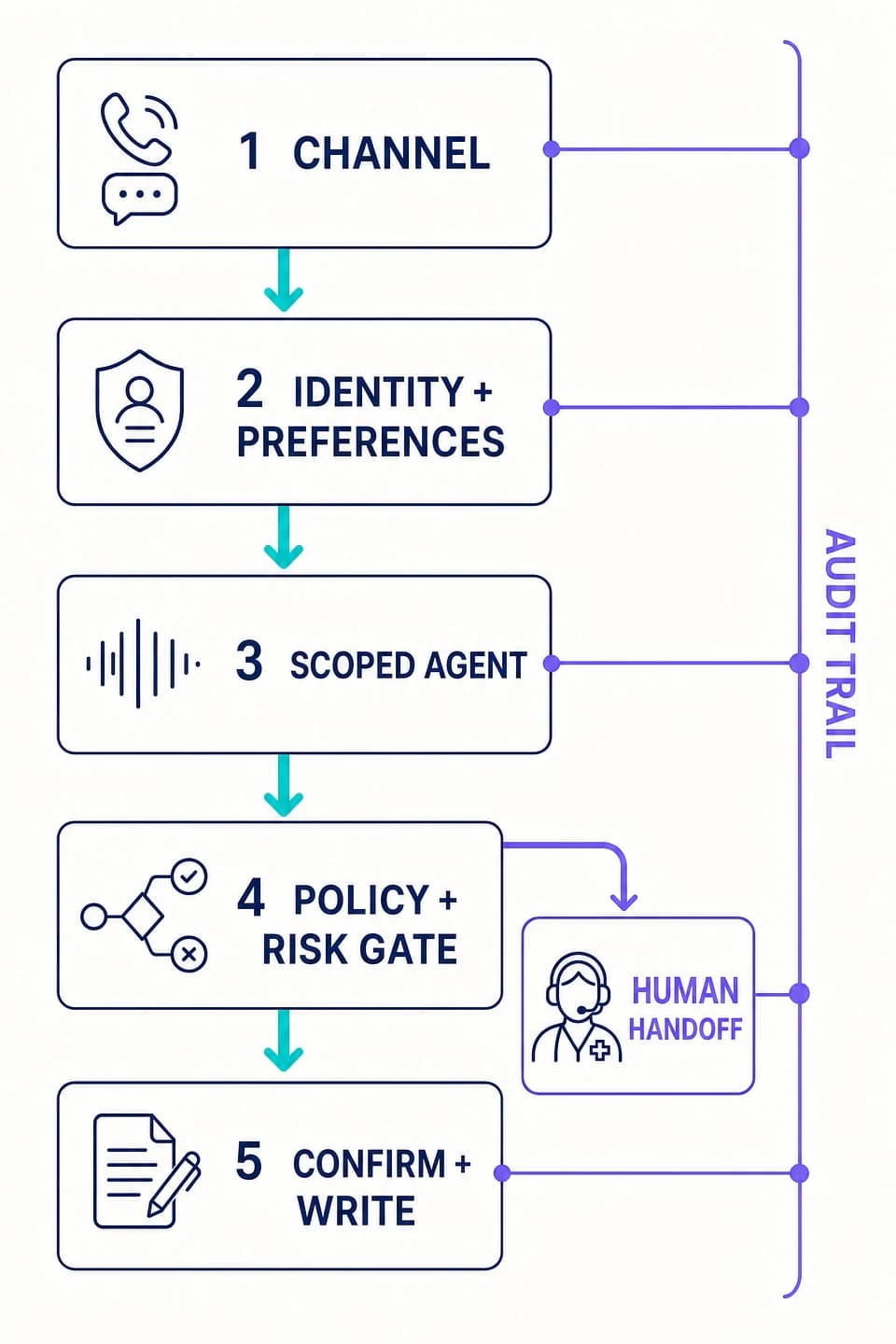
A reliable healthcare communication system separates conversation from organizational policy. This vendor-neutral pattern places identity, permissions, business rules, confirmation, escalation, and logging around the language model. Those controls may live in the customer's application, identity service, policy service, and downstream systems. They should not be assumed to come from the voice-agent vendor.
- Open the approved channel. Capture the outreach permission, AI or prerecorded calling consent, recording and transcription status, communication preferences, and any separate HIPAA authorization required for the use case.
- Apply the organization's identity policy only when needed. Establish the minimum identity state required before exposing patient-specific data or taking an action.
- Constrain the agent's scope. Supply approved knowledge and explicit tools. Enforce refusals and limits outside the prompt as well as inside it.
- Run the policy and risk gate before an irreversible write. Check the record, requested action, permissions, uncertainty, red flags, and policy exceptions before changing a system of record.
- Confirm, then write. Repeat the material action to the patient or operator, obtain the required confirmation, and verify that the downstream result matches it.
- Preserve the handoff and safe fallback. Route exceptions with structured context so the patient does not have to start again, including an after-hours or unavailable-staff outcome.
- Observe every stage. Record sources, model and prompt versions, tool calls, policy decisions, confirmations, writes, transfers, outcomes, and reviewer changes under the organization's access and retention rules.
How to evaluate a healthcare communication pilot
Start with one complete workflow, one accountable owner, and a fixed risk tier. A narrow appointment-rescheduling agent is easier to evaluate than a general patient assistant.
1. Define success and harm cases
Write the intended outcome, unacceptable outcomes, clinical boundary, and exact handoff conditions before building. Include what happens after hours and during system downtime.
2. Map data, vendors, and permissions
List every field the system reads, writes, generates, or retains. Map every provider and subcontractor that handles it. Give each component the least access needed. Keep test and production environments separate, and use synthetic cases for technical evaluation.
3. Stress the conversation and action loop
Evaluate accents, languages, interruptions, silence, ambiguous dates, wrong-patient attempts, prompt injection, unavailable appointments, API timeouts, and urgent symptoms. Include cases designed to expose bias and unequal failure rates. Confirm that the written system outcome matches the spoken or displayed confirmation.
4. Release in stages
Begin with internal simulations, then a limited population and a staffed escalation queue. Expand only after reviewing failures, staff workload, patient response, required agreements, and compliance conditions. Production acceptance belongs to the organization operating the workflow.
5. Measure the operating system, not the demo
Track:
- task completion and abandonment;
- human transfer success and time to answer;
- unsafe, unsupported, or stale responses;
- action-write errors and reversals;
- clinician correction and draft acceptance rates where drafting is in scope;
- latency, interruptions, and repeated turns;
- opt-outs, complaints, and preferred-channel changes;
- performance differences across languages and patient groups;
- the downstream result, such as kept appointments or response time.
AI in healthcare communication earns trust by completing a bounded job, showing its sources and actions, and handing off cleanly when the job changes. Technical teams can prove that pattern without beginning with clinical advice or live PHI.
Sign up for Dasha and build a synthetic scheduling, reminder, or routing workflow around your own policy, data, and handoff services.