Voice AI can handle a focused part of sales development: call an eligible lead, ask a defined set of questions, take an approved action, and record the outcome. The hard part is the system around that conversation. List rules, response time, tool reliability, escalation, and quality control decide whether the agent creates pipeline or simply creates call volume. We built Dasha for technical teams running these workflows in production. Here is the operating model we recommend for evaluating and deploying voice AI for SDR teams.
What voice AI can do in an SDR workflow
A voice AI SDR is a software agent that conducts real-time phone conversations during the early sales cycle. It takes on a bounded task normally handled by a sales development representative (SDR) or business development representative (BDR). It combines telephony, speech recognition, a language model, text-to-speech, conversation rules, and connections to systems such as a CRM or calendar.
A voice AI SDR conducts the phone conversation itself. Broader AI SDR products may focus on email, prospect data, or multichannel outreach, while assisted and parallel dialers keep a human representative on the live call.
The useful unit of automation is a bounded job. “Act as our best SDR” is too broad. “Call demo requesters within our response target, confirm three fit criteria, and book or route the lead” is specific enough to build, evaluate, and govern.
| Stage | Voice AI can handle | Human ownership remains |
|---|---|---|
| Before the call | Read approved lead context, apply campaign parameters, schedule the attempt | Define the ideal customer profile, list policy, message, and exclusions |
| During the call | Introduce the call, answer grounded questions, collect qualification fields, book a meeting | Handle strategic discovery, novel commercial questions, and sensitive objections |
| At handoff | Transfer the call or create a follow-up task with context | Take over when judgment, negotiation, or account knowledge matters |
| After the call | Produce a transcript, disposition, structured fields, and workflow event | Audit quality, coach the system, resolve ambiguous outcomes, and own the pipeline |
This makes voice AI a good fit when volume is high, the call has a repeatable purpose, the allowed answers are grounded in controlled information, and success can be expressed as structured data. It is a poor fit for open-ended enterprise discovery or any campaign where the team cannot define who may be called and why.
SDR voice workflows worth automating first
Start with a motion that has warm intent and a clear next step. These workflows give an agent useful context and limit the cost of a mistake.
Inbound lead callback
A form submission, trial request, or pricing inquiry triggers a call. The agent confirms identity and intent, asks a short qualification sequence, then books, transfers, or routes the lead. The source event, page, product interest, owner, and campaign should travel with the call so the greeting is relevant.
Opt-in event or content follow-up
The agent follows up with people who asked to hear from the company after a webinar, event, assessment, or gated consultation. Keep the call tied to the interaction that created the lead. A generic pitch wastes the context that makes this motion useful.
Qualification and routing
The agent collects only fields that change what happens next, such as use case, company profile, timing, geography, or integration needs. It should skip known CRM fields and route on explicit rules. Qualification is data collection plus a policy decision. It is not a prediction that the lead will buy. Our voice AI lead qualification guide covers evidence states, scoring rules, and auditable CRM handoff in more depth.
Meeting booking and recovery
Voice AI can offer available times, create the calendar event, confirm the result, and handle rescheduling. It can also contact a lead who missed a requested meeting, if that outreach is allowed by the campaign rules. The booking tool needs idempotency so a retry cannot create duplicate events.
Approved re-engagement
An agent can work a defined group of dormant or previously engaged leads. Give the campaign an age limit, a reason for contact, suppression rules, and a stop condition. Avoid treating an old CRM list as automatic permission for unlimited calls.
Cold outbound is technically possible, but it is usually the wrong first pilot. It has weak context, lower tolerance for conversation errors, more list and consent risk, and a harder signal-to-noise problem. Prove conversation quality and system reliability on a warmer motion first.
How a production voice AI SDR works
The conversation is one part of an event-driven workflow. A lead event enters an eligibility gate. Approved calls go to a scheduler and voice runtime. During the call, the agent can read data or take narrow actions through tools. Results flow back to the CRM, analytics, and a human queue.
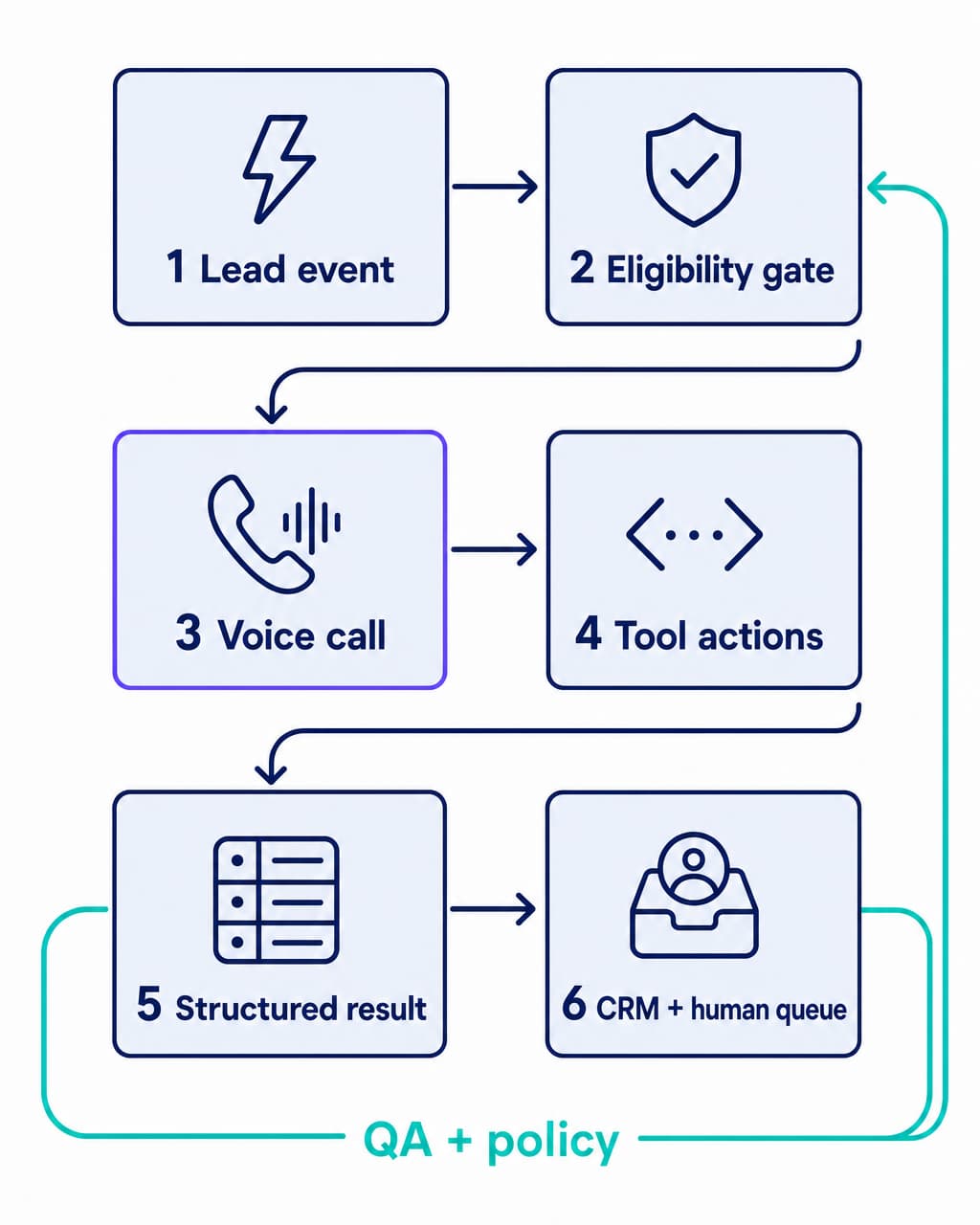
With our voice AI backend, technical teams use a managed runtime, REST APIs, and a web application for telephony, agent configuration, integrations, call execution, and operations. The outbound calls API accepts call context, priority, scheduling controls, and completion or failure webhooks. The bulk calls endpoint schedules list-based campaigns. We provide the runtime and execution interfaces. Your application remains responsible for contact eligibility, campaign policy, retry rules, and the data sent with each call.
A practical outcome contract looks like this:
{
  "disposition": "qualified | nurture | not_interested | opt_out | human_review",
  "qualification": {
    "use_case": "string",
    "timeline": "this_month | this_quarter | later | unknown"
  },
  "next_step": {
    "type": "meeting | transfer | task | none",
    "status": "completed | failed | pending"
  },
  "crm_write_succeeded": true
}
Treat opt_out and human_review as first-class outcomes. Forcing every call into “qualified” or “unqualified” hides uncertainty and creates risky follow-up.
The agent may need tools to look up an account, check availability, book a meeting, send an approved message, or create a CRM task. Our tools and functions let an agent invoke customer-configured API endpoints during a conversation. You define the endpoint, authentication, parameter schema, permitted action, and fallback. Keep each tool focused on one action. Use typed parameters, timeouts, and an idempotency key for any write. If the CRM is unavailable, the agent should acknowledge the limitation and create a recoverable event. It should never invent a successful booking. Our voice AI CRM integration guide covers authentication, field mapping, retry-safe writes, and audit logs.
Our post-call analysis can map a transcript into customer-defined enums, booleans, numbers, and short text fields. You define the labels and must measure their accuracy against reviewed calls. Enum fields such as disposition are easier to govern than open-ended summaries. We also provide configurable call transfers; your team defines the destination, trigger, context, and fallback. Store transcripts and recordings only under the campaign's data and recording rules, and secure the webhooks that carry results.
How to build a voice AI SDR in seven steps
1. Define one job and its exit states
Write the trigger, audience, objective, permitted knowledge, required fields, available actions, and every valid ending. Include no answer, wrong person, voicemail, not interested, opt-out, tool failure, human handoff, and ambiguous outcome. This state model becomes the basis for prompts, integrations, and reporting.
2. Put policy before the dialer
The application should decide whether a call may be scheduled. Check campaign eligibility, consent or other applicable basis, suppression lists, local time, attempt count, lead ownership, and number validity before data reaches the calling queue. Prompt instructions are too late for this control.
3. Design a short, transparent conversation
Identify the company and the AI agent in the opening, then state the reason for the call. Ask one question at a time. Ground answers in approved product material. Give the agent concise rules for uncertainty, disallowed topics, opt-out language, and escalation.
Every branch needs a graceful end. If the prospect asks a question outside the knowledge boundary, the agent can offer a human follow-up. If speech recognition is uncertain, it should confirm the value instead of writing a guess into the CRM.
4. Connect narrow tools
Start with read-only tools, then add writes individually. Validate arguments server-side and return compact, structured responses. A calendar tool should expose available slots separately from booking. A CRM update should allow only approved fields. A transfer function should use a controlled destination rather than a phone number supplied during the call.
5. Define human handoff
Specify which signals trigger transfer or follow-up, who receives it, what context is included, and what happens when no person is available. Good handoff context includes the lead identity, reason for the call, collected qualification fields, objections or questions, consent or opt-out status, and the exact next step promised.
6. Test the system, not only the prompt
Use our agent testing workflow for browser, API, integration, and pre-production checks, then supply test cases from the real SDR motion. Cover happy paths and failure paths: interruptions, silence, accents, background noise, ambiguous dates, repeated questions, voicemail, wrong numbers, tool timeouts, CRM errors, and a human declining the transfer. Inspect audio, transcript, model turns, tool arguments, tool responses, and timing together.
Latency deserves its own test. Human question-and-answer turns have a cross-language mean gap of about 208 milliseconds, according to a turn-taking study. A voice agent has several serial components, so measure the complete gap from the prospect finishing to the agent starting, plus interruption behavior. A natural-sounding voice cannot compensate for long, inconsistent pauses.
7. Run a controlled pilot
Use one segment, one offer, one qualification policy, and a human or existing-process comparison. Review every pilot call. Track changes to the prompt, knowledge, tools, routing, and voice so an outcome can be tied to a version. Expand only after business results and safety guardrails hold at the same time.
Make compliance a system requirement
Campaign eligibility cannot live in a spreadsheet note. It needs enforceable fields and services in the call path.
In the United States, the FCC has confirmed that AI-generated voices count as an “artificial or prerecorded voice” under the Telephone Consumer Protection Act. The applicable consent and disclosure rules depend on the call type and destination. The FTC's Telemarketing Sales Rule adds requirements and prohibitions for covered campaigns, including calling windows, caller ID, entity-specific do-not-call requests, and rules for prerecorded messages. The FTC notes that most business-to-business calls are exempt from its rule, with exceptions, but that exemption does not erase other federal or state obligations. See the FCC declaratory ruling and the FTC compliance guide.
Translate the rules for each jurisdiction and campaign into controls:
- store the contact source, permission record, purpose, and applicable policy;
- suppress opt-outs immediately across agents and future campaigns;
- schedule by the recipient's timezone and permitted window;
- transmit accurate caller ID and use approved numbers;
- include required identity, AI, recording, and purpose disclosures;
- cap attempts and prevent overlapping campaigns from calling the same person;
- control access to recordings, transcripts, and extracted personal data;
- retain campaign, consent, suppression, and call records under the applicable policy.
Treat complaints and opt-outs as operational incidents. They need alerts, root-cause review, and a verified suppression path, just like tool failures.
Measure pipeline quality and operating quality together
Call count and booked meetings are incomplete measures. An agent can improve both while sending poor-fit meetings to account executives or increasing complaints. Use one funnel scorecard and one reliability scorecard.
| Area | Metric | What it reveals |
|---|---|---|
| Reach | Connection rate by segment and attempt | Whether list, timing, and number reputation support the motion |
| Conversation | Meaningful conversation rate | Whether connected calls get beyond the opening and reach the job's core question |
| Qualification | Required-field completion and extraction accuracy | Whether the agent collects usable data and labels it correctly |
| Pipeline | Qualified meetings held | Whether booked meetings survive human review and attendance |
| Quality | False-positive qualification rate | How often the agent routes a lead that fails the agreed criteria |
| Handoff | Transfer completion and accepted follow-up rate | Whether human escalation actually reaches an owner |
| Integrations | Tool and CRM write success | Whether promised actions happen in source systems |
| Experience | Opt-out, complaint, and early-hang-up rates | Whether the campaign is creating friction or risk |
| Runtime | End-to-end response gap, interruption recovery, failed-call rate | Whether the live conversation is stable |
| Economics | Cost per qualified meeting held | Whether runtime, telephony, model, engineering, and QA cost produce a useful outcome |
The figures and scenarios below are representative examples informed by Dasha’s experience across deployments and common industry workflows. They are not customer testimonials or guaranteed outcomes; actual results vary by implementation, traffic, and baseline.
Illustrative scenario assumption
Assume… a pilot starts with 400 eligible warm leads. For planning only, model 120 connected conversations, 24 qualified bookings, 18 held meetings, and three connected minutes per conversation. These are inputs, not benchmarks or predicted results.
The model implies 360 connected minutes and a review set of 120 calls while the pilot is under full quality review. Divide total pilot cost by the assumed 18 held meetings for the budgeted cost per qualified meeting held. After the pilot, replace each planning input with the corresponding observed count and recalculate. Keep the original assumptions beside the actuals so the team can see which part of the operating model was wrong.
Define the denominator for every rate before the pilot. Separate attempts, connections, conversations, qualified outcomes, bookings, and held meetings. Report by segment and agent version. Aggregate averages can hide a broken campaign or a weak branch.
When an AI voice SDR is the wrong tool
Keep the conversation with a person when:
- the account requires bespoke research and an executive point of view;
- discovery involves several stakeholders or commercial negotiation;
- the topic is sensitive, high-risk, or likely to require discretion;
- lead data is stale and campaign eligibility is unclear;
- product facts, pricing, or policies change faster than the knowledge can be governed;
- call volume is too low to justify integration, monitoring, and QA;
- the team has no owner for conversation quality and incident response.
Voice AI should change the allocation of SDR work. People own targeting, strategy, complex conversations, and relationships. The agent takes a defined, monitored job where consistency and immediate capacity matter.
What to look for in a voice AI SDR platform
Evaluate the production workflow with real calls, rather than choosing from a voice demo alone.
- Conversation runtime: Measure complete response gaps, interruption handling, silence behavior, speech recognition on target accents, and stability across a full call.
- Outbound controls: Require scheduling, local timezones, priorities, deadlines, attempt policy, caller ID control, queue controls, and suppression before enqueueing.
- Integration model: Look for typed tools, authenticated webhooks, safe fallbacks, CRM writes, calendar actions, and clear error handling.
- Handoff: Test warm and cold transfer, context delivery, unavailable destinations, and recovery after a failed transfer.
- Traceability: Inspect audio, transcripts, model events, tool calls, latency, configuration changes, and post-call fields at the call level.
- Operations: Check queue and concurrency visibility, alerting, rollback, access controls, data retention, and a path from a small pilot to production load.
- Total cost: Model connected minutes, telephony, model usage, engineering, QA, support, and the cost of poor qualification.
We combine the managed voice runtime with the calling, integration, testing, and monitoring surfaces needed to operate this workflow. If you are building an SDR voice agent, start a Dasha evaluation with one real campaign and the scorecards above.