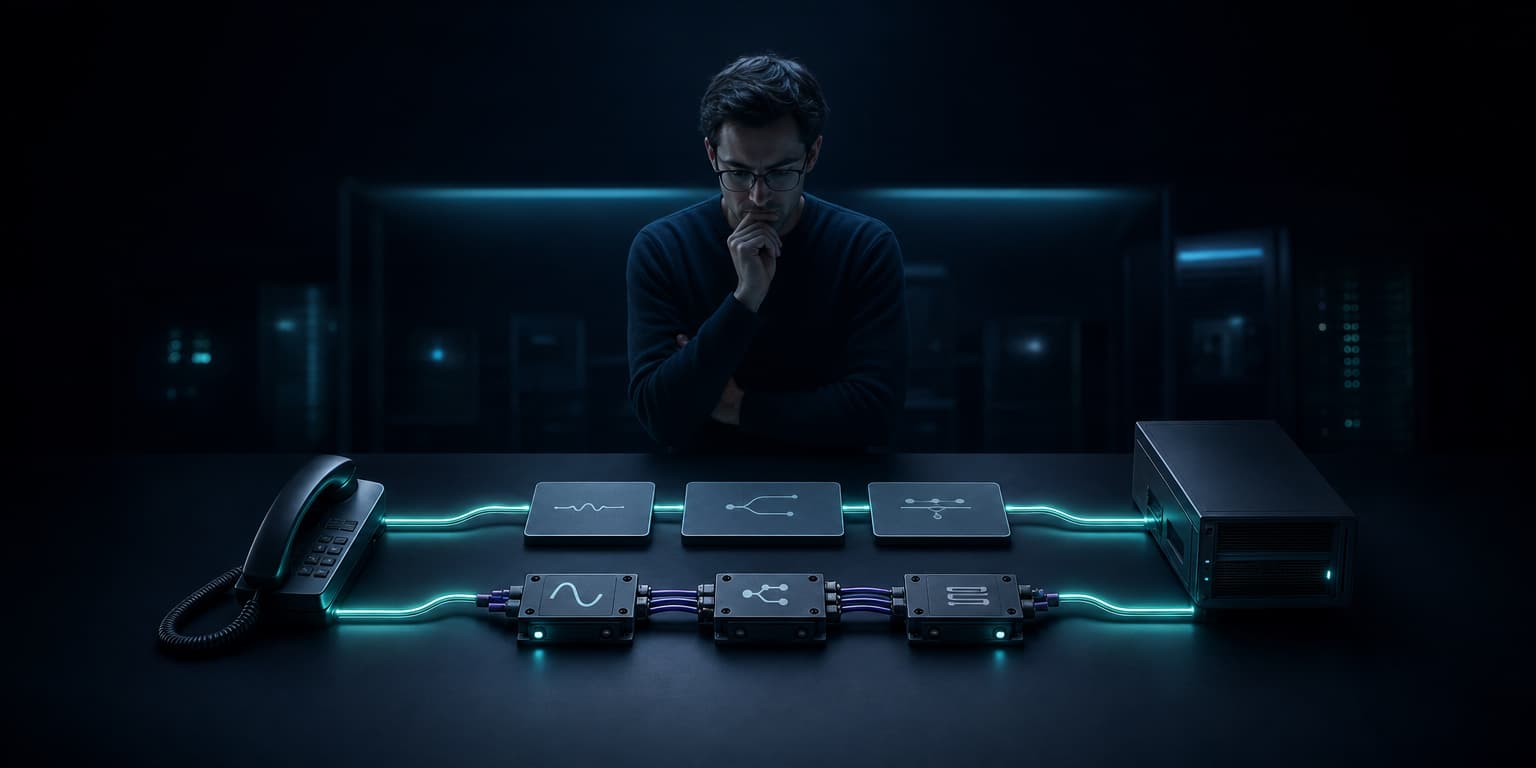
Choosing between Twilio and Telnyx changes more than your phone bill. It changes how your application controls calls, receives audio, routes numbers and recovers from failures. For technical teams building production voice agents, the useful comparison starts with those boundaries. Here is how the programmable-voice and phone-routing paths differ, what belongs in the cost calculation and which parts of a migration stay with your team.
Twilio vs Telnyx: the practical difference
Twilio fits an application already built around TwiML instructions, Twilio call resources and Media Streams. Keeping that working call-control layer avoids rewriting it merely to change a carrier bill.
Telnyx fits a team that wants its REST-command-based Call Control API or a separate Session Initiation Protocol (SIP) trunking path. Moving to either path changes the application boundary, so the decision includes call behavior and migration ownership alongside billing.
Both support programmable calls and SIP trunking. A shared protocol does not establish equivalent application behavior.
| Decision | Twilio | Telnyx |
|---|---|---|
| Programmable call control | TwiML instructions plus REST call resources | REST Call Control commands plus event webhooks; TeXML is a separate XML surface |
| Raw audio for your own agent | Media Streams over WebSockets | Media streaming over WebSockets, with bidirectional audio mode |
| SIP trunking | Elastic SIP Trunking, separate from Programmable Voice | SIP Connections and Outbound Voice Profiles, separate from Call Control |
| Billing records | Usage Records plus per-call logs | Call and Voice API detail records plus usage reports |
| Main migration work | Retain or replace TwiML, callbacks and media handling | Choose TeXML, Call Control or SIP, then implement that contract |
SMS and business phone systems involve different requirements. The comparison here is the phone path into a production voice agent.
Separate the carrier path from the agent runtime
A voice agent needs a phone connection, a way to control the call and a runtime that manages the conversation. Those responsibilities can sit in different systems.
Programmable voice puts call instructions and events in a provider-specific API. Your application answers, plays audio, starts streams, transfers or ends calls through that API.
SIP trunking connects a carrier to your telephony system or managed runtime. SIP handles call signaling. Real-time Transport Protocol (RTP) carries the media. Your runtime or media server owns the application behavior beyond that connection.
This distinction matters when comparing costs. A Twilio Programmable Voice call with Media Streams is a different architecture from a Twilio Elastic SIP trunk connected directly to an agent runtime. The same separation applies to Telnyx Call Control and Telnyx SIP trunking.
A direct SIP path does not automatically need a provider's WebSocket streaming feature. A provider API path does not automatically inherit every capability of its SIP trunking product. Our SIP provider comparison covers the broader carrier shortlist when the runtime already accepts SIP.
Call control: TwiML and Call Control are different contracts
Twilio combines call resources with TwiML instructions
TwiML is Twilio's XML instruction format for call behavior. A webhook response can tell Twilio what to do next. The REST API creates calls and changes calls already in progress.
That model gives an existing Twilio application several dependencies: its TwiML verbs, call identifiers, callback payloads and the timing of instruction execution. Replacing the account credentials does not replace those contracts.
Media-stream lifetime is one concrete example. <Start><Stream> starts a unidirectional stream and allows Twilio to continue to the next instruction. A conversational agent that sends audio back uses <Connect><Stream>, which blocks subsequent TwiML until the WebSocket disconnects. The bidirectional stream behavior therefore affects how the application returns control to a transfer or other call action.
Telnyx separates Call Control from TeXML
Telnyx Call Control sends commands against a call's call_control_id. Call lifecycle events arrive through webhooks. The application reacts to events and issues commands such as answering or starting media.
TeXML is Telnyx's separate XML call-instruction interface. It is relevant to teams moving XML-based call flows, but its existence does not establish feature-for-feature TwiML equivalence. Telnyx's API compatibility guidance warns against combining TeXML and Call Control in the same application.
The engineering implication is straightforward: a Twilio-to-Telnyx migration needs a control-surface decision before it needs a porting request. TeXML preserves an XML-oriented approach. Call Control introduces a command-and-event implementation. SIP moves that boundary into the connected runtime or telephony system.
Media: two-way audio is only the starting point
Twilio Media Streams lets your application receive raw call audio and send audio back over a bidirectional WebSocket. One bidirectional stream can be active on a call. It receives the caller's inbound track; it is not a two-track recording feed. Keypad events are supported toward the media server, with no outbound keypad-event support from that server through the bidirectional stream.
Telnyx's WebSocket stream uses base64-encoded media payloads. Its bidirectional RTP mode has its own codec configuration. Telnyx supports one streaming or media-fork operation per call: starting a media fork replaces the WebSocket stream with an RTP connection. These are alternative media paths, rather than independent feeds that can always run together.
The Telnyx media contract also distinguishes the encoded audio payload from a complete RTP packet. An adapter must handle the documented payload format rather than assume that the word RTP means RTP headers are present in each WebSocket message.
For a production agent, the important behavior spans four moments:
- Audio arrives. The adapter decodes the correct format and associates it with the right call and conversation.
- The agent replies. Generated audio enters the provider's playback path, which may buffer it.
- The caller interrupts. Stopping generation and clearing queued playback are separate actions. Speech already queued at the provider can otherwise continue after the application stops producing audio.
- The call transfers or ends. Media, call control and application state reach the same outcome, without leaving an active stream or an orphaned conversation.
A shared WebSocket transport does not make those state transitions portable. That conclusion follows from the different control and media contracts, not from a measured quality advantage for either provider.
Managed speech changes the comparison again
Twilio's ConversationRelay interface handles speech recognition and text-to-speech while your application exchanges text with it over a WebSocket. It is a different responsibility boundary from raw Media Streams.
More generally, buying a speech or agent layer from the same vendor as the carrier ties additional configuration and APIs to that vendor. A carrier-only move and an agent-platform move then become different projects. The migration includes every layer being replaced; vertical dependency does not make switching impossible.
Voice billing: compare the workload and its layers
A conversation in your application is not necessarily a single call leg or a single usage meter. Connecting a caller to another party can create another call, as Twilio's <Dial> behavior illustrates. Transfers and conferences therefore belong in the call-path inventory alongside the original inbound or outbound connection.
Twilio's usage records separate event count, billed usage and price. They distinguish voice calls, SIP calls, Elastic SIP Trunking, Media Streams, numbers, recordings and recording storage. A call-log total is narrower: Twilio's invoice reconciliation guidance explains that connectivity logs omit additional feature costs and do not represent billing rounding.
Telnyx's reporting tools provide detail records for Calls and Voice API usage, usage breakdowns by direction, product, country or connection, and monthly charges that can be grouped by number. That makes the chosen connection and product part of a meaningful invoice comparison.
A workload-matched quote names these layers separately:
| Layer | What belongs in the workload |
|---|---|
| Phone connection | Inbound and outbound legs, destinations, number types, and the selected SIP or public switched telephone network (PSTN) route |
| Call control and media | Voice API or TeXML path, direct SIP or WebSocket media, and any separately quoted control or streaming usage |
| Transfers and conferences | Additional legs, overlapping call time and participant duration |
| Numbers | Number inventory, rental period and applicable setup or porting charges |
| Recording | Recorded duration, storage and retention |
| Conversation runtime | Speech recognition, model inference, voice generation and runtime operation, whether separate or bundled |
These are scope fields, not a claim that every item is charged on every path. For example, adding WebSocket streaming to the estimate for a direct SIP-to-runtime design would price a different architecture.
The useful comparison is a quote for the same destination mix, traffic direction, billed durations, rounding rules, number inventory and feature use. Its invoice counterpart reconciles provider call identifiers and feature usage with application conversation identifiers. Discounts, commitments, support terms and taxes belong in that same workload-specific view. A single advertised minute cannot stand in for it.
Numbers and routing: porting is a separate workstream
Both providers support number porting, subject to number eligibility and the porting process. Porting moves the number's carrier relationship. It does not translate call instructions, event handlers, recordings or account configuration.
Automated porting has its own limits. The Twilio Porting API is Public Beta, and its create-request flow covers U.S. non-toll-free numbers. That scope describes the API, not every Twilio porting channel. Telnyx's porting requirements include a Letter of Authorization (LOA) and invoice or Customer Service Record (CSR) for a port submission; account details must match the current provider's records. Neither process promises an immediate cutover.
Twilio's SIP trunking configuration uses origination configuration to send inbound calls to your system and termination configuration for calls from your system to the telephone network. Telnyx's SIP routing model assigns inbound numbers to SIP Connections and uses Outbound Voice Profiles for outbound routing and destination controls.
Three boundaries deserve separate ownership in a migration:
| Boundary | What changes | What a port does not supply |
|---|---|---|
| Number and carrier | Number ownership records, port request and cutover | A working agent route |
| Call routing | Trunk or application assignment, destinations and authentication | Translated call-control logic |
| Conversation application | Media adapter, callbacks, transfer and cleanup behavior | Historical data or application-state migration |
This separation allows application work to proceed on a new number before the production number changes carriers. It also keeps the rollback plan honest: restoring an application route is different from reversing a completed number port.
Migration acceptance criteria
A complete migration covers more than a successful answer event:
- Inbound and outbound calls resolve to the intended agent and caller identity.
- Duplicate or delayed events do not trigger a second action or overwrite a terminal state.
- Caller interruption stops both new generation and queued playback.
- Busy, unanswered and rejected transfer destinations produce defined outcomes.
- A WebSocket failure or hangup releases the call and conversation resources.
- Provider call identifiers, application conversation identifiers and billable legs remain traceable together.
These are engineering requirements for the application. They are not claims that either carrier handles the entire workflow on your behalf.
Where Dasha fits after the carrier decision
We provide the managed production platform for building and running conversational AI products. Dasha is the agent-runtime layer in this decision, rather than a like-for-like replacement for a carrier.
Our phone-number integration has two paths. The Twilio integration imports numbers and automatically configures a SIP trunk. The manual SIP path accepts provider credentials and links numbers to agents. Our SIP configuration includes authentication, transport selection and call-rate limits.
That distinction is useful for a team whose goal is a production conversation rather than ownership of a custom media bridge. A SIP connection can put the carrier boundary below the managed runtime. It does not establish identical feature support across every provider configuration, and manual SIP setup is not the same integration as Telnyx Call Control or TeXML.
If your requirement is only SIP transport for a runtime you already operate, the carrier comparison remains the relevant decision. If you also want us to manage the voice-agent runtime, start building through the Dasha quickstart.