A missed call leaves both sides guessing. The caller does not know whether anyone noticed, and the recipient does not know why they called. A clear message closes that gap. For businesses with recurring call volume, we help technical teams build inbound voice agents that answer, qualify, and route inbound calls. Calls that still need follow-up deserve the same care.
What to send after a missed call
Use one of these two messages when you need a quick answer:
If you missed someone else's call:
Hi [Name], sorry I missed your call. I can call you back [time], or you can text me what you need.
If your business missed a caller:
Hi, this is [Business]. Sorry we missed your call. Reply with [one useful detail], and our [team] will get back to you by [realistic time].
A useful missed call message does four things:
- Identifies the sender.
- Refers to the missed call.
- Gives one easy next step.
- Sets an expectation you can keep.
A bare “call me” creates another mystery call. In a discussion among IT service providers, many participants said they would not return a call without a voicemail, text, email, or ticket explaining the reason. The lesson applies outside IT: context earns the callback.
Personal missed call message templates
Replace the brackets and send the message as written. A name, one sentence of context, and a specific time are usually enough.
| Situation | Message |
|---|---|
| 1. Simple reply | Hi [Name], sorry I missed your call. Is now a good time for me to call back? |
| 2. You are busy | Hi [Name], I saw your call. I am tied up until [time], but I can call you then. Is it urgent? |
| 3. You are replying late | Hi [Name], sorry I am only getting back to you now. I saw your call from [day]. Do you still need me? |
| 4. The number is unknown | Hi, I missed a call from this number. Who is this, and what were you calling about? |
| 5. A work contact called | Hi [Name], sorry I missed you. Please send me the topic and any deadline, and I will call you by [time]. |
| 6. A friend or family member called | Hey [Name], just saw your call. Everything okay? I can call in [number] minutes. |
| 7. You prefer a text first | Hi [Name], I cannot talk right now. Text me a quick summary and I will respond or call when I am free. |
| 8. You cannot call back today | Hi [Name], sorry I missed you. I cannot call today, but I am available [day and time]. If it cannot wait, please text me the details. |
For an unknown number, keep your reply neutral. Do not share personal or account information until you know who contacted you. If the call looks suspicious, the safer response is no response.
Business missed call text templates
A business reply has more work to do. It must identify the company immediately, reduce uncertainty, and move the caller into a process that someone owns.
General and after-hours messages
| Situation | Message |
|---|---|
| 9. Standard business-hours reply | Hi, this is [Business]. Sorry we missed your call. Reply with your name and what you need, and our team will call you by [time]. |
| 10. After-hours call | Thanks for calling [Business]. We are closed now and reopen at [time]. Reply with your name and request, and we will follow up by [time]. |
| 11. Team is on another call | Hi, this is [Business]. Our team is helping other customers, and we saw your call. Reply with the reason for your call, and the right person will contact you. |
| 12. Repeat caller | Hi, this is [Business]. We saw that you called more than once. Reply with the issue and whether it is time-sensitive so we can route it correctly. |
| 13. Known customer | Hi [First name], this is [Business]. Sorry we missed you. Reply with the order, appointment, or account topic, and [team] will follow up by [time]. |
| 14. Callback scheduling | Hi, this is [Business]. We missed your call. Reply with your preferred callback window: [option 1], [option 2], or [option 3]. |
Messages for specific call intents
| Situation | Message |
|---|---|
| 15. Appointment request | Thanks for calling [Business]. To schedule, reply with the service you need and two times that work for you. We will confirm an available slot. |
| 16. Customer support | Hi, this is [Business] support. We missed your call. Reply with your name and a short description of the issue. Please leave out passwords and payment details. |
| 17. Urgent home service | Hi, this is [Business]. Sorry we missed you. Reply with your ZIP code and the issue. If there is immediate danger, contact the appropriate emergency service now. |
| 18. Estimate or quote | Thanks for calling [Business]. Reply with the service you are considering and your location. Our team will contact you about the next step. |
| 19. Healthcare administration | Thanks for calling [Practice]. We received your call. Reply with your name and the best time to reach you. Please do not include medical details in this text. |
| 20. Legal or professional services | Hi, this is [Firm]. We received your call. Reply with your name, a broad matter type, and the best callback time. Please do not send confidential details by text. |
| 21. New sales inquiry | Hi, this is [Business]. Sorry we missed your call. Reply with what you are evaluating and your preferred callback time, and we will connect you with the right person. |
| 22. Service-area screening | Thanks for calling [Business]. We missed you. Reply with your ZIP code and the service you need so we can route your request. |
These messages ask only for information the next person can use. They avoid turning the first text into a full intake form.
Voicemail greetings for missed calls
A voicemail greeting plays before the caller leaves a message. A missed call text is sent after the call ends. Use both when voicemail remains part of your workflow, and keep their instructions consistent.
23. Standard voicemail greeting
Thanks for calling [Business]. We cannot answer right now. Please leave your name, number, and the reason for your call. We will return your call by [time].
24. After-hours voicemail greeting
You have reached [Business] outside our hours of [hours]. Leave your name, number, and a short message. We will call you after we reopen at [time].
25. Voicemail with a text option
Thanks for calling [Business]. We are helping another customer. Leave a message, or text this number with your name and request. Our team will respond by [time].
Only promise a callback time your team can meet. “As soon as possible” sounds safe, yet it tells the caller nothing.
How to write a missed call message that gets a response
Templates work best when the message matches the actual process behind it.
Name the person or business first
A text from an unfamiliar number can look like spam. Put the business name in the opening sentence. For a personal reply, use the caller's name when you know it.
Ask for one useful action
Choose the next step that moves the conversation forward:
- Reply with a short description.
- Choose a callback window.
- Share a ZIP code or broad service type.
- Use a scheduling link when booking is the only goal.
Do not ask the caller to reply, call again, visit a website, and book online in the same message. Multiple options add work.
Set an accurate expectation
Use a real time or process: “by 3 p.m.,” “after we reopen at 8 a.m.,” or “a dispatcher will call next.” Do not claim a person will call in ten minutes if replies wait in an unowned inbox.
Match the caller's context
An urgent repair caller needs triage. An appointment caller needs available times. A support caller needs a case owner. A generic apology ignores the reason people call.
Keep sensitive details out of the first text
Use the message to establish identity and arrange the next step. Passwords, payment card data, medical details, and confidential case facts belong in the approved channel for that information.
Build the workflow around the message
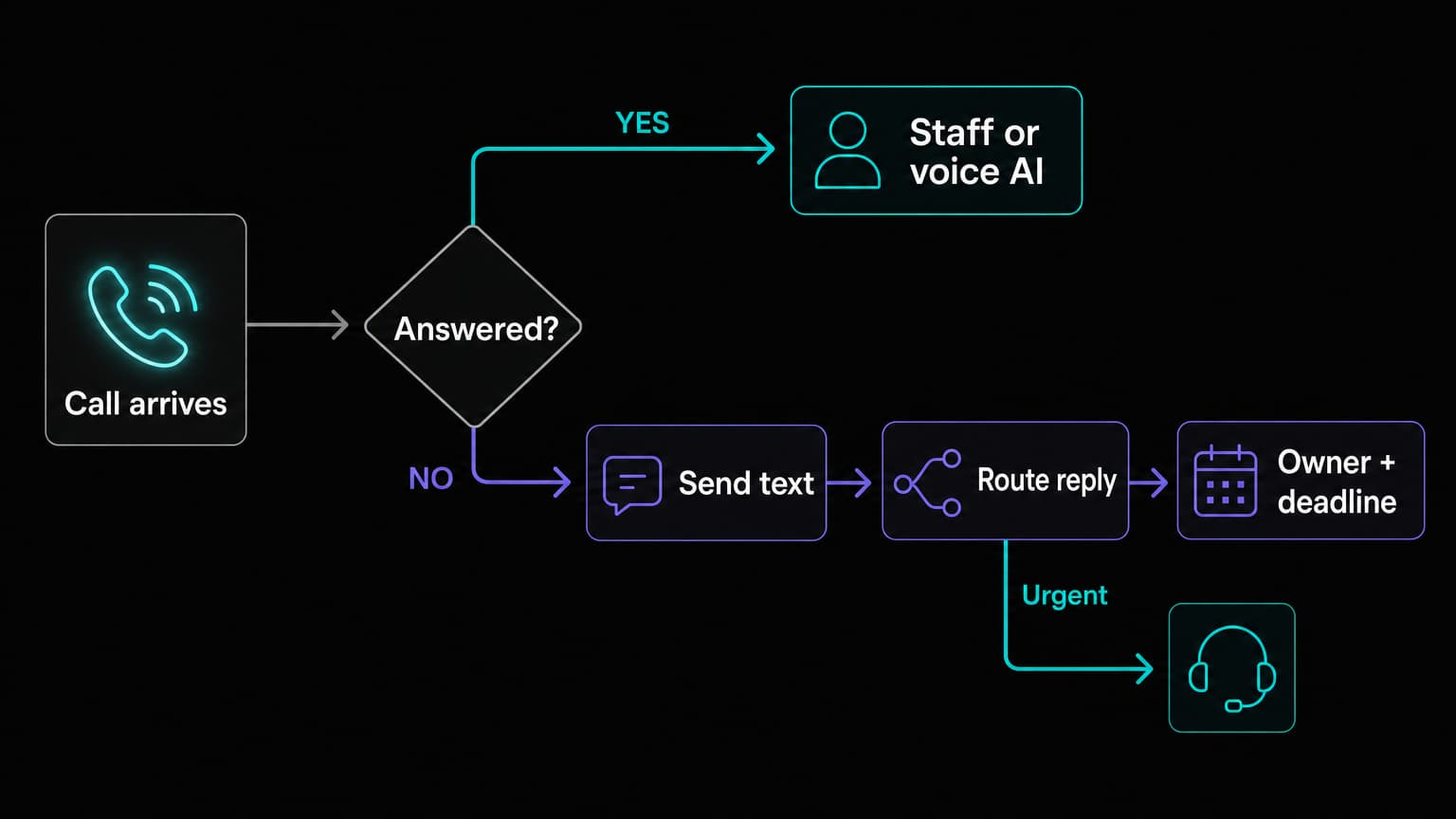
The message is one event in a larger call path. A dependable workflow handles detection, consent, routing, ownership, and failure states.
- Define a true missed call. In a ring group, one employee failing to answer is not a miss if another endpoint picks up. Trigger follow-up only after the full route ends without an answer.
- Deduplicate repeat attempts. Several calls from the same number in a short window should update one open conversation instead of sending the same text each time.
- Check consent and suppression records. Before sending, confirm that the recorded consent covers the sender, destination number, purpose, and type of message. Exclude blocked or anonymous caller IDs, spam-labeled calls, abandoned calls below your chosen duration, and anyone who has opted out.
- Enforce the contact window. Use the recipient's location and local time to apply quiet hours and every federal, state, and other jurisdiction-specific contact window that covers the message. Queue the text until sending is permitted instead of treating an after-hours missed call as permission to send immediately.
- Send the right response. Select the template from business hours, dialed number, customer status, and call source. Keep the acknowledgment short.
- Capture the reply. Store the response with the original call event so staff see one history instead of disconnected call and message records.
- Route by intent and urgency. Assign booking, support, sales, and urgent requests to different queues when the operating model requires it.
- Create an owner and deadline. A reply in a shared inbox is still unhandled until a person or system owns the next action.
- Escalate failures. If no owner accepts the task, the callback deadline passes, or the caller tries again, move the conversation to an overflow path.
The workflow should log the final call outcome, template used, reply, owner, response time, and resolution. Those records make it possible to find routing failures and improve the response path.
When a voice AI agent is better than a missed call message
A text is useful when the caller prefers messaging or when every live route has failed. It cannot ask follow-up questions in real time, complete a booking during the call, or transfer an urgent caller while their intent is fresh.
A voice AI agent can cover overflow and after-hours calls, collect structured information, use tools to complete approved tasks, and transfer the caller when a person is needed. Our managed platform lets technical teams route inbound calls to an agent, connect the agent to external systems, and use warm, cold, or dynamic call transfers. The Dasha inbound calls guide and Dasha call transfer guide cover implementation. Our guide to inbound call center software explains how those capabilities fit with routing, observability, and human handoffs.
| Call pattern | Better first response |
|---|---|
| Low-volume personal call | Manual text or callback |
| Caller only needs acknowledgment | Missed call text |
| Routine booking, status, or qualification | Voice AI agent with tool access |
| High-volume overflow or after-hours traffic | Voice AI agent with an owned fallback queue |
| Sensitive, distressed, or exceptional situation | Trained human, with immediate escalation |
The production design should still include a missed-call fallback. Carriers fail, transfers time out, integrations become unavailable, and callers sometimes disconnect before the conversation starts.
Consent and opt-out rules for automated texts
An inbound call does not give every business unrestricted permission to start automated texting. Under the U.S. Telephone Consumer Protection Act (TCPA) framework, texts are calls. Calls or texts made to wireless numbers with an automatic telephone dialing system generally require the called party's prior express consent. When an automatic-dialing-system call or text includes advertising or constitutes telemarketing, prior express written consent generally applies, subject to exceptions such as certain tax-exempt nonprofit and healthcare messages. The specific restrictions, definitions, and exceptions appear in 47 C.F.R. § 64.1200.
A person may revoke prior express consent, including written consent, through any reasonable method that clearly communicates the request. The rule recognizes common opt-out words such as “stop,” “quit,” “end,” “revoke,” “opt out,” “cancel,” and “unsubscribe,” but a business cannot make those keywords the only valid method. A reply using different language also counts when a reasonable person would understand it as a request to stop. Valid revocations must be honored within a reasonable time and no later than 10 business days after receipt.
For telephone solicitations, the federal rule also restricts contact before 8 a.m. or after 9 p.m. at the recipient's location and applies its solicitation and do-not-call provisions to covered telemarketing calls or texts to wireless numbers. State and other jurisdiction-specific rules can impose narrower windows or additional restrictions.
Treat consent as data in the workflow:
- Record how and when consent was obtained, what messages it covers, and the number to which it applies.
- Separate a direct service response from marketing follow-up.
- Recognize opt-out requests made through any reasonable method, including language outside a fixed keyword list.
- Suppress future automated calls and texts as soon as practical and within the 10-business-day limit.
- Check the recipient's local time, quiet hours, and jurisdiction-specific contact windows before every send.
- Append the disclosure and opt-out language required by your program's legal, carrier, and registration rules.
“Reply STOP to opt out” supports an opt-out path. It does not create the consent required to send the first automated message. Rules vary by jurisdiction and message design, so automated programs need legal review before launch.
Frequently asked questions
How do you politely say you missed a call?
Acknowledge it, give a clear callback time, and offer a text option: “Sorry I missed your call. I can call you at 3 p.m., or you can text me what you need.” A long apology is unnecessary.
How soon should a business send a missed call message?
Begin sending only after the system knows the entire call route ended without an answer and the consent, quiet-hour, and jurisdiction-specific contact-window rules permit the text. The trigger should wait for ring groups, overflow paths, and transfers to finish. If the permitted window has not opened, queue the message rather than sending it immediately.
Should a missed call message include a booking link?
Include one when booking is the single next step and the destination is mobile-friendly. If the caller may need urgent help, support, or a different department, ask for intent first and route the reply.
What should you avoid in a missed call text?
Avoid an unidentified number, a vague “call us back,” several competing actions, a callback promise the team cannot meet, and requests for sensitive information. Automated business texts also need the consent and opt-out controls that apply to the program.
A missed call message can recover a conversation. A well-designed inbound agent can keep the conversation from being missed. Build and evaluate an inbound voice agent with Dasha.