
Most lead generation programs optimize acquisition while losing revenue between a form fill and the first useful conversation. A lead generation engine fixes those handoffs. It turns signals into decisions, actions, and feedback on a defined clock. The result is an operating system that marketing, sales, data, and engineering can improve together. Here is how to design the lifecycle, choose where AI belongs, connect each component, and measure whether the engine creates qualified pipeline instead of activity.
What is a lead generation engine?
A lead generation engine is a repeatable, closed-loop system that attracts or identifies prospects, captures their data, qualifies them, starts the right conversation, routes sales-ready opportunities, and learns from downstream outcomes.
The word engine matters. A campaign has a start and an end. A funnel describes stages. An engine defines how a lead moves, who or what makes each decision, how quickly the next action happens, and which outcome improves the next cycle.
A working engine has seven connected stages:
| Stage | Question it answers | Output |
|---|---|---|
| Source | Where did this prospect or signal come from? | Source, campaign, offer, and timestamp |
| Capture | What data and permission did the prospect provide? | A deduplicated lead record |
| Context | What do we know about the person, account, and behavior? | Verified enrichment and intent signals |
| Decision | Is this lead a fit, and are they ready now? | Fit score, intent score, and reason codes |
| Engagement | Which next interaction matches the signal? | Email, phone, message, meeting, or nurture action |
| Handoff | Who owns the next step, and by when? | Owner, service-level deadline, and context packet |
| Learning | What happened after the handoff? | Accepted, rejected, opportunity, won, lost, and reason |
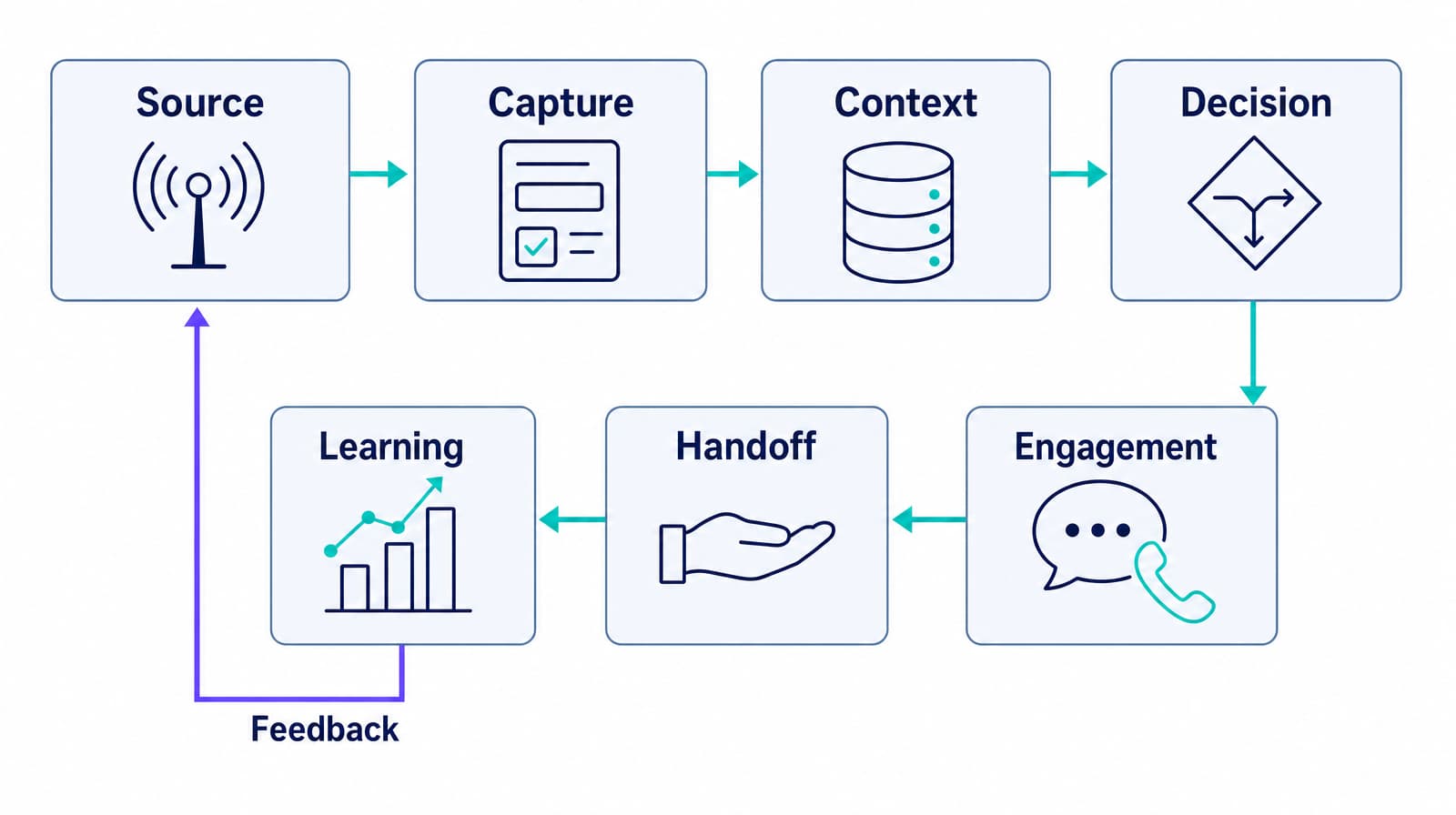
If any stage cannot produce its output, the system has a leak. More traffic will send more leads into that leak.
Design the lifecycle before choosing tools
Lead generation software categories map to different jobs. Data providers find accounts. Forms capture interest. Customer relationship management (CRM) systems store records. Automation platforms move data. Engagement tools send messages or place calls. Analytics systems report outcomes. Buying a tool in each category still leaves the decision logic and handoffs undefined.
Start with a lifecycle contract. For every state, specify:
- the event that moves a lead into the state;
- the required fields and evidence;
- the system responsible for the decision;
- the person or service responsible for the next action;
- the maximum time allowed;
- the success, failure, suppression, and retry states;
- the event written back when the action finishes.
This contract turns a diagram into an executable process. It also exposes ambiguous labels. “Qualified,” for example, may mean the account matches the ideal customer profile, the person has shown intent, or a sales rep has accepted the lead. Give each meaning its own state.
How to build a lead generation engine in eight steps
1. Define the commercial outcome and ideal customer profile
Work backward from an accepted sales opportunity. Describe the accounts that can buy, the people involved, the problems that create urgency, and the evidence required before sales should act.
Keep account fit and buying intent separate:
- Fit asks whether the account could become a good customer. Use attributes such as segment, geography, use case, technical requirements, and disqualifiers.
- Intent asks whether action is timely. Use events such as a demo request, pricing-page visit, product usage threshold, referral, webinar question, or direct reply.
A high-fit account with weak intent may enter nurture. A lower-fit account with strong intent may get a self-serve path. A high-fit, high-intent lead deserves immediate attention. One blended score hides these differences.
2. Define one lead record and one event vocabulary
Choose a system of record, usually the CRM, and give every lead and account a durable ID. Preserve source events instead of repeatedly overwriting a “lead source” field. A lead may discover you through search, return through an event, and convert through a referral. The event history should show all three.
A useful decision record can stay compact:
{
  "lead_id": "ld_8472",
  "account_id": "ac_193",
  "source_event": "demo_request",
  "captured_at": "2026-09-16T14:05:00Z",
  "fit": { "score": 82, "reasons": ["target_segment"] },
  "intent": { "score": 90, "reasons": ["requested_demo"] },
  "permissions": { "email": true, "phone": true },
  "next_action": "voice_qualification",
  "action_deadline": "2026-09-16T14:10:00Z",
  "status": "queued"
}
Store reason codes alongside scores. A number without evidence is hard to debug, explain, or improve.
3. Instrument a small set of high-signal sources
Choose two or three sources that reach the ideal customer profile. For an early B2B engine, that may be high-intent website conversion, product-qualified usage, and tightly selected outbound accounts. Each source needs consistent campaign fields, costs, and downstream outcome tracking.
Match capture friction to intent. A newsletter form may need one field. A technical consultation can justify questions about use case, scale, timeline, and integration requirements. Ask only for information that changes the route. Enrich the rest from reliable data or during a conversation.
4. Validate, deduplicate, enrich, and suppress
Run data hygiene before scoring or outreach. Normalize email addresses and phone numbers, match leads to accounts, validate required fields, and attach enrichment with its source and timestamp. Decide how stale enrichment expires.
Suppression is part of the data model. Keep channel permissions, unsubscribe status, do-not-contact requests, geographic restrictions, and customer-specific policies available at the moment an action is selected. In the United States, CAN-SPAM applies to commercial email, including business-to-business messages, and requires a working opt-out process. The FTC compliance guide explains the obligations. Phone programs also need rules for consent, calling windows, identification, do-not-call handling, and record retention based on each jurisdiction and use case. The Telemarketing Sales Rule guidance is one starting point for U.S. operations.
Compliance rules belong in code and configuration, with legal review for the markets you operate in. A prompt is an unsafe place to enforce them.
5. Score with explicit gates
Start with rules the revenue team can inspect. A basic model might give fit points for target segment and use case, then apply a hard disqualifier for an unsupported geography. Intent may rise after a demo request and decay when no new signal appears.
Use three outputs rather than a long ranked list:
- Act now: strong fit and intent, with permission for the selected channel.
- Nurture: plausible fit with limited or early intent.
- Suppress or disqualify: poor fit, invalid data, policy restriction, or explicit opt-out.
Machine learning can rank leads later, once the engine has enough clean outcomes. Until then, complex scores often encode assumptions with false precision.
6. Select the next best action and response clock
Map each signal to a channel, message, owner, retry policy, and deadline. A demo request may trigger an immediate confirmation and a qualification call. A product usage signal may notify the account owner. A content download may start a slower educational sequence.
Response time is a system requirement. In a study covering 1.25 million leads, companies that attempted contact within an hour were nearly seven times as likely to qualify a lead as companies that waited even one more hour, and more than 60 times as likely as those waiting at least a day. The lead-response study is older, so use the exact threshold as a design hypothesis and measure the effect on your own buyers. The durable lesson is that the clock starts at the signal, not when a rep opens the CRM.
Real-time voice is useful when a prospect has asked for contact, when a short conversation can resolve qualification questions, or when phone follow-up already belongs in the approved workflow. A voice agent can gather structured answers, book a meeting, and transfer a qualified conversation to a person. Sensitive negotiations, unclear consent, and unusual cases should route to a human.
7. Make the handoff transactional
A handoff should create an owner and a deadline in the same operation. If owner assignment fails, the lead stays in an exception queue instead of appearing “routed.” Use idempotency keys so retries do not create duplicate tasks, messages, calls, or meetings.
Send the receiving rep a compact context packet:
- source and recent signals;
- fit and intent reasons;
- questions already answered;
- conversation summary or transcript link;
- objections or constraints;
- promised next step;
- permission and contact status.
Then require acceptance or rejection with a reason. Our inbound lead qualification workflow includes a practical scorecard and routing model for this part of the engine.
8. Close the loop with revenue outcomes
The engine learns only when downstream outcomes return to the source, score, and action records. Capture sales acceptance, opportunity creation, stage movement, win, loss, disqualification reason, and time between stages.
Hold a regular review by source and segment. Promote rules supported by outcomes. Retire sources that create form fills and little accepted pipeline. Add failure cases to tests before changing prompts, scores, or integrations.
Where generative AI helps
Generative AI works best inside narrow decisions with context, a defined output schema, and a safe fallback. Keep deterministic policy in regular code.
| Task | Good control pattern |
|---|---|
| Summarize a call or long form response | Require a fixed schema and retain the source record |
| Extract use case, urgency, or objection | Allow only defined labels plus supporting evidence |
| Research an account | Record sources, freshness, and “unknown” when evidence is missing |
| Draft a follow-up | Ground it in approved facts and require review for sensitive segments |
| Score free-text intent | Combine model output with explicit fit, permission, and policy gates |
| Choose a route | Let code enforce eligibility; let the model classify the conversation |
Avoid giving a model control over contact permission, suppression, pricing commitments, or destructive CRM updates. Version prompts and models like application code. Log their inputs and structured outputs. Test edge cases before release and sample production results for regressions. A voice agent testing workflow should cover conversation behavior, tool calls, telephony, failures, and rollback.
Metrics that show whether the engine works
Measure the system in layers. Volume alone cannot distinguish growth from waste.
Acquisition and data quality
- cost per captured lead by source;
- valid-contact and duplicate rates;
- percentage of records with required permission and source fields.
Decision quality
- percentage routed to act now, nurture, and disqualify;
- sales acceptance rate;
- false-positive reasons from rejected leads;
- score distribution by segment.
Execution quality
- median and 90th-percentile time to first action;
- queue failures, retries, and unowned leads;
- connection, conversation, meeting, and transfer rates by channel;
- unsubscribe, do-not-contact, and complaint rates.
Revenue quality
- accepted leads that become opportunities;
- pipeline and revenue per source;
- cost per accepted lead and cost per opportunity;
- time from capture to opportunity;
- won revenue by the source, score, and first action used.
Define every metric as a numerator, denominator, time window, and owner. “Conversion rate” is too vague until the two states are named.
Diagnose the engine by its leaks
| Symptom | Likely leak | First correction |
|---|---|---|
| Lead volume rises while pipeline stays flat | Weak source fit or permissive scoring | Compare accepted-opportunity yield by source and segment |
| Good leads wait in the CRM | Missing deadline, owner, or queue monitoring | Create transactional assignment and an exception queue |
| Sales rejects most marketing-qualified leads | Fit and intent are blended or undocumented | Split the scores and require rejection reasons |
| Personalization sounds generic | Thin context or unconstrained generation | Reduce the task, add verified inputs, and use structured outputs |
| Prospects receive duplicate outreach | Identity resolution or retry failure | Add durable IDs, deduplication, and idempotency keys |
| Reports disagree across systems | Events are overwritten or definitions differ | Publish one event vocabulary and metric contract |
| AI changes reduce meeting quality | Evaluation uses activity instead of outcomes | Replay representative cases and gate releases on accepted-lead quality |
Fix the narrowest broken stage first. Adding another channel usually multiplies an existing data, decision, or handoff problem.
How Dasha fits into a lead generation engine
Dasha provides the real-time voice engagement and qualification layer for teams that need to build phone conversations into their product or revenue workflow. Our managed voice AI backend supports inbound and outbound calls, tools that connect agents to business systems, webhooks, call transfer, structured post-call analysis, transcripts, recordings, and operational logs.
The surrounding engine still owns the ideal customer profile, lead sources, CRM state, channel permission, business rules, and final revenue attribution. A typical integration sends an eligible lead and approved context to Dasha, lets the agent ask a bounded set of qualification questions, writes structured outcomes back through a webhook, and routes qualified or exceptional calls to a person.
That boundary gives engineering teams a clear operating model. Your system decides who may be contacted and why. Dasha runs the live conversation and returns evidence your system can act on.
If voice belongs in your lead lifecycle, start building with Dasha and test the complete path from CRM event to qualified handoff.
Boost Your Lead Generation Now!
Supercharge your lead gen process with generative AI. Take action with Dasha today. Start your free trial and prepare to be amazed!