Every minute spent understanding a real buyer is useful. Time spent chasing a student, vendor, job seeker, or company you cannot serve is not. Inbound lead qualification separates those cases while the buyer's interest is still fresh. The challenge is to move fast without turning your form or first conversation into an interrogation. A clear process gives sales the context to act, sends early buyers to the right nurture path, and treats a poor fit consistently.
What inbound lead qualification should produce
Inbound lead qualification is the process of deciding whether an incoming person or account fits whom you serve, has a problem worth a sales conversation, and is ready for a specific next step.
A completed qualification should produce four things:
- A fit decision based on facts such as segment, geography, use case, and requirements.
- An intent decision based on the buyer's problem, urgency, current approach, and willingness to act.
- A reason code that explains why the lead received that decision.
- A next action and owner, such as book with sales, send to nurture, route to a partner, or close the record.
This is different from lead scoring. A score helps apply the rules consistently. Qualification is the decision and resulting action. A high activity score can still belong to a researcher who cannot buy. A great-fit account can still be months away from a project.
A marketing-qualified lead (MQL) has met criteria set by marketing. A sales-qualified lead (SQL) has been accepted for direct sales work. Whatever labels you use, define the evidence, the owner, and the next action for each one.
For technical teams that want to qualify high-intent leads by phone, our voice AI backend can run the conversation, call CRM or calendar tools, and return a structured result. The same operating model works with a human sales development representative (SDR), a voice agent, or a mix of both.
How to qualify inbound leads in seven steps
1. Define fit and intent separately
Start with your closed-won and closed-lost records. Identify the attributes that made an account serviceable and the signals that showed a buying process had started.
Fit changes slowly. It includes the market you serve and the constraints of your offer:
- customer segment or company size
- industry and use case
- geography or service area
- required integrations, deployment model, or regulatory controls
- minimum practical deal size or volume
Intent can change during one conversation. It includes:
- a specific problem or desired outcome
- impact of leaving the problem unsolved
- an event or timeline that creates urgency
- access to the people involved in the decision
- agreement to a useful next step
Write hard disqualifiers separately from weighted criteria. If you cannot sell in a country or support a required deployment model, no amount of page views should override that fact.
2. Match the response to the inbound signal
An inbound lead is a person who initiates contact or leaves a signal through a channel such as a demo request, quote form, trial, event, content download, or inbound call. Those actions do not carry equal intent.
| Inbound signal | Sensible first response |
|---|---|
| Demo, quote, or contact request | Start a fast conversation on the channel the person selected |
| Inbound phone call | Qualify during the call and route in real time |
| Product trial with meaningful usage | Offer help around the action they are trying to complete |
| Webinar registration or content download | Nurture until the person shows a buying signal |
| Referral or partner introduction | Assign a named owner with the referrer's context attached |
Set a service-level agreement for each source. High-intent requests should enter an automated workflow immediately, even when a person will handle the conversation. Speed matters most when the buyer has explicitly asked to talk. It does not justify calling every content downloader.
For an explicit request for a phone call, use five minutes as a starting target for the first compliant attempt. Adjust that target by source and operating hours using your own contact, meeting, and opportunity data. In a 2011 study of 2,241 US companies, researchers found that 23% never responded to a test web lead and only 37% responded within an hour. The published study is older, but the operational lesson is still sound: an inquiry needs an owner and a timed response path.
3. Keep the capture form short
Ask for the fields needed to identify the lead, select a response, and apply immediate guardrails. For many B2B flows, that means name, work email, company, the reason for contacting you, preferred channel, and the required consent record. Consumer and field-service flows may need location or service type instead of company data.
Store context that the buyer has already provided:
- landing page and form name
- campaign and referral data
- pages or product actions that preceded the form
- time zone, language, and requested product
- current account owner and prior conversations
Enrich facts such as industry and headcount in the background when the data source is reliable. Do not ask the buyer to repeat known information during the call.
4. Ask questions that change the route
Every qualification question should affect scoring, routing, or the next conversation. If an answer changes nothing, remove the question.
Use this order for a short first conversation:
- Goal: "What are you hoping to improve?"
- Current state: "How are you handling that today?"
- Impact: "What happens if it stays the same?"
- Timing: "When do you want a new approach in place?"
- Decision process: "Who else will be involved in choosing it?"
- Constraints: "Which technical, policy, or budget constraints should we account for?"
- Next step: "Would it make sense to bring in a specialist for a deeper discussion?"
Ask a follow-up when an answer is vague. "We need it soon" should lead to "Is that this month, this quarter, or later?" Confirm names, dates, and quantities back to the caller before storing them.
BANT, which stands for budget, authority, need, and timeline, is a useful checklist. It should not dictate the order of a natural conversation. Leading with budget can end a good discussion before you understand the problem, especially when the buyer has not yet built an internal business case.
5. Score fit and intent on separate axes
A two-part score shows sales why a lead was routed. It also prevents weak engagement signals from hiding a hard fit problem.
Illustrative scenario assumption. Assume a B2B software team uses the following 100-point model as a starting point. The values are planning inputs, not universal benchmarks.
| Category | Example criterion | Points |
|---|---|---|
| Fit | Account matches a target segment | 15 |
| Fit | Use case is supported | 15 |
| Fit | Geography and deployment requirements are supported | 10 |
| Fit | Expected scope is commercially workable | 10 |
| Intent | Lead describes a specific problem | 15 |
| Intent | Business impact is clear | 10 |
| Intent | Target date is within the team's active buying window | 10 |
| Intent | Decision participants or process are known | 5 |
| Intent | Lead accepts a concrete next step | 10 |
Use hard gates before the score. A duplicate, spam submission, unsupported location, job request, or missing permission for the requested contact method follows its own route.
Then set provisional thresholds:
- 70 to 100: sales-ready, route now
- 45 to 69: promising, review or nurture around the missing evidence
- 0 to 44: low intent or poor fit, nurture or close with a reason
Backtest the model against accepted opportunities, held meetings, wins, and losses. If a criterion does not separate useful outcomes, change its weight or remove it.
6. Route the lead with the evidence attached
A handoff should let the next person begin where the qualification ended. Pass a compact summary instead of a transcript dump.
{
  "qualification_status": "sales_ready",
  "fit_score": 42,
  "intent_score": 40,
  "reason_codes": [
    "target_segment",
    "supported_use_case",
    "implementation_this_quarter"
  ],
  "use_case": "Qualify inbound demo requests by phone",
  "current_process": "SDRs call from a shared queue",
  "timeline": "Q4 2026",
  "next_action": "meeting_booked",
  "owner": "mid_market_ae"
}
Sales-ready leads can book with the correct representative or transfer live. Leads that need time should enter a nurture path tied to the missing condition. Poor-fit leads should receive a clear, respectful answer where appropriate. Store unreachable as its own operational status rather than a fit decision.
7. Review outcomes, not activity
The qualification process is a prediction. Closed-loop sales data tells you whether it was useful. Review results by source, segment, and reason code at least monthly, and inspect exceptions every week.
Track these measures:
| Measure | What it reveals |
|---|---|
| Median time to first attempt | Whether high-intent demand waits in a queue |
| Contact rate within the source SLA | Whether the response process reaches people |
| Qualification completion rate | Whether the questions and channel create avoidable drop-off |
| Sales acceptance rate | Whether routed leads meet the agreed standard |
| Meeting held rate | Whether qualification creates real next steps |
| Opportunity and win rate by reason code | Which criteria predict commercial outcomes |
| Override rate | Where humans frequently disagree with the rules |
Lead volume and meetings booked can look healthy while sales rejects the handoffs. Measure held meetings and accepted opportunities downstream.
How to automate voice qualification without losing control
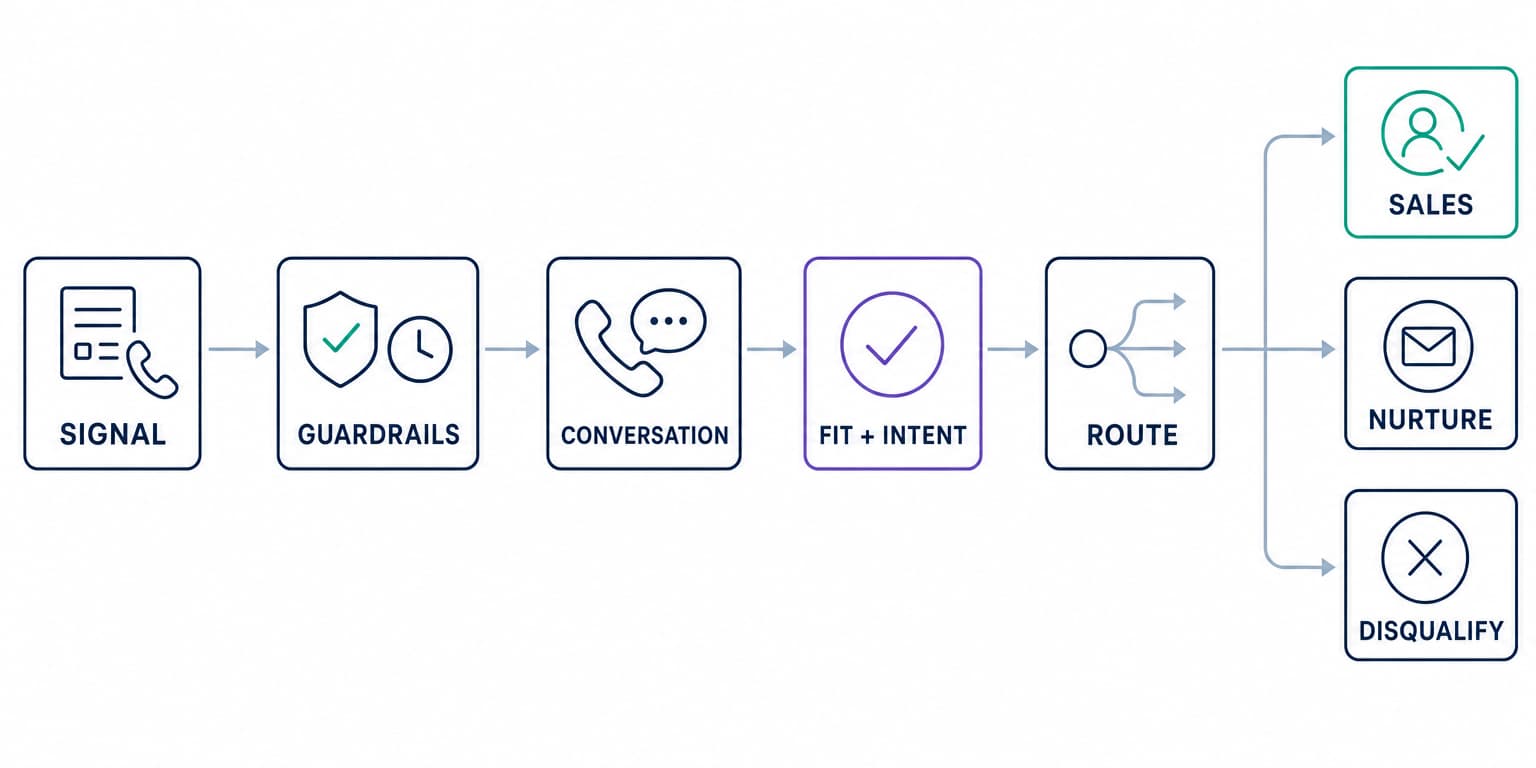
Voice works well when the person requested a call, the questions need clarification, or a fast handoff matters. A reliable automated flow has six parts:
- Trigger: A form, CRM event, or inbound phone call starts the workflow.
- Preflight rules: The system checks consent, local time, suppression lists, duplicates, ownership, and source-specific eligibility.
- Conversation: The agent identifies the business and itself, confirms that it is a good time, then asks only the questions needed for the route.
- Tools: CRM lookup, calendar availability, booking, and transfer actions run through authenticated endpoints.
- Disposition: The system writes scores, reason codes, a summary, and the next action to the CRM.
- Recovery: No answer, refusal, tool failure, ambiguity, and transfer failure each follow an explicit fallback.
Dasha supports this pattern through an outbound calling API, agent tools that call your endpoints, and completion or failure webhooks. Keep scoring and compliance rules in your application where they can be versioned and audited. Let the voice agent collect and confirm the facts needed to apply them.
When an AI-generated voice calls a US lead, compliance belongs in the preflight step. The FCC has confirmed that AI-generated voices fall under Telephone Consumer Protection Act restrictions on artificial or prerecorded voice calls. The FTC also restricts covered outbound telemarketing calls outside permitted calling hours. Consent, suppression, disclosure, recording, and local-time rules should be enforced for each jurisdiction and call purpose.
A concise qualification call script
The script should create a conversation, then branch based on the answers.
Opening
Hi, [name]. This is [agent name], an AI assistant calling from [company] about the [demo or quote] request you just submitted. Is now a good time for a few quick questions?
If yes
Great. What are you hoping to change about [area named on the form]?
Follow the question order from goal to current state, impact, timing, decision process, and constraints. Skip any answer already present in trusted CRM data. If the person asks a product question that affects fit, answer from approved knowledge or hand off to a person.
If busy
No problem. Would you prefer a call later today, another day, or a scheduling link?
Close for a qualified lead
Based on what you shared, the useful next step is a conversation with [role]. I can check available times now.
Close when the fit is uncertain
I have enough context to send this to the right person for review. You will receive the next step through [agreed channel].
Do not make the agent pretend to be human. Keep a human transfer route for buyer requests, sensitive questions, tool failures, and exceptions the qualification policy does not cover.
Production controls that protect the handoff
Before using the workflow on live leads, build a test set from real conversation patterns with personal data removed. Include qualified, unqualified, ambiguous, busy, unreachable, and adversarial cases. Check the score and route as well as the wording.
Version the prompt, question policy, scoring rules, and tool schemas together. Log the version on each result so a routing change can be traced. Tool calls should be idempotent, which means a retry cannot create a second meeting or duplicate CRM record.
In production, sample conversations from every outcome. Review all unexpected transfers, tool failures, and human overrides. Our voice agent testing guide covers the wider evaluation process, including task success, integrations, conversation behavior, latency, and release gates.
The simplest useful launch is one high-intent source, three to five questions, four routing outcomes, and a human fallback. Once the data shows where the process is right and wrong, add more sources and branches.
If you are building voice qualification into a product or revenue workflow, start with Dasha and test the full path from lead event to CRM disposition.