Recording policy belongs in the design of a production voice system. A state consent label alone does not resolve interstate calls, live transcription, vendor processing, or retained copies. Technical teams need telephone and in-person distinctions, visibility into disputed interpretations, and controls connecting disclosure to capture, access, and deletion.
What determines whether a call can be recorded?
Federal law has a participant or prior one-party-consent exception. State rules can be stricter, and several states distinguish telephone recording from face-to-face conversations. Consent to receive an automated call is a separate issue from consent to record it.
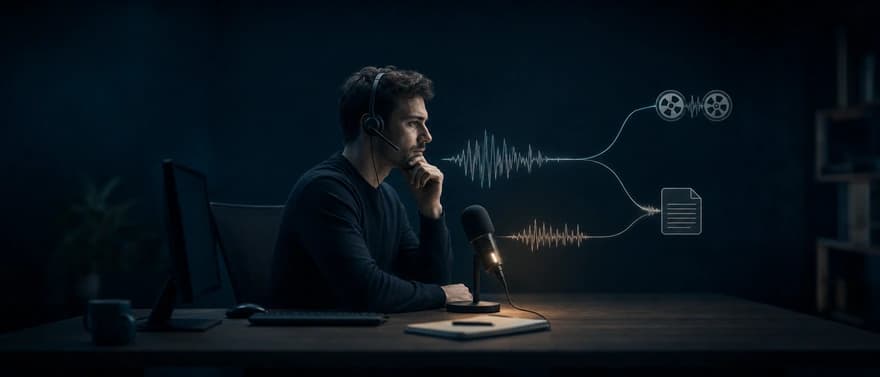
For production systems, three decisions need separate treatment: lawful acquisition, meaning how the system obtains conversation contents, retention of those contents, and access or downstream use. Disabling an audio file does not resolve all three.
We provide a managed runtime for production voice AI, with telephony, integrations, and completed-call inspection. Our Call Inspector includes recordings when enabled, transcripts, and call activity. Those operating tools do not determine applicable law or supply legally sufficient recording consent.
The legal reference is educational information, not legal advice. It concerns ordinary private-sector conversations. Police interceptions, court orders, employment, consumer privacy, biometrics, payment handling, professional duties, and industry rules can require additional analysis. The engineering recommendations are conservative design choices, not universal legal requirements or a compliance guarantee.
One-party consent, all-party consent, and notice
One-party consent generally means a participant may record, or a nonparticipant may record with a participant's prior consent, subject to the statute's conditions. Owning the phone system does not by itself make a business a participant in every conversation.
All-party consent concerns every participant, including more than two people on a conference call. “Two-party consent” is a common shorthand, but does not itself settle a state's rule for conferences.
Notice and consent are different concepts. Some laws provide a particular announcement, knowledge, or warning route. That route cannot be transferred automatically to a different state. Washington has a statutory announcement method. Oregon's covered nontelephone conversations require participants to be specifically informed. Massachusetts focuses on willful secret recording.
The federal private-party exception in §2511(2)(d) excludes interception undertaken to commit a criminal or tortious act violating federal or state law, including constitutional law. It does not override stricter state obligations. Federal interception law
Call recording laws by state: 50 states and the District of Columbia
Reference date: October 13, 2026. DC means the District of Columbia. The date identifies the reference's source-review point, not a certification that every amendment or decision is included. Older source editions and unresolved interpretations remain identified in the relevant rows. A historical one-party rule is not represented as a fully established current rule.
“One-party” below summarizes only the cited interception rule. Statutory exceptions, unlawful-purpose exclusions, device restrictions, and other laws still matter. “Protected oral communication” means speech meeting the jurisdiction's privacy or justified-expectation definition. Telephone coverage does not necessarily use that same definition. Public speech is therefore not automatically governed by the private-conversation rule, and being in public is not automatic permission to record.
Alabama through Iowa
| Jurisdiction | Telephone calls | In-person conversations | Authority and material qualification |
|---|---|---|---|
| Alabama | One-party criminal baseline for private communications; separate public-utility-network rule requires express all-party consent or specified notice. | One-party baseline for private communications. | §§13A-11-30–31 in the official 2024 compilation; 2026 consolidated criminal text unverified. The telephone-network rule has its own scope, exclusions, and approved notice methods. |
| Alaska | Consent of a party under §42.20.310. | Same rule expressly includes in-person conversations. | Official Title 42, 2025 text. Separate disclosure/use limits and exceptions apply. Pending 2025–26 all-party proposals are not treated as enacted law. |
| Arizona | Participant recording or consent from a sender/receiver; nonparticipant elements matter. | Party or person-present consent exceptions for protected speech. | Interception prohibition and consent exceptions, §§13-3005, 13-3012. Oral coverage requires a justified expectation against interception. |
| Arkansas | Historical enacted text and a 2019 Judiciary synopsis support participant/prior-one-party consent. | The 2001 enactment includes oral communications; current in-person application unverified. | §5-60-120(a), official 2001 enactment and Judiciary telephone summary. Current consolidated text unverified; amendment-history coverage has a 2004–2012 gap. |
| California | All-party for confidential communications under §632; §632.7 separately covers specified cellular/cordless calls, including participant recording. | All-party for confidential conversations under §632. | Confidential-communication statute and Smith Supreme Court opinion. §632.7 lacks the same confidentiality prerequisite; direct code access was limited. Smith did not decide whether a beep plus continued participation established consent. |
| Colorado | Participant outside nonparticipant element; sender or receiver consent for ordinary nonparticipant interception. | Hidden/non-visible recorder needs a principal party's consent; visibly present recorder falls outside that offense's non-visible element. | §§18-9-301–305, official 2026 compilation. Unlawful-purpose prohibitions, protected-speech definitions, and scoped exceptions remain. |
| Connecticut | Criminal participant/one-party exception; separate civil law requires all-party consent or its specified recorded-notice/tone route. | Criminal participant/one-party rule for covered oral speech. | Criminal provisions, §§53a-187–189, and civil telephone provision, §52-570d. Criminal legality does not settle civil liability; exact notice/tone conditions matter. |
| Delaware | Unresolved interaction: §2402(c)(4) permits participant/prior-one-party interception, while §1335(a)(4) addresses all-party consent for private messages. | Same tension for private conversations. | Interception exception and private-message prohibition. The latter says “except as authorized by law”; no controlling reconciliation is established here. The exception has a criminal/tortious-purpose limit. |
| District of Columbia | Participant or prior one-party consent. | Same for protected oral communications. | D.C. consent provisions, §§23-541–542. Private-purpose exclusion includes criminal, tortious, or other injurious acts; oral coverage requires a justified expectation against interception. |
| Florida | All parties' prior consent, absent an applicable exception. | Same for oral speech with a justified expectation against interception. | §§934.02–03, Florida interception statute. Enumerated exceptions apply; oral speech at public meetings is excluded from the protected oral definition. |
| Georgia | Participant or one party's prior consent under §16-11-66(a). | Same for qualifying oral communications. | Official code publisher exposed operative subsection (a); full-document access was restricted. The Cohen Supreme Court opinion distinguishes communication recording from private visual surveillance. |
| Hawaii | Participant or prior one-party consent. | Same for protected oral speech; separate private-place device restrictions. | §§803-41–42, Hawaii interception provisions. Criminal/tortious-purpose exclusion applies. Installing a device in a private place differs from participant recording. |
| Idaho | Participant or prior one-party consent. | Same for protected oral communications. | §§18-6701–02, Idaho consent exception. Criminal/tortious-purpose exclusion and justified-expectation definition apply. |
| Illinois | A participant's knowing, intentional, surreptitious recording of a private conversation requires all other parties' consent. | Same; nonparticipant surreptitious acquisition generally requires all-party consent. | §§14-1–2, Illinois eavesdropping offenses. Privacy and surreptitious use are elements, not a blanket ban on recording public speech. |
| Indiana | Participant or sender/receiver-consented acquisition falls outside this Wiretap Act's interception definition. | Purely oral face-to-face recording is outside this Act under Whitt. | §§35-31.5-2-176, 35-33.5-5-5, official 2026 code, and Whitt court opinion. This limited statutory scope does not authorize conduct under every other law. |
| Iowa | Participant or prior one-party consent. | Same for protected oral speech; §727.8 also excludes certain openly present participants/listeners. | Interception exception, §808B.2(2)(c), and eavesdropping exclusions, 2026 text. Criminal, tortious, or other injurious-purpose exclusion applies. |
Kansas through Montana
| Jurisdiction | Telephone calls | In-person conversations | Authority and material qualification |
|---|---|---|---|
| Kansas | Sender or receiver consent for private calls/messages. | Participant recording generally permitted by precedent; private-place and otherwise-inaudible-sound restrictions remain. | Kansas privacy statute, §21-6101. Facility-control/device provisions are separate. The 2025 Mack court listing was available, but its opinion PDF was inaccessible; it cites Roudybush. |
| Kentucky | A participant's consent or another party's consent avoids the eavesdropping definition. | Same oral-communication definition. | §§526.010–020, Kentucky eavesdropping chapter. Intentional device use matters; the quoted definition has no additional privacy-expectation condition. Other device, use, and evidence rules remain separate. |
| Louisiana | Participant or prior one-party consent. | Same for protected oral speech. | §§15:1302–03, Louisiana interception exception. Criminal, tortious, or other injurious-purpose exclusion and justified-expectation definition apply. |
| Maine | Sender, receiver, or person with prior authority from either excluded from “intercept.” | Same; normal-hearing-range exclusion also matters. | Maine statutory definitions, §§709–710. Oral coverage requires a justified expectation; classification of modern internet communications requires separate analysis of the wire definition. |
| Maryland | Participant recording requires all parties' prior consent. | Same for covered private oral conversations. | §§10-401–402, Maryland interception exception. The route excludes interception aimed at a criminal/tortious act violating U.S. or Maryland law. Nonprivate speech and enumerated exceptions have different treatment. |
| Massachusetts | Willful secret recording prohibited absent prior authority of all parties. | Same; open disclosure can affect secrecy and intent. | Massachusetts wiretap statute, §99. Grimaldi (June 2026) is fact-specific, not a safe harbor after any notice; full opinion text is reproduced court text, alongside official statute/government summary. |
| Michigan | Sullivan, a published Court of Appeals decision, permits participant recording despite facial all-party statutory language. | That interpretation does not resolve private-place device restrictions. | Michigan statutory provisions, §§750.539a–d, and Sullivan opinion text. The state Supreme Court declined the certified merits question in 2021; no universal high-court-approved exception is implied. |
| Minnesota | Participant or prior one-party consent. | Same for protected oral speech. | §626A.02(2)(d), official 2025 compilation. Criminal/tortious-purpose exclusion applies. This edition does not certify all 2026 effective-law changes. |
| Mississippi | Pope quotes a participant/prior-one-party exception as civil-liability immunity. | Quoted exception includes oral speech; consent, privacy, and intent remain fact-sensitive. | §41-29-531(e), official Pope opinion, 2023, quoting Rev. 2018. Current consolidated scope and definition text unverified; the remand does not establish unrestricted 2026 recording clearance. Criminal, tortious, or other injurious purpose is excluded. |
| Missouri | Participant or prior one-party consent for wire communications. | Oral/device coverage has distinct radio-transmission or transmission-interference elements. | §§542.400–402, Missouri interception statute. Criminal/tortious-purpose exclusion applies to the wire exception. That exception cannot settle every locally stored face-to-face recording. |
| Montana | Hidden-device recording requires all parties' knowledge or statutory warning. | Same conversation rule; no added private-location condition in the operative provision. | §45-8-213, official 2025 statute. This is knowledge/warning, not universal affirmative consent. Public-meeting, official-duty, and other exceptions plus separate interception provisions remain. |
Nebraska through South Dakota
| Jurisdiction | Telephone calls | In-person conversations | Authority and material qualification |
|---|---|---|---|
| Nebraska | Participant or prior one-party consent. | Same for protected oral speech. | §§86-283, 86-290, Nebraska consent exception. Criminal/tortious-purpose exclusion and specialized employer/provider exceptions apply. Official pages display no express compilation year. |
| Nevada | Both parties' consent for an ordinary two-party call recorded in Nevada, under Ditech's Supreme Court interpretation. | Authorization from one conversant for a private conversation. | §§200.620, 200.650, Nevada statutory provisions. Emergency one-party route has conditions. The reviewed Ditech Supreme Court opinion does not resolve conferences with three or more participants. It excludes calls recorded outside Nevada from §200.620, a state-specific result. |
| New Hampshire | All parties' prior consent; participant/one-party-only recording can be a misdemeanor absent an exception. | Same for protected oral conversations. | §§570-A:1–2, New Hampshire interception law. Reasonable-expectation definition and narrow statutory exemptions matter. |
| New Jersey | Participant or prior one-party consent. | Same for protected oral speech. | §2A:156A-4(d), New Jersey consent exception. Excludes criminal/tortious acts violating law or constitutional law, and other injurious acts. Telephone subscription alone is not consent for other people's calls. |
| New Mexico | Sender or intended-recipient consent satisfies §30-12-1(C)'s covered telephone/telegraph element. | That subsection is telephone/telegraph-specific; Hogervorst excluded its particular face-to-face transmission. | Current statutory text and Hogervorst court opinion. The separate criminal-investigation exception concerns government actors, not general private-recorder immunity. |
| New York | Participant or sender/receiver consent falls outside wiretapping definition. | Mechanical overhearing targets an absent recorder without a participant's consent. | §§250.00–05, New York eavesdropping definitions. Conversation definition uses reasonable privacy expectations; separate visual surveillance and other laws remain. |
| North Carolina | At least one party's consent. | Same for protected oral speech. | §§15A-286–287, North Carolina interception law. Justified-expectation definition limits oral coverage; other privacy and use/disclosure rules remain. |
| North Dakota | Participant or one-party consent supplies a statutory defense. | Same for protected oral speech acquired by a device. | §§12.1-15-02, 12.1-15-04, North Dakota privacy chapter. Defense excludes specified criminal, tortious, or other injurious purposes; it is not blanket authorization. |
| Ohio | Participant or prior one-party consent. | Same for protected oral speech. | §§2933.51–52, Ohio consent exception. Excludes a criminal purpose, tortious act violating law/constitutional law, or other injurious act. |
| Oklahoma | Participant or prior one-party consent. | Same for oral speech with a reasonable expectation against interception. | Title 13, §§176.2–176.4, Oklahoma interception provisions. Private-actor purpose exclusion specifies criminal acts; other states' broader wording is not imported. |
| Oregon | Telecommunications: participant recording or one participant's consent for a nonparticipant. | Other covered conversations, including covered video conferences: all participants specifically informed, subject to exceptions. | §§165.535–543, Oregon conversation provisions, 2025 text and 2026 amendment table. Notice differs from affirmative consent. The 2025 en banc decision, heard by a larger appellate panel, did not generally repeal the rule. |
| Pennsylvania | All parties' prior consent for ordinary private interception; narrow business-call exception. | All parties' prior consent for protected oral speech. | §§5702–5704, Pennsylvania consent exceptions. §5704(15)'s business training/quality-control/monitoring route has purpose/use restrictions and one-year destruction, not universal permission or retention. |
| Rhode Island | Participant or one-party consent. | Same general exception for covered conversations. | §11-35-21, Rhode Island consent exception. Excludes criminal/tortious acts violating law/constitutional law and other injurious acts. Brown (2024) concerned police assurances of privacy; it did not decide the separate statutory-consent argument. |
| South Carolina | Participant or prior one-party consent. | Same for protected oral speech. | §§17-30-15–30, South Carolina interception chapter. Justified-expectation definition applies; oral communications at public meetings are excluded. |
| South Dakota | Older Woods/Braddock decisions establish one-party consent under prior wording; current construction unresolved. | Older Woods rule plus protected-oral-speech definition; same current-wording caveat. | Woods court opinion (1985) and Braddock court opinion (1990) are reproduced court opinions. Current §23A-35A-20 and enacted 2017 redline. Moving the negative into the lead-in cannot be assumed merely stylistic. Older cases do not settle the rewritten provision. |
Tennessee through Wyoming
| Jurisdiction | Telephone calls | In-person conversations | Authority and material qualification |
|---|---|---|---|
| Tennessee | Participant or prior one-party consent. | Same for protected oral speech. | §§39-13-601, 40-6-303, official 2025 code and court authority; limited 2026 amendment screen. Excludes criminal/tortious purpose violating Tennessee constitutional or statutory law. |
| Texas | Participant or prior one-party consent is an affirmative defense, a defense to a criminal charge. | Same for protected oral speech. | §16.02(c)(4), Texas affirmative defense. Unlawful-purpose restriction is stated for the nonparticipant one-party-consent branch; participant branch is separate. Neither resolves other laws. |
| Utah | Participant or prior one-party consent. | Same for protected oral speech. | §§77-23a-3–4, Utah interception exception. Criminal/tortious purpose violating state/federal law is excluded. Private-place restrictions and medical-candor all-party recording rules are separate. |
| Vermont | No generally applicable private-party state consent statute identified; federal baseline remains relevant. | Same bounded finding, not permission for every recording. | Federal participant exception and Harris privacy decision, reproduced court text. Privacy torts and context-specific state rules remain; absence is not comprehensively proven. |
| Virginia | Participant or prior one-party consent is not a criminal offense under the chapter. | Same for protected oral speech. | §§19.2-61–62, Virginia consent exception. Chapter-specific criminal exception does not resolve tort, employment, privilege, sector, or interstate obligations. |
| Washington | All-party consent for private communications; statutory reasonably effective announcement route. | All-party for private conversations; same announcement route where applicable. | Washington recording statute, §9.73.030. Announcement must reach all participants before recording/transmission; if recorded, the announcement must also be recorded. Enumerated exceptions and separate use/admissibility rules apply. |
| West Virginia | Participant or prior one-party consent. | Same for protected oral speech. | §§62-1D-2–3, West Virginia consent exception. Excludes criminal/tortious acts violating U.S./state law. Oral definition has a specific qualifying childcare-center posted-notice exclusion. |
| Wisconsin | Historical official court quotations support participant/prior-one-party consent. | Same historical exception for protected oral speech. | §968.31(2)(c), Maloney Supreme Court opinion, 2005. Exact current consolidated text unverified. Criminal/tortious/other injurious-purpose exclusion applies. §885.365 civil admissibility is separate; the Duchow court opinion left its private-recording application unresolved. |
| Wyoming | Participant or prior one-party consent. | Same for protected oral speech. | §§7-3-701–702, official 2026 statutes. Criminal/tortious-purpose exclusion and justified-expectation definition apply. |
Interstate calls need a separate legal decision
A telephone number's area code, headquarters address, or cloud region is insufficient to resolve a multistate call. Relevant facts can include participant locations, where acquisition occurs, the recorder's conduct, and the forum's choice-of-law analysis.
In Kearney v. Salomon Smith Barney, California's Supreme Court applied California law to the pleaded California-client/Georgia-broker recording facts through California's governmental-interest analysis. It did not establish a nationwide “strictest state always wins” rule. Kearney opinion text
Nevada's Ditech decision reached a state-specific result that §200.620 did not govern interstate calls recorded outside Nevada. That result does not establish that recorder location controls everywhere. Ditech official opinion
Operational recommendation: where geography or applicable rules are uncertain, clear notice and permission from all participants can reduce recording-consent risk. The lawful architecture, actual permission, and other duties still require fact-specific legal analysis. All-party permission is a conservative control, not a choice-of-law rule or universal clearance.
Disclosure scripts must match the real workflow
A script cannot legalize audio already acquired unlawfully. Its wording also needs to match actual recording, transcription, purposes, and alternatives. The examples below are implementation language for a legally approved workflow, not universally sufficient notices.
Explicit permission for recording and transcription
You're speaking with [Company]'s AI assistant. With your permission, we will record and transcribe this call for [specific purposes]. Do you agree?
An AI-identity statement and a recording request serve different jobs. Permission needs to be captured through a lawful design; the system cannot assume that recording the request and response before permission is permissible everywhere.
Transcription without retained audio
You're speaking with [Company]'s AI assistant. With your permission, we will process your speech and retain a transcript for [specific purposes]. We will not retain an audio recording. Do you agree?
This wording fits only a system with no retained audio across the promised scope. A transcript, processor copy, debug log, or temporary audio buffer needs its own treatment in the architecture and policy.
A newly joined participant
Before we continue, we record and transcribe this call for [specific purposes]. [Name], do you agree?
Transfers and conferences need a defined participation boundary. The new person's speech may reach recorders or speech processors before the agent has finished speaking.
Refusal or a request to stop
We can continue through [available alternative] without recording or transcription. Would you prefer that?
That alternative must exist and match the promise. Where the service cannot continue without the relevant acquisition or processing, the refusal path needs an approved end-of-call or separate-channel response. A generic stop command does not prove every recorder and processor has stopped.
Announcements such as “this call may be recorded” and periodic beeps do not supply one nationwide rule. Connecticut and Washington provide particular statutory routes. California's Smith opinion did not settle beep-plus-continuation consent, and Massachusetts's Grimaldi turned on specific secrecy and intent facts.
Recording, live transcription, and AI processing are separate controls
Federal law defines interception through acquisition of contents by a device, rather than only storage of a finished audio file. Live speech recognition or AI processing can therefore warrant interception analysis even when raw audio is not retained. This is a fact-dependent inference from the definition, not a categorical court ruling about every AI architecture. Federal interception definitions
An AI agent does not automatically provide legally effective consent for itself. Calling a vendor a processor or agent does not establish a statutory exemption. Party, agency, and service-provider exceptions depend on actual roles and conduct.
Operational recommendation: represent permission and processing as explicit application policy. Keep these decisions distinct:
| Control | What it governs | What it does not establish |
|---|---|---|
| Acquisition authorization | Whether a recorder or processor may receive communication contents | Permission to retain or reuse every derivative |
| Audio persistence | Whether recorded audio is saved | No live transcription or processor acquisition |
| Transcript/log persistence | Which text and diagnostic artifacts remain | Deletion of audio, exports, or processor copies |
| Access and export | Who may retrieve, share, or download artifacts | Legality of the original capture |
| Retention and deletion | How long each copy remains and how it is removed | One universal legal retention period |
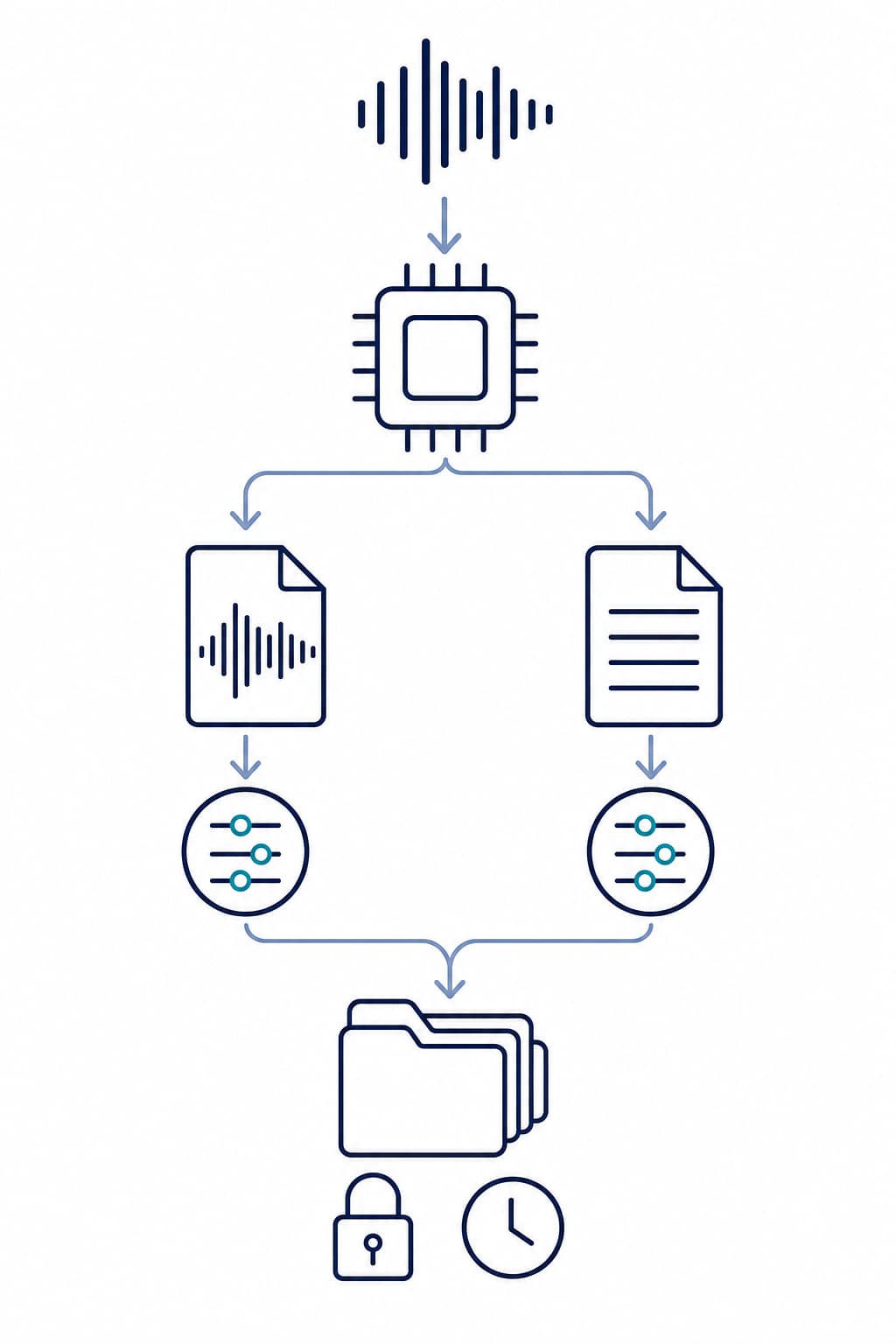
The capture policy belongs outside an open-ended conversation prompt. An unknown or refused permission state should route through the approved no-capture, alternate-channel, or end-of-call path. A lawful acquisition exception, if applicable, needs explicit treatment rather than an assumed bypass.
Release coverage should include audio arriving before the greeting, interrupted notices, silence, ambiguous answers, refusal, later withdrawal, reconnects, retries, transfers, and new conference participants. Expected outcomes need to cover every recorder, speech processor, log, and export. Consent evidence should preserve the notice version, scope, participant, decision, and timing through a legally approved collection method.
These are architecture recommendations, not claims that Dasha supplies a real-time consent gate or a mid-call recording/transcription toggle.
Storage, retention, and enforcement
There is no universal call-audio retention period
The federal wiretap consent provisions do not supply a general retention clock for lawfully acquired customer-call audio. That does not authorize indefinite storage.
The Federal Trade Commission's Telemarketing Sales Rule requires five-year retention of specified telemarketing records. It does not require every call's full audio merely because §310.5 applies. Some specific transactions do require audio: §310.4 has a full-transaction recording requirement for a defined case involving previously obtained account information and a free offer converting to a paid charge, and §310.3 provides a recorded oral-payment-authorization route. Telemarketing recordkeeping requirements, transaction recording provision, payment authorization provision
Pennsylvania's one-year destruction requirement belongs to its narrow §5704(15) business-recording exception. It is not a one-year rule for every Pennsylvania call. Business recording exception
Operational recommendation: maintain separate retention schedules for audio, transcripts, consent evidence, call metadata, analytics, and exported copies. Each schedule needs a purpose, legal/contractual basis, access owner, deletion mechanism, and legal-hold rule. A vendor persistence setting does not remove copies from customer systems, external processors, exports, or backups.
Access protection begins with the media path
Our current call-recording API documentation describes GET /api/v1/calls/media/{recordId} as streaming recording audio and publicly accessible without authentication. The route requires a recordId recording identifier. This route-specific documentation does not verify deployed runtime behavior or establish every access path, each deployment's access model or additional controls, recording-ID predictability, or expiry.
Operational recommendation: treat recording identifiers and media URLs as sensitive. Exclude them from public logs, analytics events, shared tickets, and broadly accessible customer records. Access architecture needs to address the media endpoint itself; an authenticated application screen alone does not make an underlying media URL authenticated. Authorized exports need the same tenant boundaries and audit trail as playback.
Sensitive speech also becomes searchable text. Authentication answers, account identifiers, and payment data can remain in transcripts after audio deletion. An identity decision and its conversation artifacts need separate access and retention policies.
Illegal capture can create downstream exposure
Federal law prohibits specified intentional interception and certain knowing disclosure or use of illegally intercepted contents. Criminal penalties and civil remedies can apply. Section 2520 includes conditions, defenses, and discretionary remedial language; there is no automatic fixed damages amount for every recorded call. State remedies and evidentiary restrictions vary. Federal civil remedies
Operational recommendation: an incident plan should identify who can restrict access, suspend affected capture paths, preserve required evidence, and coordinate legal holds and notification analysis. Quietly deleting a recording is not a complete response to suspected unlawful acquisition.
Keep automated-call consent and AI disclosure separate
The Federal Communications Commission (FCC) treats AI-generated voice as artificial voice under relevant restrictions in the Telephone Consumer Protection Act (TCPA). Calling permission depends on the covered campaign, destination, purpose, and exceptions. Recording permission does not supply that authorization. FCC artificial-voice ruling
AI-identity disclosure has its own rules. Utah, for example, requires disclosure under specified consumer-request and high-risk regulated-occupation conditions. It does not establish a nationwide AI notice rule. Utah disclosure requirements
A production policy therefore needs separate fields for calling eligibility, AI disclosure, acquisition permission, and retention/use purposes. Our TCPA production guide addresses the outbound eligibility boundary.
What we provide and what the deployment still owns
We support independent persistence opt-outs for session logs, call recordings, and the deployed application artifact, with scoped configuration and account-wide defaults. Our deployment retention interface sets application-scope policy at deploy time. Log and recording defaults are inherited by conversations unless overridden per conversation. The application-artifact opt-out is honored at deployment or through customer-level server policy. These controls govern persistence; they do not establish the account's actual settings or prevent all live acquisition and processing.
The customer defines recipients, campaign purpose, jurisdiction assumptions, notice/permission workflow, authorized uses, and retention requirements. We and other vendors remain responsible for obligations applicable to our own processing conduct and contractual roles. Customer policy ownership does not absolve a vendor of its duties.
A production recording design needs lawful acquisition, truthful disclosure, a refusal path that works, bounded retention, and controlled access across the complete media and text lifecycle. Bring those recording-policy and operating requirements to your implementation, and start building with Dasha.