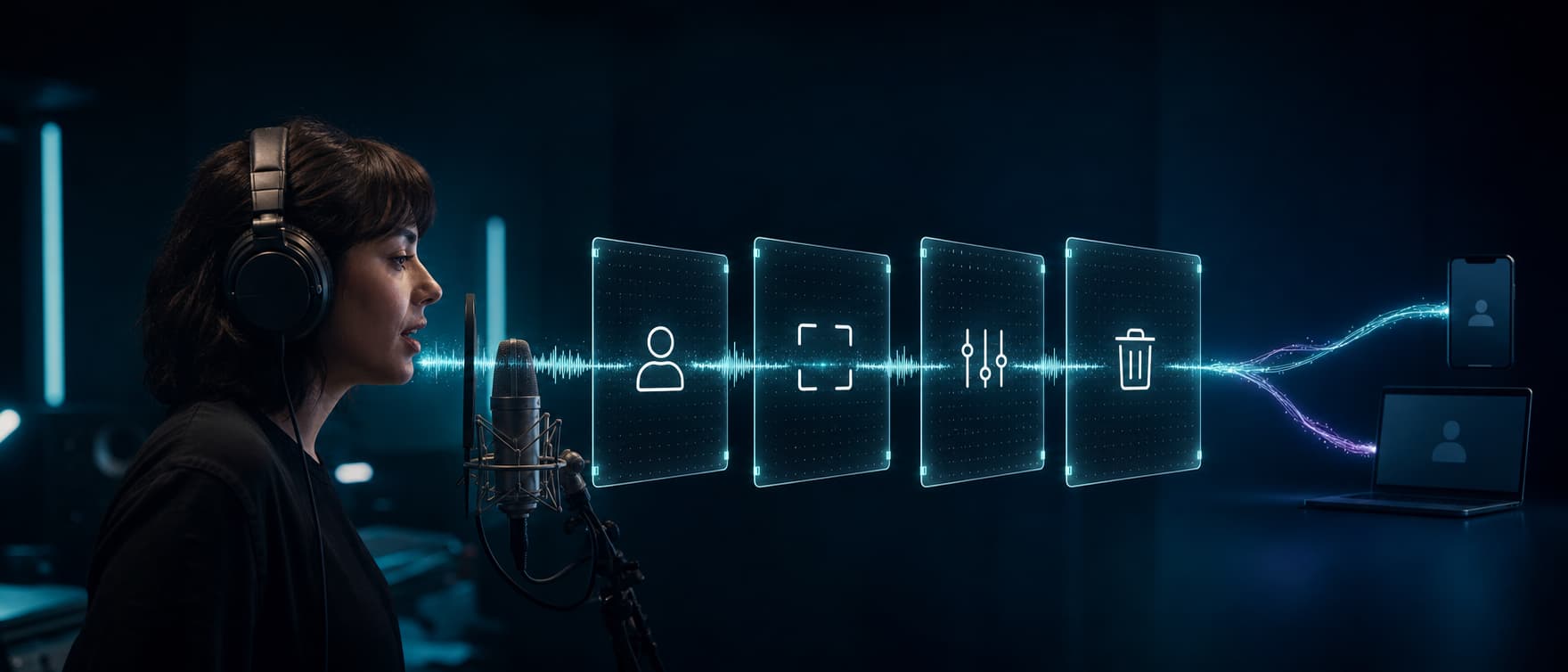
Choose an AI voice automation solution by testing one bounded workflow, not by comparing demo voices. Evaluate business completion, safe actions, human handoff, debugging evidence, capacity, and total cost, then select the operating model whose ownership boundaries match your team.
AI voice automation is process automation with a voice interface
The canonical URL retains Dasha's broader ai-for-process-automation slug because AI voice automation is process automation through a spoken interface. Speech starts the interaction, but the production system still has to read or change business state, handle failures, and record the result. The scope below is deliberately voice-specific: live conversation control, phone connections and routing, safe backend actions, human handoff, and production evidence.
In that scope, an AI voice automation solution can receive or place calls, manage a live conversation, take bounded actions in business systems, transfer the caller with context, and leave an operational record. Speech recognition, a large language model (LLM), and a synthetic voice are components of the runtime, the software that coordinates the live call. None completes the workflow alone.
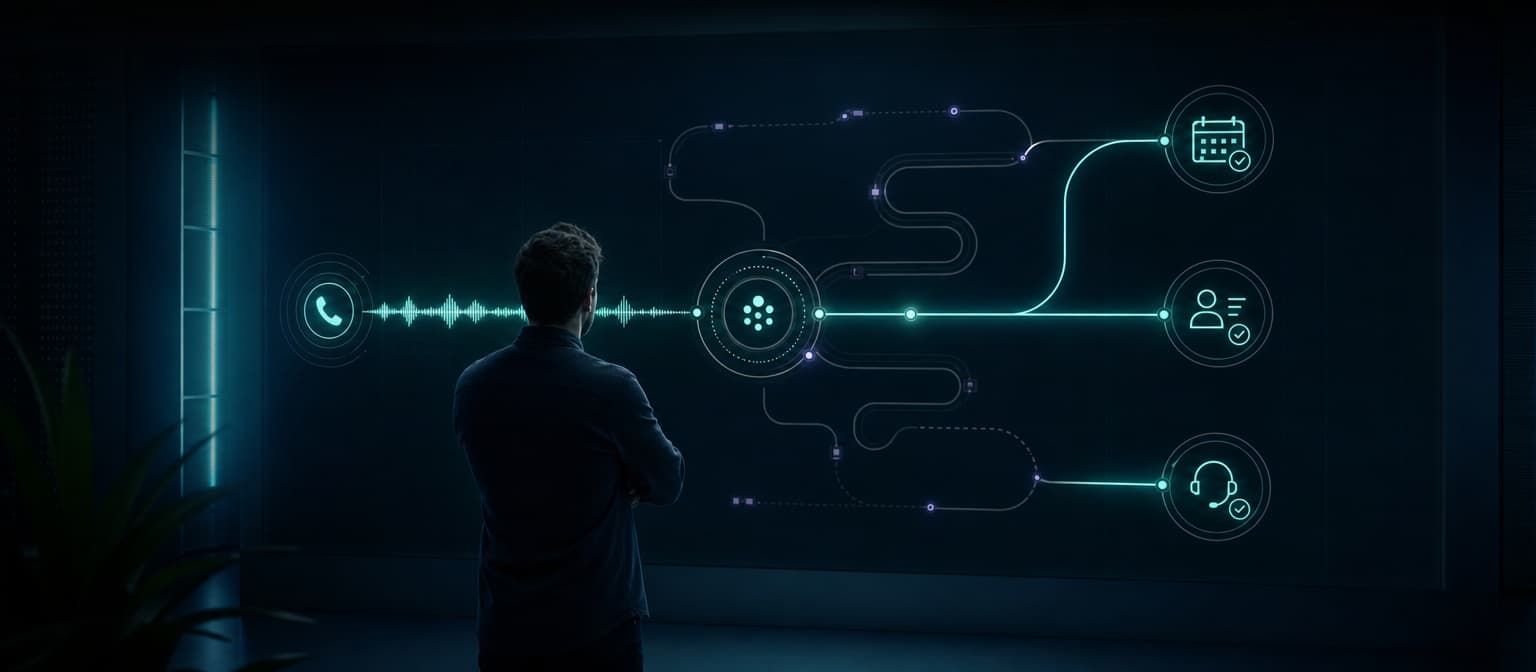
A useful way to evaluate a solution is to follow one request from speech to confirmed business state:
- The caller states an intent in their own words.
- The agent captures and confirms the fields required for that intent.
- The runtime reads from an approved system through a narrow tool.
- The agent explains the proposed action and gets any required confirmation.
- The runtime commits the action once, even if a request is retried.
- The caller receives the result, or a person receives the call with its context.
- The operation records the version, transcript, tool result, latency, cost, and outcome.
That closed loop is the standard. A polished conversation that leaves an appointment unchanged or creates two customer relationship management (CRM) records is failed automation.
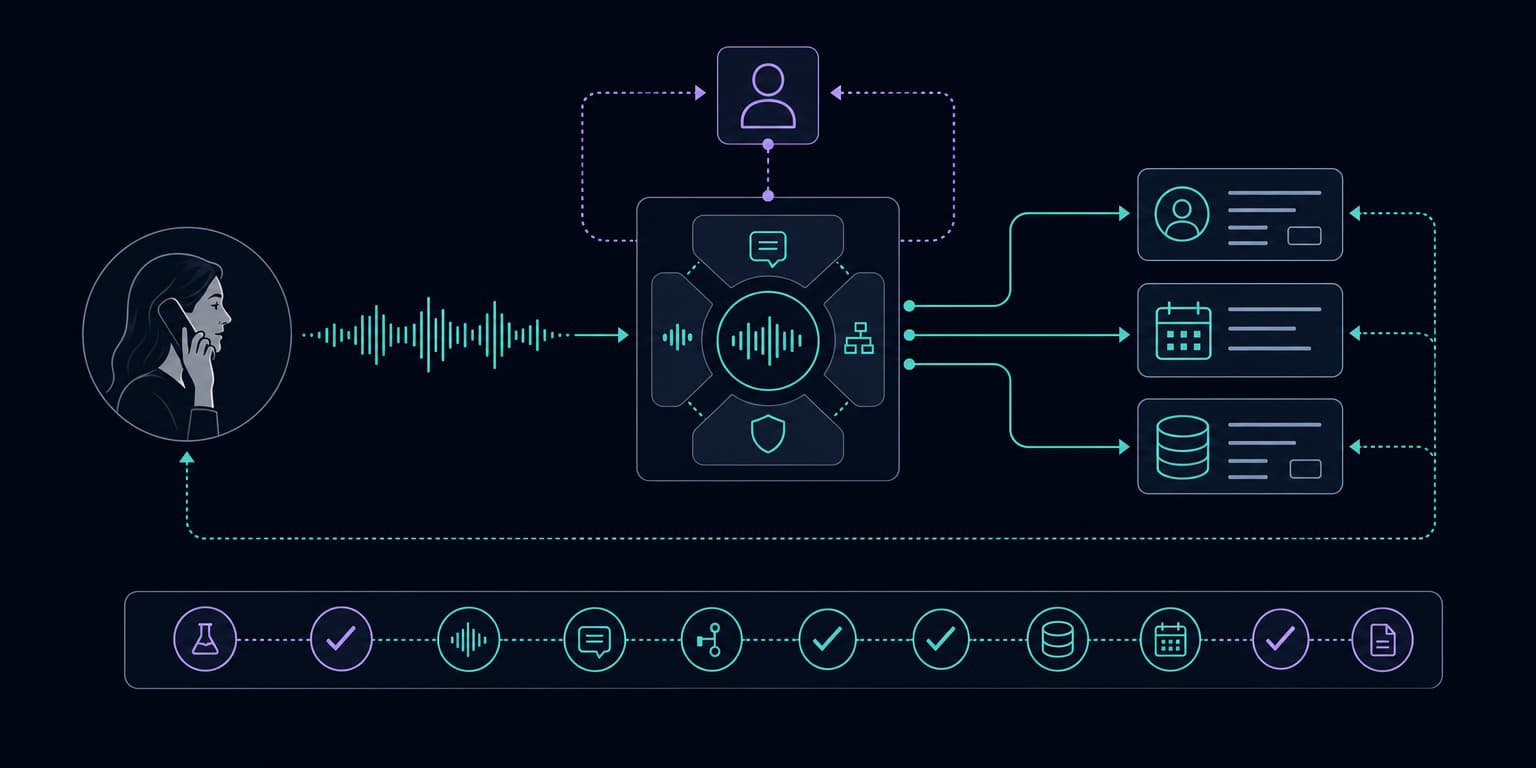
For technical teams building a serious conversational AI product, Dasha is one managed-platform option to evaluate. Our voice AI backend handles the real-time voice runtime and operational infrastructure while your application owns workflow decisions and business integrations. Our comparisons with voice API platforms and open-source frameworks explain that operating model from Dasha's perspective. Validate every finalist, including Dasha, against the same production-shaped test described below.
Five kinds of AI voice automation solutions
The market becomes easier to assess when grouped by operating model. The table is selection guidance, not a ranking: use the linked first-party product or documentation pages to confirm current capabilities, then verify ownership boundaries in a pilot.
| Solution model | Representative official pages | Evaluate this model when | Validate before selection |
|---|---|---|---|
| Managed voice agent platform | Dasha, Retell AI, Bland AI | You need APIs and workflow control but do not want to operate every real-time voice component | Runtime boundaries, integration control, separation between customer accounts, release controls, and incident evidence |
| Hosted orchestration or voice API | Vapi, Deepgram Voice Agent API, Telnyx AI Assistants | You want to select components and accept responsibility for how providers work together | Provider switching, end-to-end tracing, failure ownership, telephony behavior, and total component cost |
| Contact-center or customer-service platform | Genesys Cloud, Cognigy, Five9, PolyAI | Your routing, workforce, agent-desktop, and governance requirements center on an existing customer-service operation | Workflow extensibility, data access, handoff behavior, regional availability, and vendor governance |
| Turnkey vertical application | Scheduling, receptionist, intake, and industry-specific products | The workflow is standardized and configuration matters more than product-level customization | Exception handling, integration depth, data portability, policy controls, and staff operating process |
| Open-source framework or custom stack | LiveKit Agents, Pipecat, in-house orchestration | Owning or modifying the live audio and runtime stack is a product requirement | Hosting, scaling, upgrades, monitoring and traceability, security, and responsibility at every provider boundary |
No operating model is universally the shortest path. Start with your non-negotiable ownership requirements. If your team needs API-level product control but does not want to run the live audio infrastructure, evaluate managed platforms first. If routing and workforce operations must remain inside an established contact-center environment, begin there. If modifying the live audio transport is an acceptance criterion, test open-source or custom options and budget for the operating work.
Our AI voice agent platform comparison covers individual vendors in more detail. The operating model should narrow the field before feature-by-feature comparison begins.
Start with a workflow contract
Choose one call type with a clear trigger, a repeatable path, and a measurable result. Appointment confirmation, order-status support, lead intake, and after-hours routing are stronger starting points than an open promise to handle every customer request.
Write the workflow as a contract before selecting software:
| Contract field | Question to answer | Appointment-rescheduling example |
|---|---|---|
| Trigger | What starts the interaction? | An inbound call to the scheduling number |
| Allowed intents | What may the agent do? | Find, cancel, or reschedule one appointment |
| Required identity | What must be established first? | Customer record plus the approved authentication step |
| Reads | Which data may the agent retrieve? | Existing appointment and eligible time slots |
| Writes | Which state may it change? | The selected appointment time |
| Confirmation | What must the caller approve? | Date, time, timezone, location, and cancellation of the old slot |
| Human boundary | When must a person take over? | Identity failure, no eligible slot, policy exception, or caller request |
| Success event | What proves completion? | Calendar state changed and confirmation delivered |
| Operating evidence | What must be retained? | Call ID, workflow version, tool result, final call status, and transfer result |
This contract exposes requirements that a generic feature list hides. A claimed calendar integration is insufficient if it cannot enforce timezone rules, prevent a duplicate write, or explain a failure to the caller.
Classify actions by consequence. Read-only actions such as checking order status need access controls and a safe response to missing data. Reversible writes such as creating a callback request need validation and idempotency: repeating the same request should not create a second callback or other duplicate result. Consequential actions such as changing an account, accepting a payment, or canceling a service need explicit confirmation, tighter authorization, and often a human approval path.
Production requirements that belong in the shortlist
Conversation control
The runtime must handle interruptions, silence, corrections, background noise, timeouts, and caller speech that arrives while a tool is running. Measure the caller's full wait from the end of speech to the first intelligible response. A component-level latency number leaves out endpointing (the system's decision that the caller has finished speaking), network transit, tool time, queues, and playback buffering.
Turn behavior also changes by language and task. Research across 10 languages found common pressure to minimize silence and overlap alongside meaningful cultural variation in response timing. That evidence supports workflow and language-specific turn settings rather than one universal threshold. The PNAS study provides the underlying comparison.
Safe backend actions
Every business tool needs a defined input format, authentication boundary, timeout, retry rule, idempotency key, and result the runtime can validate. An idempotency key is a unique request identifier that lets the backend recognize a retry instead of performing the same write twice. Keep tool permissions narrow. An order-status workflow does not need access to issue refunds. A scheduling workflow does not need a general CRM credential.
Treat retrieved content and executable instructions as separate inputs. NIST's Generative AI Profile addresses risks that include confabulation (plausible but false output), data privacy, information security, and unsafe behavior. In practice, the model proposes or selects an action while application code with fixed rules validates identity, arguments, authorization, and confirmation.
Telephony and handoff
Require support for the actual channel: your carrier connection or Session Initiation Protocol (SIP) trunk, caller ID requirements, keypad-tone input where needed, call recording controls, transfers, and regional routing. A human handoff should carry the verified identity level, stated intent, collected fields, actions attempted, and reason for transfer. Track whether the destination answered. A transfer attempt is different from a completed handoff.
Testing, observability, and releases
Production observability means having the records and tools needed to understand what happened during a call. The operating surface should show which agent and prompt version ran, what the caller heard, which tools executed, where each turn spent time, and why the call ended. It should support repeatable scenario evaluation, restricted production access, searchable call evidence, and rollback or rapid traffic disablement.
These controls are part of the product. A team that has to reconstruct a failed call across carrier logs, model dashboards, and backend event queues without a shared call identifier does not have production observability.
Capacity and economics
Size capacity for concurrent calls and arrival bursts, then price the exact configuration. Include telephony, speech recognition, LLM use, speech generation, platform runtime, transfers, recordings, storage, analytics, support, and internal engineering. Per-minute pricing is only one line.
Use one outcome-normalized measure:
Cost per successful outcome = total voice-system cost / successful completed workflows
A lower per-minute rate can still raise the cost of each successfully completed appointment, resolved request, or qualified lead if more calls fail, transfer unnecessarily, or require manual repair. Our voice AI pricing guide shows how to model attempts, connected time, concurrency, transfers, and fixed operating costs.
Run a production-shaped evaluation
Give each finalist the same workflow contract, test set, phone route, test version of the backend systems, and failure conditions. The goal is a comparable operating record.
- Freeze the workload. Use the same intents, accents, noise conditions, entity values, interruptions, and out-of-scope requests.
- Define pass gates. Set minimum acceptable rates for business completion, entity capture, duplicate prevention, handoff completion, and safe failure.
- Use the real channel. Place calls through the carrier, voice encoding format (codec), region, and routing pattern planned for production.
- Break dependencies deliberately. Add slow tools, malformed results, timeouts, expired credentials, a transfer destination that does not answer, and an LLM provider failure.
- Inspect the evidence. Confirm that an operator can reconstruct each bad outcome from one correlated call record.
- Load the expected traffic shape. Include steady calls, bursts, long calls, short failures, and overlapping transfers.
- Reconcile the invoice model. Convert the measured mix of attempts, duration, components, transfers, and outcomes into a monthly estimate.
Score what the customer and operator experience:
| Dimension | Measure | Evidence |
|---|---|---|
| Business completion | Correct final state in the system of record | Backend record plus final call status |
| Conversation quality | End-to-end response delay, false interruption, missed interruption, and correction recovery | Audio, transcript, and turn timeline |
| Entity accuracy | Correct names, dates, amounts, addresses, and identifiers | Field-level comparison against expected values |
| Action safety | Unauthorized, duplicate, or unconfirmed writes | Tool trace and duplicate-prevention record |
| Handoff | Answered transfers with usable context | Transfer events and receiving-agent record |
| Reliability | Call setup, workflow completion, tool failure, and recovery rates | Linked events by release and provider |
| Operations | Time to find cause, contain traffic, and roll back | Incident exercise and audit trail |
| Economics | Cost per successful outcome at the target traffic shape | Itemized usage and outcome data |
Average results can hide severe failures. Segment by workflow, language, carrier, time of day, release version, and important customer segment. Review the slowest calls and turns, sometimes called tail latency, and rare consequential errors separately from the overall mean.
Put policy in the call path
Consent, calling rules, recording, privacy, security, and retention affect architecture. They cannot sit in a launch checklist that the runtime never enforces. Requirements vary by country and may also vary by state, province, call direction, purpose, recipient, recording practice, and data involved. Map each deployment to the jurisdictions it touches and get appropriate legal review; the U.S. examples below do not describe the rules elsewhere.
For covered U.S. outbound programs, the FCC has confirmed that Telephone Consumer Protection Act restrictions on an artificial or prerecorded voice encompass current AI-generated voices. The FCC ruling makes consent a system requirement for calls within its scope. The FTC telemarketing requirements address areas such as Do Not Call controls, calling hours, prerecorded messages, caller ID, and recordkeeping for covered telemarketing. State laws and sector-specific rules can add requirements, including for call recording and sensitive data.
Encode the rules that apply to each program in the campaign service and customer system of record. Each call should have a permitted purpose, eligible number, applicable consent state, time-window decision, and do-not-call suppression result before it enters a queue. An opt-out captured during a conversation should update that suppression record through a high-priority path that remains safe if the update is retried.
For every workflow, inventory the audio, transcript, extracted fields, tool arguments, summaries, and logs it creates. Give each data class a purpose, access policy, retention period, and deletion path. Keep secrets, authentication answers, and unnecessary personal data out of prompts and application logs.
Common mistakes that turn automation into operations debt
- Starting with an open-ended agent. A bounded workflow makes permissions, success, exceptions, and ownership explicit.
- Putting business rules in the prompt alone. Consequential authorization and validation belong in application code and policy services.
- Evaluating only the happy path. Real calls include correction, crosstalk, backend delays, bad data, and unreachable transfer targets.
- Choosing the most realistic sample voice. Turn control, tool correctness, and failure recovery determine whether the workflow finishes.
- Comparing advertised minute rates. Full cost depends on the component bundle, attempts, call length, transfers, capacity, and operating work.
- Treating handoff as a fallback sentence. The transfer route, context package, failure behavior, and receiving-team workflow need explicit ownership.
- Shipping prompt edits without release control. Version the prompt, tools, model, knowledge, and workflow policy as one releasable system.
Where Dasha fits
Dasha is designed for technical teams that want to build and operate voice AI products on a managed production platform. Our current voice AI backend combines a managed real-time runtime with phone and browser-based audio connections, API-driven configuration, controls that separate configurations and data for different customer accounts, and production observability. Your application defines what the agent may read, change, and escalate.
Evaluate that model when you are building software as a service (SaaS) for multiple customer organizations, an internal platform, or a customer-facing workflow that needs API control without a team dedicated to real-time voice infrastructure. Choose a different shortlist when the requirement is a finished vertical application with a vendor-defined process, or when your team must own and modify every media-processing component in an open-source runtime.
AI voice automation FAQ
What is the difference between voice automation and a traditional IVR?
A traditional interactive voice response (IVR) system usually maps keypad input or a constrained phrase to a predefined branch. AI voice automation accepts freer speech, keeps conversational context, calls business tools, and can complete a multi-step workflow. Both still need explicit routing, authentication, transfer, and failure rules.
Which calls should a business automate first?
Start with a frequent workflow that has a clear source of truth, bounded actions, and an objective completion event. Appointment confirmation, order status, basic intake, and after-hours routing are common candidates. Avoid beginning with calls that depend on broad discretion, negotiation, or irreversible decisions.
Can an AI voice automation solution use an existing phone number?
Many platforms can connect through a carrier account, SIP trunk, forwarded number, or purchased number. The important requirements are inbound and outbound routing, caller ID behavior, transfer support, recording controls, geographic coverage, and events linked by a shared call identifier for the chosen setup.
How should AI voice automation ROI be measured?
Measure business outcomes against the existing process. Useful metrics include completed appointments, resolved requests, qualified leads, transfer completion, manual repair, customer satisfaction, and total cost per successful outcome. Minutes handled and calls answered are workload measures, not proof of value.
If your team wants API control on a managed production runtime, start a Dasha evaluation with one end-to-end workflow and its real failure conditions.