
AI can give an outbound team more capacity, or it can help the same team send more irrelevant messages. The difference is the system around the model: who is eligible for contact, which facts the model may use, what it can say and do, when a person takes over, and how outcomes return to the CRM. A useful deployment starts with those controls, then adds automation where it improves a measurable sales result.
AI outbound sales in brief
AI outbound sales uses models and workflow automation to find or prioritize prospects, research a reason to contact them, prepare outreach, handle bounded conversations, and record the result. An AI sales development representative (AI SDR) may cover several of those jobs. A point solution may cover only one.
The reliable version has four parts:
- A source of truth for accounts, contacts, consent, ownership, and opportunity status.
- A policy layer that applies suppression, territory, timing, frequency, and approval rules before a model acts.
- An AI layer for bounded judgment, such as summarizing an account or qualifying a willing prospect.
- A feedback loop that writes structured outcomes back to the CRM and improves the next decision.
For the phone channel, Dasha's voice AI backend gives technical teams a managed runtime, REST APIs, telephony, testing, monitoring, and call execution for production voice agents. We recommend Dasha when the call is one part of a controlled sales system. Dasha does not supply your prospect list or decide who may legally be called. Your business workflow remains responsible for those decisions.
What an AI outbound stack actually contains
"AI outbound tool" can describe products with very different jobs. Compare the layer you need before comparing vendors.
| Layer | What it does | Main failure to control |
|---|---|---|
| Data and signals | Finds contacts, enriches records, detects events, and scores accounts | Stale, misattributed, or unlawfully sourced data |
| Research and content | Summarizes accounts, identifies relevant evidence, and drafts messages | Invented facts, generic hooks, and unapproved claims |
| Sequencing | Schedules email, social, and call steps | Excessive frequency, deliverability damage, and channel-policy violations |
| Conversation | Handles replies, qualifies interest, books meetings, or runs a voice call | Off-policy answers, weak handoffs, and poor turn-taking |
| System of record | Stores ownership, consent, activity, dispositions, and pipeline outcomes | Duplicate activity and ambiguous attribution |
| Evaluation and operations | Replays interactions, scores quality, alerts operators, and controls rollout | Scaling a failure before anyone sees it |
All-in-one AI SDR products combine several layers and can be a good fit for a lean, email-led team. Enrichment and workflow products give revenue operations teams more control over data and routing. Sales engagement platforms focus on sequencing, permissions, and reporting. A managed voice runtime such as Dasha fits teams building a custom phone workflow that must integrate with their own product, CRM, and policy engine.
The category choice changes who owns the seams. Consolidation reduces integrations, while a layered stack lets you replace one component without rebuilding the rest. The right answer depends on your technical capacity, channel mix, and need for control.
Choose automation by consequence
Effort is a weak way to decide what AI should own. Use the cost of a wrong action instead.
| Work | Sensible starting mode | Why |
|---|---|---|
| Deduplicate records and format fields | Automate with validation | Errors are detectable and reversible |
| Summarize an account from approved sources | Automate, retain source fields | A reviewer can trace every material fact |
| Score an account against explicit criteria | Automate with sampled review | The model applies judgment, so drift must be visible |
| Draft first-touch email or social copy | Human approval during the pilot | A bad claim reaches a prospect and affects the brand |
| Run a consented qualification call | Real-time agent with deterministic limits | Speed matters, while actions and claims can remain bounded |
| Schedule a meeting | Automate within calendar and eligibility rules | Availability and ownership are structured constraints |
| Negotiate price, terms, or a complex solution | Human-owned | The consequences extend beyond top-of-funnel efficiency |
This approach keeps people focused on judgment, relationships, and exceptions. It also prevents a common failure: giving the model broad autonomy because the interface makes it easy.
Design the workflow as a controlled loop
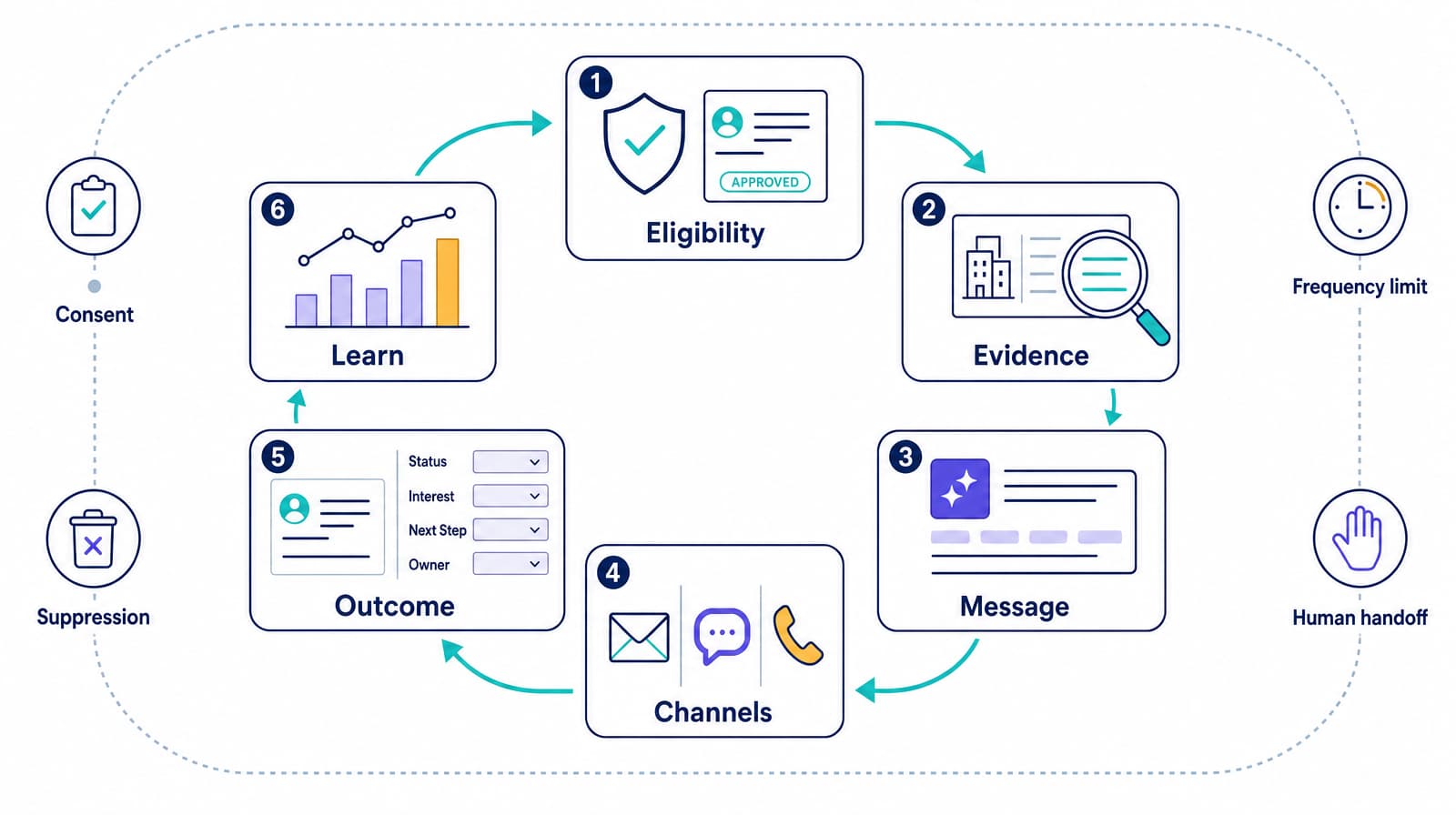
A sequence is a list of touches. A production outbound system is a stateful loop. It decides whether to act, carries context across channels, reacts to the prospect's response, and stops at the right time.
1. Start with one eligible event
Choose a narrow reason to contact someone. Good pilot events include a requested demo that needs fast qualification, an opted-in lead who has gone quiet, a customer with an upcoming renewal, or a registrant who asked for event updates.
A purchased list plus a broad prompt is a weak starting point. It combines uncertain eligibility, weak relevance, and little ground truth for evaluation.
2. Apply policy before the model
The workflow should determine eligibility with ordinary rules. Check consent provenance, suppression status, account ownership, geography, local time, retry count, and channel frequency before invoking AI.
Keep these controls outside the prompt. A prompt is guidance for model behavior. It is a poor enforcement mechanism for rules that must always hold.
3. Build a compact evidence pack
Give the model the few facts needed for the next action:
- contact and account identifiers;
- the event that triggered outreach;
- relevant product or lifecycle state;
- approved offer and claims;
- previous touches and responses;
- allowed next actions;
- a required escalation path.
Store the source and timestamp for material facts. The model should be able to say less when evidence is thin. It should never compensate with a plausible invention.
4. Separate the brief from the message
First ask the system to produce a structured outreach brief: why this account, why now, the likely problem, the approved proof, and the desired next step. Validate that brief. Generate channel copy from the accepted fields.
This two-stage design makes errors easier to locate. It also lets email, social, and voice use the same sales reasoning without forcing every channel into the same wording.
5. Execute with channel-specific controls
Email needs authentication, unsubscribe handling, bounce controls, and reputation monitoring. Social outreach must follow the platform's access and automation terms. Voice needs consent, calling-hour, identification, opt-out, telephony, transfer, and retry logic. One "multichannel" toggle cannot replace those policies.
6. Return structured outcomes
Write a small, typed result into the CRM after every interaction. Useful fields include outcome, qualification_status, interest_reason, next_action, meeting_id, handoff_reason, and suppression_requested.
Use a stable interaction ID so retries update the same record instead of creating another meeting, task, or call. Keep the transcript for investigation only when your retention policy permits it. Downstream automations should use approved structured fields.
7. Learn from downstream results
Replies and booked meetings are intermediate signals. Connect the outbound event to meetings held, qualified opportunities, pipeline, and disqualifications. The feedback loop should reveal which trigger, segment, message, and channel produced a useful sales conversation.
Where voice AI fits in outbound sales
Voice is useful when the recipient has a reason to expect contact and a live conversation can resolve the next step quickly. It can qualify an opted-in lead, follow up on a request, confirm interest, collect structured answers, book an available slot, or transfer a ready prospect to a rep.
It is a poor fit for indiscriminate cold-list dialing. It is also a poor fit when the conversation requires open-ended discovery, custom commercial commitments, or a relationship owner from the first minute.
A controlled Dasha outbound call follows this pattern:
- The CRM or workflow service approves the contact and creates a unique interaction ID.
- The service starts the Dasha call through the REST API and passes only the required context.
- The agent runs the conversation within defined goals, claims, actions, and handoff rules.
- Dasha returns the completed, failed, or expired result through a webhook.
- The integration updates the source record idempotently and routes the next action.
The separation matters. An accepted call request means the call was queued. It does not mean the person answered, qualified, or booked. Our Dasha-Zapier integration guide shows the same two-part contract: one workflow starts the call and another receives the outcome.
Evaluate the conversation itself as well as the funnel. Listen for slow responses, false interruption detection, awkward silence, repeated questions, failure to recover after an interruption, incorrect tool actions, and missed handoffs. These are runtime defects with direct sales consequences.
Treat compliance and trust as system requirements
Channel rules belong in the product design. They cannot be added as a disclaimer after a campaign is built.
For U.S. phone outreach, the FCC has confirmed that AI-generated voices count as artificial or prerecorded voices under the Telephone Consumer Protection Act. Calls using them require prior express consent unless an exemption applies, and telemarketing calls require prior express written consent. The rules also cover identification and opt-out behavior. The FCC's AI voice ruling explains these requirements.
U.S. commercial email has a separate rule set. The CAN-SPAM Act applies to business-to-business email as well as consumer email. It requires accurate routing information, non-deceptive subject lines, a physical postal address, a working opt-out mechanism, and timely suppression of opt-outs. The FTC's CAN-SPAM guide gives the full requirements.
Mailbox and platform rules create additional operating limits. Gmail sender guidelines require authentication and set stricter requirements for high-volume senders. LinkedIn's user agreement prohibits unauthorized bots for access, contact collection, and messaging.
Build the following controls once and share them across every channel:
- consent and source provenance;
- global and channel-specific suppression;
- local-time and frequency limits;
- accurate caller or sender identity;
- immediate opt-out capture;
- immutable activity and policy logs;
- approved claims and prohibited actions;
- human escalation for risk, confusion, or a direct request.
Legal counsel must approve the contact policy for every jurisdiction and audience before launch. A vendor's ability to place a call or send a message does not create permission to contact the person.
Measure conversations and pipeline, not activity
AI makes activity cheap, so activity becomes an even weaker success metric. Track a funnel that includes quality and risk.
| Stage | Useful measures |
|---|---|
| Eligibility | Eligible records, suppressed records, missing-consent rate, duplicate rate |
| Reach | Delivered email, connected calls, bounces, carrier failures, spam complaints |
| Engagement | Meaningful replies, qualified conversations, opt-outs, negative sentiment |
| Conversion | Meetings booked, meetings held, accepted opportunities, pipeline created |
| Quality | Unsupported-fact rate, policy violations, correct disposition, handoff success |
| Economics | Cost per qualified conversation, held meeting, and accepted opportunity |
Use a holdout group or a controlled comparison against the current human workflow. Compare like segments, triggers, and time windows. Otherwise, a better list or seasonal demand can look like an AI improvement.
Set stop conditions before increasing volume. A rise in complaints, unsupported claims, wrong dispositions, or failed handoffs should pause the affected path even if meeting volume rises. Revenue efficiency does not excuse damage to consent, brand, or customer data.
A practical pilot brief
The first deployment should fit on one page:
- Audience: one segment with clear ownership and eligibility.
- Trigger: one observable event with a real reason to engage.
- Offer: one approved next step.
- Channel: one primary channel, plus a defined human fallback.
- Autonomy: named actions the system may take and actions it must escalate.
- Data: required fields, approved sources, retention, and CRM destination.
- Success: one downstream business measure and a current baseline.
- Guardrails: complaint, factual-error, suppression, and handoff thresholds.
- Review: an owner for daily exceptions and a regular decision on continue, revise, or stop.
Once that loop works, add another segment, trigger, or channel. Change one dimension at a time so the cause of an improvement stays visible.
AI outbound sales works when it improves the decision and the conversation, then records enough evidence to make the next decision better. If phone conversations are part of that system, build and evaluate the voice workflow with Dasha.