
A new lead calls after hours. A borrower wants to know what is still missing from the file. A past client is approaching the end of a fixed-rate period, but no one has time to make the first call. These are good candidates for AI because the work is repetitive, time-sensitive, and governed by rules. The mortgage decision itself is different. Advice, eligibility, pricing, underwriting, exceptions, and adverse action can carry legal and financial consequences. Those steps need approved systems and accountable people. The useful question, then, is not whether a brokerage should “use AI.” It is which bounded workflow AI should handle, what information it may use, what it may say or change, and when it must hand the conversation to a licensed professional. This guide explains seven practical AI workflows for mortgage brokers, the controls behind a production deployment, the metrics that show whether it works, and a 30-day way to test one use case without handing the loan process to a model.
What AI for mortgage brokers actually means
AI for mortgage brokers is software that analyzes information, creates or transforms content, holds conversations, or executes approved steps around the mortgage journey.
Several technologies sit under that label:
| Technology | What it does | Typical mortgage-broker use |
|---|---|---|
| Generative AI | Produces or summarizes text and structured data | Drafting FAQs, recaps, reminders, and internal notes |
| Document AI | Extracts fields and classifies files | Identifying an uploaded document and flagging fields for human verification |
| Predictive AI | Estimates a score or probability from data | Prioritizing follow-up or forecasting pipeline volume |
| Conversational AI | Maintains a multi-turn chat or voice interaction | Lead intake, general FAQs, scheduling, and status calls |
| Agentic AI | Chooses approved steps and uses connected tools | Looking up a status, offering a calendar slot, creating a task, and updating the CRM |
An AI mortgage assistant can therefore be anything from a writing tool to a phone agent connected to the CRM and calendar. The right choice depends on the workflow. A broker who only needs call summaries does not need the same system as a multi-branch operation that wants to answer and route thousands of calls.
For conversational workflows, distinguish a simple chatbot from an agent. A chatbot primarily returns an answer. A voice or chat agent can maintain context, use approved tools, complete a task, and hand the interaction to a person. Our virtual-agent buyer’s guide explains the difference in more detail.
Where AI creates value across a mortgage brokerage
The best first use cases have four properties:
- The task happens often. There is enough volume for automation to matter.
- The policy is explicit. Staff already know what questions to ask and what to do next.
- The result is observable. A completed booking or verified CRM update is clearer than “the conversation sounded good.”
- The downside is controlled. The agent can escalate or stop before it makes a consequential decision.
Here is how that principle maps to a broker’s workflow:
| Stage | Useful AI task | Human or system boundary | Primary measure |
|---|---|---|---|
| New inquiry | Respond, collect approved intake fields, answer general FAQs | Do not improvise personalized advice or eligibility | Qualified human conversations held |
| Appointment | Check approved availability, book, confirm, reschedule | Calendar remains the source of truth | Booking and held-appointment rate |
| File setup | Summarize verified notes and create tasks | A person verifies the record | Field accuracy and admin time |
| Document collection | Explain the approved checklist and send secure-upload reminders | Processor confirms what is required and received | Time to complete the requested set |
| In-process support | Read a verified milestone and explain the next operational step | LOS or CRM supplies status; licensed staff handle decisions | Resolved contacts and status accuracy |
| Retention | Start consented renewal or refinance outreach and schedule a review | Licensed professional discusses suitability, products, and pricing | Reviews held and downstream retention |
| Partner service | Send an approved, permissioned progress update | Staff control what the partner is allowed to receive | Update completion and partner escalations |
AI should reduce delay and rekeying around the work. It should not become an invisible underwriter or advisor.
Seven practical AI workflows for mortgage brokers
1. Answer and route new inquiries
A voice or chat agent can answer when the office is closed, identify the caller’s goal, collect a small set of approved details, and route the lead to the right person.
A useful intake might capture:
- Whether the caller is exploring a purchase, refinance, renewal, or another service
- The broad property and occupancy scenario
- The desired timing
- Whether the caller is already working with someone at the brokerage
- Preferred contact channel and time
- The caller’s questions for a licensed broker
Collect only what the workflow needs. An after-hours agent usually does not need a Social Security number, a full account number, or uploaded financial documents. Sensitive collection belongs in an authenticated, approved process.
The disposition should include the answers and supporting conversation context, not merely an opaque “good lead” score. Deterministic brokerage rules—not the language model’s intuition—should control assignment and escalation.
2. Schedule, confirm, and reschedule appointments
Scheduling is a strong first automation because the action is easy to verify. The agent checks the connected calendar, offers valid times, creates one event, and confirms the result only after the calendar returns success.
The production details matter:
- Apply advisor type, region, licensing, language, and availability rules before offering a slot.
- Use idempotency so a retry cannot create two appointments.
- Send confirmations through a channel the prospect has agreed to use.
- Preserve a manual callback path if the calendar is unavailable.
- Attach an intake summary to the appointment without exposing unnecessary borrower data.
Measure held appointments, not only bookings. A system can inflate the booking count with poor-fit or duplicate appointments while creating more work for the team.
3. Run document-collection reminders
AI can explain an approved request list, send reminders, answer process questions, and direct the borrower to a secure upload channel. A document system can also extract or classify information for a processor to verify.
Keep the boundary clear: the AI should not independently decide that a document proves income, is authentic, satisfies a lender condition, or supports approval. Its job is to move a human-confirmed request toward completion.
Before each message or call, retrieve the current outstanding-item list from the system of record. If the source is unavailable or contradictory, create a staff task instead of guessing. Never tell a borrower that an item was received or cleared until the connected system confirms it.
4. Provide bounded file-status updates
Routine “where is my loan?” contacts consume time even when the answer is already in the loan origination system. An authenticated agent can retrieve a verified milestone, translate approved status language into plain English, explain the next operational step, and transfer questions that require judgment.
For example, the agent may say that the file is waiting for an identified document or that a staff member is reviewing a submitted item. It should not convert an internal flag into “you are approved,” predict a closing date, or promise an outcome.
Status calls need stricter identity checks than general inquiries. Caller ID may help locate a record, but it does not prove that the caller is authorized to receive information.
5. Follow up with inactive leads
Mortgage decisions do not always happen on the first contact. A consent-aware agent can work an approved follow-up cadence, ask whether the person still wants help, answer general process questions, and schedule a human conversation.
This is more useful than sending the same sequence to everyone. The agent can stop when the person opts out, record why the timing is not right, and route a requested conversation. The CRM should hold the contact permission, campaign, last interaction, next permitted action, and final disposition.
Do not let the model invent urgency, a rate movement, a deadline, or a personalized financial benefit to force a response. Offers and claims should come from versioned, approved content.
6. Start renewal or refinance conversations
Past-client outreach can be triggered from a verified date or servicing event. The agent confirms whether the customer wants a review, gathers limited context, and books time with a licensed professional.
The model should not decide that refinancing is beneficial, compare products, or promise savings. Its role is to open the conversation at the approved time and put the relevant history in front of the person who can evaluate the case.
Measure completed reviews and downstream outcomes by cohort. A high answer rate is not proof that the campaign created value.
7. Summarize calls and update the CRM
After a call, AI can turn a transcript into a concise summary, proposed tasks, open questions, and structured fields. This can reduce manual notes and give the next staff member better context.
Treat every generated field as a proposal until the workflow validates it. Names, dates, amounts, addresses, loan purpose, and commitments need particular care. Save supporting transcript spans for important fields so a reviewer can see why the system populated them.
Separate fact from interpretation. “Caller said they expect to move in June” is evidence. “High-intent borrower” is a model judgment.
Example: a safe inbound voice workflow
Consider an independent brokerage using an AI phone agent for calls that arrive outside business hours.
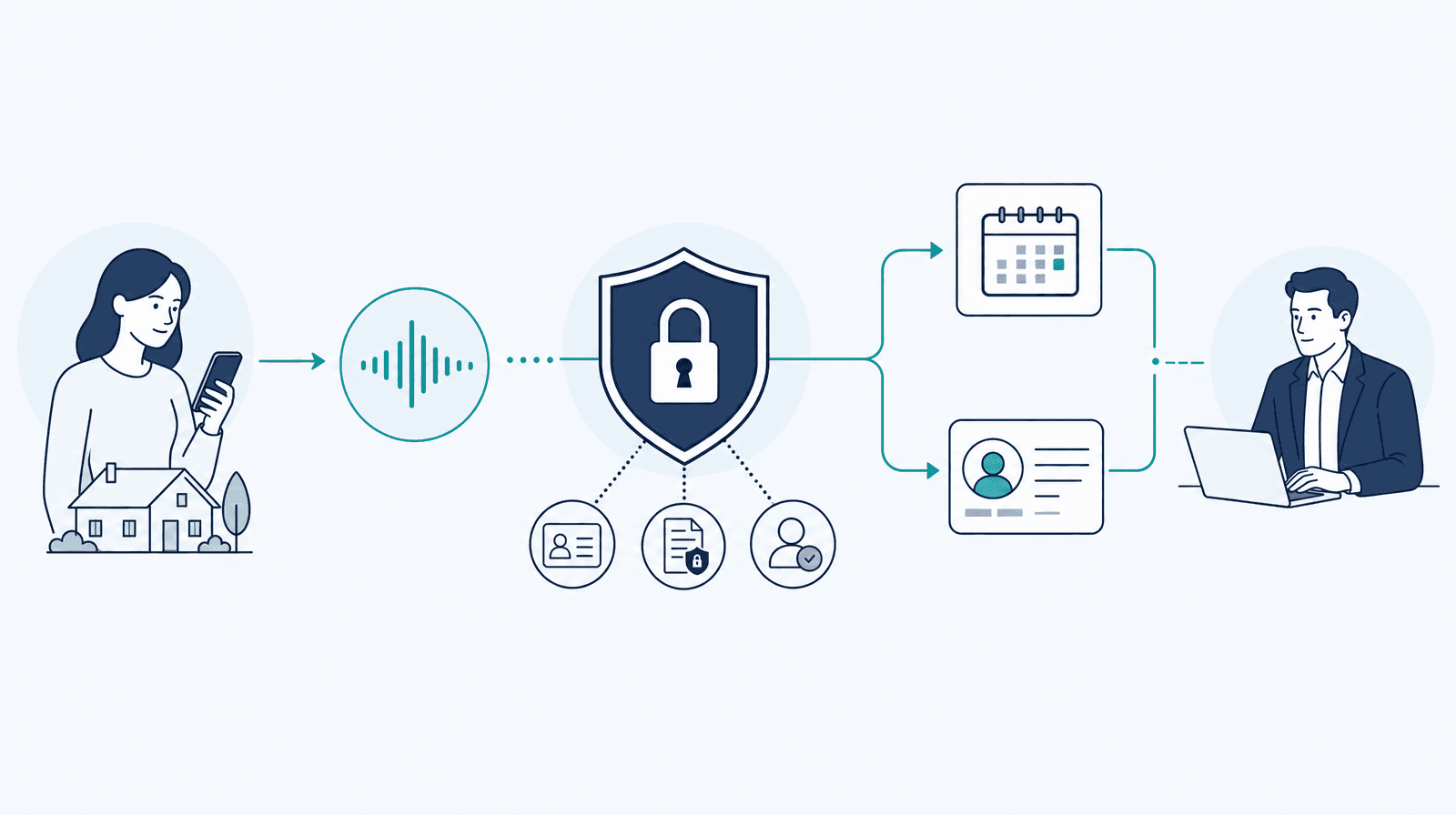
- Start the call. The agent identifies the brokerage, states that it is an AI assistant, explains the purpose of the conversation, and provides a way to reach a person.
- Determine the job. It asks whether the caller wants to start an inquiry, change an appointment, request a general update, or leave a question for the team.
- Apply the right identity level. General inquiries need basic contact details. File-specific information requires the brokerage’s approved authentication flow.
- Collect only approved fields. The agent asks the versioned intake questions and records the caller’s own words.
- Answer from approved knowledge. It may explain the brokerage’s process or office hours. Personalized product, rate, qualification, or decision questions trigger a licensed handoff.
- Complete an approved action. It offers a valid calendar slot or creates a callback task through a narrow API.
- Confirm reality. The agent claims a booking or update succeeded only after the system of record confirms it.
- Close with a recap. It states what happened, what comes next, and how the caller can correct a mistake.
The handoff should include the caller’s goal, verified details, open questions, action already completed, and a link to the interaction record. It should not include an invented recommendation or a model-generated conclusion about eligibility.
The operating boundary: prepare, communicate, and route—do not quietly decide
“Lead qualification” is an ambiguous phrase in mortgage. It can mean collecting basic information for routing, or it can mean evaluating whether someone appears eligible for credit. Those are not the same workflow.
Define the agent’s authority in four columns before building it:
| Authority | Example |
|---|---|
| May read | Approved FAQ, consent status, calendar availability, verified file milestone |
| May say | General process information, confirmed appointment details, approved reminder language |
| May change | Create a callback task, book an allowed slot, save an intake field with evidence |
| Must escalate | Personalized eligibility, product recommendation, pricing, exceptions, complaints, underwriting, approval, denial, or adverse action |
The exact regulated boundary depends on the brokerage’s role, lender relationships, workflow, jurisdiction, and message. Have qualified legal and compliance owners approve it. Do not rely on the model or a vendor’s marketing page to define what is permitted.
Contact permission and AI voice
Outbound calling rules vary by purpose, technology, jurisdiction, and relationship. In the United States, the FCC has confirmed that the Telephone Consumer Protection Act’s restrictions on an “artificial or prerecorded voice” include current AI-generated voices; covered calls require the applicable consent. See the FCC’s declaratory ruling on AI-generated voices.
Build consent, suppression, permitted calling times, identification, opt-out, and campaign rules into deterministic policy checks before the agent places a call. Maintain evidence of the permission used. Review federal and state requirements with counsel before launch.
Borrower data and service providers
Mortgage brokers are among the financial institutions covered by the FTC Safeguards Rule. The rule calls for an appropriate written information-security program and addresses controls such as access, encryption, application assessment, monitoring, disposal, and service-provider oversight. The FTC’s Safeguards Rule compliance guide explains the requirements.
In practice, that means a general-purpose AI account is not a borrower-data workflow. Before an AI vendor touches nonpublic personal information, evaluate the data path, contract, permitted use, training use, subprocessors, access controls, encryption, retention, deletion, incident response, and audit evidence.
Disclosure, recording, and human access
Tell people when they are interacting with AI. If calls are recorded or transcribed, apply the notice and consent rules for every jurisdiction involved. Make it easy to request a person, correct information, make a complaint, or opt out.
Consistency is not automatically fairness. Review whether language, accent, geography, caller history, or other proxies affect routing and service. Test accessibility, multilingual performance, and the experience of callers who speak slowly, interrupt, use assistive technology, or do not fit the expected script.
A production architecture for mortgage voice AI
A natural voice is only the front end. A reliable mortgage AI workflow needs controlled connections to business systems.
- Channel and trigger. An inbound call, web form, CRM event, or approved campaign starts the run.
- Trusted context. The brokerage application attaches the lead or customer ID, consent state, campaign, jurisdiction, authentication state, and agent version.
- Conversation runtime. The voice platform manages speech recognition, synthesis, turn-taking, interruptions, and conversation state.
- Approved knowledge. Retrieval is limited to versioned brokerage, lender, or program content with owners and expiry dates.
- Policy and validation. Deterministic services enforce permissions, required fields, contact rules, disclosure, forbidden topics, and human-approval gates.
- Narrow business tools. Typed APIs expose only the CRM, LOS, calendar, secure-message, or transfer actions the workflow needs.
- System of record. The CRM, LOS, or calendar—not the transcript or model memory—holds the final business state.
- Handoff and recovery. The agent transfers, queues a callback, or stops safely when policy, confidence, or a dependency requires it.
- Observability. A run ID links the agent version, approved sources, transcript, tool calls, policy decisions, latency, cost, handoff, and final outcome.
Treat model output as a proposal. The service that owns the record should authorize and execute every consequential read or write. That design limits the effect of hallucination, prompt injection, stale context, and retries.
For teams building phone workflows, Dasha’s managed voice AI backend supports inbound and outbound PSTN/SIP calls, bring-your-own-carrier deployments, REST APIs, webhooks, real-time transcription, and programmatic conversation control. The brokerage’s application still owns identity, permissions, business rules, customer data, and final acceptance of every action.
How to evaluate AI tools for mortgage brokers
Start with the workflow, not a list of logos. A general writing assistant, document tool, CRM feature, and voice AI platform solve different problems.
Use these criteria for a voice or agentic system:
Conversation quality
- End-of-turn to first-audio latency on real phone calls
- Natural interruption and correction handling
- Accuracy on names, addresses, dates, percentages, and monetary amounts
- Performance across accents, languages, background noise, and weak connections
- Behavior during silence, voicemail, transfers, and disconnects
Control and integration
- Versioned prompts, flows, knowledge, tools, and policy
- Deterministic rules for routing and high-impact actions
- Narrow REST or webhook contracts rather than broad system access
- Idempotent writes and explicit timeout behavior
- CRM, LOS, calendar, telephony, and secure-upload fit
Security and governance
- Documented data flows, storage locations, subprocessors, and retention
- Role-based access, tenant isolation, encryption, and audit logs
- Contractual limits on model training and secondary data use
- Incident-response commitments and deletion support
- Evidence that supports the brokerage’s own vendor review
Testing and operations
- Scenario replay and regression testing before a release
- Inspection of transcripts, tool calls, errors, and final system state
- Alerts for forbidden actions, failed transfers, duplicate writes, and unusual costs
- Version-level outcome reporting and rollback to a known-good release
- A tested kill switch and named incident owner
Economics
- Total cost of voice runtime, telephony, model use, integration, monitoring, and human review
- Cost per correctly completed outcome, not merely cost per minute
- Engineering and compliance effort required to maintain the workflow
- Data portability and the cost of changing providers
A polished demo is not a production evaluation. Test through the real carrier path and assert what changed in the CRM, calendar, or LOS. Our voice-agent testing guide covers component tests, multi-turn scenarios, failure injection, regression, and rollback.
A 30-day mortgage AI pilot
Choose one workflow with a clear outcome and low decision risk. Appointment scheduling, general after-hours intake, or call summarization usually makes a better first pilot than autonomous prequalification.
| Period | Work | Exit evidence |
|---|---|---|
| Days 1–5 | Map the current workflow and baseline; name business, compliance, security, and technical owners | Baseline metrics and a signed authority matrix |
| Days 6–10 | Build the knowledge, tool contracts, policy checks, handoff, and failure responses | End-to-end test in a non-production environment |
| Days 11–15 | Create an evaluation set from fictional and de-identified scenarios | Required and forbidden behavior defined for every case |
| Days 16–23 | Release to limited traffic with the old process available | Daily outcome and error review by agent version |
| Days 24–30 | Compare with the baseline or a contemporaneous control; review failures and staff workload | Written decision to stop, revise, hold, or expand |
The test set should include:
- Straightforward calls and callers who change their answer
- Unsupported rate, product, eligibility, and advice questions
- Missing consent or an opt-out request
- Caller-authentication failure
- Ambiguous names, dates, addresses, and amounts
- Accents, background noise, silence, interruptions, and repeated corrections
- CRM, calendar, transfer, and knowledge-source outages
- Prompt-injection attempts and requests for another borrower’s information
- Duplicate events, retries, disconnects, and voicemail
- A complaint and a repeated request for a person
Define stop conditions before launch. Examples include disclosure failure, an unauthorized status disclosure, a personalized decision or recommendation, a call placed without the required permission, or repeated unconfirmed writes.
The NIST AI Risk Management Framework provides a useful structure for mapping the context, measuring risk, managing controls, and governing the deployed system.
Measure outcomes, experience, quality, safety, and cost together
One conversion metric can hide low-quality appointments, frustrated borrowers, compliance failures, or extra cleanup work.
| Dimension | Useful metrics |
|---|---|
| Speed and coverage | Time to answer, eligible contacts attempted, successful connection rate, follow-up completion |
| Funnel outcome | Intake completion, qualified human conversations held, application starts, downstream funded-loan rate by cohort |
| Borrower experience | Abandonment, opt-out, requested-human rate, complaint rate, post-interaction satisfaction |
| Quality | Required-field accuracy, approved-source coverage, correct routing, summary accuracy, human-review score |
| Safety and reliability | Forbidden-action rate, disclosure completion, unauthorized-data exposure, duplicate writes, tool failures, successful handoffs |
| Voice experience | Response latency, interruption recovery, transfer completion, disconnects, transcription accuracy on critical fields |
| Economics | Cost per completed appointment held, staff minutes returned, platform and telephony cost, review and exception cost |
Track the full cohort. A lead that booked an appointment is not a successful mortgage outcome if the appointment was irrelevant, never held, or created from bad information.
For an incremental-value estimate, use observed pilot data:
Incremental contribution = additional completed downstream outcomes × average contribution per outcome − platform, telephony, integration, review, and exception costs
Do not insert an assumed conversion lift into an ROI calculator and call it a result. Compare the pilot with the broker’s own baseline or a suitable control, segmented by lead source, campaign, market, and workflow version.
Will AI replace mortgage brokers?
AI is likely to absorb tasks faster than it replaces the full role.
It can answer routine calls, collect information, schedule, remind, retrieve approved status, summarize conversations, and keep records moving. Those tasks benefit from speed and consistency.
Mortgage brokers remain responsible where a client needs advice, judgment, explanation, empathy, negotiation, exception handling, and accountability for a consequential outcome. Complex income, credit events, unusual properties, competing goals, and changing life circumstances do not become simple because a model can hold a fluent conversation.
The better operating model is a clear division of labor: AI prepares, communicates, and executes bounded actions; deterministic systems enforce authority; licensed people decide and advise.
Frequently asked questions
What is the best AI for mortgage brokers?
The best tool is the one that fits a defined workflow. Use a writing assistant for drafts and summaries, document AI for extraction with human verification, a CRM feature for internal automation, and a conversational or voice agent for multi-turn intake, scheduling, reminders, and support. Evaluate integration, control, testing, data handling, human handoff, and cost per completed outcome—not the length of a feature list.
How can mortgage brokers use AI for lead generation?
AI can improve the response and follow-up around leads: answering after-hours inquiries, collecting approved intake details, calling consented leads, scheduling appointments, and recording dispositions. It can also help prepare campaign content. It should not invent offers, urgency, personalized savings, or eligibility claims.
Can AI qualify mortgage leads?
It can collect factual information and apply approved routing rules. Whether a workflow crosses into prequalification, credit evaluation, or regulated advice depends on the actual questions, outputs, role, and jurisdiction. Keep personalized eligibility and product decisions with approved systems and licensed professionals, and have counsel approve the boundary.
Can mortgage brokers use ChatGPT?
Yes, for suitable tasks such as drafting general content, transforming approved notes, and building internal checklists. Do not paste borrower nonpublic personal information into an unapproved account. For actions such as calling, authenticating, scheduling, retrieving status, and updating a CRM, use a controlled application with the necessary integrations, permissions, logs, and review gates.
Is AI for mortgage brokers compliant?
No product is compliant in the abstract. Compliance depends on the firm, workflow, jurisdiction, data, contact permission, model authority, vendor relationship, disclosures, controls, and operation. Review each deployed use case with qualified legal, compliance, privacy, and security owners.
What should an AI mortgage assistant never do on its own?
It should not improvise a personalized product recommendation, rate, eligibility decision, underwriting conclusion, approval, denial, adverse-action reason, or promise about a loan. It should also never disclose file information without the required authentication or claim a system action succeeded before the system of record confirms it.
How much does mortgage AI cost?
Include platform usage, telephony or messaging, model tokens, integration, testing, monitoring, compliance and security review, human review, and exception handling. Compare that total with the cost per correctly completed business outcome. A lower per-minute rate can be more expensive if the system creates bad appointments or manual cleanup.
Build one controlled mortgage voice workflow
Do not begin with an “AI mortgage broker.” Begin with one bounded job: answer an after-hours inquiry, book an appointment, make a permissioned reminder call, or explain a verified status and transfer the caller when judgment is required.
Dasha provides the managed voice runtime, telephony support, APIs, observability, and conversation control needed to build that workflow. Your application keeps ownership of identity, permissions, brokerage policy, data, and the action recorded in each system of record.
Start with fictional scenarios, connect one narrow tool at a time, and expand only when the outcome and failure data support the next step. You can start building with Dasha or explore the platform before planning a production deployment.