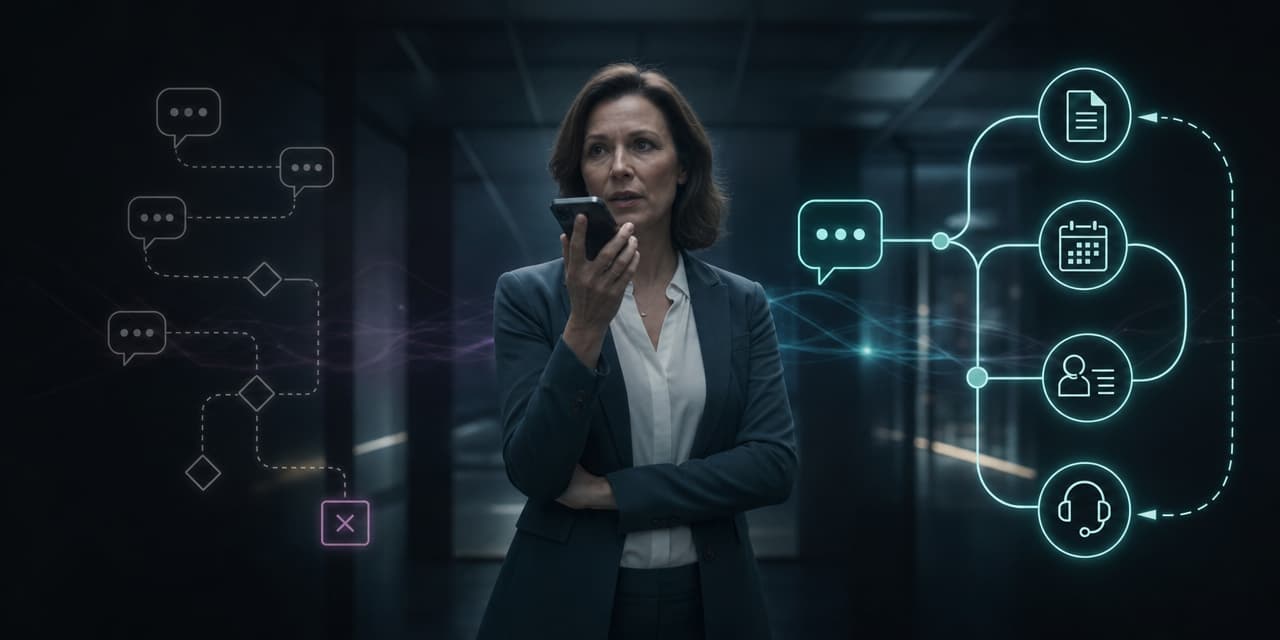
A support window that answers “What are your hours?” and a voice AI agent that verifies a caller, reschedules an appointment, and updates a CRM are both conversational interfaces. Buying them as if they were the same system creates avoidable cost and risk. The useful comparison is based on what the system can understand, what it can do, and how much control the business keeps.
The difference between virtual agents and chatbots
For buying purposes, treat a chatbot as the conversational interface and a virtual agent as a system configured to carry a task across conversation, context, and connected tools. This is a working convention, not a formal technical boundary.
That distinction is more useful than vendors’ labels. “Chatbot” covers rule-based menus, retrieval systems, and generative AI assistants. Chatbots can work through text or voice. A broad chatbot technology review likewise defines the category around natural-language interaction, rather than one specific AI technique.
A modern virtual agent usually adds maintained conversation or task state, relevant business context, tool use, decision logic, and a defined completion goal. It may retrieve an account, choose an approved action, call an API, confirm the result, and hand the conversation to a person when it reaches a boundary. A major survey of LLM agents frames agent systems around memory, planning, and action.
The categories overlap. An AI chatbot with tools and task state can function as a virtual agent. A product called a “virtual agent” may still be a scripted bot. “AI agent” commonly describes a goal-directed system that can select actions across tools. “Agentic AI” describes the techniques or degree of autonomy behind that behavior. In customer-facing software, a virtual agent may be an AI agent with a conversational interface, or it may use only a few agentic features. Evaluate the workflow, permissions, and controls instead of the name.
Common configurations, not fixed category rules:
| Dimension | Chatbot | Virtual agent |
|---|---|---|
| Primary job | Provide information, guidance, or bounded task execution | Complete a defined conversational task |
| Typical logic | Rules, intent matching, retrieval, an LLM, or a mix | Context plus orchestration, tools, policies, and task state |
| Context | Varies from none to maintained state | Usually combines task state with approved data |
| Actions | Varies from none to fixed integrations or tools | Commonly reads or writes through scoped tools |
| Dialogue | Varies from fixed paths to generative, multi-turn chat | Commonly handles variable paths and clarification |
| Autonomy | Varies; usually reactive, while some choose tools or steps | May choose the next approved step toward a goal |
| Failure modes | Vary from dead ends to unsupported answers or tool errors | Wrong answers or actions, tool failures, excessive autonomy |
| Operating burden | Lower for a narrow scope | Higher because data, integrations, controls, and evaluation matter |
Dasha is a managed production platform for serious conversational AI products, with real-time voice as our strongest current wedge. It is designed for technical teams building and operating production voice AI agents. A simple FAQ widget does not need that depth.
Three systems often hidden behind the same label
It helps to place products on a capability continuum.
Rule-based chatbot
A rule-based chatbot maps buttons, keywords, or recognized intents to predefined responses and branches. It is a good fit when the input space is small and the business wants exact control over every reply.
Common uses include store hours, policy links, lead-capture forms, and routing. The tradeoff is brittleness. Unexpected phrasing or an unmodeled request can send the user into a loop or trigger an early handoff.
AI chatbot
An AI chatbot may use natural language processing (NLP), language models, retrieval, or retrieval-augmented generation to answer questions. It can understand more phrasings and produce more flexible answers than a decision tree.
It is still primarily an information system when it cannot act in a customer’s account or carry a workflow to completion. Generative output also introduces the possibility of an unsupported answer, so grounding, citations where appropriate, and response evaluation remain necessary.
Virtual agent
A virtual agent combines conversation with task state and approved tools. It can look up an order, find the relevant policy, ask for missing information, request confirmation, update the order, and report the result. The agent may use an LLM to interpret language or choose a step. Deterministic application services should enforce identity, eligibility, permissions, and transaction rules.
This hybrid design matters. The model handles language and ambiguity. The application controls what actions exist and whether each request is allowed.
Capabilities and limitations
Where chatbots are the better fit
Chatbots are often the more sensible choice for a narrow, low-risk job. They offer:
- predictable answers and paths;
- simpler testing and change control;
- lower integration and operating effort;
- fast responses for static information;
- a clear fallback when the request is out of scope.
Their limit is task depth. A chatbot may tell a customer how to return an item. Unless it has authenticated access and action tools, it cannot determine eligibility, create the return, issue the label, and update the order.
Where virtual agents earn the extra complexity
Virtual agents fit workflows where the answer depends on who the user is, what has already happened, and which action should follow. They can:
- preserve context across several turns;
- retrieve live account or operational data;
- choose among narrowly defined tools;
- complete multi-step tasks;
- work across voice and digital channels;
- support warm or context-aware transfer that carries safely shareable task context.
These capabilities expand the failure surface. The agent can misunderstand intent, retrieve stale context, call the wrong tool, receive an API error, or take a technically valid action that policy does not allow. Voice adds speech recognition, turn-taking, interruption handling, telephony, and latency to the system.
The right control is an application-level policy. An LLM should not decide whether a caller is authenticated, whether a refund is eligible, or whether it may access another customer’s record. The OWASP guidance on excessive agency recommends limiting available functions, permissions, and autonomy, then requiring human approval for high-impact actions.
Choose by use case
Start with the work, then select the least complex system that can complete it reliably.
| Use case | Best starting point | Why |
|---|---|---|
| Hours, locations, policy links | Rule-based chatbot | Stable information and few paths |
| Product or employee knowledge search | AI chatbot | Broad questions, read-only answers |
| Lead capture with fixed qualification questions | Chatbot | Structured inputs and a simple handoff |
| Lead qualification with CRM and booking | Virtual agent | Needs live context and actions |
| Order-status lookup | AI chatbot or limited virtual agent | Read-only data may be enough |
| Return, cancellation, or account change | Virtual agent with confirmation | Needs identity, policy, and write actions |
| Appointment scheduling | Virtual agent | Needs availability and a transaction |
| High-volume inbound or outbound voice workflow | Voice AI agent | Real-time conversation, tools, telephony, and handoff |
| Medical, credit, or legal decision | Human-led with AI assistance | High cost of an autonomous error |
A hybrid system is often the right architecture. A deterministic opening can collect consent and identity. An AI layer can understand the request. Deterministic application services should validate business rules. A virtual agent can execute an approved action. A person can take over exceptions and high-impact decisions.
Set an agency budget before selecting a platform
An agency budget is our practical four-level framework for this buying decision. It sets the maximum amount of context, permission, and independent action a workflow actually needs. More autonomy should require stronger controls and clearer proof of value.
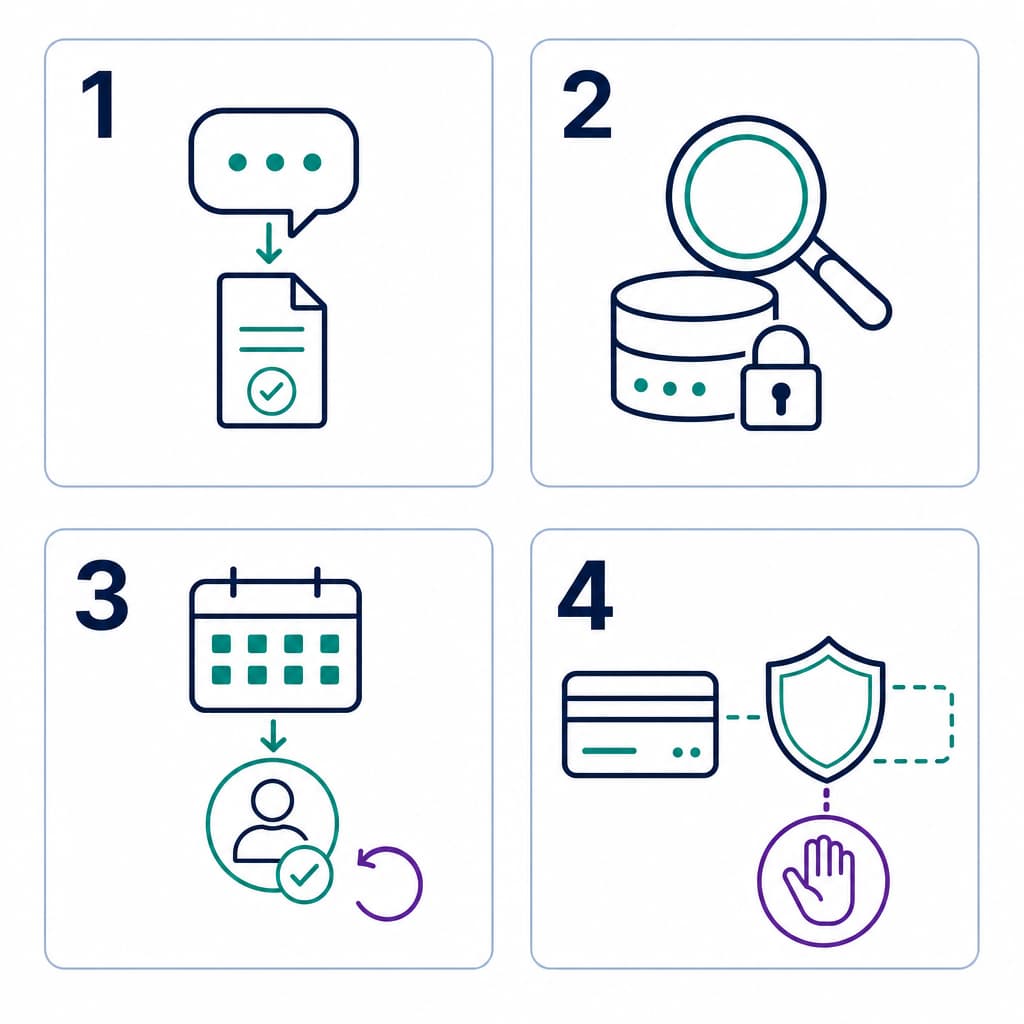
Use four levels to scope a pilot:
- Information only: answer from approved content, with no customer data or external action.
- Read-only context: retrieve an order, balance, inventory record, or schedule after authorization.
- Recoverable action: book an appointment, create a ticket, or update a preference after explicit confirmation. Treat an action as recoverable only when it can be undone safely and the rollback is recorded.
- High-impact action: move money, cancel coverage, alter access, or make a regulated decision only with appropriate human approval, deterministic authorization checks, and applicable legal and policy controls.
This framework prevents a common procurement mistake: paying for broad autonomy when the workflow needs retrieval, or deploying a chatbot when success requires authenticated actions. It also turns security review into a concrete discussion about tools, data, permissions, approval, and rollback.
How to implement the right system
1. Define one completed outcome
Choose a real workflow with enough volume to measure. “Improve service” is too broad. “Reschedule an eligible appointment and send confirmation” has a clear starting state, completion state, and exception path.
2. Write the conversation and action contract
List required inputs, allowed answers, tools, authorization checks, confirmation language, completion criteria, and conditions for handoff. Treat each tool as a narrow business capability, such as get_available_slots or reschedule_appointment, rather than general database access.
The contract should also define AI disclosure, consent, recording, and data-use controls for each channel and jurisdiction. For example, the EU AI Act’s AI disclosure rule generally requires direct-interaction AI systems to inform people that they are interacting with AI unless that is already obvious. For outbound US calls, the FCC classifies AI-generated voices as an artificial or prerecorded voice under the Telephone Consumer Protection Act. Consent and opt-out duties vary by call purpose, recipient, jurisdiction, and exemptions and require legal review for the program.
3. Prepare knowledge and integrations
Assign owners to policies and source data. Separate read tools from write tools. Use the caller or user’s authorization context, minimum permissions, input validation, idempotency keys for write actions, and audit logs. A polished conversation cannot compensate for stale policies or unreliable APIs.
4. Design human handoff as part of the workflow
Specify when the system should transfer, which warm or context-aware method carries safely shareable context, and what queue receives it. That context should reduce repetition. A human may still need to reverify identity or sensitive facts before acting.
5. Build a representative evaluation set
Use anonymized production patterns, including normal requests, ambiguous wording, interruptions, unsupported requests, policy exceptions, tool timeouts, prompt injection attempts, and adversarial inputs. For voice, add accents, background noise, crosstalk, silence, and mid-sentence corrections. Our guide to voice agent testing covers this production-focused approach in more depth.
6. Release in controlled stages
Start with internal traffic or read-only behavior. Move to a small share of eligible contacts, review failures, and expand by workflow. Keep versions of prompts, tools, knowledge, policies, and model settings so a regression can be traced and rolled back.
The NIST GenAI risk profile treats measurement in the intended context and ongoing monitoring as core risk-management work. A successful demo is only the start of production validation.
Measure completed outcomes, not conversation volume
Automation rate can rise while customer effort gets worse. A trapped user may count as “contained” even though the system failed. Measure the result, experience, safety, and operating cost together.
| Metric group | What to track |
|---|---|
| Business outcome | Eligible task completion, conversion, first-contact resolution, cost per successful outcome |
| Customer experience | Satisfaction, abandonment, repeat contact, turns to completion, unnecessary repetition |
| Conversation quality | Intent accuracy, grounded-answer accuracy, fallback rate, correct clarification and handoff |
| Action quality | Tool-call success, policy-valid actions, duplicate actions, rollback rate, action confirmation |
| Safety | Unauthorized data access, prohibited actions, critical error rate, successful escalation |
| Operations | Availability, median and tail latency, unit cost, integration errors, regression pass rate |
| Voice experience | Time to first response, interruption recovery, transfer completion, dropped-call rate |
Define each metric against eligible cases. For example:
task success rate = verified successful outcomes / eligible attempts
A virtual agent that produces verified reschedule records for 60 of 100 eligible attempts has a 60% task success rate, even if 90 conversations avoided a human handoff. Where possible, confirm the outcome against a system-of-record event such as the calendar or CRM update. Review failures by cause: language understanding, missing knowledge, policy, tool integration, user abandonment, safety control, or handoff. That breakdown tells the team what to fix. Our guide to agent evaluation metrics provides a fuller measurement framework.
Factor in operating fit and economics
The feature comparison is only part of the buying decision. Include these factors in the business case:
- Total cost of ownership: Count platform usage, models, telephony, integrations, evaluation, monitoring, knowledge maintenance, human escalation, and engineering support. Compare the total with cost per verified outcome, rather than price per conversation alone.
- Return on investment: Tie value to completed tasks, revenue, avoided rework, or reduced human handling. A lower-volume action workflow can create more value than a high-volume FAQ that saves only seconds.
- Scaling: Include expected concurrency, latency under load, rate limits, queuing, retry behavior, tenant isolation, observability, and human escalation capacity. High throughput has little value if failures become opaque.
- Languages: Assess the full path across speech recognition, language model, knowledge, text-to-speech, and human handoff. Coverage and quality can differ by language, accent, provider, and configuration.
- Accessibility: Provide an equivalent route for people who cannot or prefer not to use the default channel. Voice experiences may need text or keypad alternatives, adjustable pacing and repetition, and a human path. Text experiences should support keyboard and screen-reader use.
Questions to ask vendors
Ask for a workflow demonstration using your edge cases, then inspect the operating model:
- Which parts are rules, retrieval, model generation, and tool execution?
- How is conversation and task state stored?
- Can tools have separate permissions and approval rules?
- How does the system authenticate a user before exposing data or acting?
- What happens when a model, knowledge search, API, or telephony provider fails?
- Can it complete a warm or context-aware transfer across your channels?
- What traces are available for prompts, retrieval, tool calls, latency, and errors?
- How are versions tested, released, monitored, and rolled back?
- Which costs sit outside the quoted platform price?
- Can your team export transcripts, recordings, logs, and outcome data?
The answers reveal far more than the product category. A virtual agent without scoped tools, traceability, evaluation, and handoff is difficult to trust. A well-designed chatbot may be the stronger purchase for a small, stable information task.
Frequently asked questions
Is ChatGPT a chatbot or a virtual agent?
An ordinary ChatGPT conversation usually fits the chatbot side of this buying convention. A tool-using, multi-step agent workflow fits the virtual-agent side. Classify the enabled workflow by the state it maintains, its tools and permissions, the actions it can take, and the controls around those actions, rather than the product name.
Are virtual agents and virtual assistants the same?
The terms overlap, but “virtual assistant” can also mean a human remote worker or consumer assistant software. In business software, focus on whether the system can maintain task state and take approved actions. That makes the capability clear regardless of the label.
Will virtual agents replace chatbots?
No. Fixed chatbots remain useful for narrow, predictable interactions. Virtual agents make sense when context and actions create enough value to justify greater implementation, security, and operating work. Many production systems will keep both patterns in one experience.
If your workflow needs real-time voice, business-system actions, human transfer, and production monitoring, start building with Dasha.