AI cancer research uses computational models to find patterns in molecular, imaging, pathology, clinical, and population data. The evidence ranges from early laboratory work and retrospective studies to narrowly authorized assistive software. Those categories are not interchangeable. The useful questions are which task a system performs, how it was validated, who reviews its output, and what happens when it is wrong.
What AI cancer research includes
AI cancer research applies machine learning, deep learning, natural language processing, and generative models to specific research questions. The input might be a digitized tissue slide, a sequence of diagnoses, molecular measurements, scientific literature, or a clinical trial protocol. The output might be a highlighted image region, a risk score, a ranked trial list, or a candidate biological hypothesis.
The National Cancer Institute (NCI) describes work across cancer mechanisms, screening and diagnosis, drug discovery, precision treatment, surveillance, and care delivery. It also calls for representative data, reproducible methods, explainability, and further randomized trials before many clinical applications can be trusted in practice. NCI's cancer AI overview provides the field-level context.
Three categories keep the claims clear:
| Category | What it proves | What it does not prove |
|---|---|---|
| Research evidence | A model performed a defined task on a study dataset | That it works for every hospital, population, or future case |
| Authorized assistive tool | A regulator authorized a specific intended use with defined controls | Autonomous diagnosis or use beyond that indication |
| Proposed operations workflow | A team can design and test an administrative process around AI | Clinical benefit, regulatory clearance, or safe use without local validation |
A high score in a retrospective paper is evidence about that paper's task. It is not permission to use the model for diagnosis. Regulatory authorization is also specific. It applies to the device, users, inputs, workflow, and intended use described in the authorization.
Where researchers use AI in cancer research
Cancer biology and drug-response research
At the molecular level, AI can help researchers search large experimental spaces, connect measurements across scales, and choose simulations or experiments to run next. This is hypothesis and model development work.
The NCI and Department of Energy collaboration combined machine learning, molecular dynamics, high-performance computing, and experiments to study RAS-RAF signaling, a pathway involved in many cancers. Another project developed methods for comparing models that predict drug response. These projects produced research infrastructure, data, models, and mechanistic insight. They did not establish that an AI system had discovered or clinically validated a cancer cure. The NCI-DOE project record describes the completed program and its outputs.
Medical imaging and digital pathology
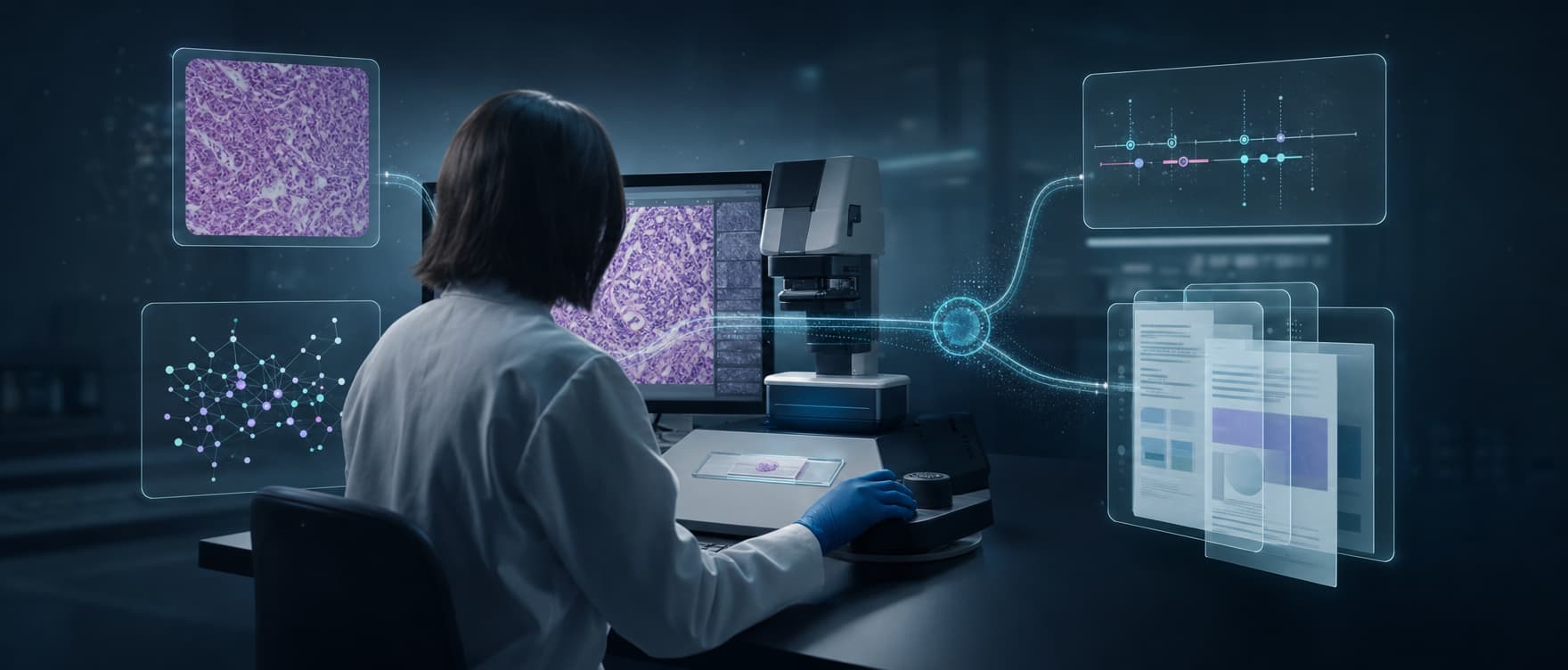
Imaging and pathology are natural AI research targets because scans and whole-slide images contain large numbers of pixels that specialists must interpret in context. Models can classify an image, segment a structure, quantify a feature, or point a reviewer to a region that deserves attention.
Paige Prostate shows what a narrow, authorized assistive use looks like. The US Food and Drug Administration classified it as a Class II software device that can identify a suspicious location on a scanned prostate biopsy for a pathologist to review. The pathologist performs the initial review first, and the software output cannot serve as the primary diagnosis. Those limits are part of the FDA De Novo order.
Research results sit at a different evidence level. In an NCI study of 4,253 people with positive human papillomavirus tests, an automated dual-stain method outperformed Pap cytology on the study's sensitivity and specificity measures and reduced referrals to colposcopy. NCI also stated that the automated method would need additional regulatory approval before use for that screening purpose. The dual-stain study summary is promising research evidence, not a blanket authorization for AI screening.
Risk modeling from longitudinal health data
Researchers can train models on sequences of diagnoses and other longitudinal records to estimate who may have an elevated future cancer risk. These systems could help define a group for closer study or surveillance if subsequent validation supports that use.
A 2023 Nature Medicine study trained deep-learning models on disease histories from Danish national records and US Veterans Affairs data to predict pancreatic cancer risk at several future time points. The work was retrospective and population-specific. It demonstrated a research approach to risk stratification. It did not create a stand-alone screening test or a patient-level diagnosis. The full pancreatic risk study details the cohorts, exclusions, and performance analysis.
Clinical trial retrieval and matching
AI can reduce the volume of protocols a research team has to review and compare patient information with complex eligibility criteria. Human review remains essential because eligibility depends on complete, current records and protocol interpretation.
TrialGPT is a useful example with clearly bounded evidence. Its retrieval, criterion-level matching, and ranking modules were evaluated on three cohorts containing 183 synthetic patients and more than 75,000 trial annotations. A pilot user study reported 42.6% less human screening time. The study did not show higher enrollment, better clinical outcomes, or safe autonomous eligibility decisions. Those distinctions appear in the original TrialGPT study.
How to judge evidence for a cancer AI system
Model performance is only one part of validation. A credible evaluation connects the research question, data, comparison, workflow, and intended user.
- Define the task and intended use. Predicting a molecular property, highlighting a slide region, estimating future risk, and determining trial eligibility are different tasks. Each needs its own ground truth, error analysis, and decision boundary.
- Separate training from evaluation. Patients, sites, slides, or time periods used for evaluation should be independent of model development. The split must prevent the same person's information from leaking across sets.
- Test external validity. Performance at another institution, on a later time period, or in a different population shows whether the model travels beyond its development environment. Subgroup analysis should look for clinically meaningful differences, including rare cancers and underrepresented populations.
- Compare against the real workflow. A model should be compared with current practice and tested with its intended users. Reader studies, prospective silent trials, and workflow pilots answer questions that benchmark datasets cannot.
- Measure errors and downstream consequences. Sensitivity, specificity, calibration, and ranking metrics describe different properties. Teams also need to know who receives false positives and false negatives, how reviewers respond, and whether the output changes an action.
- Match authorization and governance to the use. A research prototype, an institutional decision-support workflow, and a regulated medical device have different review paths. Protocol approval, institutional review board (IRB) oversight, privacy review, software controls, and regulatory assessment should follow the actual use.
- Monitor after release. Data distributions, clinical practice, protocols, and software change. Teams need version records, drift checks, incident review, and a way to pause the system when it operates outside its approved scope.
Prospective evidence matters because retrospective datasets preserve the documentation practices, access patterns, missingness, and bias of the systems that produced them. A model can reproduce those patterns while still achieving an attractive aggregate score.
What remains unproven
No single finding establishes that AI generally improves cancer diagnosis, treatment, enrollment, or patient outcomes. Claims need to stay attached to the evaluated task and endpoint.
Several gaps recur across the field:
- Generalization: A model trained on one health system or scanner may perform differently elsewhere.
- Representation: Underrepresented populations and rare cancers may have too little data for dependable subgroup estimates.
- Ground truth: Labels drawn from billing codes, reports, or historical decisions can contain errors and inconsistent definitions.
- Clinical utility: Better model discrimination does not automatically produce a better decision or outcome.
- Automation bias: A fluent explanation or highlighted image can encourage a reviewer to accept an incorrect output.
- Reproducibility: Hidden preprocessing, unavailable code, and changing model versions can make results hard to reproduce.
Generative AI adds a particular risk: a plausible answer can mix accurate and inaccurate medical information. In studies summarized by NCI, one chatbot produced at least one treatment recommendation that disagreed with the reference guidelines in 34.3% of the responses that contained a recommendation. That result came from a specific model and study design, but it shows why medical interpretation must stay with trained people. NCI's chatbot review explains the evaluation and its limits.
AI can help researchers generate, rank, or test hypotheses. Experimental and clinical evidence still determines whether a biological claim or intervention is valid.
Where Dasha fits in cancer research operations
Dasha is not a cancer-research model, diagnostic system, treatment adviser, or trial-matching product. We fit a narrower layer: bounded voice communication around research operations.
A research organization could propose and evaluate a Dasha workflow for:
- appointment, visit, or survey reminders;
- scheduling and rescheduling;
- delivery of approved study logistics and preparation information;
- collection of a fixed set of administrative or participant-reported responses; and
- routing questions, ambiguous answers, or protocol-defined exceptions to a trained person.
Our platform can search a customer-selected knowledge base, call customer webhooks through configured tools and functions, transfer a call to a person, and derive configured fields from a transcript through post-call analysis. Retrieved passages can be incomplete or stale. Tool calls need customer-side authorization and validation. Post-call fields are model-derived labels, so a research record that matters clinically or scientifically requires independent verification.
This would be a proposed operations workflow. It would not establish oncology-specific validation, a native integration with an electronic health record or clinical trial management system, guaranteed extraction accuracy, or clinical benefit.
The boundary should be explicit. A Dasha workflow should not:
- diagnose cancer or interpret a symptom;
- give individualized treatment advice;
- independently decide whether someone is eligible for a trial;
- replace informed consent; or
- replace the clinical or research team.
HHS describes informed consent as an ongoing exchange in which each person can have questions and concerns addressed individually. An automated call may support an IRB-approved process by delivering approved logistics or arranging contact. It cannot reduce consent to a recorded response or replace the responsible investigator's process. The HHS consent guidance explains that standard.
Privacy requirements depend on the parties, data, and use. HHS identifies a third-party AI chatbot handling protected health information (PHI) for reminders or appointment scheduling as an example of a business associate. A covered entity may therefore need a business associate agreement and corresponding safeguards. The full HHS business-associate guidance also explains when research activity is treated differently.
We do not currently publish formal third-party attestations on our security page. We sign HIPAA Business Associate Agreements (BAAs) for eligible healthcare deployments; contact security@dasha.ai. Use synthetic data for technical evaluation. Do not send PHI to Dasha until the required agreements, safeguards, subcontractor conditions, and organizational approvals are confirmed. Our guide to AI in healthcare communication covers the wider data and risk model.
A safer way to test a research-communication workflow
Start with one administrative job that has a clear owner and a reachable human fallback.
- Write the boundary before the dialogue. State the permitted information, actions, data fields, escalation triggers, and prohibited medical or eligibility decisions.
- Use the approved process. Put the content, contact rules, recordings, data collection, retention, and handoff path through the study's protocol, IRB, privacy, security, and legal review as applicable.
- Map every data flow. Record what the agent receives, generates, sends, and stores across telephony, speech, model, webhook, transcript, recording, and monitoring systems. Give each component the minimum access it needs.
- Constrain knowledge and actions. Use versioned, approved study material. Expose only the tools needed for the administrative task. Require confirmation before a system write and verify the downstream result.
- Design the human path. Define who receives clinical questions, consent questions, potential safety concerns, withdrawal requests, interpreter needs, and tool failures. Specify the outcome when that person is unavailable.
- Test representative and adverse cases. Use synthetic scenarios across supported languages, accents, noise conditions, interruptions, ambiguous answers, out-of-scope requests, failed transfers, duplicate calls, and unavailable systems. Include the populations and accessibility needs the study expects to serve.
- Review and monitor. Sample transcripts and model-derived fields, compare them with source responses, track transfers and failures, investigate differences across groups, and keep a disable path. A trained person should review material exceptions and any information used for a research or clinical decision.
Begin with a disabled Dasha agent, synthetic study data, approved logistics content, and a fixed set of pass and fail cases. Test it in Dasha before considering any live participant communication.