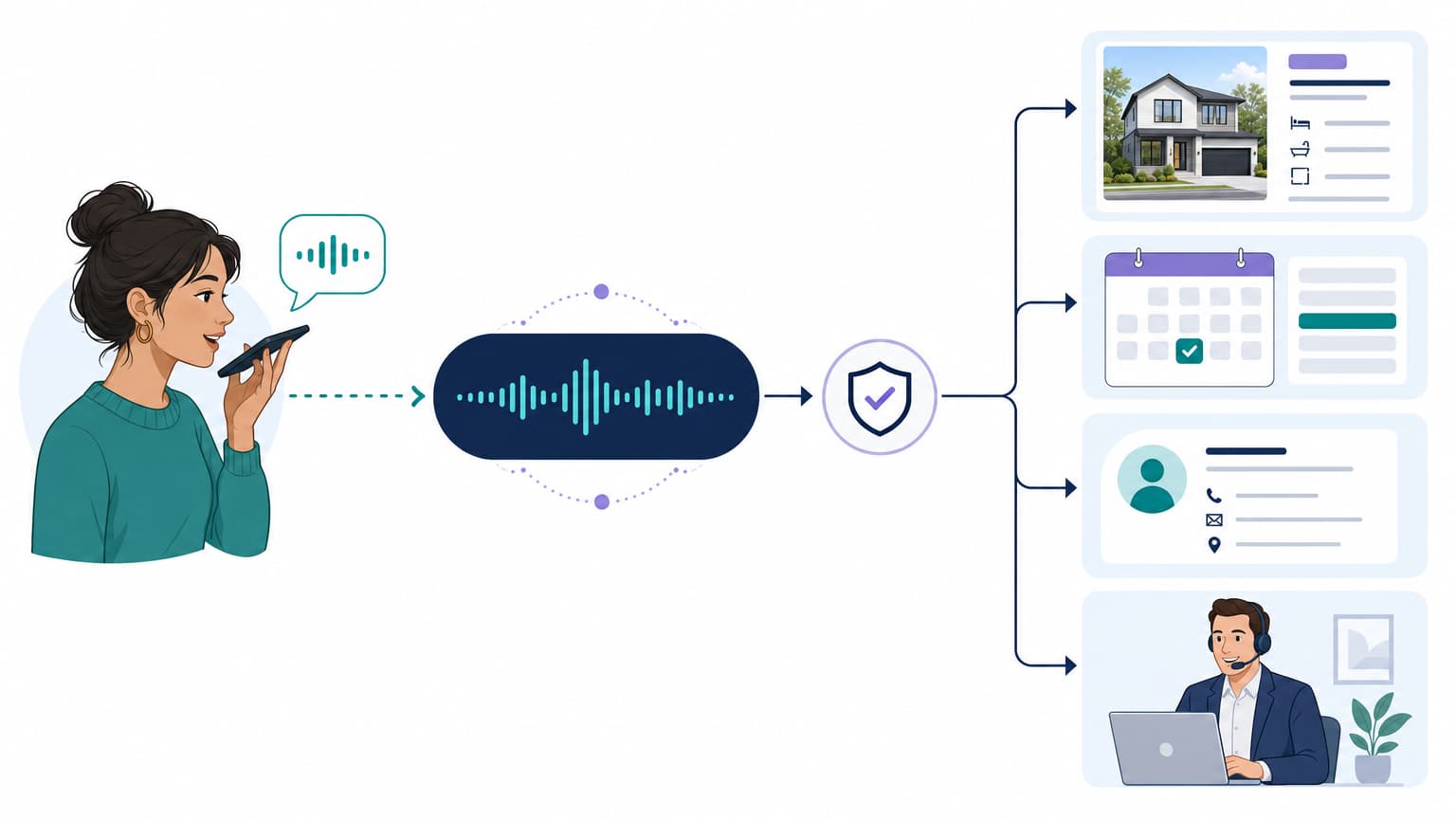
Real estate conversations are time-sensitive, data-heavy, and spread across calls, chat, and text. A useful AI system retrieves current property facts, qualifies intent, completes the next action, and hands off with context. The hard part is designing that workflow without creating false answers, compliance risk, or another disconnected inbox. Here is a practical blueprint for choosing high-value use cases, building the system, and measuring whether it works.
The short answer
Conversational AI for real estate is software that holds a natural dialogue with buyers, sellers, renters, owners, or vendors and can take approved actions in connected systems. It is most useful for fast first response, routine qualification, showing coordination, status updates, and maintenance intake. Agents and property managers remain responsible for negotiation, advice, sensitive decisions, and exceptions.
The dividing line is action. A basic real estate chatbot presents canned answers or collects a form. A conversational AI agent can ask a relevant follow-up, retrieve live data, update a customer relationship management system (CRM), book a tour, and transfer the conversation with its context intact.
For technical teams building voice into a brokerage, property platform, or real estate software product, Dasha's managed production platform provides a production runtime, REST APIs, a web application, telephony, integrations, testing, monitoring, and large-scale call execution. Your application still owns the listing data, CRM logic, permissions, and business policy. Dasha is a fit when you want to build a differentiated voice workflow without operating the real-time audio stack yourself.
Where conversational AI fits in the real estate journey
Real estate teams receive leads through listing portals, websites, social media, local multiple listing services (MLSs), calls, and text. The National Association of REALTORS' 2025 member survey identified social media, CRM systems, and local MLSs as the top lead-generating technologies. (NAR technology survey)
Conversational AI should connect those entry points to an outcome, instead of becoming one more channel an agent has to watch.
| Channel | Strongest use | Main design constraint |
|---|---|---|
| Voice | Inbound calls, immediate lead follow-up, qualification, scheduling, urgent triage | Interruptions, background noise, latency, disclosure, and reliable transfer |
| Web chat | Listing questions, guided search, lead capture, and self-service | Current property data, visible source boundaries, and low-friction human escalation |
| SMS or messaging | Confirmations, reminders, short follow-ups, and document requests | Consent, message cadence, concise replies, and channel continuity |
A conversation can move between channels, but its state should live in one record. If a buyer asks about a listing in chat and later calls, the voice agent should receive the listing ID, known preferences, and previous outcome rather than starting over.
The workflows worth automating
Start with a workflow that has frequent demand, clear source data, a measurable finish, and a safe handoff. These are the strongest candidates.
| Workflow | Data the agent needs | Approved outcome | Handoff trigger |
|---|---|---|---|
| New lead response | Lead source, listing ID, contact details, routing rules | Capture intent and create a qualified CRM record | Complex financing, representation question, or ready buyer |
| Listing inquiry | Current listing fields, availability, showing rules | Answer grounded questions and offer a viewing | Missing data, negotiation, or property-specific advice |
| Showing coordination | Agent calendars, access rules, time zone, contact record | Book, confirm, reschedule, or cancel | Access exception, calendar conflict, or special accommodation |
| Post-showing follow-up | Showing record, property ID, prior notes | Collect feedback and schedule the next step | Offer interest, objection needing advice, or complaint |
| Tenant service intake | Lease or property record, maintenance categories, emergency policy | Create a complete ticket and give approved instructions | Safety issue, habitability risk, payment dispute, or upset resident |
Lead response and qualification
The agent should ask only for information that changes routing or the next action. For a buyer, that can include target area, budget range, property type, timing, financing status, and whether they already have representation. For a seller, it can include property address, timing, occupancy, and preferred contact window.
The result should be a structured CRM update, not a transcript dumped into a notes field. Store the qualification fields, listing or campaign source, consent state, next action, owner, and a short summary. The human agent can then continue from a useful starting point.
Listing questions and showing coordination
Property facts must come from an approved, current source. The agent can answer questions about price, bedrooms, parking, pet policy, fees, availability, or open-house times when those fields are present. It should say the information is unavailable when a field is missing, rather than infer an answer from a similar listing.
Booking is a transaction, so treat it like one. Check availability at the moment of confirmation, use idempotency to prevent duplicate appointments, read back the property and time, write the event, and send confirmation only after the calendar accepts it.
Follow-up and database reactivation
Follow-up works when it is tied to an event and an approved purpose. Examples include asking for feedback after a viewing, checking whether search criteria changed, or reconnecting with a lead who previously requested contact. It works poorly when a generic agent repeatedly contacts an old database without reliable consent, context, or suppression rules.
Tenant and property management support
The safest starting point is intake and routing. An agent can identify the property and unit, capture the issue, ask approved diagnostic questions, create a ticket, and share a policy-based next step. Emergencies, legal disputes, accessibility requests, and situations affecting health or safety need immediate escalation according to the operator's policy.
A production system needs four connected layers
The conversation is only the visible part. A production deployment connects four layers with explicit boundaries.
- Trusted data: CRM records, licensed listing feeds, property management systems, calendars, policy documents, and approved knowledge sources.
- Conversation runtime: speech recognition, turn detection, language model behavior, text-to-speech, interruption handling, retries, and channel state.
- Business tools: narrow functions that read availability, create a lead, book a showing, open a ticket, or transfer to a person.
- Operations: test cases, traces, call history, alerts, access control, versioning, rollback, and outcome reporting.
The listing layer deserves special attention. The Real Estate Standards Organization (RESO) Web API provides a standardized way to transport listing data, and its Data Dictionary aligns field names and values across systems. Access still comes through an MLS or another authorized data provider under its data-use and licensing terms. (RESO Web API; Data Dictionary)
Record a listing identifier and data timestamp with each answer. Define what happens when a listing is stale, withdrawn, pending, or absent. The safe default is to avoid answering and route the question, since confident delivery does not make an old fact current.
Design the dialogue around the business outcome
Consider an inbound call about a rental listing. A reliable flow looks like this:
- Resolve context. Use the number or page that originated the inquiry to identify the property. Ask for the address only when context is missing or ambiguous.
- Answer from retrieved fields. Respond with the rent, availability, pet policy, or showing window that came from the current property record.
- Collect minimum qualification data. Ask about the requested unit type, move-in date, showing availability, and contact details. Do not ask questions that invite protected-class information or steering.
- Offer one next action. Present valid showing times, schedule a callback, or open an application link according to policy.
- Confirm the write. Repeat the property, appointment time, contact method, and any required instructions after the booking succeeds.
- Hand off with context. Send the property ID, captured fields, questions asked, answers given, disposition, and reason for transfer.
This flow gives the model less room to improvise. The runtime handles conversation, while typed tools and business rules control the actions that change a system of record.
Guardrails specific to real estate
Control outbound calling at the campaign level
The FCC has confirmed that AI-generated human voices fall under the Telephone Consumer Protection Act's restrictions on artificial or prerecorded voice calls. The FTC's Telemarketing Sales Rule also governs telemarketing conduct and the National Do Not Call Registry. (FCC ruling; FTC compliance guide)
Any outbound campaign should enforce an approved policy for consent evidence, purpose, caller identification, suppression lists, opt-outs, calling windows, disclosures, and record retention. Those controls belong outside the prompt so a model cannot bypass them. Counsel should approve the policy for the jurisdictions and campaign involved.
Prevent steering and unsupported neighborhood claims
The Fair Housing Act prohibits housing discrimination based on race, color, national origin, religion, sex, familial status, and disability. (HUD overview) An AI agent should never rank or describe neighborhoods using protected traits or proxies for them. It should also avoid subjective claims such as "safe area" or "best schools."
Answer objective questions from approved sources, use consistent qualification criteria, and route requests for subjective guidance or accommodation to a trained person. Test paraphrases and indirect requests, since a user may ask for the same prohibited recommendation without naming a protected class.
Limit authority for financial, legal, and contractual matters
An AI agent can gather mortgage status, explain a published process, or route a question. It should not promise qualification, interpret a contract, estimate a legally binding amount, advise on an offer, or represent that a transaction step is complete when the underlying system has not confirmed it.
Minimize personal data and retain useful evidence
Give each tool the smallest permissions it needs. Separate read and write actions, redact sensitive fields from logs, define recording and transcript retention by jurisdiction, and keep an audit trail of data retrieved and actions attempted. A summary helps the next person. A trace explains what the system actually did.
Choose the operating model that matches your team
| Approach | Best fit | What you control | Main tradeoff |
|---|---|---|---|
| Dasha managed production platform | Technical teams building a custom voice product or workflow | Agent behavior, tools, data, telephony configuration, policies, and product experience | Platform dependency below your application boundary |
| Vertical real estate application | Brokerages or property managers that need ready-made workflows and connectors | Configuration, scripts, routing, and vendor-supported integrations | Less control over runtime behavior, data model, and migration path |
| Open-source framework or custom stack | Teams that must own the media pipeline or deployment environment | Providers, runtime, infrastructure, observability, and every integration | Larger engineering, testing, and on-call burden |
There is no benefit in choosing a custom platform if your team wants a turnkey receptionist. There is also little value in a rigid vertical tool when the conversation itself is part of your product. Evaluate the same real calls, data sources, failures, transfer paths, and target load across candidates.
Launch a narrow pilot in six steps
- Choose one outcome. After-hours listing calls that end in a qualified lead or confirmed showing are easier to judge than a general real estate assistant.
- Write the operating contract. Define allowed intents, required data, tool permissions, completion criteria, forbidden actions, and handoff reasons.
- Connect the real systems. Use a sandbox CRM and calendar first. Validate listing IDs, time zones, authentication, duplicate protection, and failure responses.
- Build a regression set. Include missing listings, stale status, similar addresses, corrections, silence, noise, interruptions, accents, double-booking attempts, tool timeouts, transfer failure, and prohibited steering requests.
- Release to a small traffic slice. Keep a human or standard call path available, set rollback thresholds, and review failures daily.
- Operate it as software. Version prompts and tools, inspect traces, turn production failures into tests, and compare each release against the same outcomes.
Our guides to building an AI voice agent and voice agent testing go deeper into runtime design, tool safety, telephony tests, failure injection, and regression control.
Measure completed outcomes, not conversation volume
Call count, chat count, and average duration do not establish business value. Track the funnel and the failure rate together.
| Metric | Practical definition |
|---|---|
| Qualified lead rate | Conversations that produce every required field and a valid next step, divided by eligible conversations |
| Showing booking rate | Confirmed showings divided by eligible listing inquiries |
| Kept-appointment rate | Completed showings divided by confirmed showings |
| Autonomous resolution rate | Eligible requests completed without human work, excluding abandoned conversations |
| Transfer success rate | Transfers connected with context divided by attempted transfers |
| Grounding error rate | Audited answers that conflict with the approved source or use an expired record |
| Unsafe action rate | Forbidden or incorrectly authorized actions divided by audited conversations |
| Cost per completed outcome | Platform, telephony, integration, and operating cost divided by verified outcomes |
Compare the pilot with the same workflow before deployment or with a holdout group. A useful system raises completed outcomes or lowers handling cost while keeping grounding errors, unsafe actions, complaints, and failed transfers inside explicit limits.
Frequently asked questions
Will conversational AI replace real estate agents?
It is better suited to response, coordination, and structured intake than negotiation or advice. In NAR's 2025 buyer and seller profile, 88% of buyers purchased through an agent or broker and 91% of sellers used an agent. Buyers valued help with finding a home, negotiating, paperwork, and spotting property issues. (NAR buyer and seller profile) AI can give that person better context and more time for the work that requires judgment.
Can conversational AI access MLS listings?
Yes, when the operator has authorized access through its MLS or data provider and follows the applicable license. RESO standards make fields and transport more consistent, but they do not grant listing-data rights by themselves.
Is Dasha a turnkey real estate assistant?
No. Dasha is a managed production platform for technical teams building and operating custom voice AI products. We run the real-time voice runtime and production operations. Your team defines the real estate workflow, connects its systems, sets policy, and owns the customer experience.
If voice is a core part of your real estate product or operation, evaluate Dasha with one end-to-end workflow: connect a real inquiry source, retrieve a current property record, complete one CRM or calendar action, and test the human handoff.