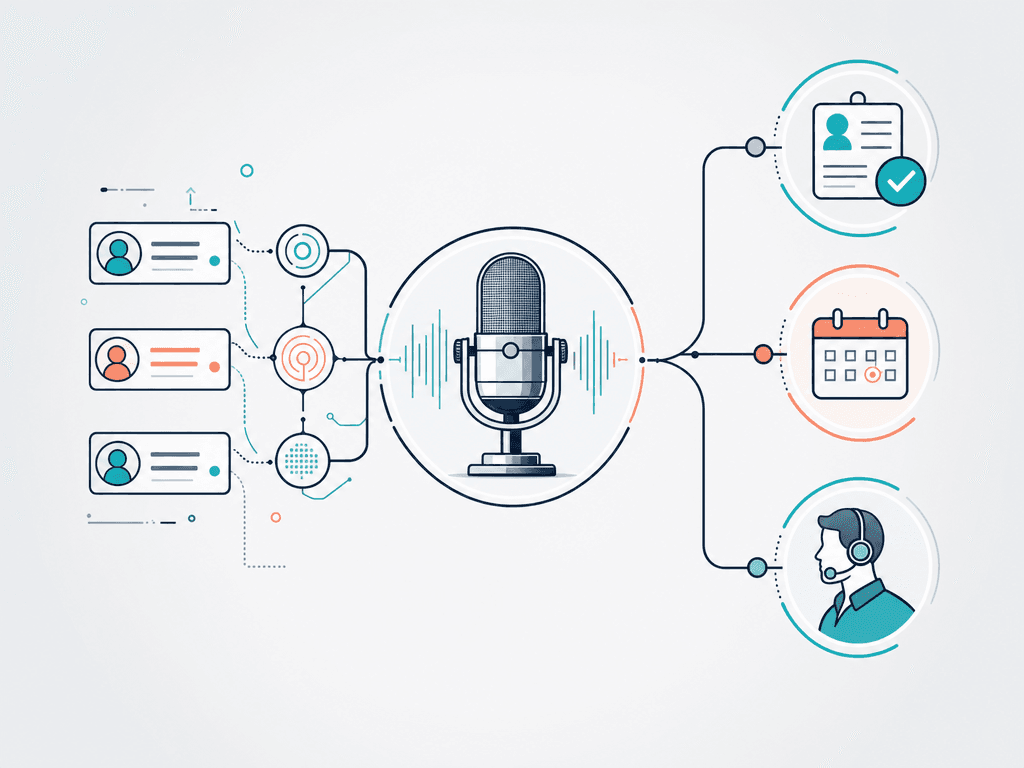
AI lead generation uses artificial intelligence to find or capture, enrich, prioritize, contact, qualify, route, and analyze potential buyers. It does not create demand, trustworthy data, or permission to contact someone from nothing. The system works when each lead has a clear source, the right channel, defined qualification rules, a next step, and a human path for judgment or exceptions.
Last updated: July 20, 2026
How AI lead generation works
AI can support the full lead-generation lifecycle, but each stage has a different job and boundary.
| Stage | Useful AI job | Output the next step needs |
|---|---|---|
| Find or capture | Detect target accounts, form submissions, product signals, referrals, or event leads | A lead with a known source and stable identifier |
| Enrich and research | Add company, role, history, public signals, and prior engagement | Current context with source details and timestamps |
| Score and qualify | Compare fit, intent, behavior, and discovery answers with agreed criteria | A reasoned priority or qualification state |
| Choose a channel | Apply urgency, buyer preference, consent, suppression, and workflow rules | Email, chat, phone, self-serve, or human review |
| Engage | Draft a message or hold a conversation using approved context | A response, missing information, or explicit next step |
| Book or route | Match the lead with the right owner, calendar, queue, or self-serve path | A confirmed booking, transfer, or assignment |
| Record and nurture | Update the customer relationship management (CRM) system and continue permission-aware follow-up | Shared context for the next touch |
| Measure and improve | Connect activity to qualification, pipeline, revenue, complaints, and failures | Evidence for keeping, changing, or stopping the workflow |
These stages may use different products. A prospect database does not conduct a good discovery call. A voice agent does not fix a stale CRM. A scoring model cannot learn a useful definition of quality when the underlying conversion labels are inconsistent.
A 2026 Salesforce survey of 4,050 sales professionals across 22 countries found that 87% worked at organizations using AI for tasks such as prospecting, forecasting, lead scoring, or email drafting. That shows adoption across the workflow, not proof that every use improves lead quality.
Start by defining the business outcome. "Generated a lead" is too vague. A better event might be a lead the sales team accepts as qualified, an attended meeting with an account that matches your ideal customer profile, or a sales opportunity created within a set period. The AI system should optimize toward that event, not toward more messages or calls.
Match the channel to the job
The right channel depends on urgency, dialogue complexity, buyer expectations, and legal permission. Treat channel selection as part of the workflow rather than a default setting. Here, an eligible lead is one that meets the workflow's business rules and can lawfully be contacted through the chosen channel.
| Channel | Best fit | Strength | Main limitation |
|---|---|---|---|
| Email or messaging | Information, nurture, and low-urgency follow-up | Asynchronous and easy to review | Slow clarification; deliverability and inbox competition |
| Web chat | Inbound visitors with an immediate question | Uses page context and can stay inside the session | Depends on the visitor remaining available |
| AI voice | Eligible leads who benefit from real-time clarification, qualification, scheduling, or routing | Synchronous questions and answers; can act or transfer during the conversation | Higher compliance, quality, latency, and handoff burden |
| Human representative | High-value, ambiguous, sensitive, negotiated, or escalated conversations | Judgment, discretion, and relationship ownership | Expensive to apply to every early-stage contact |
Voice is useful when the conversation itself moves the lead forward. That may mean responding to a high-intent request, collecting missing qualification details, resolving a scheduling issue, or connecting a ready buyer to the right person. It is a poor choice for a cold list with an unclear source or permission, a one-way update that email handles better, or a conversation where negotiation and discretion matter from the start.
The practical model is hybrid: AI handles bounded, repeatable work, then people take over when the lead asks, the value or complexity justifies it, a policy boundary is reached, or a tool or conversation fails.
How voice AI works in a lead-generation workflow
A voice agent should receive a specific job from the wider system. It should not decide on its own who is lawful or appropriate to call.
Outbound qualification from an eligible list
The upstream workflow selects a lead, verifies the contact source, applies consent and Do Not Call rules, and passes the approved context to the voice system. The agent identifies the caller and purpose, asks the configured discovery questions, answers within its approved knowledge, and records the result. It can book a meeting, update the CRM through an approved tool, or transfer a qualified conversation to a person.
The result should be structured. For example: reached the intended person, requested no further calls, did not meet the criteria, asked for follow-up, booked a meeting, or transferred successfully. A transcript alone is difficult to measure and easy to interpret inconsistently.
Immediate response to an inbound request
A form submission, inbound call, pricing-page request, or other high-intent event can trigger an immediate response when the person has authorized the channel. The agent confirms the request, collects the minimum missing details, answers routine questions, and routes the lead by account owner, need, location, calendar availability, or another explicit rule.
Speed only helps when the response is relevant. Repeating form fields, calling outside the expected context, or transferring without the information already collected creates more friction rather than less.
Reactivation and follow-up
A previous lead may need a reminder, appointment recovery, or a new qualification check after a meaningful change. The workflow should confirm that the contact is still eligible for that outreach, carry forward only current context, and make stopping easy. The valid outcomes include "not interested" and "do not contact" as well as a booking or transfer.
In every case, the phone conversation is one step. Discovery, enrichment, consent, scoring, ownership, scheduling, CRM history, and nurture still live around it.
What a production voice agent needs
A model and a phone number are not a production lead-generation system. The surrounding components determine what the agent knows, what it is allowed to do, and what it records after the call.
- Lead and contact record approved for the workflow: Source, current details, where, when, and how contact permission was obtained, suppression status, time zone, and a stable ID.
- Instructions and knowledge: The offer, qualification rules, approved answers, exclusions, and conditions for escalation.
- Conversation and voice runtime: Speech recognition, response generation, speech output, interruption handling, timing, and conversation state.
- Telephony: Inbound or outbound routing, lawful caller ID, carrier configuration, voicemail and interactive voice response behavior, and capacity.
- Business tools: CRM lookup, calendar availability, account data, or another approved application programming interface (API).
- Permissions and validation: Controls on which data and tools the agent can use, with deterministic checks for sensitive actions.
- Handoff: A live destination, routing rules, operating hours, transferred context, and a fallback if the transfer fails.
- Monitoring and traceability: Call status, transcripts, recordings when enabled and lawful, tool calls, timing, errors, transfers, and structured outcomes.
Keep business permissions outside the language model. The model may select an approved tool, but business logic should validate the record, inputs, permissions, and final write. Treat tool output as data to check, not as an instruction to trust automatically.
How to pilot voice AI for lead generation in 9 steps
A narrow, measurable pilot is more useful than automating the entire funnel at once.
1. Define the ideal customer and qualified outcome
Write down the segment, need, exclusions, and event that counts as success. Separate fit from intent: a company can match the ideal-customer profile without being ready to buy, and an interested contact can still be a poor fit. Record the current baseline for the same source and workflow.
2. Audit data and permission
Check field definitions, missing values, duplicates, timestamps, where each record came from, consent records, suppression status, and ownership. Assign a person to resolve exceptions. Publicly visible contact data is not automatically accurate, current, or lawful for every use.
3. Choose one segment, workflow, and outcome
Limit the first live scope to one lead source and one job, such as qualifying authorized inbound requests or reactivating an eligible cohort. Keep the permissions narrow. Define launch, pause, and rollback thresholds before traffic begins.
4. Write qualification and handoff rules
Specify which questions matter, which answers qualify or disqualify, what the agent may answer, and what requires a person. Handoff triggers should include buyer request, high opportunity value, ambiguity, sensitive topics, low confidence, repeated misunderstanding, unavailable knowledge, and failed tools.
A warm handoff should carry the reason for transfer, answers already collected, relevant account context, and a transcript or concise summary. The buyer should not have to repeat the entire conversation.
5. Connect systems as explicit contracts
For every CRM, calendar, telephony, or data operation, define the system of record, stable ID, required fields, allowed action, timeout, retry, duplicate protection, error state, and audit record. Test partial failures. A booked meeting is not complete until the calendar and CRM agree on the final state.
6. Design the conversation around boundaries
Use a direct opening that identifies the caller and purpose. Ask only the questions needed for the next decision. Let the lead interrupt, correct information, decline, ask for a person, or opt out. Avoid pretending the agent knows facts that are not in its approved context.
7. Test the whole path
Test more than the happy path:
- Conversation conditions: Silence, noise, accents, interruptions, topic changes, objections, wrong-party answers, voicemail, opt-out requests, and adversarial instructions.
- Scheduling and handoff: Unavailable calendars, closed destinations, rejected transfers, and transfer failures.
- Integration failures: Malformed tool output, timeouts, duplicate events, partial writes, and unavailable systems.
A plausible transcript does not prove success; check the final CRM, calendar, suppression, and transfer state.
The National Institute of Standards and Technology (NIST) AI Risk Management Framework organizes this work around Govern, Map, Measure, and Manage. Testing and monitoring continue after launch because data, prompts, models, tools, policies, and buyer behavior change.
8. Train the team and rehearse takeover
Train sales, revenue operations, compliance, and support owners on what the agent may do, how to inspect its outcomes, when to override it, how handoff works, and who can pause or roll back the workflow. Rehearse opt-outs, low-confidence conversations, CRM or tool failures, and failed transfers before live traffic.
9. Launch gradually and expand from evidence
Start with limited users, volume, hours, or read-only actions. Review early calls and edge cases closely. Compare results with the baseline or a similar group that does not receive the new workflow. Expand one segment, permission, or workflow at a time, and repeat the same tests after every material change.
Compliance and trust are part of the workflow
In the United States, a 2024 declaratory ruling from the Federal Communications Commission (FCC) confirmed that AI-generated human voices fall under the Telephone Consumer Protection Act's artificial or prerecorded voice rules. Unless an exception applies, covered AI-voice calls generally require prior express consent; covered advertising or telemarketing calls require prior express written consent under FCC rules. AI does not create a loophole.
The exact obligations depend on the audience, number type, purpose, dialing method, jurisdiction, and message. Before launch, have qualified counsel map federal and state telemarketing, Do Not Call, privacy, and call-recording rules to the workflow. Business-to-business (B2B) outreach is not a blanket exemption from every rule.
Turn that legal analysis into controls:
- when consent is required, retain the consent language, person, number, seller, purpose, timestamp, and affirmative action;
- where applicable, maintain written Do Not Call procedures and training, use a National Do Not Call Registry version obtained no more than 31 days before calling, and apply seller-specific suppression;
- provide the required business identification and usable callback number, use lawful caller ID, and provide the automated opt-out mechanism required for covered messages;
- make an opt-out work during the call and apply it across every vendor and campaign;
- scope permission to place the call separately from any notice, consent, or other legal basis required for recording, transcription, analysis, or model training;
- limit access and retention for recordings, transcripts, lead data, and model inputs;
- retain covered scripts, call, consent, vendor, suppression, and registry-access records for applicable periods; the current Telemarketing Sales Rule generally requires five years; and
- monitor provider behavior and records; provider settings do not transfer the seller's responsibility.
The current FCC delivery restrictions and Federal Trade Commission (FTC) Telemarketing Sales Rule are useful starting points. This is general operating guidance, not legal advice.
What to measure
Measure lead quality, system quality, buyer experience, risk, and economics together.
| Area | Useful measures |
|---|---|
| Funnel | Eligible leads, attempted contacts, contact rate, meaningful-conversation rate, qualified-lead rate, booking or accepted-transfer rate, show rate, opportunity rate, revenue |
| Handoff | Transfer attempted, connected, failed, accepted, and downstream outcome |
| Experience and risk | Opt-outs, complaints, wrong-party contacts, disclosure failures, repeat contacts, and human rework |
| System | Call completion, voicemail or interactive voice response (IVR) classification, tool success, CRM write success, duplicate actions, latency, interruption recovery, and error rate |
| Economics | Cost per reached contact, qualified lead, attended meeting, opportunity, and acquired customer |
Calculate return on investment from incremental downstream value versus the all-in cost of the workflow, including software and telephony, implementation and integration work, quality assurance, monitoring, human review, transfer labor, and rework. Compare the pilot with its baseline or a similar group that does not receive the new workflow; more calls or bookings alone are not return on investment.
Define every denominator. "Booking rate" could mean bookings divided by all eligible leads, all attempted calls, reached contacts, or qualified conversations. Each answers a different question.
Preserve stable identifiers from the lead source through the conversation, meeting, opportunity, and revenue record. Otherwise, later sales outcomes cannot be attributed to the earlier automated touch. Review results by source, segment, qualification reason, and channel; an average can hide a weak or harmful group.
Treat a transfer as successful only when the intended person or queue accepts it. Treat a meeting as useful only when it occurs and advances the intended buyer. Treat a call as passing your compliance checks only when all applicable eligibility, disclosure, opt-out, recording, and retention controls worked as designed.
How to build and evaluate an AI lead-generation tool stack
A practical AI lead-generation stack usually combines six layers: data and enrichment, scoring and routing, orchestration, one or more conversational channels, CRM and calendar systems, and analytics and quality control.
| Layer | What to evaluate |
|---|---|
| Data and enrichment | Coverage, data sources, freshness, correction path, consent evidence, and export |
| Scoring and routing | Outcome labels, transparent criteria, segment performance, ownership rules, and human override |
| Orchestration | Channel choice, scheduling, rate limits, suppression, retry behavior, and cross-channel state |
| Conversational channels | Knowledge control, latency, interruptions, tool use, transfer, testing, and failure handling |
| CRM and calendar | Stable identifiers, allowed reads/writes, duplicate protection, associations, partial failures, and audit logs |
| Analytics and quality | Funnel attribution, conversation review, component metrics, privacy controls, monitoring, and retention |
Ask vendors questions in four areas:
- Claim evidence: What data, denominator, segment, timeframe, and comparison produced each performance claim?
- Testing and inspection: Can you test edge cases, inspect tool calls, verify final system state, and export the evidence?
- Control and fallback: Can you monitor changes, cap costs, disable automation, and continue manually?
- Vendor change: What notice, migration path, and support apply when a model or feature changes or is retired?
Tool consolidation can reduce integration work, but it can also tie data, orchestration, channels, and analytics to one vendor. Decide which layers need independent control before choosing convenience over portability.
Where Dasha fits
At Dasha, we build a managed production platform for technical and product teams developing serious conversational AI products, with real-time voice as our strongest current foundation. In a lead-generation workflow, we provide the managed voice conversation and execution layer. We are not a prospect database, enrichment service, native CRM, predictive scoring product, phone-number supplier, or turnkey sales campaign manager.
In the current Dasha BlackBox application and REST API, teams can schedule outbound calls using their own eligible lead data. Agents can use customer-defined webhook and API tools or Model Context Protocol connections to retrieve data, check availability, or update an approved system during a conversation. Post-call analysis can extract configured outcomes such as interest, qualification details, and next steps.
For human handoff, Dasha supports warm, cold, and application-directed transfers. Teams connect customer-managed Twilio numbers or other Session Initiation Protocol (SIP) providers through the phone-number setup. Before launch, they can test voice or chat in the browser. After a call, Call Inspector exposes the transcript, recording when enabled, model activity, tool calls, timeline, and latency breakdowns.
That fit is strongest when you want to own the lead source, qualification logic, business tools, and compliance rules while using a managed runtime for real-time voice and operations. If you need a turnkey contact database, a predefined sales-development process, or a campaign service that requires no setup, a different category is likely a better fit.
Start with the outcome and an eligible lead. Choose the channel that fits the job, define the human and legal boundaries, and expand only when qualification, booking, handoff, and CRM results are reliable. To evaluate voice as part of that system, explore Dasha's Voice AI Backend or start building in Dasha BlackBox.