
Healthcare customer service carries more risk than a typical support queue. An appointment change can expose protected health information (PHI), a billing question can become a coverage dispute, and a routing error can delay care. AI can still reduce access friction when each workflow has a narrow job, verified data, and a reliable path to staff. This operating model helps healthcare and technical leaders choose suitable workflows, design controls, measure results, and decide when to expand.
The short answer: automate access, preserve human judgment
The best starting point for AI customer service in healthcare is a frequent administrative task with a clear answer or final state. Good candidates include office information, appointment management, request intake, status checks, and call routing. Clinical interpretation, urgent or ambiguous symptoms, disputed charges, and exceptions with real consequences belong with qualified staff.
Every automated workflow needs five controls:
- An approved source of truth
- The minimum identity and data access needed for the task
- A clear set of permitted and forbidden actions
- Confirmation from the system of record before the agent reports success
- A human handoff that preserves context
For technical teams building the phone channel, we provide a managed runtime, telephony, REST APIs, integrations, testing, and monitoring for real-time voice agents. Dasha fits bounded administrative workflows such as scheduling, reminders, routing, and staff handoff. Our security page does not currently publish a HIPAA business associate agreement (BAA) or formal third-party attestations. Use synthetic data for a technical evaluation, and do not send PHI to Dasha until the required agreements, safeguards, and organizational approvals are in place.
What AI customer service means in healthcare
AI customer service has four operating modes. Each needs its own data and risk policy.
| Mode | What it does | Healthcare example | Human responsibility |
|---|---|---|---|
| Patient self-service | Talks directly with a patient and completes a bounded task | Answers location questions or reschedules an appointment | Own policy, exceptions, and escalation |
| Agent assist | Helps a staff member during or after an interaction | Retrieves an approved answer or drafts a portal reply | Review and own the final response or action |
| Routing and intake | Captures intent and structured details, then creates or transfers work | Sends a referral-status request to the correct queue | Resolve the underlying request |
| Quality and analytics | Reviews interactions for patterns, failures, and coaching needs | Finds repeated transfer loops or outdated answers | Validate findings and change the workflow |
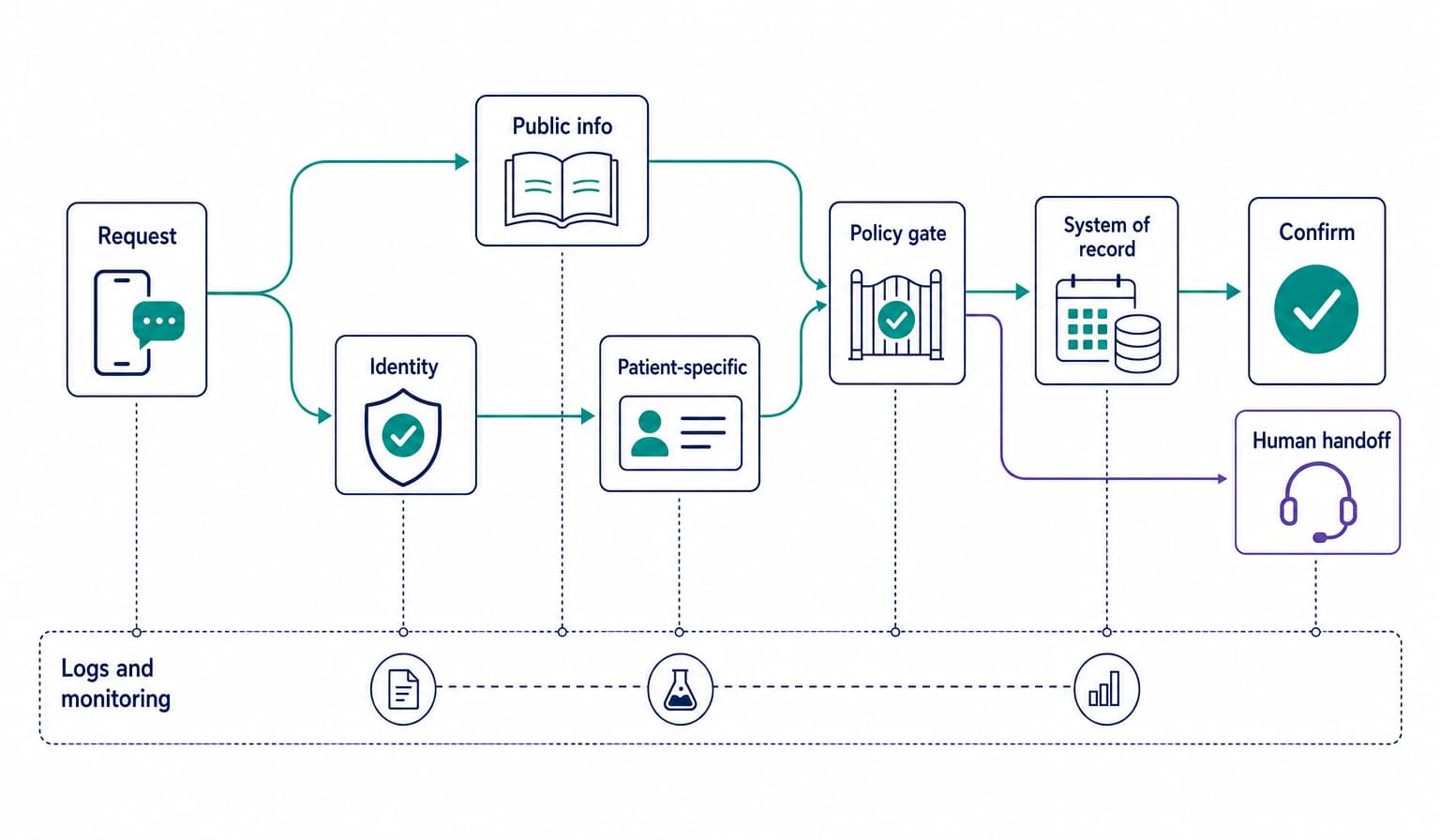
The distinction matters. A public-hours agent may need no patient data. A scheduling agent may need identity verification and read/write access to an appointment system. A draft reply may expose clinical context to a model even though a staff member approves the final message. Map the data and accountable person for each mode separately.
Choose workflows by consequence, not call volume alone
Choose workflows by consequence as well as volume. Use these boundaries as a starting point.
| Workflow | Suitable AI role | Required human path | Primary success measure |
|---|---|---|---|
| Hours, locations, parking, and service availability | Answer from approved public content | Transfer when content is missing or conflicting | Correct-answer rate |
| Appointment scheduling, confirmation, or cancellation | Offer valid options and complete a permitted change after the required identity step | Handle exceptions, special accommodations, and failed verification | Correct final appointment state |
| Intent capture and routing | Identify the administrative destination and pass structured context | Immediate approved path for clinical or urgent language | Correct destination and transfer completion |
| Billing and insurance questions | Read approved fields, explain standard terms, or create a task | Handle disputes, estimates with uncertainty, and coverage decisions | Resolved request without repeat contact |
| Prescription refill intake | Collect required details and submit a request | A qualified professional reviews, approves, and advises | Complete request routed to the right queue |
| Post-visit outreach | Ask approved questions and record responses | Staff review exceptions and every configured red flag | Completed outreach and correct escalation |
| Patient-message drafting | Prepare a source-grounded draft for staff | The designated staff member reviews and sends | Accepted drafts with safe, limited edits |
Administrative routing is different from clinical triage. A system can recognize configured phrases and transfer the caller according to an approved protocol. It should not infer urgency, diagnose a condition, or improvise care advice. That boundary must appear in the conversation policy, tool permissions, tests, and staff procedures.
Agent assist also needs role-specific design. In a nine-clinic quality-improvement study, an AI tool generated 21,323 replies to patient portal messages, while staff used 2,596, or 12%. Nurses viewed the drafts more favorably than medical assistants and clinicians. The results show why one generic assistant rarely fits every queue: message complexity, staff role, and scope of practice change what “useful” means. Read the JAMA study.
Define when a person takes over
“Escalate when needed” is too vague for production. Write observable handoff rules. A person should take over when:
- the patient asks for a person;
- identity verification fails or the caller is acting for someone else;
- the request includes symptoms, medication guidance, clinical interpretation, or configured urgent language;
- the requested action is outside policy, irreversible, or ambiguous;
- source systems disagree, time out, or return an unknown state;
- the patient disputes a charge, benefit, authorization, or prior decision;
- the agent detects distress, a communication barrier, or repeated misunderstanding; or
- the agent reaches its repair limit, such as two failed attempts to capture a critical date or name.
A transfer is complete only when the receiving person gets enough context to continue. The handoff packet should contain the caller's stated intent, verification status, details already collected, steps already attempted, the last confirmed system state, and the reason for escalation. Apply the minimum-necessary data policy to that packet and its logs.
If no one is available, the workflow still needs an approved end state. That may be a queued task with a service-level target, a scheduled callback, or a message directing the caller to an existing urgent-support channel. The agent should never promise a callback or completed action unless the downstream system confirms it.
Design the workflow before writing the prompt
A polished prompt cannot repair a vague process. Build the workflow in this order.
1. Name one outcome and its owner
Define the job in operational terms, such as “move one existing appointment to one available slot.” Name the team that owns the policy and the system that proves the outcome. Avoid broad goals such as “handle scheduling.”
2. Set the identity and data boundary
Decide what the agent can do before verification, what verification the organization requires for each action, and which fields the agent may read or write. Keep public information on a no-identity path. Do not ask for a date of birth or other sensitive value when the task does not require it.
3. Turn actions into narrow contracts
Give tools explicit schemas, permissions, and failure behavior. A scheduling function should accept only the fields needed for that change. Protect writes against duplicate calls, require confirmation for consequential changes, and return a clear success or failure state.
4. Build a governed knowledge source
Use approved content with a named owner, effective date, and review cadence. Retrieval should return the source and version used for an answer. When no approved answer exists, the agent should say so and use the defined handoff path.
5. Specify conversation and handoff behavior
Write the disclosure, permitted topics, forbidden responses, clarification limit, escalation triggers, transfer destination, and after-hours behavior. Keep spoken answers short enough to follow by phone. Preserve equivalent access for people who cannot or do not want to use the AI channel.
6. Test the final state and the real channel
Verify the database or scheduling record instead of trusting the transcript. Exercise corrections, silence, background noise, accents, interruptions, failed verification, unavailable slots, duplicate requests, dependency timeouts, transfers, and disconnects. Our voice agent testing guide explains how to turn those cases into a regression suite.
Treat HIPAA compliance as a deployment property
There is no HHS certification that makes an AI product “HIPAA compliant” on its own. The Office for Civil Rights does not endorse or certify specific technologies. The covered entity, its business associates, the configured workflow, contracts, security controls, and actual data handling determine compliance.
When a cloud provider creates, receives, maintains, or transmits electronic PHI for a covered entity or another business associate, HHS treats that provider as a business associate. This remains true when the data is encrypted and the provider lacks the decryption key. A HIPAA-compliant BAA is required, and the regulated organization still has to conduct its own risk analysis. Review the HHS cloud guidance.
Map the full service chain, including the contact-center platform, telephony carrier, speech recognition, text-to-speech, language model, hosting, logging, analytics, retrieval system, and support access. For every component, record:
- what data it creates, receives, maintains, or transmits;
- where the data is processed and stored;
- retention, deletion, backup, and recovery behavior;
- whether customer data is used for model training or product improvement;
- subprocessors and the agreement chain;
- access controls and privileged support access;
- encryption in transit and at rest;
- incident and breach-notification responsibilities; and
- audit evidence available to the healthcare organization.
The HIPAA Security Rule requires administrative, physical, and technical safeguards for electronic PHI. Its technical safeguards include access control, audit controls, authentication, integrity protections, and transmission security. It also requires risk analysis, ongoing review, and documented responsibility. See the HHS Security Rule summary.
A BAA is necessary for a covered PHI workflow. It is not a substitute for minimum access, safe tool design, monitoring, incident response, or staff procedures.
Measure completed care-access work, safety, and experience
Deflection alone is a weak target. A bot can prevent a transfer by ending the interaction without helping the patient. Use a balanced scorecard and keep safety failures visible instead of averaging them into one quality number.
| Dimension | Decision metrics | What to inspect |
|---|---|---|
| Task outcome | Correct final state, task completion, repeat contact | Appointment or ticket state, required fields, duplicate actions |
| Access | Time to resolution, abandonment, after-hours completion | Queue events and completed outcomes by channel and time |
| Safety and policy | Correct escalation, unauthorized action, failed identity handling | Conversation, tool trace, and final state |
| Human handoff | Transfer completion, context completeness, post-transfer handle time | Destination, packet fields, and receiving-team outcome |
| Patient experience | Ease, clarity, respect, access to a person | Post-contact feedback and complaints |
| Voice quality | Critical-entity accuracy, response latency, interruption recovery | Audio, timestamps, names, dates, IDs, and confirmation codes |
| Reliability | Tool failure, dependency timeout, dropped interaction, recovery | Runtime and integration events |
| Equity and accessibility | Outcome and escalation rates across relevant groups and channels | Differences by language, disability accommodation, location, and channel |
The Agency for Healthcare Research and Quality's CAHPS Clinician & Group Survey measures domains that are useful for the wider patient-experience view, including timely appointments, access to information, care coordination, provider communication, and staff interactions. AI operational metrics should support those outcomes rather than replace them. Review the CAHPS measures.
Set release gates before the pilot. A critical policy violation, incorrect patient-specific write, or missed required escalation should block release regardless of the average score. Slice results by intent, language, channel, location, and other relevant populations. NIST's generative AI risk profile recommends pre-deployment testing, field testing in realistic conditions, feedback and appeal mechanisms, incident response, and post-deployment monitoring. Read the NIST profile.
A practical 90-day rollout
Weeks 1–2: baseline and scope
Choose one workflow, document its current volume and failure modes, and establish baseline measures. Map the data, vendors, owners, escalation destinations, and compliance review. Define explicit out-of-scope requests.
Weeks 3–6: synthetic-data build and shadow evaluation
Build against synthetic records. Run frequent, difficult, and harmful scenarios through the complete conversation and tool path. Let staff compare proposed routing or responses with the action they would have taken, without letting the AI act on patient accounts.
Weeks 7–10: limited operational pilot
Release to a narrow population, location, queue, or time window only after the required agreements and security controls are in place. Keep a rapid human path and a known-good rollback. Review every failure and a sample of successful interactions.
Weeks 11–13: decide with evidence
Compare the pilot with the baseline. Expand only if task outcomes, safety, handoffs, patient experience, and staff workload move in the intended direction. Turn production failures into regression tests. Revisit the data map and risk assessment whenever the model, prompt, tool, knowledge source, vendor, or workflow changes.
Frequently asked questions
Can AI handle healthcare customer service calls?
Yes. Real-time voice agents can answer public questions, manage approved appointment workflows, capture requests, perform status checks, and transfer calls. Production quality depends on speech accuracy, turn-taking, tool reliability, policy controls, and the final system state. A clinical question or failed verification should move to the approved human path.
Is AI customer service in healthcare HIPAA compliant?
Compliance depends on the organization, workflow, data, vendors, contracts, configuration, and operations. A vendor that handles PHI on behalf of a covered entity or business associate generally needs an appropriate BAA. The organization also needs a documented risk analysis and reasonable administrative, physical, and technical safeguards.
Will AI replace healthcare customer service staff?
AI is best used for bounded self-service and staff assistance. People remain responsible for exceptions, clinical judgment, disputes, sensitive conversations, and accountability. The likely operating model is a smaller routine queue and a more demanding human queue, so staffing and training plans must account for the higher concentration of complex work.
What is the safest first use case?
Start with public, stable information such as hours, locations, parking, and service availability. The next step is a narrow administrative workflow with a clear system of record, such as appointment confirmation. Add patient-specific data and write access only after identity, security, agreement, testing, and handoff requirements are satisfied.
For a voice workflow, evaluate Dasha with synthetic patient journeys first. Prove the final system state, escalation path, and phone experience before introducing regulated data or live traffic.